From Surf Wiki (app.surf) — the open knowledge base
Germany women's national football team
Women's association football team

Women's association football team
| Field | Value |
|---|---|
| Name | Germany |
| Badge | DFBWomen.svg |
| Badge_size | 190px |
| FIFA Trigramme | GER |
| Nickname | DFB-Frauenteam (DFB Women's Team) |
| DFB-Frauen (DFB Women) | |
| Association | Deutscher Fußball-Bund (DFB) |
| Confederation | UEFA |
| website | DFB.de |
| Coach | Christian Wück |
| Captain | Giulia Gwinn |
| Most caps | Birgit Prinz (214) |
| Top scorer | Birgit Prinz (128) |
| Home Stadium | Various |
| FIFA Rank | |
| FIFA max | 1 |
| FIFA max date | October 2003 – December 2006, October – December 2007, December 2014 – March 2015, March 2017 |
| FIFA min | 6 |
| FIFA min date | August – December 2023 |
| pattern_la1 | _ger26h |
| pattern_b1 | _ger26hA |
| pattern_ra1 | _ger26h |
| pattern_sh1 | _ger26h |
| pattern_so1 | _ger26hl |
| leftarm1 | FFFFFF |
| body1 | FFFFFF |
| rightarm1 | FFFFFF |
| shorts1 | 000000 |
| socks1 | ffffff |
| pattern_la2 | _ger25aw |
| pattern_b2 | _ger25aw |
| pattern_ra2 | _ger25aw |
| pattern_sh2 | _ger25aw |
| pattern_so2 | _ger25awl |
| leftarm2 | 99222e |
| body2 | 99222e |
| rightarm2 | 99222e |
| shorts2 | 99222e |
| socks2 | 99222e |
| pattern_la3 | _ger125y |
| pattern_b3 | _ger125y |
| pattern_ra3 | _ger125y |
| pattern_sh3 | _shorts |
| pattern_so3 | _whitetop |
| leftarm3 | FFFFFF |
| body3 | FFFFFF |
| rightarm3 | FFFFFF |
| shorts3 | 000000 |
| socks3 | 000000 |
| pattern_name3 | Anniversary |
| First game | 5–1 |
| (Koblenz, West Germany; 10 November 1982) | |
| Largest win | 17–0 |
| (Wiesbaden, Germany; 19 November 2011) | |
| Largest loss | 6–0 |
| (Decatur, United States; 14 March 1996) | |
| World cup apps | 9 |
| World cup first | 1991 |
| World cup best | Champions (2003, 2007) |
| Regional name | European Championship |
| Regional cup apps | 13 |
| Regional cup first | 1989 |
| Regional cup best | Champions (1989, 1991, 1995, 1997, 2001, 2005, 2009, 2013) |
| 2ndRegional name | Olympic Games |
| 2ndRegional cup apps | 6 |
| 2ndRegional cup first | 1996 |
| 2ndRegional cup best | Gold medal (2016) |
| 3rdRegional name | Nations League Finals |
| 3rdRegional cup apps | 2 |
| 3rdRegional cup first | 2024 |
| 3rdRegional cup best | Runners-up (2025) |
| type | women |
the women's team
DFB-Frauen (DFB Women) (Koblenz, West Germany; 10 November 1982) (Wiesbaden, Germany; 19 November 2011) (Decatur, United States; 14 March 1996)
The Germany women's national football team () represents Germany in international women's football. The team is governed by the German Football Association (DFB).
The Germany national team is one of the most successful in women's football. They are two-time world champions, having won the 2003 and 2007 tournaments. The team has won eight of the thirteen UEFA European Championships, claiming six consecutive titles between 1995 and 2013. They, along with the Netherlands, are one of the two nations that have won both the women's and men's European tournament. Also, they and Spain are the only two teams that have won both the women's and men's World Cup tournament. Germany has won Olympic gold in 2016, after three consecutive bronze medals at the Women's Olympic Football Tournament, finishing third in 2000, 2004 and 2008. Birgit Prinz holds the record for most appearances and is the team's all-time leading goalscorer. Prinz has also set international records; she has received the FIFA World Player of the Year award three times and is the joint second overall top goalscorer at the Women's World Cup.
Women's football was long met with scepticism in Germany, and official matches were banned by the DFB until 1970. However, the women's national team has grown in popularity since winning the World Cup in 2003, as it was chosen as Germany's Sports Team of the Year. As of August 2025, Germany is ranked fifth in the FIFA Women's World Rankings.
History
Early history
In 1955, the DFB decided to forbid women's football in all its clubs in West Germany. In its explanation, the DFB cited that "this combative sport is fundamentally foreign to the nature of women" and that "body and soul would inevitably suffer damage". Further, the "display of the body violates etiquette and decency". In spite of this ban, more than 150 unofficial international matches were played in the 1950s and 1960s. On 30 October 1970, the ban on women's football was lifted at the DFB annual convention.
Other football associations had already formed official women's national teams in the 1970s, the DFB long remained uninvolved in women's football. In 1981, DFB official Horst R. Schmidt was invited to send a team to the unofficial women's football world championship. Schmidt accepted the invitation but hid the fact that West Germany had no women's national team at the time. To avoid humiliation, the DFB sent the German club champions Bergisch Gladbach 09, who went on to win the tournament and repeat the same feat three years later in 1984. Seeing a need, the DFB established the women's national team in 1982. DFB president Hermann Neuberger appointed Gero Bisanz, an instructor at the Cologne Sports College, to set up the team.
1982–1994: Difficult beginnings and first European titles
In September 1982, Bisanz organised two scouting training courses from which he selected a squad of 16 players. The team's first international match took place on 10 November 1982 in Koblenz. Following the tradition of the men's team, Switzerland was chosen as West Germany's first opponent. Doris Kresimon scored the first international goal in the 25th minute. In the second half, 18-year-old Silvia Neid contributed two goals to the 5–1 victory; Neid later became the assistant coach in 1996 and the head coach in 2005.
With five draws and one defeat, West Germany failed to qualify for the inaugural 1984 European Championship, finishing third in the qualifying group. In the beginning, Bisanz's primary objective was to close the gap to the Scandinavian countries and Italy – then the strongest teams in Europe. He emphasized training in basic skills and the need for an effective youth programme. Starting in 1985, Bisanz increasingly called-up younger players, but at first had little success with this concept, as West Germany again failed to qualify for the 1987 European Championship finals.
Undefeated and without conceding a goal, the German team qualified for the European Championship for the first time in 1989; the tournament was played on home soil in West Germany. The semi-final against Italy was the first international women's football match shown live on German television. The game was decided by a penalty shootout, in which goalkeeper Marion Isbert saved three penalty kicks and scored the winning penalty herself. On 2 July 1989 in Osnabrück, West Germany played Norway in the final. Before a crowd of 22,000, they beat favourites Norway and won 4–1 with goals from Ursula Lohn, Heidi Mohr and Angelika Fehrmann. This victory marked the team's first international title.
After the German reunification, the East German football association joined the DFB. The East German women's national football team had played only one official international match, losing 3–0 to Czechoslovakia in a friendly match on 9 May 1990. The unified German team defended their title successfully at the 1991 European Championship. After winning all games in the qualifying group, Germany again met Italy in the semi-final, this time winning 3–0. On 14 July 1991, the German team once more faced Norway in the final. The game went to extra time, during which Heidi Mohr and Silvia Neid scored for Germany and secured the 3–1 victory.
In November 1991, Germany participated in the first Women's World Cup in China. Following victories over Nigeria, Taiwan and Italy, the German team reached the quarter-final without conceding a single goal. Silvia Neid scored the first German World Cup goal on 17 November 1991 against Nigeria. Germany won the quarter-final against Denmark 2–1 after extra time, but lost 2–5 in the semi-final to the United States, who went on to win the tournament. Following a 0–4 defeat in the third-place match against Sweden, Germany finished fourth in the tournament.
The German team failed to defend their title at the 1993 European Championship, suffering a semi-final defeat to Italy in a penalty shootout, and later losing 1–3 against Denmark in the third-place playoff. Despite the disappointing result, new talents such as Steffi Jones, Maren Meinert and Silke Rottenberg made their tournament debut and later became key players for the German team.
1995–2002: Olympic and World Cup disappointments
Birgit Prinz scored in a major tournament for the first time in 1995. Germany won its third European Championship during the same year. After winning all qualification matches, scoring 55 goals, the German team defeated England 6–2 over two legs in the semi-final. Germany met Sweden in the final, which was played at the Fritz Walter Stadion in Kaiserslautern, Germany, on 26 March 1995. The Swedish team managed to score early, but Germany came back to win 3–2 with goals from Maren Meinert, Prinz and Bettina Wiegmann.
At the 1995 Women's World Cup in Sweden, the German team lost against the Scandinavian hosts, but still succeeded in winning their group by beating Japan and Brazil. Germany won the quarter-final against England 3–0, and defeated China 1–0 with a late goal by Bettina Wiegmann in the semi-final. On 18 June 1995 in Stockholm, the German team appeared in their first Women's World Cup final. Facing Norway, they lost the match 0–2, but as runners-up achieved their best World Cup result until then.
Women's football was first played as an Olympic sport at the 1996 Summer Olympics. Bettina Wiegmann scored the first Olympic goal in the opening match against Japan, which Germany won 3–2. After losing their second group game against Norway 2–3, and drawing with Brazil 1–1, Germany was eliminated, finishing third in the group with four points from three matches. Head coach Gero Bisanz resigned after the tournament and his assistant since 1983, Tina Theune, took over as the new national coach. Silvia Neid ended her playing career and was appointed the new assistant coach.
The 1997 European Championship was the first test for new coach Theune. Following a defeat against Norway, Germany finished second in the qualifying group and only secured qualification by beating Iceland in a relegation play-off. After drawing with Italy and Norway, a victory over Denmark in the last group game saw the German team go through to the knockout stage. They beat Sweden 1–0 in the semi-final, and on 12 July 1997, claimed their fourth European championship with a 2–0 win over Italy, with goals from Sandra Minnert and Birgit Prinz.
At the 1999 Women's World Cup in the United States, the German team also failed to qualify directly, but managed to beat Ukraine in a qualifying play-off. Germany started their World Cup campaign by drawing with Italy and winning 6–0 over Mexico. In the last group game, Germany drew 3–3 against Brazil; by conceding a last minute equalizer, Germany failed to win the group and subsequently had to face the hosts in the quarter-final. With 54,642 people in attendance, among them U.S. President Bill Clinton, the crowd at the Jack Kent Cooke Stadium was the biggest the German team had ever played in front of. Despite leading twice, they lost 2–3 to the eventual World Cup winners.
Germany competed at the 2000 Summer Olympics, winning all three group games against Australia, Brazil and Sweden. The German team dominated the semi-final against Norway, but lost the game 0–1 after an own goal by Tina Wunderlich in the 80th minute. They beat Brazil 2–0 in the third place match with goals from Birgit Prinz and Renate Lingor, and won the bronze medal. It was the first Olympic medal for the German Football Associations since 1988 when the men's team also won bronze.
In 2001, Germany hosted the European Championship. Following victories over Sweden, Russia and England in the group stage, the German team beat Norway 1–0 in the semi-final courtesy of a diving header by Sandra Smisek. On 7 July 2001 in Ulm, they met Sweden in the final, which was played in heavy rain. The game was scoreless after 90 minutes and went to extra time, where Claudia Müller scored a golden goal and secured the fifth European title for Germany.
2003–2023: Two consecutive World Cup titles
At the 2003 Women's World Cup in the United States, Germany was drawn in a group with Canada, Japan and Argentina. After winning all three group games, the German team defeated Russia 7–1 in the quarter-final, which set up another clash with the United States. Germany's Kerstin Garefrekes scored after 15 minutes and goalkeeper Silke Rottenberg made several key saves. In the dying minutes of the semi-final, Maren Meinert and Birgit Prinz sealed the 3–0 win. On 12 October 2003, Germany met Sweden in the World Cup final in Los Angeles. The Scandinavians went ahead before half time, but Maren Meinert equalized shortly after the break. The game went to extra time, where Nia Künzer headed the winning golden goal in the 98th minute to claim Germany's first Women's World Cup title. Birgit Prinz was honoured as the tournament's best player and top goalscorer.
With wins over China and Mexico, the German team finished first in their group at the 2004 Summer Olympics. They beat Nigeria 2–1 in the quarter-final, but suffered a 1–2 semi-final loss to the United States after extra time. In the third place match, Germany defeated Sweden 1–0 with a goal by Renate Lingor, winning the team's second Olympic bronze medal.
The 2005 European Championship was held in England. With wins over Norway, Italy and France in Round 1, the German team advanced to the semi-final, where they defeated Finland 4–1. On 19 June 2005, they met Norway for the third time in the European championship final. Germany won 3–1 with goals from Inka Grings, Renate Lingor and Birgit Prinz and added a sixth European title. Head coach Tina Theune stepped down after the tournament and her assistant Silvia Neid took over as national coach. In 2006, Germany won the annual Algarve Cup for the first time.

As reigning world champion, Germany played the opening game at the 2007 Women's World Cup in China, outclassing Argentina 11–0. After a goalless draw against England and a 2–0 win over Japan, the German team defeated North Korea 3–0 in the quarter-final. They beat Norway by the same result in the semi-final, with goals from Kerstin Stegemann, Martina Müller and a Norwegian own goal. On 30 September 2007, Germany faced Brazil in the World Cup final in Shanghai. Birgit Prinz put Germany in front after half time and goalkeeper Nadine Angerer saved a penalty by Brazilian Marta. Simone Laudehr scored a second goal after 86 minutes, which sealed the German 2–0 victory. Germany was the first team (men's and women's game) to win the World Cup without conceding a goal and the first to successfully defend the Women's World Cup title. With 14 goals, Prinz became the tournament's overall top goalscorer.
In a replay of the 2007 World Cup final, the German team drew 0–0 with Brazil in the opening game at the 2008 Summer Olympics. They then beat both Nigeria and North Korea to advance to the quarter-final, where they defeated Sweden 2–0 after extra time. In the semi-final, Germany again met Brazil. Birgit Prinz scored in the 10th minute, but the German team lost 1–4 after conceding three goals to Brazilian counter-attacks in the second half. They beat Japan 2–0 for the bronze medal, with Fatmire Bajramaj scoring both goals. The third consecutive semi-final loss at the Olympics was seen as a disappointment by both the players and the German press.
Germany qualified for the 2009 European Championship in Finland winning all eight games and scoring 34 goals. They beat Norway, France and Iceland in the group stage to advance to the quarter-final, where they won 2–1 against Italy. After trailing Norway at half-time in the semi-final, the German team fought back to a 3–1 victory. On 10 September 2009, they defeated England 6–2 for their seventh European trophy. Birgit Prinz and Inka Grings scored twice, with Melanie Behringer and Kim Kulig also scoring. Grings retained her award as the tournament's top scorer from 2005, while Germany extended their winning streak at the European Championship finals to a 19-match run dating back to 1997.
Germany hosted the 2011 FIFA Women's World Cup and won the three games on the group stage, over Canada, France and Nigeria. On the quarterfinals, the team suffered an upset by Japan, who won on overtime with a goal by Karina Maruyama. The defeat broke the Germans' streak of sixteen undefeated games at the World Cup.
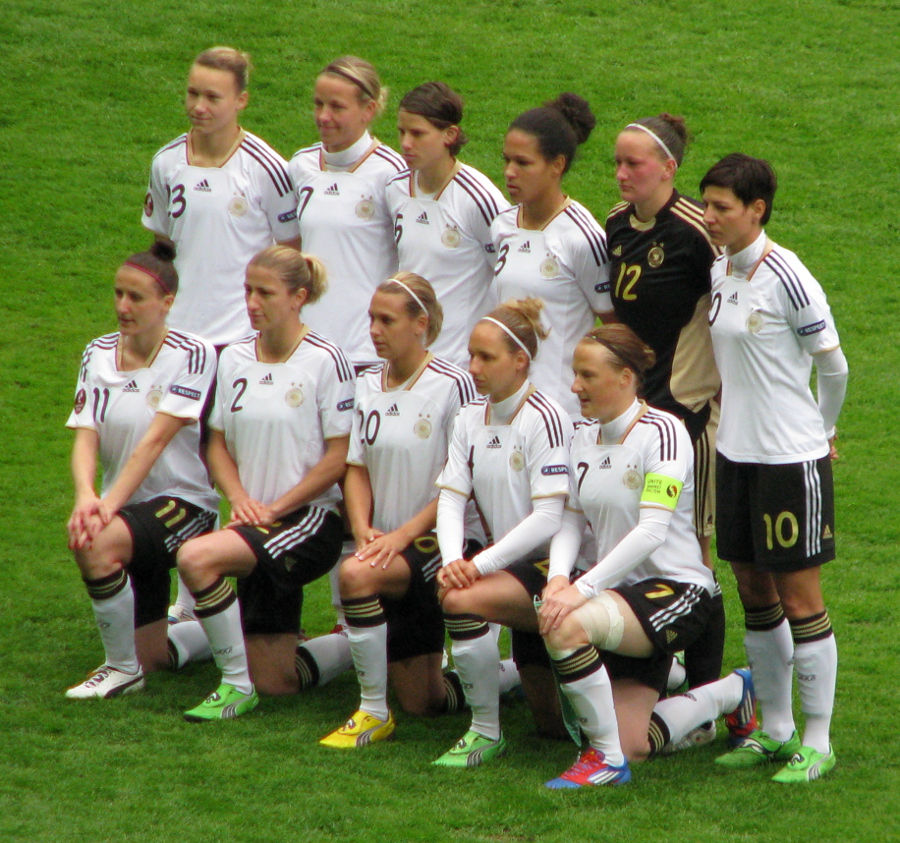
By failing to finish among the top two UEFA teams, Germany was unable to qualify for the 2012 Summer Olympics.
At the 2013 European Championship in Sweden, the Germans won their sixth straight continental title, with the decisive game being a 1–0 victory over Norway. Goalkeeper Nadine Angerer, who stopped two penalties during the final, was chosen as the tournament's best player.
.jpg)
The 2015 FIFA Women's World Cup had Germany again reaching the top four. In the semi-final against the United States, Célia Šašić, who wound up as the tournament's top scorer, missed a penalty, and afterwards goals by Carli Lloyd and Kelley O'Hara lead to an American victory. The third place match saw the Germans lose their first ever match to England after 21 contests, due to a penalty kick by Fara Williams during extra time.
At the 2019 Women's World Cup Germany were in Group B with China PR, South Africa, and Spain. They topped the group with three wins and defeated Nigeria in the Round of 16. Germany was eliminated by Sweden in the quarter-finals, losing to them for the first time in 24 years and conceding their only goals of the tournament and so failed to qualify for the Olympic football tournament of Tokyo 2020.
At the 2022 European Championship, Germany reached the final, where the team lost 1–2 after extra time against the host of the tournament, England. For Germany, the record winners of the competition, this was their ninth appearance in a Euro final and the first in which they were defeated.
Germany entered the 2023 FIFA Women's World Cup as one of the title favourites, being second in the FIFA Rankings at the time. Drawn into Group H alongside Morocco, Colombia, and South Korea, they seemed to have a strong start after defeating Morocco 6–0. However, they would lose to Colombia 2–1. After tying with South Korea 1–1 alongside Morocco's 1–0 victory against Colombia, they were eliminated and missed the knockout stage for the first time in their history. This was widely described as one of the biggest upsets in the history of the Women's World Cup.
Team image
Nicknames
The Germany women's national football team has been known or nicknamed as "Die Nationalelf (The National Eleven)".
Kits and crest


The German women's national football team wears white shirts with black shorts and white socks, following the tradition of the German men's team – black and white are the colours of Prussia. The current change kit is all dark green. In the past, Germany also used green shirts with white shorts and green socks as the away kit, as well as a red and black kit, with black shorts and red socks.
The women's national team originally played with the emblem of the German men's team, a variation of the DFB logo with the Federal Eagle of Germany (Bundesadler) and three stars at the top for the men's 1954, 1974 and 1990 World Cup titles. Since their first Women's World Cup win in 2003, the team displays its own World Cup titles; initially with one star, and since 2007, with two stars at the top of the emblem. While being reigning world champions, Germany also displayed the newly created "FIFA Women's World Champions Badge" on their shirts from 2009 until 2011 when they were succeeded by Japan.
In accordance with the rules of the International Olympic Committee, Germany does not wear its official uniform with the logo of the German Football Association while competing at the Summer Olympics. Instead, the DFB badge is replaced by the coat of arms of Germany. Like all DFB squads, the women's national team is supplied by Adidas. The team's main sponsor is the German insurance company Allianz.
Home stadium

The Germany national football team has no national stadium. Like the men, the women's team play their home matches in different stadiums throughout the country. As of June 2011, they have played in 87 different German cities. Most home games have been held in Osnabrück with six matches, followed by Ulm (five games), and Bochum, Kaiserslautern, Koblenz, Lüdenscheid, Rheine, Siegen and Weil am Rhein (three games each). The first home match in former East Germany was played in Aue in May 1991.
In the 1980s and 1990s, home matches were mostly played in smaller towns with no professional football clubs. As the team became more successful, especially after the World Cup win in 2003, the number of spectators rose accordingly.
The record attendance for Germany was 73,680 in the 2011 Women's World Cup opening game against Canada at the Olympic Stadium in Berlin. That game also set a new European record in women's football. Away from home, the team's crowd record was 54,642 in the 1999 Women's World Cup quarter-final against the United States at the Jack Kent Cooke Stadium in Landover.
Acceptance and popularity

For most of the 20th century, women's football was a niche sport in Germany and was frowned upon. The 2003 World Cup title marked the breakthrough for the women's national football team in Germany. The final was watched by 10.48 million viewers on German television (a 33.2 percent market share) and the German team was welcomed home by almost 10,000 fans at Frankfurt's city hall. Later that year, they were honoured as the 2003 German Sports Team of the Year. Nia Künzer's World Cup winning golden goal was voted Germany's 2003 Goal of the Year, the first time the award was won by a female player. Each member of the World Cup squad received a prearranged bonus of 15,000 euros for winning the tournament; four years later the players received 50,000 euros for their successful title defense. Since 2005, almost all of the women's national football team's matches have been shown live on German television. In 2009, one million of the 6.7 million DFB members were female.
The final of the 2007 Women's World Cup was seen by 9.05 million television viewers (a 50.5 percent market share). After the team returned to Germany, they were celebrated by a crowd of 20,000 in Frankfurt. In December 2007, all players of the World Cup squad received the Silberne Lorbeerblatt (Silver Laurel Leaf), the highest state decoration for athletes in Germany. National coach Silvia Neid was awarded the Federal Cross of Merit on ribbon by German president Horst Köhler.
Women's football is one of the fastest growing sports in Germany. Attendance for the women's Bundesliga more than tripled in one year, with an average of 806 in 2022 to an average of 2,723 in 2023.
In 2022 the most watched sporting event on German TV with nearly 18 million people watching was the women's national team final of the Euros against England. The following year the women kept more views than the men's team with 10.37 million television viewers.
Results and fixtures
Main article: Germany women's national football team results
The following is a list of match results in the last 12 months, as well as any future matches that have been scheduled.
;Legend
2025
- Schüller
- Nüsken
- Freigang
- Dallmann
- Hoffmann
- Endemann
- Senß
- Howard
- Zicai
- Schüller
- Cerci
- Hoffmann
- Freigang
- Dallmann
- Schüller
- Linder
- Lohmann
- Schüller
- Cerci
- Bühl
- Freigang
- Brand
- Schüller
- Nüsken
- Schüller
- Vangsgaard
- Blackstenius
- Holmberg
- Rolfö
- Hurtig
- Brand
- Majri
- Karchaoui
- Malard
- Baltimore
- Jean-François
- N'Dongala
- Sombath
- Minge
- Dallmann
- Knaak
- Däbritz
- Berger
- Bühl
- Nüsken
- Malard
- Mateo
- Anyomi
- Bühl
- Pina
- López
2026
Coaching staff
Current technical staff
| Position | Name |
|---|---|
| Head coach | GER Christian Wück |
| Assistant coaches | |
| Fitness coach | GER Julius Balsmeier |
| Goalkeeping coach | GER Michael Fuchs |
| Team doctor | GER Tobias Schmenn |
| Kit Manager | USA Steve Smith |
Manager history
| Name | Tenure | P | W | D | L | % | Achievements | Total |
|---|---|---|---|---|---|---|---|---|
| GER | 1982–1996 | 1984 European Championship – failed to qualify | ||||||
| 1987 UEFA Euro – failed to qualify | ||||||||
| 1989 UEFA Euro – champions | ||||||||
| 1991 UEFA Euro – champions | ||||||||
| 1991 Women's World Cup – fourth place | ||||||||
| 1993 UEFA Euro – fourth place | ||||||||
| 1995 UEFA Euro – champions | ||||||||
| 1995 Women's World Cup – runners-up | ||||||||
| 1996 Summer Olympics – group stage | ||||||||
| GER | 1996–2005 | 1997 UEFA Euro – champions | ||||||
| 1999 Women's World Cup – quarter-final | ||||||||
| 2000 Summer Olympics – bronze medal | ||||||||
| 2001 UEFA Euro – champions | ||||||||
| 2003 Women's World Cup – champions | ||||||||
| 2004 Summer Olympics – bronze medal | ||||||||
| 2005 UEFA Euro – champions | ||||||||
| GER | 2005–2016 | 2007 Women's World Cup – champions | ||||||
| 2008 Summer Olympics – bronze medal | ||||||||
| 2009 UEFA Euro – champions | ||||||||
| 2011 Women's World Cup – quarter-final | ||||||||
| 2012 Summer Olympics – failed to qualify | ||||||||
| 2013 UEFA Euro – champions | ||||||||
| 2015 Women's World Cup – fourth place | ||||||||
| 2016 Summer Olympics – champions | ||||||||
| GER | 2016–2018 | 2017 UEFA Euro – quarter-final | ||||||
| GER (interim) | 2018 | |||||||
| GER | 2019–2023 | 2019 Women's World Cup – quarter-final | ||||||
| 2020 Summer Olympics – failed to qualify | ||||||||
| 2022 UEFA Euro – runners-up | ||||||||
| GER (interim) | 2023–2024 | 2024 Summer Olympics – bronze medal | ||||||
| GER | 2024– |
:*Key: P–games played, W–games won, D–games drawn; L–games lost, %–win percentage. Statistics as of 2 December 2025.
Christian Wück is the current head coach of the German women's national football team. The coach's official title is DFB-Trainer and the coach is employed by the German Football Association.
- Gero Bisanz (1982–1996) was the first coach of the women's national team. He selected his first squad in September 1982. At the same time, he also worked as the chief instructor for DFB coaching training from 1971 to 2000. Bisanz led the German team to three European Championships in 1989, 1991 and 1995. Under Bisanz, Germany also was runners-up at the 1995 Women's World Cup. He resigned after the German team was eliminated in Round 1 at the 1996 Summer Olympics. With his assistant since 1983, Tina Theune, he built a scouting system and was responsible for a new DFB youth programme.
- Tina Theune (1996–2005) took over as head coach after the 1996 Summer Olympics. She was the first woman to acquire the highest German football coaching license. Theune was responsible for three European Championship titles in 1997, 2001 and 2005. During her time as head coach, Germany won the bronze medal at the 2000 and 2004 Summer Olympics. Her biggest success was the 2003 Women's World Cup title. Theune is the most successful national coach to date. She benefited from an effective youth programme and integrated several Under-19 players into the nation team. Theune stepped down after winning the European Championship in 2005.
- Silvia Neid (2005–2016) was the team's assistant coach from 1996 to 2005 and the head coach of the German Under-19 team, winning the 2004 U-19 Women's World Championship. In July 2005, she became the team's head coach and the 2006 Algarve Cup marked her first tournament win. By winning the 2007 Women's World Cup, Neid became the first Germany national team coach of either gender to win the World Cup at the first attempt. At her first Summer Olympics as a coach in 2008, Germany won the bronze medal for a third time. Neid was also responsible for Germany's seventh European Championship in 2009. She coached the Germany national team until 2016 and her assistant was Ulrike Ballweg.
- On 30 March 2015, DFB announced that Steffi Jones (2016–2018) would become the new German head coach in 2016.
- Horst Hrubesch (2018) took over as the interim head coach from March to November 2018.
- Martina Voss-Tecklenburg (2019–2023) then became the new coach in 2019. The contract was voided in November 2023.
- Horst Hrubesch (2023–2024) again took over as the interim head coach in October 2023.
- Christian Wück took over after the 2024 Summer Olympics.
Players
Current squad
The following players were called up for the 2025 UEFA Women's Nations League finals against Spain on 28 November and 2 December 2025.
:Caps and goals correct as of 2 December 2025, after the match against Spain.
Recent call-ups
The following players have also been called up to the squad within the past 12 months.
;Notes ALT = Alternate --
- INJ = Withdrew due to injury MED = Withdrew due to medical reasons --
- PRE = Preliminary squad
- RET = Retired from the national team TOP = Train-on player -- UNV = Unavailable for selection --
- WD = Player withdrew from the squad due to non-injury issue
Records
Main article: List of Germany women's international footballers
: :Players in bold are still active at national team level.
| # | Name | Germany career | Caps | Goals |
|---|---|---|---|---|
| 1 | 1994–2011 | 214 | 128 | |
| 2 | 1995–2009 | 191 | 8 | |
| 3 | 1996–2011 | 174 | 10 | |
| 4 | 2004–2017 | 158 | 50 | |
| 5 | 1989–2003 | 154 | 51 | |
| 6 | 1995–2008 | 149 | 35 | |
| 7 | 1992–2007 | 147 | 16 | |
| 8 | 1996–2015 | 146 | 0 | |
| 9 | 2010–2024 | 145 | 67 | |
| 10 | 1986–2001 | 144 | 16 |
Top goalscorers
| # | Name | Germany career | Goals | Caps | Ratio |
|---|---|---|---|---|---|
| 1 | 1994–2011 | 128 | 214 | ||
| 2 | 1986–1996 | 83 | 104 | ||
| 3 | 2010–2024 | 67 | 145 | ||
| 4 | 1996–2012 | 64 | 96 | ||
| 5 | 2005–2015 | 63 | 111 | ||
| 6 | **** | 2017– | 54 | 82 | |
| 7 | 1989–2003 | 51 | 154 | ||
| 8 | 2004–2017 | 50 | 158 | ||
| 9 | 1982–1996 | 48 | 111 | ||
| 10 | 2001–2011 | 43 | 130 |
|}
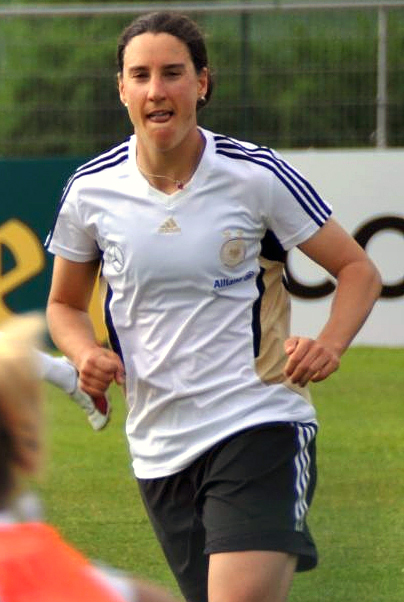
Birgit Prinz, a former team captain who retired after the 2011 World Cup, holds the record for Germany for appearances, having played 214 times from 1994 to 2011. She is one of 21 German players to have reached 100 caps. Kerstin Stegemann is second, having played 191 times. Bettina Wiegmann, Germany's team captain during the 2003 World Cup win, comes fourth with 154 games. Prinz exceeded Wiegmann's record as the most capped player in November 2006. Prinz also held the record for most appearances by a European player until 15 June 2021, when she was surpassed by Sweden's Caroline Seger.
Wiegmann and Prinz have successively been awarded the title of honorary captain of the German women's national football team.
The title of Germany's highest goalscorer is also held by Prinz. She scored her first goal in July 1994 against Canada and finished her career with 128 goals (averaging 0.60 goals per game). Heidi Mohr, as well as being the second-highest scorer, is also the most prolific with 83 goals coming from 104 games (averaging 0.80 goals per game). Two players share the record for goals scored in one match: Conny Pohlers scored five goals in October 2001 against Portugal, and Inka Grings scored five times in February 2004, again facing Portugal. Silvia Neid, the former Germany national coach, is the sixth highest goalscorer with 48 goals in 111 games.
The largest margin of victory achieved by Germany is 17–0 against Kazakhstan during a European Championship qualifying game in November 2011. The record defeat, a 6–0 loss against the United States, occurred during a friendly match in March 1996.
Former goalkeeper Nadine Angerer has the most appearances for a goalkeeper, with 145 games as goal keeper (89 without conceding a goal) and one game as a substitute as defender. Silke Rottenberg is second with 126 caps and 68 games without conceding a goal. Bettina Wiegmann holds the record of 14 goals from penalty kicks; Renate Lingor comes in second with 8 goals. Tina Wunderlich scored the team's only own goal in the semi-final of the 2000 Summer Olympics against Norway; it was the game's only goal.
The German team also holds several international records. In 2007, they were the first to win two consecutive Women's World Cup titles and they achieved the then-biggest win in tournament history by beating Argentina 11–0, Germany is also the only team to win the women's World Cup without conceding a goal and the only country to win both World Cups. With 14 goals, Prinz became the overall top goalscorer at the Women's World Cup in 2007, and she and Brazilian Marta are the only women to have received the FIFA World Player of the Year award at least three times.
Player of the Year
-
2017: Linda Dallmann
-
2018: Svenja Huth
-
2019: Giulia Gwinn
-
2020: Lena Oberdorf
-
2021: Lea Schüller
-
2022: Alexandra Popp
-
2023: Klara Bühl
-
2024: Giulia Gwinn
Competitive record
FIFA Women's World Cup
Main article: Germany at the FIFA Women's World Cup
Germany is one of the most successful nations at the FIFA Women's World Cup, having won the tournament twice and finishing runner-up once. The German team won the World Cup in 2003 and 2007. At the first World Cup in 1991, they finished in fourth place. In 1995, Germany reached the World Cup final, but were defeated by Norway. The team's worst result was a Group stage exit in 2023. Overall, the German team has appeared in three Women's World Cup finals, and is a five-time semi-finalist. They have participated in every Women's World Cup and have a 31–6–10 win–draw–loss record.
| FIFA Women's World Cup record | Qualification record | Year | Result | Pld | W | D | L | GF | GA | Pld | W | D | L | GF | GA | Total | 9/10 | 47 | 31 | 6* | 10 | 129 | 42 | 50 | 45 | 1* | 4 | 223 | 20 | ||||||||||||
|---|---|---|---|---|---|---|---|---|---|---|---|---|---|---|---|---|---|---|---|---|---|---|---|---|---|---|---|---|---|---|---|---|---|---|---|---|---|---|---|---|---|
| PRC 1991 | Fourth place | 6 | 4 | 0 | 2 | 13 | 10 | UEFA Women's Euro 1991 | |||||||||||||||||||||||||||||||||
| SWE 1995 | Runners-up | 6 | 4 | 0 | 2 | 13 | 6 | UEFA Women's Euro 1995 | |||||||||||||||||||||||||||||||||
| USA 1999 | Quarter-finals | 4 | 1 | 2 | 1 | 12 | 7 | 8 | 5 | 1 | 2 | 15 | 6 | ||||||||||||||||||||||||||||
| USA 2003 | Champions | 6 | 6 | 0 | 0 | 25 | 4 | 6 | 6 | 0 | 0 | 30 | 1 | ||||||||||||||||||||||||||||
| PRC 2007 | Champions | 6 | 5 | 1 | 0 | 21 | 0 | 8 | 8 | 0 | 0 | 31 | 3 | ||||||||||||||||||||||||||||
| Germany 2011 | Quarter-finals | 4 | 3 | 0 | 1 | 7 | 4 | Qualified as host | |||||||||||||||||||||||||||||||||
| CAN 2015 | Fourth place | 7 | 3 | 2 | 2 | 20 | 6 | 10 | 10 | 0 | 0 | 62 | 4 | ||||||||||||||||||||||||||||
| FRA 2019 | Quarter-finals | 5 | 4 | 0 | 1 | 10 | 2 | 8 | 7 | 0 | 1 | 38 | 3 | ||||||||||||||||||||||||||||
| AUS NZL 2023 | Group stage | 3 | 1 | 1 | 1 | 8 | 3 | 10 | 9 | 0 | 1 | 47 | 5 | ||||||||||||||||||||||||||||
| BRA 2027 | To be determined | To be determined | |||||||||||||||||||||||||||||||||||||||
| CRCJAMMEXUSA 2031 | To be determined | To be determined | |||||||||||||||||||||||||||||||||||||||
| UK 2035 | To be determined | To be determined |
:*Denotes draws including knockout matches decided on penalty kicks. :**Gold background colour indicates that the tournament was won. :***Red border colour indicates tournament was held on home soil.
Olympic Games
Women's football debuted at the 1996 Summer Olympics and Bettina Wiegmann scored the first Olympic goal in the opening game of the tournament. However, Germany failed to progress to the knockout stage and was eliminated in the group stages. Four years later the German team won the bronze medal at the 2000 Summer Olympics. They again finished third at both the 2004 and the 2008 Summer Olympics.
The German team qualified for all Women's Olympic Football Tournaments until 2008. However, they failed to qualify for the 2012 tournament as UEFA used the 2011 World Cup for qualification, and Germany ended below France and Sweden. The German team beat Sweden in the Olympics final in Rio in 2016 to obtain their first Olympic gold medal.
| Summer Olympics record | Year | Result | Pld | W | D | L | GF | GA | Total | 6/8 | 31 | 20 | 4 | 7 | 58 | 27 | |||||||
|---|---|---|---|---|---|---|---|---|---|---|---|---|---|---|---|---|---|---|---|---|---|---|---|
| USA 1996 | Group stage | 3 | 1 | 1 | 1 | 6 | 6 | ||||||||||||||||
| AUS 2000 | Third place | 5 | 4 | 0 | 1 | 8 | 2 | ||||||||||||||||
| GRE 2004 | 5 | 4 | 0 | 1 | 14 | 3 | |||||||||||||||||
| CHN 2008 | 6 | 4 | 1 | 1 | 7 | 4 | |||||||||||||||||
| GBR 2012 | Did not qualify | ||||||||||||||||||||||
| BRA 2016 | Champions | 6 | 4 | 1 | 1 | 14 | 6 | ||||||||||||||||
| JPN 2020 | Did not qualify | ||||||||||||||||||||||
| FRA 2024 | Third place | 6 | 3 | 1 | 2 | 9 | 6 | ||||||||||||||||
| USA 2028 | To be determined | ||||||||||||||||||||||
| AUS 2032 | To be determined |
UEFA Women's Championship
Main article: Germany at the UEFA Women's Championship
Germany failed to qualify for the first two UEFA European Championships in 1984 and 1987. Since 1989, the German team has participated in every tournament and is the record European champion with eight titles. Germany has won six consecutive championships from 1995 to 2013 and has an overall finals record of 38 wins, 7 draws, and 6 losses.
| UEFA Women's Championship record | Qualifying record | Year | Result | Pld | W | D | L | GF | GA | Pld | W | D | L | GF | GA | P/R | Rnk | Total | 13/15 | 51 | 38 | 7* | 6 | 108 | 34 | 101 | 81 | 14* | 6 | 421 | 40 | colspan=2 | 3rd | |||||||||||||
|---|---|---|---|---|---|---|---|---|---|---|---|---|---|---|---|---|---|---|---|---|---|---|---|---|---|---|---|---|---|---|---|---|---|---|---|---|---|---|---|---|---|---|---|---|---|---|
| 1984**** | Did not qualify | 6 | 0 | 5 | 1 | 6 | 7 | – | ||||||||||||||||||||||||||||||||||||||
| NOR 1987 | 6 | 2 | 1 | 3 | 5 | 7 | ||||||||||||||||||||||||||||||||||||||||
| FRG 1989 | Champions | 2 | 1 | 1 | 0 | 5 | 2 | 8 | 5 | 3 | 0 | 21 | 1 | – | ||||||||||||||||||||||||||||||||
| DEN 1991 | 2 | 2 | 0 | 0 | 6 | 1 | 8 | 7 | 1 | 0 | 24 | 2 | ||||||||||||||||||||||||||||||||||
| ITA 1993 | Fourth place | 2 | 0 | 1 | 1 | 2 | 4 | 3 | 2 | 1 | 0 | 10 | 0 | – | ||||||||||||||||||||||||||||||||
| ENG GER NOR SWE 1995 | Champions | 3 | 3 | 0 | 0 | 9 | 4 | 8 | 8 | 0 | 0 | 60 | 0 | – | ||||||||||||||||||||||||||||||||
| NOR SWE 1997 | 5 | 3 | 2 | 0 | 6 | 1 | 8 | 6 | 1 | 1 | 22 | 3 | ||||||||||||||||||||||||||||||||||
| GER 2001 | 5 | 5 | 0 | 0 | 13 | 1 | 6 | 5 | 1 | 0 | 27 | 5 | ||||||||||||||||||||||||||||||||||
| ENG 2005 | 5 | 5 | 0 | 0 | 15 | 2 | 8 | 8 | 0 | 0 | 50 | 2 | ||||||||||||||||||||||||||||||||||
| FIN 2009 | 6 | 6 | 0 | 0 | 21 | 5 | 8 | 8 | 0 | 0 | 34 | 1 | ||||||||||||||||||||||||||||||||||
| SWE 2013 | 6 | 4 | 1 | 1 | 6 | 1 | 10 | 9 | 1 | 0 | 64 | 3 | ||||||||||||||||||||||||||||||||||
| NED 2017 | Quarter-finals | 4 | 2 | 1 | 1 | 5 | 3 | 8 | 8 | 0 | 0 | 35 | 0 | – | ||||||||||||||||||||||||||||||||
| ENG 2022 | Runners-up | 6 | 5 | 0 | 1 | 14 | 3 | 8 | 8 | 0 | 0 | 46 | 1 | – | ||||||||||||||||||||||||||||||||
| SUI 2025 | Semi-finals | 5 | 2 | 1 | 2 | 6 | 7 | 6 | 5 | 0 | 1 | 17 | 8 | 3rd | ||||||||||||||||||||||||||||||||
| GER 2029 |
:*Denotes draws including knockout matches decided on penalty kicks. :**Gold background colour indicates that the tournament was won. :***Red border colour indicates tournament was held on home soil. :****Missing flag indicates no host country; tournament was played in two-leg knockout rounds (with the exception of the 1995 final).
UEFA Women's Nations League
| UEFA Women's Nations League record | League phase | Finals | Season | LG | GP | Pos | Pld | W | D | L | GF | GA | P/R | Rnk | Year | Pos | Pld | W | D | L | GF | GA | Total | 12 | 9 | 2 | 1 | 40 | 7 | 3rd and 2nd | Total | 0 Titles | 6 | 2 | 2 | 2 | 6 | 7 |
|---|---|---|---|---|---|---|---|---|---|---|---|---|---|---|---|---|---|---|---|---|---|---|---|---|---|---|---|---|---|---|---|---|---|---|---|---|---|---|
| 2023/24 | A | 3 | 1st | 6 | 4 | 1 | 1 | 14 | 3 | 3rd | FRA NED ESP 2024 | 3rd | 2 | 1 | 0 | 1 | 3 | 2 | ||||||||||||||||||||
| 2025 | A | 1 | 1st | 6 | 5 | 1 | 0 | 26 | 4 | 2nd | FRA GER ESP SWE 2025 | 2nd | 4 | 1 | 2 | 1 | 3 | 5 |
| * |
|---|
| Participated in promotion/relegation play-offs |
Honours
Main article: Germany national football team honours
Major competitions
-
FIFA Women's World Cup
-
UEFA Women's Championship
- Champions (8): 1989, 1991, 1995, 1997, 2001, 2005, 2009, 2013
- Runners-up (1): 2022
-
Summer Olympic Games
- Gold Medal (1): 2016
- Bronze Medal (4): 2000, 2004, 2008, 2024
-
UEFA Women's Nations League
- Third place (1): 2024
Summary
| Competition | Total | Total | 11 | 2 | 5 | 18 |
|---|---|---|---|---|---|---|
| FIFA Women's World Cup | 2 | 1 | 0 | 3 | ||
| UEFA Women's Championship | 8 | 1 | 0 | 9 | ||
| Summer Olympic Games | 1 | 0 | 4 | 5 | ||
| UEFA Women's Nations League | 0 | 0 | 1 | 1 |
Friendly
-
Algarve Cup
-
Women's World Invitational Tournament
- Champions (2): 1981, 1984
- Third place (1): 1987
-
SheBelieves Cup
-
Four Nations Tournament
-
Mundialito Cup
- Runners-up (1): 1984
Awards
FIFA Women's World Cup Fair Play Trophy
- Winners: 1991
FIFA Women's World Cup Most Entertaining Team
- Winners: 2003
German Sports Team of the Year
- Winners: 2003, 2009
Silbernes Lorbeerblatt
- Winners: 1989, 1991, 1995, 1997, 2001, 2003, 2005, 2007, 2009, 2013, 2016
Bambi Award
- Winners: 2003, 2007
Titles
Notes
References
References
- (18 February 2025). "Gwinn: "I want to get even more out of the players"".
- "FIFA Women's World Cup 2019™ – Germany – Profile – Germany".
- "FIFA/Coca-Cola Women's World Ranking".
- Theweleit, Daniel. [http://www.bpb.de/themen/PIDIRH,0,Mannschaftsportr%E4t_Deutschland.html Mannschaftsporträt Deutschland] {{Webarchive. link. (20 October 2021 . Bundeszentrale für politische Bildung. 10 September 2007. Retrieved 5 August 2008. "Diese Kampfsportart der Natur des Weibes im wesentlichen fremd ist", "Körper und Seele erleiden unweigerlich Schaden", "verletze es Schicklichkeit und Anstand." {{in lang). de
- Hoffmann, Eduard and Nendza, Jürgen. [http://www.bpb.de/themen/CE11Q4,0,0,Geschichte_des_Frauenfu%DFballs.html Geschichte des Frauenfußballs] {{Webarchive. link. (20 October 2021 . Bundeszentrale für politische Bildung. 1 May 2006. Retrieved 5 August 2008. {{in lang). de
- Hoffmann, Eduard and Nendza, Jürgen. (2005). "Verlacht, verboten und gefeiert – Zur Geschichte des Frauenfußballs in Deutschland", Landpresse, p. 48. {{in lang. de
- Kittmann, Matthias. [https://www.welt.de/sport/article1125689/Aus_einer_Peinlichkeit_wurden_Weltmeisterinnen.html Aus einer Peinlichkeit wurden Weltmeisterinnen] {{Webarchive. link. (19 March 2012 . ''Die Welt''. 22 August 2007. Retrieved 7 August 2008. {{in lang). de
- link. (5 March 2021 . UEFA. Retrieved 7 August 2008.)
- link. (25 December 2009 . UEFA. 16 January 2005. Retrieved 7 August 2008.)
- link. (9 September 2006 . UEFA. 16 January 2005. Retrieved 7 August 2008.)
- link. (26 September 2008 . UEFA. 16 January 2005. Retrieved 7 August 2008.)
- [https://www.fifa.com/womensworldcup/archive/chinapr1991/index.html FIFA Women's World Cup – China PR 1991] {{Webarchive. link. (30 March 2019 . FIFA. Retrieved 21 June 2015.)
- link. (26 September 2008 . UEFA. 16 January 2005. Retrieved 7 August 2008.)
- Deutscher Fußball-Bund. [https://www.dfb.de/fileadmin/user_upload/2007-08/25_Frauen_Lsp_Heft_Teil2.pdf Broschüre 25 Jahre Frauen-Fußball, Teil 2] {{webarchive. link. (2 October 2008 . DFB.de. Retrieved 11 August 2008. {{in lang). de
- link. (26 September 2008 . UEFA. 16 January 2005. Retrieved 7 August 2008.)
- [https://www.fifa.com/womensworldcup/archive/sweden1995/index.html FIFA Women's World Cup – Sweden 1995] {{Webarchive. link. (12 April 2019 . FIFA. Retrieved 21 June 2015.)
- "Olympic Games Atlanta 1996".
- (21 July 2021). "Wiegmann: I'm a little proud that I made women's football history". FIFA.
- Stokkermans, Karel. (19 February 2020). "Games of the XXVI. Olympiad". RSSSF.
- link. (26 September 2008 . UEFA. 16 January 2005. Retrieved 7 August 2008.)
- [https://www.fifa.com/womensworldcup/archive/usa1999/index.html FIFA Women's World Cup – USA 1999] {{Webarchive. link. (15 June 2015 . FIFA. Retrieved 21 June 2015.)
- [http://www.spiegel.de/sport/sonst/0,1518,95108,00.html Eigentor verhindert Traum-Finale gegen USA] {{Webarchive. link. (17 July 2011 . ''Der Spiegel''. 24 September 2000. Retrieved 27 August 2008. {{in lang). de
- [https://www.fifa.com/tournaments/womens/womensolympic/sydney2000/match-center Norwegian Gold] {{Webarchive. link. (8 April 2014 . FIFA. Retrieved 21 June 2015.)
- [https://www.fifa.com/tournaments/mens/mensolympic/seoul1988/match-center Seoul, 1988] {{Webarchive. link. (16 October 2017 . FIFA. Retrieved 21 June 2015.)
- link. (5 February 2010 . UEFA. 16 January 2005. Retrieved 7 August 2008.)
- [https://www.fifa.com/womensworldcup/archive/usa2003/index.html FIFA Women’s World Cup USA 2003] {{Webarchive. link. (28 April 2020 . FIFA. Retrieved 21 June 2015.)
- [https://www.fifa.com/womensworldcup/archive/usa2003/awards/index.html FIFA Women's World Cup USA 2003 – Awards] {{Webarchive. link. (15 November 2017 . FIFA. Retrieved 21 June 2015.)
- [https://www.fifa.com/tournaments/womens/womensolympic/athens2004/match-center US vets hold youth at bay one last time] {{Webarchive. link. (15 November 2017 . FIFA. Retrieved 21 June 2015.)
- link. (22 September 2008 . UEFA. 1 July 2005. Retrieved 7 August 2008.)
- [https://www.fifa.com/womensworldcup/archive/china2007/index.html Germany set the record straight] {{Webarchive. link. (4 March 2020 . FIFA. Retrieved 21 June 2015.)
- link. (20 October 2021 . FIFA. Retrieved 21 June 2015.)
- Morbach, Andreas. [http://www.spiegel.de/sport/sonst/0,1518,573543,00.html "Bei uns war der Knoten drin"] {{Webarchive. link. (10 September 2011 . ''Der Spiegel''. 21 August 2008. Retrieved 21 August 2008. {{in lang). de
- [http://www.uefa.com/competitions/woco/fixturesresults/allmatches.html UEFA Women's C'ship – Fixtures & Results] {{webarchive. link. (18 September 2009 . UEFA. 10 September 2009. Retrieved 12 September 2009.)
- link. (14 September 2009 . UEFA. 9 September 2009. Retrieved 12 September 2009.)
- link. (12 June 2019 . FIFA. 9 July 2011. Retrieved 24 October 2011.)
- (11 July 2011). "German women's football squad eliminated from London 2012 Games after shock defeat".
- "Germany win sixth-straight women's European Championship | DW | 28.07.2013".
- "USA 2–0 Germany". BBC Sport.
- "Germany Women 0–1 England Women (aet)". BBC Sport.
- (17 June 2019). "South Africa 0–4 Germany, China 0–0 Spain: Women's World Cup clockwatch – live!". The Guardian.
- Edwards, Luke. (29 June 2019). "Sweden come from behind to knock out Germany and reach World Cup semi-final". The Telegraph.
- Bantock, Jack. (31 July 2022). "England wins its first ever major women's championship in 2–1 Euro 2022 win over Germany".
- Kane, Desmond. (3 August 2023). "Women's World Cup 2023: Seismic shock as Germany crash out in group stages after South Korea draw". [[Eurosport]].
- Wrack, Suzanne. (3 August 2023). "Germany crash out of World Cup in huge upset after draw with South Korea". [[The Guardian]].
- Bosher, Luke. (3 August 2023). "Germany crash out in one of the biggest upsets in Women's World Cup history".
- [http://www.crwflags.com/fotw/flags/de-pr_hi.html Historical Flags (Prussia, Germany)] {{Webarchive. link. (17 January 2017 . Flags of the World. Retrieved 6 August 2008.)
- link. (8 September 2009 . DFB.de. 22 July 2009. Retrieved 5 August 2009. {{in lang). de
- Deutscher Fußball-Bund. [https://www.dfb.de/uploads/media/25_Frauen_Lsp_Heft_Teil3_01.pdf Broschüre 25 Jahre Frauen-Fußball, Teil 3] {{webarchive. link. (2 October 2008 . DFB.de. Retrieved 11 August 2008. {{in lang). de
- Löer, Christian. [https://archive.today/20120605050115/http://www.berlinonline.de/berliner-zeitung/archiv/.bin/dump.fcgi/2003/1014/sport/0126/index.html Auf einem eigenen Stern]. ''Berliner Zeitung''. 14 October 2003. Retrieved 11 August 2008. {{in lang. de
- Deutscher Fußball-Bund. [https://www.dfb.de/fileadmin/user_upload/2008-08/OlympiaBroschuere2008.pdf DFB-Olympia-Broschüre] {{webarchive. link. (2 October 2008 . DFB.de. Retrieved 11 August 2008.)
- link. (8 May 2018 . FIFA. 17 April 2009. Retrieved 21 June 2015.)
- Associated Press. [http://sportsillustrated.cnn.com/2008/olympics/wires/08/09/2080.ap.as.oly.soc.brazil.uniform.dispute/ Brazil makes uniform change for Olympics]{{dead link. (September 2024)
- link. (1 November 2011 . DFB.de. Retrieved 9 June 2011. {{in lang). de
- link. (8 June 2011 . DFB.de. Retrieved 11 August 2008.)
- Whelan, Barry. [http://www.bellinghamherald.com/2011/06/26/2076863/hosts-germany-begins-world-cup.html Hosts Germany begins World Cup campaign with win over Canada]{{dead link. (April 2017)
- link. (8 June 2011 . DFB.de. Retrieved 11 August 2008.)
- [https://www.welt.de/sport/article1226616/505_Prozent_Marktanteil_beim_WM-Finale.html 50,5 Prozent Marktanteil beim WM-Finale] {{Webarchive. link. (27 May 2008 . ''Die Welt''. 1 October 2007. Retrieved 11 August 2008. {{in lang). de
- [https://www.fifa.com/womensworldcup/destination/footballgermany/nationalteam.html Peerless track record for German women] {{Webarchive. link. (15 November 2017 . FIFA. Retrieved 11 August 2008.)
- [http://www.sportler-des-jahres.de/2-wahl/mannschaften-seit-1947 Sportler des Jahres: Mannschaften des Jahres seit 1947] {{webarchive. link. (1 January 2013 . Sportler-des-Jahres.de. Retrieved 11 August 2008. {{in lang). de
- Deutsche Presse-Agentur. [https://archive.today/20120915110239/http://www.sueddeutsche.de/sport/265/389059/text/ Tor des Jahres: Nia Künzer]. ''Süddeutsche Zeitung''. 12 January 2004. Retrieved 4 January 2009. {{in lang. de
- Sport-Informations-Dienst. [http://www.focus.de/sport/fussball/fussball-wm-hohe-wm-praemien-fuer-fussball-frauen_aid_280094.html Hohe WM-Prämien für Fußball-Frauen] {{Webarchive. link. (24 September 2015. Focus.de. 28 August 2007. Retrieved 5 August 2009. {{in lang). de
- [http://www.fansoccer.de/ffallgemein/proff/brief.htm Die Antwort des DFB] {{Webarchive. link. (24 September 2015 . Fansoccer.de. Retrieved 11 August 2008. {{in lang). de
- link. (17 September 2008. DFB.de. 9 April 2008. Retrieved 11 August 2008.)
- [https://www.derwesten.de/nachrichten/sport/lokalsport/siegen/2007/12/5/news-8977360/detail.html Silvia Neid war "gerührt und sehr stolz"]{{dead link. (April 2017). de
- (4 July 2023). "Women's football in Germany".
- Thomas, Emmanuel. (8 June 2023). "Attendance in women's Bundesliga triples". Starconnect Media.
- (21 December 2023). "TV-Quoten 2023: Das ist die meistgesehene Sport-Sendung".
- link. (8 June 2011 . DFB.de. Retrieved 3 March 2010.)
- (13 January 2014). "Spielbilanz gegen".
- "Coaches : Women's National Team". [[Deutscher Fußball-Bund]].
- Deutscher Fußball-Bund. [https://www.dfb.de/uploads/media/25_Frauen_Lsp_Heft_Teil1_01.pdf Broschüre 25 Jahre Frauen-Fußball, Teil 1] {{webarchive. link. (2 October 2008 . DFB.de. Retrieved 11 August 2008. {{in lang). de
- [http://www.dshs-koeln.de/kurier/2005/Kurier_1_05.pdf 50. DFB-Fußball-Lehrer-Lehrgang an der DHDS] {{webarchive. link. (2 October 2008 . ''Kurier Deutsche Sporthochschule Köln''. January 2005. Retrieved 11 August 2008. {{in lang). de
- [http://www.uefa.com/competitions/woco/history/index.html History] {{Webarchive. link. (17 September 2009 . UEFA. 13 July 2005. Retrieved 11 August 2008.)
- Deutsche Presse-Agentur. [http://www.fussball24.de/fussball/115/132/189/20264-gero-bisanz-vater-des-frauenfussballs-wird-70 Gero Bisanz: «Vater» des Frauenfußballs wird 70] {{Webarchive. link. (25 April 2016 . Fußball24.de. 3 November 2005. Retrieved 11 August 2008. {{in lang). de
- [https://www.fifa.com/tournaments/archive/womensolympic/index.html Women's Olympic Football Tournament] {{Webarchive. link. (15 November 2017 . FIFA. Retrieved 21 June 2015.)
- Deutsche Presse-Agentur. [http://www.fussball24.de/fussball/115/132/189/10147-%C3%84ra-Theune-geht-mit-em-zu-ende Ära Theune-Meyer geht mit EM zu Ende] {{webarchive. link. (4 October 2011 . Fußball24.de. 23 January 2005. Retrieved 11 August 2008. {{in lang). de
- [http://www.abendblatt.de/daten/2004/11/29/370017.html WM-Triumph für die U-19-Frauen] {{Webarchive. link. (4 December 2004 . ''Hamburger Abendblatt''. 29 November 2004. Retrieved 11 August 2008. {{in lang). de
- Sport-Informations-Dienst. [http://sport.ard.de/sp/fussball/news200603/15/dfb-damen_holen_algarve-cup_im_elfmeterschiessen.jhtml DFB-Damen holen Algarve-Cup]{{dead link. (April 2017). de
- (30 March 2015). "Jones wird 2016 Nachfolgerin von Neid". dfb.de.
- (13 March 2018). "DFB entbindet Bundestrainerin Steffi Jones von Aufgaben". dfb.de.
- (5 November 2023). "Martina Voss-Tecklenburg und DFB lösen Vertrag auf". dfb.de.
- (7 October 2023). "Frauen-Nationalmannschaft: Hrubesch wird interimsweise Bundestrainer". dfb.de.
- (8 March 2024). "DFB-Frauen: Christian Wück übernimmt Traineramt von Horst Hrubesch". T-Online.
- (18 November 2025). "Nations-League-Endspiele: Torhüterin Berger kehrt zurück". Deutscher Fußball-Bund / German Football Association.
- [https://www.dfb.de/frauen-nationalmannschaft/team/ German Squad]
- (22 January 2026). "Rekord-Spielerinnen von Deutschland". German Football Association.
- (22 January 2026). "Rekord-Torjägerinnen von Deutschland". German Football Association.
- (12 August 2011). "Former Germany captain Birgit Prinz retires". [[Yahoo! News]].
- link. (8 June 2011 . DFB.de. Retrieved 11 August 2008.)
- (16 June 2021). "Caroline Seger, most capped European in history | Women's EURO".
- link. (15 October 2007 . DFB.de. Retrieved 6 August 2008. {{in lang). de
- link. (20 October 2021 Dfb.de. Retrieved 10 May 2020.)
- link. (8 June 2011 . DFB.de. Retrieved 11 August 2008.)
- link. (8 June 2011 . DFB.de. Retrieved 11 August 2008.)
- (19 November 2011). "Germany-Kazakhstan". UEFA.
- link. (8 June 2011 . DFB.de. Retrieved 11 August 2008.)
- Deutscher Fußball-Bund. [https://www.dfb.de/datencenter/personen/nadine-angerer/spielerin Players Info Angerer] {{Webarchive. link. (27 June 2018 . DFB.de. Retrieved 11 March 2019.)
- Deutscher Fußball-Bund. [https://www.dfb.de/datencenter/personen/silke-rottenberg/spielerin Players Info Rottenberg] {{Webarchive. link. (13 November 2020 DFB.de. Retrieved 11 March 2019.)
- link. (8 June 2011 . DFB.de. Retrieved 11 August 2008.)
- link. (8 June 2011 . DFB.de. Retrieved 11 August 2008.)
- [https://www.fifa.com/mm/document/fifafacts/wcwwc/ip-202_02e_wwc_24474.pdf FIFA facts – Women's World Cup] {{Webarchive. link. (5 March 2016 , a record that stood until 2019. FIFA. Retrieved 11 August 2008.)
- Hooper, Simon. [http://www.cnn.com/2007/SPORT/football/10/03/player.angerer/index.html Angerer triumphs in test of nerve] {{Webarchive. link. (19 June 2015 . CNN. 3 October 2007. Retrieved 15 August 2008.)
- [https://www.fifa.com/ballon-dor/history/index.html Previous editions of the FIFA Ballon d'Or] {{Webarchive. link. (5 June 2016 . FIFA. Retrieved 21 June 2015.)
- "sp-Fußball-Frauen-DFB-Dallmann-Abstimmung-Meldung: Dallmann ist Fußball-Nationalspielerin des Jahres – WELT".
- Mehring, Friederike. (4 January 2019). "Nationalspielerin des Jahres – SVENJA HUTH".
- (9 January 2020). "Frauenfußball: Gwinn als beste Nationalspielerin 2019 ausgezeichnet".
- (9 January 2021). "Oberdorf ist Fußball-Nationalspielerin des Jahres".
- "Schüller ist Nationalspielerin des Jahres".
- "Popp ist "Nationalspielerin des Jahres"".
- "Bühl ist "Nationalspielerin des Jahres 2023"".
- "Giulia Gwinn ist Nationalspielerin des Jahres 2024".
- "All FIFA Women's World Cup winners – Complete list".
- "Women's National Team".
- Jones, Grahme L. "[https://www.latimes.com/sports/la-xpm-2011-jul-14-la-sp-jones-world-cup-20110715-story.html Women's World Cup semifinal losers get consolation prizes] {{Webarchive. link. (26 January 2021 ". ''Los Angeles Times''. 14 July 2011. Retrieved 24 October 2011.)
- (20 August 2016). "Germany beat Sweden in Olympic final to win their first women's football gold". The Guardian.
- Garin, Erik. (4 September 2008). "European Women Championship 1982–84". RSSSF.
- Garin, Erik. (4 September 2008). "European Women Championship 1985–87". RSSSF.
This article was imported from Wikipedia and is available under the Creative Commons Attribution-ShareAlike 4.0 License. Content has been adapted to SurfDoc format. Original contributors can be found on the article history page.
Ask Mako anything about Germany women's national football team — get instant answers, deeper analysis, and related topics.
Research with MakoFree with your Surf account
Create a free account to save articles, ask Mako questions, and organize your research.
Sign up freeThis content may have been generated or modified by AI. CloudSurf Software LLC is not responsible for the accuracy, completeness, or reliability of AI-generated content. Always verify important information from primary sources.
Report