From Surf Wiki (app.surf) — the open knowledge base
Germany national football team
Men's association football team

Men's association football team
| Field | Value | |||||||||
|---|---|---|---|---|---|---|---|---|---|---|
| Name | Germany | |||||||||
| Badge | DFBEagle.svg | |||||||||
| Upright | 0.7 | |||||||||
| FIFA Trigramme | GER | |||||||||
| Nickname | DFB-Team (DFB Team) | |||||||||
| Die Nationalelf (The National Eleven) | ||||||||||
| DFB-Elf (DFB Eleven) | ||||||||||
| Die Mannschaft (The Team) | ||||||||||
| Association | Deutscher Fußball-Bund (DFB) | |||||||||
| Confederation | UEFA (Europe) | |||||||||
| website | ||||||||||
| Coach | Julian Nagelsmann | |||||||||
| Captain | Joshua Kimmich | |||||||||
| Most caps | Lothar Matthäus (150) | |||||||||
| Top scorer | Miroslav Klose (71) | |||||||||
| Home Stadium | Various | |||||||||
| FIFA Rank | ||||||||||
| FIFA max | 1 | |||||||||
| FIFA max date | December 1992 – August 1993, December 1993 – March 1994, June 1994, July 2014 – June 2015, July 2017, September 2017 – June 2018 | |||||||||
| FIFA min | 22 | |||||||||
| FIFA min date | March 2006 | |||||||||
| Elo Rank | ||||||||||
| Elo max | 1 | |||||||||
| Elo max date | 1990–92, 1993–94, 1996–97, July 2014 – May 2016, October 2017 – November 2017 | |||||||||
| Elo min | 24 | |||||||||
| Elo min date | September 1924 – October 1925 | |||||||||
| pattern_la1 | _ger26h | |||||||||
| pattern_b1 | _ger26hA | |||||||||
| pattern_ra1 | _ger26h | |||||||||
| pattern_sh1 | _ger26h | |||||||||
| pattern_so1 | _ger26hl | |||||||||
| leftarm1 | FFFFFF | |||||||||
| body1 | FFFFFF | |||||||||
| rightarm1 | FFFFFF | |||||||||
| shorts1 | 000000 | |||||||||
| socks1 | ffffff | |||||||||
| pattern_la2 | _ger24a | |||||||||
| pattern_b2 | _ger24a | |||||||||
| pattern_ra2 | _ger24a | |||||||||
| pattern_sh2 | _ger24a | |||||||||
| pattern_so2 | _ger24al | |||||||||
| leftarm2 | DD42AA | |||||||||
| body2 | DD42AA | |||||||||
| rightarm2 | DD42AA | |||||||||
| shorts2 | 241E76 | |||||||||
| socks2 | 241E76 | |||||||||
| pattern_la3 | _ger125y | |||||||||
| pattern_b3 | _ger125y | |||||||||
| pattern_ra3 | _ger125y | |||||||||
| pattern_sh3 | _monterrey1213t1 | |||||||||
| pattern_so3 | _whitetopl | |||||||||
| leftarm3 | FFFFFF | |||||||||
| body3 | FFFFFF | |||||||||
| rightarm3 | FFFFFF | |||||||||
| shorts3 | 000000 | |||||||||
| socks3 | 000000 | |||||||||
| pattern_name3 | Anniversary | |||||||||
| First game | 5–3 | |||||||||
| (Basel, Switzerland; 5 April 1908) | ||||||||||
| Largest win | 16–0 Russian Empire Russian Empire | |||||||||
| (Stockholm, Sweden; 1 July 1912) | ||||||||||
| Largest loss | 9–0 | |||||||||
| Oxford, England; 13 March 1909) | ||||||||||
| World cup apps | 21 | |||||||||
| World cup first | 1934 | |||||||||
| World cup best | Champions (1954, 1974, 1990, 2014) | |||||||||
| Regional name | European Championship | |||||||||
| Regional cup apps | 14 | |||||||||
| Regional cup first | 1972 | |||||||||
| Regional cup best | Champions (1972, 1980, 1996) | |||||||||
| Confederations cup apps | 3 | |||||||||
| Confederations cup first | 1999 | |||||||||
| Confederations cup best | Champions (2017) | |||||||||
| 2ndRegional name | Nations League Finals | |||||||||
| 2ndRegional cup apps | 1 | |||||||||
| 2ndRegional cup first | 2025 | |||||||||
| 2ndRegional cup best | Fourth place (2025) | |||||||||
| 3rdRegional name | Olympic Games | |||||||||
| 3rdRegional cup apps | 8 | |||||||||
| 3rdRegional cup first | 1912 | |||||||||
| 3rdRegional cup best | [[File:Bronze medal.svg | 16px]] Bronze medal (1988) | ||||||||
| {{MedalBronze | 2012 Poland and Ukraine{{Efn | Although there was no third-place play-off match, UEFA decided to award the defeated semi-finalists of Euro 2012 with bronze medals.<ref>{{cite web | title | Regulations of the UEFA European Football Championship 2010-12 | url= https://www.uefa.com/multimediafiles/download/regulations/uefa/others/91/48/36/914836_download.pdf | publisher=UEFA | access-date=24 July 2025 | location=3.08 | page=4 }}}} | Team}} |
the men's team
Die Nationalelf (The National Eleven) DFB-Elf (DFB Eleven) Die Mannschaft (The Team) (Basel, Switzerland; 5 April 1908) (Stockholm, Sweden; 1 July 1912) Oxford, England; 13 March 1909)
The Germany national football team () represents Germany in men's international football and played its first match in 1908. The team is governed by the German Football Association (Deutscher Fußball-Bund), founded in 1900. Between 1949 and 1990, separate German national teams were recognised by FIFA due to Allied occupation and division: the DFB's team representing the Federal Republic of Germany (commonly referred to as West Germany in English between 1949 and 1990), the Saarland team representing the Saar Protectorate (1950–1956) and the East Germany team representing the German Democratic Republic (1952–1990). The latter two were absorbed along with their records; the present team represents the reunified Federal Republic. The official name and code "Germany FR (FRG)" was shortened to "Germany (GER)" following reunification in 1990.
Germany is one of the most successful national teams in international competitions, having won four FIFA World Cups (1954, 1974, 1990, and 2014), tied with Italy, and only one fewer than the most successful team, Brazil. Having won three European Championships (1972, 1980, and 1996) Germany is second behind Spain, the record holder in that international competition with four. Germany also won the FIFA Confederations Cup in 2017. They have also been runners-up at the European Championship three times, and four times at the World Cup, with a further four third-place finishes at the World Cup. East Germany won Olympic Gold in 1976. Germany was the first, and is one of only two nations to have won both the FIFA World Cup and the FIFA Women's World Cup (the other being Spain). By combined World Cups, Germany stands as the most successful football nation in history with six World Cups – four for the men's team and two for the women's. At the end of the 2014 World Cup, Germany earned the second highest Elo rating of any national football team in history, with 2,223 points. Germany is also the only European nation that has won a FIFA World Cup in the Americas.
History
Main article: History of the Germany national football team
Early years (1899–1942)
On 18 April 1897, an early international game on German soil was played in Hamburg when a selection team from the Danish Football Association defeated a selection team from the Hamburg-Altona Football Association, 5–0.
Between 1899 and 1901, prior to the formation of a national team, there were five international matches between Germany and English selection teams, which are today not recognised as official by either nation's football association (in part because England fielded their amateur side, which was an overflow or B team). All five matches ended in large defeats for the Germany teams, including a 12–0 loss at White Hart Lane in September 1901. Eight years after the establishment of the German Football Association (DFB) in 1900, the first official match of the Germany national football team was played on 5 April 1908, against Switzerland in Basel, with the Swiss winning 5–3. A follow-up to the earlier series between England Amateurs and Germany occurred in March 1909 at Oxford's White House Ground and resulted in Germany's largest official defeat to date: 9–0 (this time, the match was recognised and recorded as official by the DFB but not by the FA, again due to the amateur side being fielded). These early confrontations formed the beginning of the rich rivalry between the two teams: one of the longest and most enduring international rivalries in football.
Julius Hirsch was the first Jewish player to represent the Germany national football team, which he joined in 1911. Hirsch scored four goals for Germany against the Netherlands in 1912, becoming the first German to score four goals in a single match.
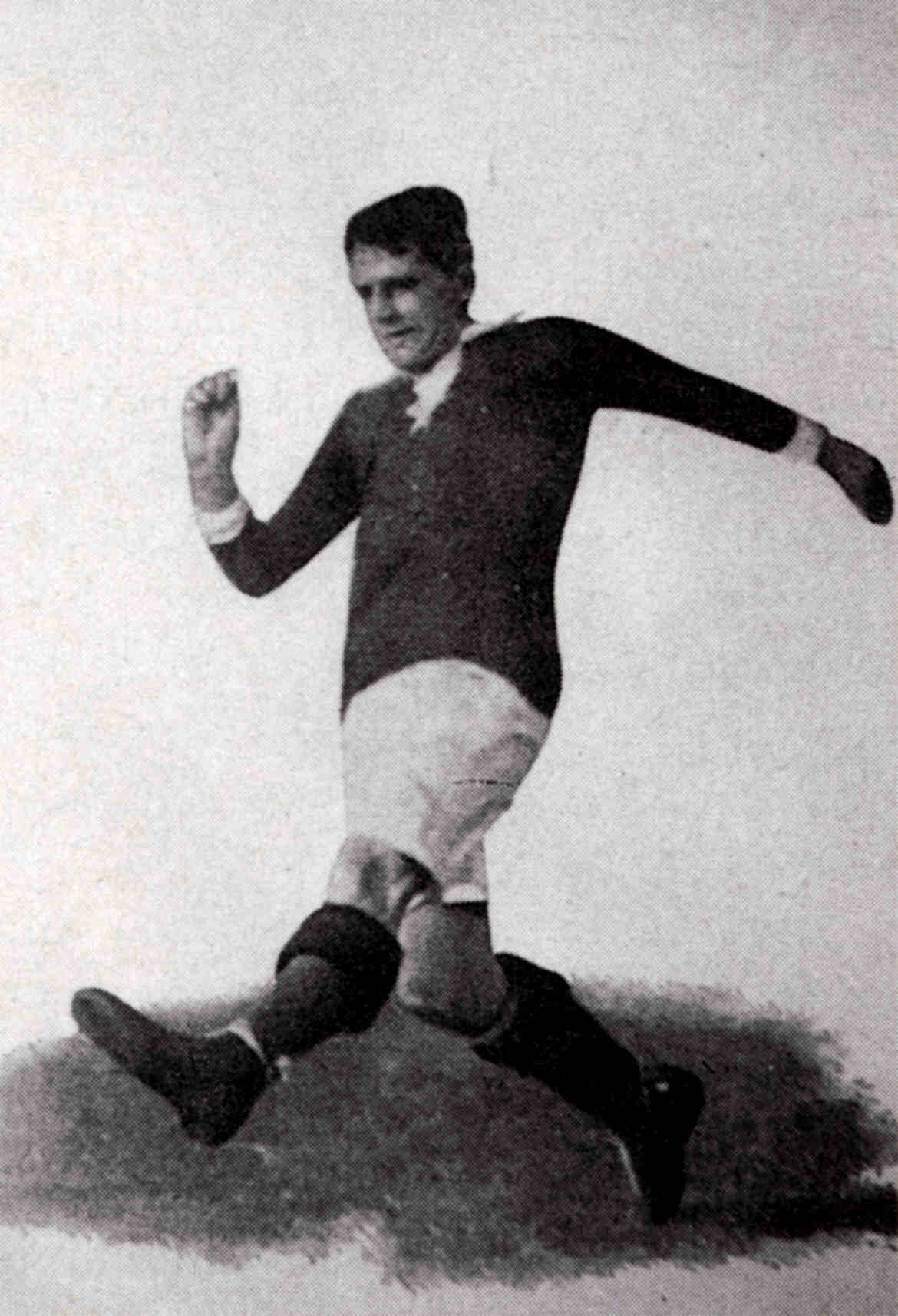
Gottfried Fuchs scored a world record 10 goals for Germany in a 16–0 win against Russia at the 1912 Olympics in Stockholm on 1 July, becoming the top scorer of the tournament; his international record was not surpassed until 2001 when Australia's Archie Thompson scored 13 goals in a 31–0 defeat of American Samoa. He was Jewish, and the German Football Association erased all references to him from their records between 1933 and 1945. As of 2016, he was still the top German scorer for one match.
At that time the players were selected by the DFB, as there was no dedicated coach. The first manager of the Germany national team was Otto Nerz, a school teacher from Mannheim, who served in the role from 1926 to 1936. The German FA could not afford travel to Uruguay for the first World Cup staged in 1930 during the Great Depression, but finished third in the 1934 World Cup in their first appearance in the competition. After a poor showing at the 1936 Olympic Games in Berlin, Sepp Herberger became coach. In 1937 he put together a squad which was soon nicknamed the Breslau Elf (the Breslau Eleven) in recognition of their 8–0 win over Denmark in the then German city of Breslau, Lower Silesia (now Wrocław, Poland).
After Austria became part of Germany in the Anschluss of March 1938, the Austrian national team – one of Europe's best sides at the time due to professionalism – was disbanded despite having already qualified for the 1938 World Cup. Nazi politicians ordered five or six ex-Austrian players, from the clubs Rapid Vienna, Austria Vienna, and First Vienna FC, to join the "all-German" team on short notice in a staged show of unity for political reasons. At the 1938 World Cup in France, this "united" Germany national team managed only a 1–1 draw against Switzerland and then lost the replay 2–4 in front of a hostile crowd in Paris. That early exit stands as Germany's worst World Cup result, and one of just three occasions the team failed to progress from the group stage – the next would not occur until the 2018 tournament, and it would be repeated in 2022.
During World War II, the team played over 30 international games between September 1939 and November 1942. National team games were then suspended, as most players had to join the armed forces. Many of the national team players were gathered together under coach Herberger as Rote Jäger through the efforts of a sympathetic air force officer trying to protect the footballers from the most dangerous wartime service.
Three German national teams (1945–1990)
After World War II, Germany was banned from competition in most sports until 1950. The DFB was not a full member of FIFA, and none of the three new German states – West Germany, East Germany, and Saarland – entered the 1950 World Cup qualifiers.
The Federal Republic of Germany, which was referred to as West Germany, continued the DFB. With recognition by FIFA and UEFA, the DFB maintained and continued the record of the pre-war team. Switzerland was the first team that played West Germany in 1950, with the latter qualifying for the 1954 World Cup and the former hosting it.
The Saarland, a French protectorate between 1947 and 1956, did not join French organisations, and was barred from participating in pan-German ones. It sent their own team to the 1952 Summer Olympics and the 1954 World Cup qualifiers. In 1957, Saarland acceded to the Federal Republic of Germany.
In 1949, the communist German Democratic Republic (East Germany) was founded. In 1952 the Deutscher Fußball-Verband der DDR (DFV) was established and the East Germany national football team took to the field. They were the only team to beat the 1974 FIFA World Cup-winning West Germans in the only meeting of the two sides of the divided nation. East Germany won the gold medal at the 1976 Olympics. After German reunification in 1990, the eastern football competition was reintegrated into the DFB.
1954 World Cup victory
Main article: 1954 FIFA World Cup final

West Germany, captained by Fritz Walter, met in the 1954 World Cup against Turkey, Yugoslavia and Austria. When playing favourites Hungary in the group stage, West Germany lost 3–8, and faced the Hungarian "Mighty Magyars" again in the final. Hungary had gone unbeaten for 32 consecutive matches, and West Germany snapped the streak by winning 3–2, with Helmut Rahn scoring the winning goal. The success is called "The Miracle of Bern" (Das Wunder von Bern).
Memorable losses: Wembley goal and game of the century (1958–1970)
After finishing fourth in the 1958 World Cup and only reaching the quarter-finals four years later, the DFB made changes. Professionalism was introduced, and the best clubs from the various Regionalligas were assembled into the new Bundesliga. In 1964, Helmut Schön took over as coach, replacing Herberger who had been in office for 28 years.
In the 1966 World Cup, West Germany reached the final after beating the USSR in the semi-final, facing hosts England. In extra time, the first goal by Geoff Hurst was one of the most contentious goals in the history of the World Cup: the linesman signalled the ball had crossed the line for a goal, after bouncing down from the crossbar, when replays showed it did not appear to have fully crossed the line. Hurst then scored another goal giving England a 4–2 win.
West Germany knocked England out in the 1970 World Cup quarter-finals 3–2, before they suffered a 4–3 extra-time loss in the semi-final against Italy. This match with five goals in extra time is one of the most dramatic in World Cup history, and is called the "Game of the Century" in both Italy and Germany. West Germany claimed third place by beating Uruguay 1–0. Gerd Müller finished as the tournament's top scorer with 10 goals.
1974 World Cup title on home soil
Main article: 1974 FIFA World Cup

In 1971, Franz Beckenbauer became captain of the national team, and he led West Germany to victory at the European Championship at Euro 1972, defeating the Soviet Union 3–0 in the final.
As hosts of the 1974 World Cup, they won their second World Cup, defeating the Netherlands 2–1 in the final in Munich. Two matches in the 1974 World Cup stood out for West Germany. The first group stage saw a politically charged match as West Germany played a game against East Germany. The East Germans won 1–0 but it made a scant difference to West Germany as the West Germans advanced to the knockout stage. The West Germans advanced to the final against the Johan Cruyff-led Dutch team and their brand of "Total Football". The Dutch took the lead from a penalty. However, West Germany equalised with a penalty by Paul Breitner, and won the match with Gerd Müller's fine finish soon after.
Late 1970s and early 1980s
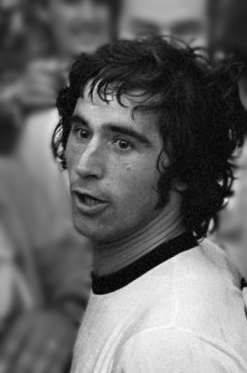
West Germany failed to defend their titles in the next two major international tournaments. They lost to Czechoslovakia in the UEFA Euro 1976 final in a penalty shootout 5–3, their last penalty shootout loss in a major tournament as of 2025.
In the 1978 World Cup, Germany was eliminated in the second group stage after losing 3–2 to Austria. Schön retired as coach afterward, and the post was taken over by his assistant, Jupp Derwall.
West Germany's first tournament under Derwall was successful, as they earned their second European title at Euro 1980 after defeating Belgium 2–1 in the final. West Germany started the 1982 World Cup with a 1–2 upset by newcomers Algeria in their first match, but advanced to the second round with a controversial 1–0 win over Austria. In the semi-final against France, they drew 3–3 and won the penalty shootout 5–4. In the final, they were defeated by Italy 1–3.
During this period, West Germany's Gerd Müller racked up fourteen goals in two World Cups (1970 and 1974). His ten goals in 1970 are the third-most ever in a tournament. Müller's all-time World Cup record of 14 goals was broken by Ronaldo in 2006; this was then further broken by Miroslav Klose in 2014 with 16 goals.
Beckenbauer's managing success (1984–1990)
.jpg)
After West Germany were eliminated in the first round of Euro 1984, Franz Beckenbauer returned to the national team to replace Derwall as manager. At the 1986 World Cup in Mexico, West Germany finished as runners-up for the second consecutive tournament after beating France 2–0 in the semi-finals, but losing to the Diego Maradona-led Argentina in the final, 2–3. In Euro 1988, after drawing Italy 1–1 and beating both Denmark and Spain 2–0 in the group stage, West Germany's hopes of winning the tournament on home soil were spoiled by the Netherlands, as the Dutch beat them 2–1 in the semi-finals.
At the 1990 World Cup in Italy, West Germany won their third World Cup title, in its unprecedented third consecutive final appearance. Captained by Lothar Matthäus, they defeated Yugoslavia (4–1), UAE (5–1), the Netherlands (2–1), Czechoslovakia (1–0), and England (1–1, 4–3 on penalty kicks) on the way to a final rematch against Argentina in Rome. West Germany won 1–0, with the only goal being a penalty scored in the 85th minute by Andreas Brehme. Beckenbauer, who won the World Cup as the national team's captain in 1974, thus became the first person to win the World Cup as both captain and manager, and the second to win as player and manager, after Mario Zagallo of Brazil.
Olympic football
Main article: Germany Olympic football team
East Germany did however achieve significantly greater success in Olympic football than the amateur teams fielded by the Western NOC of Germany due to using its elite players from the top domestic league. In 1956, 1960, and 1964 both states had sent a United Team of Germany. For 1964, the East German side had beaten their Western counterparts in order to be selected. They went on to win the bronze medal for Germany. As GDR, they won bronze in 1972 in Munich, gold in 1976 in Montreal, and silver in 1980 in Moscow.
Prior to 1984, Olympic football was an amateur event, meaning that only non-professional players could participate. Due to this, West Germany was never able to achieve the same degree of success at the Olympics as at the World Cup. The first medal coming in the 1988 Olympics, when they won the bronze medal after beating Italy 3–0 in the 3rd place match. West Germany also reached the second round in both 1972 and 1984. On the other hand, due to having an ability to field its top-level players who were classified as amateurs on a technicality East Germany did better, winning a gold, a silver and two bronze medals (one representing the United Team of Germany).
Berti Vogts years (1990–1998)

In February 1990, three months after the fall of the Berlin Wall, East Germany and West Germany were drawn together in UEFA Euro 1992 qualifying. In November 1990, the East German association Deutscher Fußball-Verband integrated into the DFB, by which time the East Germany team had ceased operations, playing its last match on 12 September 1990. The unified Germany national team completed the European Championship qualifying group. The East German 1990–91 league continued, with a restructuring of German leagues in 1991–92. The first game with a unified Germany national team was against Switzerland on 19 December 1990.
After the 1990 World Cup, assistant Berti Vogts took over as the national team coach from the retiring Beckenbauer. In Euro 1992, Germany reached the final, but lost 0–2 to underdogs Denmark. In the 1994 World Cup, they were upset 1–2 in the quarterfinals by Bulgaria.
Reunified Germany won its first major international title at Euro 1996, becoming European champions for the third time. They defeated hosts England in the semi-finals, and the Czech Republic 2–1 in the final on a golden goal in extra time.
However, in the 1998 World Cup, Germany were eliminated in the quarter-finals after a 0–3 defeat to Croatia, with all goals being scored after defender Christian Wörns received a straight red card. Vogts stepped down afterwards and was replaced by Erich Ribbeck.
Erich Ribbeck and Rudi Völler years (2000–2004)
In Euro 2000, the team went out in the first round, drawing with Romania, then suffering a 1–0 defeat to England and were routed 3–0 by Portugal (which fielded their backup players, having already advanced). Ribbeck resigned, and was replaced by Rudi Völler.
Coming into the 2002 World Cup, expectations of Germany were low due to poor results in the qualifiers, and not directly qualifying for the finals for the first time. The team advanced from the group, and in the knockout stages they produced three consecutive 1–0 wins against Paraguay, the United States, and co-hosts South Korea. Oliver Neuville scored two minutes from time against Paraguay and Michael Ballack scored both goals in the US and South Korea games, although he picked up a second yellow card against South Korea for a tactical foul and was suspended for the subsequent match. This set up a final against Brazil, the first World Cup meeting between the two. Germany lost 0–2 thanks to two Ronaldo goals. Nevertheless, German captain and goalkeeper Oliver Kahn won the Golden Ball, the first time in the World Cup that a goalkeeper was named the best player of the tournament.
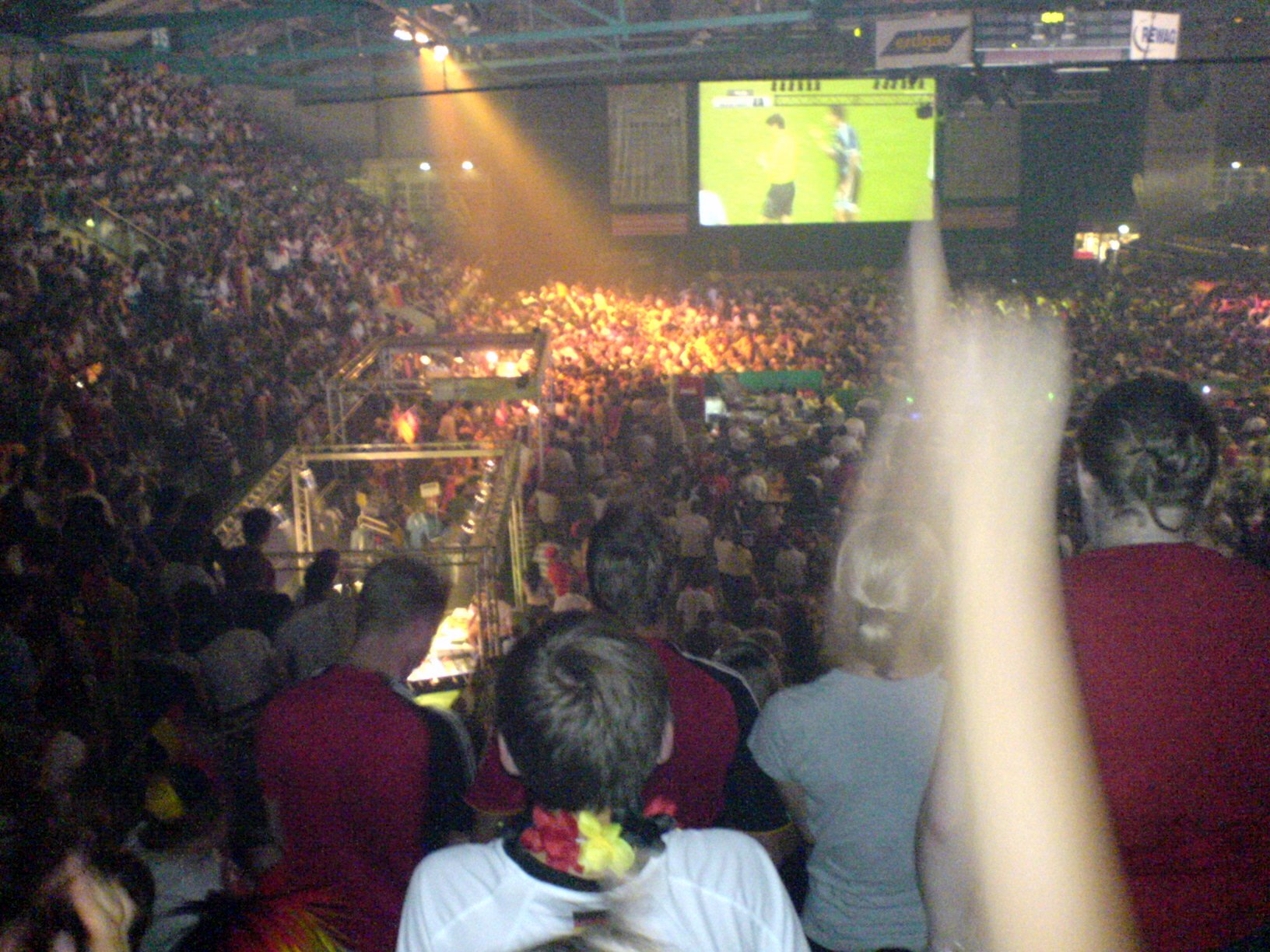
Germany once again exited in the first round at Euro 2004, drawing their first two matches and losing the third to the Czech Republic (who had fielded a second-string team). Völler resigned afterwards, and Jürgen Klinsmann was appointed head coach.
Resurgence under Klinsmann (2004–2006)
Klinsmann's main task was to lead the national team to a good showing at the 2006 World Cup in Germany. He relieved goalkeeper Kahn of the captaincy and announced that Kahn and longtime backup Jens Lehmann would be competing for the position of starting goaltender, a decision that angered Kahn and Lehmann eventually won that contest. Expectations for the team were low, which was not helped by veteran defender Christian Wörns being dropped (after Wörns criticised Klinsmann for designating him only as a backup player on the squad), a choice roundly panned in Germany. Italy routed Germany 4–1 in a March 2006 exhibition game, and Klinsmann bore the brunt of the criticism as the team was ranked only 22nd in the world entering the 2006 World Cup.
As World Cup hosts, Germany won all three group stage matches to finish top of their group. The team defeated Sweden 2–0 in the round of 16, and Argentina in the quarter-finals in a penalty shootout. The semi-final against Italy was scoreless until near the end of extra time when Germany conceded two goals. In the third place match, Germany defeated Portugal 3–1. Miroslav Klose was awarded the Golden Boot for his tournament-leading five goals.
Löw era (2006–2021)
Euro 2008, 2010 World Cup and Euro 2012
Main article: UEFA Euro 2008, 2010 FIFA World Cup, UEFA Euro 2012
Germany's entry into the Euro 2008 qualifying round was marked by the promotion of Joachim Löw following the resignation of Klinsmann. At UEFA Euro 2008, Germany won two out of three matches in group play to advance to the knockout round. They defeated Portugal 3–2 in the quarter-final, and won their semi-final against Turkey. Germany lost the final against Spain 1–0, finishing as runners-up.
At the 2010 World Cup, Germany won the group and advanced to the knockout stage. In the round of 16, Germany defeated England 4–1. Miroslav Klose tied Gerd Müller's record of 14 World Cup goals, as Germany defeated Argentina 4–0 in the quarterfinals. In the semi-finals, Germany lost 1–0 to Spain. They defeated Uruguay 3–2 to finish third. Thomas Müller won the Golden Boot and the Best Young Player Award.
.jpg)
At Euro 2012, Germany was placed in Group B along with Portugal, Netherlands, and Denmark. Germany won all three group matches, and then defeated Greece in the quarter-finals as they set a record of 15 consecutive wins in all competitive matches. In the semi-finals, Germany lost to Italy, 2–1.
2014 World Cup victory
Main article: 2014 FIFA World Cup

Germany were placed in Group G of the 2014 World Cup, with Portugal, Ghana, and the United States. They first faced Portugal in a match billed by some as the "team of all the talents against the team of The Talent (Cristiano Ronaldo)", routing the Portuguese 4–0 thanks to a hat-trick by Thomas Müller. In their match with Ghana, they led the game before Ghana fought back to take the lead. When Klose scored to level the match at 2–2, he netted his 15th World Cup goal to join former Brazil striker Ronaldo at the pinnacle of World Cup Finals scorers. They then went on to defeat the Klinsmann-led United States 1–0, securing them a spot in the knockout stages.
The round of 16 knockout match against Algeria remained goalless after regulation time, resulting in an extra time period where André Schürrle scored from a Thomas Müller pass after only less than two minutes. Mesut Özil scored Germany's second goal in the 120th minute with the match ending 2–1. In the quarter-finals against France, Mats Hummels scored the only goal in the 13th minute, as Germany advanced to a record fourth consecutive semi-final.

The 7–1 semi-final win against Brazil was one of the most memorable games in World Cup history; Germany scored four goals in just less than seven minutes and were 5–0 up by the 30th minute with goals from Thomas Müller, Miroslav Klose, Sami Khedira and two from Toni Kroos. Germany's 7–0 lead in the second half was the highest score against Brazil in a single game. It was Brazil's worst ever World Cup defeat, whilst Germany broke multiple World Cup records with the win, including the record broken by Klose, the first team to reach four consecutive World Cup semi-finals, the first team to score seven goals in a World Cup knockout phase game, the fastest five consecutive goals in World Cup history (with four of the goals scored in just 400 seconds), and the first team to score five goals in the first half in a World Cup semi-final.
The World Cup final was held at the Maracanã in Rio de Janeiro on 13 July. Mario Götze's 113th-minute goal helped Germany beat Argentina 1–0, becoming the first-ever European team to win a FIFA World Cup in the Americas and the second European team to win the title outside Europe.
Euro 2016 to 2017 Confederations Cup
Main article: UEFA Euro 2016, 2017 FIFA Confederations Cup
After several players retired from the team following the 2014 World Cup, including Philipp Lahm, Per Mertesacker and Miroslav Klose, the team had a disappointing start in the UEFA Euro 2016 qualifiers. They defeated Scotland 2–1 at home, then suffered a 2–0 loss at Poland (the first in their history), a 1–1 draw against the Republic of Ireland, and a 4–0 win over Gibraltar. Troubles during qualifying for Euro 2016 continued, drawing at home, as well as losing away to Ireland; the team also only narrowly defeated Scotland on two occasions, but handily won the return against Poland and both games against Gibraltar (who competed for the first time). They would eventually win their group and qualify for the tournament.
On 13 November 2015, Germany played a friendly against France in Paris when a series of terrorist attacks took place in the city, some in the direct vicinity of the Stade de France, where the game was held. For security reasons, the team spent the night inside the stadium, accompanied by the French squad who stayed behind in an act of comradery. Four days later, Germany was scheduled to face the Netherlands at Hanover's HDI-Arena, in another friendly. After initial security reservations, the DFB decided to play the match on 15 November. After reports about a concrete threat to the stadium, the match was cancelled 90 minutes before kickoff.
At UEFA Euro 2016, Germany began their campaign with a 2–0 win against Ukraine. Against Poland, Germany were held to a 0–0 draw but concluded Group C play with a 1–0 win against Northern Ireland. In the round of 16, Germany faced Slovakia and earned a comfortable 3–0 win. Germany then faced off against rivals Italy in the quarter-finals. Mesut Özil opened the scoring in the 65th minute for Germany, before Leonardo Bonucci equalised after netting a penalty thirteen minutes later. The score remained 1–1 after extra time, and Germany beat Italy 6–5 in a penalty shootout. It was the first time Germany had overcome Italy in a major tournament. The Germans lost to hosts France 2–0 in the semi-finals, their first competitive win against Germany in 58 years.
Germany qualified for the 2017 FIFA Confederations Cup after winning the 2014 World Cup, and won the last version of the Confederations Cup after a 1–0 win against Chile in the final at the Krestovsky Stadium in Saint Petersburg, Russia.
Disappointment at the 2018 World Cup, 2018–19 UEFA Nations League and Euro 2020
Main article: 2018 FIFA World Cup, 2018–19 UEFA Nations League, UEFA Euro 2020

After winning all their qualifying matches and the Confederations Cup the previous year, Germany started their 2018 World Cup campaign with a defeat to Mexico, their first loss in an opening match since the 1982 World Cup. Germany defeated Sweden 2–1 in their second game via an injury-time winner from Toni Kroos, but were subsequently eliminated following a 2–0 loss to South Korea, their first exit in the first round since 1938 and first in the group stage since the format had been reintroduced in 1950. With this result Germany became the fifth defending champions to be eliminated in the group stages of the World Cup, following Brazil in 1966, France in 2002, Italy in 2010, and Spain in 2014.
Following the World Cup, Germany's struggles continued into the inaugural UEFA Nations League. After a 0–0 draw at home against France, they lost 3–0 against the Netherlands and 2–1 in the rematch against France three days later; the latter result being their fourth loss in six competitive matches. Due to results elsewhere, the relegation to League B was originally confirmed, but due to the overhaul of the format for the 2020–21 UEFA Nations League, Germany were spared from relegation to League B.
In March 2021, the DFB announced that Löw would step down as Germany's manager after UEFA Euro 2020. Later that month, Germany lost 2–1 at home to North Macedonia in the 2022 World Cup qualifiers, their first World Cup qualification defeat since losing 5–1 to England in September 2001 and only their third in history. On 25 May 2021, the DFB announced that former assistant manager Hansi Flick would replace Löw as head coach.
At Euro 2020 (delayed until 2021 due to the COVID-19 pandemic), Germany were drawn with World Cup champions France (to whom they lost 1–0) and reigning European champions Portugal (whom they defeated 4–2), with each group having only two guaranteed qualifiers for the next phase, plus a chance for the third-placed team. In the final group match, the Hungarians took the lead twice only to draw. Germany then lost 2–0 to England in the round of 16, their first round of 16 exit in a major tournament since the 1938 World Cup.
Recent years (2021–present)
Following Germany's disappointment at Euro 2020, Hansi Flick, former Bayern Munich manager, took over as coach of the national team. On 11 October 2021, Germany beat North Macedonia 4–0 to become the first team (outside of the hosts) to qualify for the 2022 World Cup in Qatar. In the 2022–23 Nations League, Germany recorded their first-ever competitive win against Italy as the Germans beat the visitors 5–2. This was Germany's fourth game and first win in the league, however the Germans finished third in the group.

At the 2022 World Cup, Germany were drawn into Group E with Spain, Japan and Costa Rica. The campaign started with a shock 2–1 defeat to Japan. Germany drew 1–1 with Spain, and then were knocked out of the World Cup in the group stage for the second consecutive tournament, despite a 4–2 win over Costa Rica, missing out on a place in the knockout stages on goal difference.
After several poor performances following Germany's World Cup exit – including a 4–1 home loss to Japan – Flick was dismissed on 10 September 2023. On 22 September 2023, Julian Nagelsmann was named the new head coach. After a rocky end to 2023, only winning one out of four games, Germany found itself back in form in the new year with a second victory against France and the Netherlands, strengthening hopes for a successful UEFA Euro 2024 campaign.
As hosts of Euro 2024, Germany won the tournament's opening match against Scotland 5–1. Germany went on to defeat Hungary 2–0 in their second match to qualify for the round of 16. After defeating Denmark in the round of 16, Germany went on to the quarter-finals, where they were defeated 2–1 after extra time by Spain.
Team image
Kits and crest
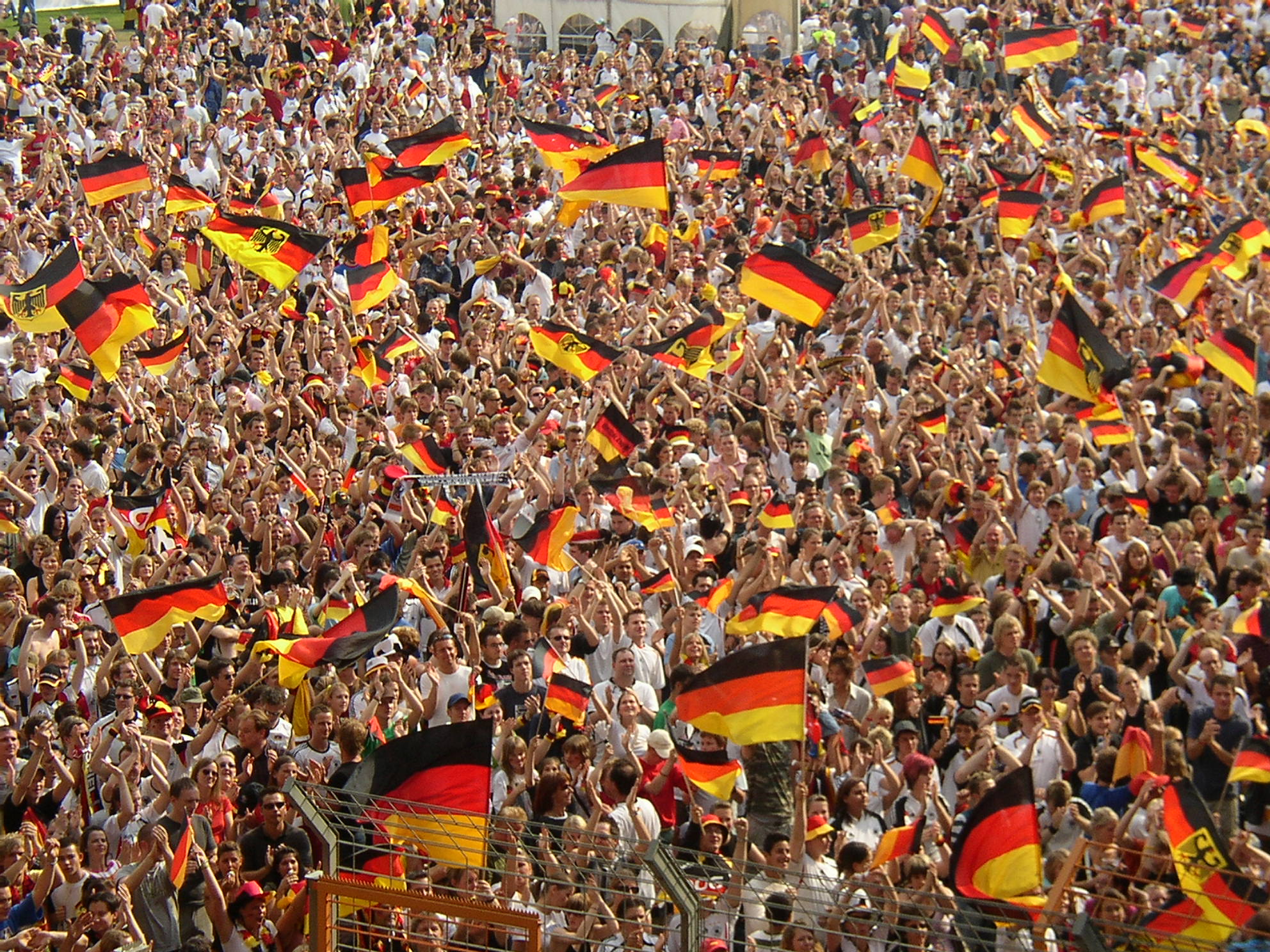
The national team's home kit has been traditionally a white shirt, black shorts, and white socks. The colours are derived from the 19th-century flag of the North German State of Prussia. Since 1988, many of the home kit's designs incorporate details patterned after the modern German flag. For the 2014 World Cup, Germany's kit was white shorts rather than the traditional black due to FIFA's kit clashing rule for the tournament. The away shirt colour has changed several times. Historically, a green shirt with white shorts is the most often used alternative colour combination, derived from the DFB colours – though it is often erroneously reported that the choice is in recognition of the fact that Ireland, whose home shirts are green, were the first nation to play Germany in a friendly game after World War II. However, the first team to play Germany after WWII, as stated above, was actually Switzerland. Other colours such as red, grey and black have also been used.
A change from black to red came in 2005 on the request of Jürgen Klinsmann, but Germany played every game at the 2006 World Cup in its home white colours. In 2010, the away colours then changed back to a black shirt and white shorts, but at the World Cup, the team dressed up in the black shorts from the home kit. The kit used by Germany returned to a green shirt on its away kit, but then changed again to red-and-black striped shirts with white stripes and letters and black shorts.
Adidas AG is the longstanding kit provider to the national team, a sponsorship that began in 1954 and is contracted to continue until at least 2022. In the 70s, Germany wore Erima kits (a German brand, formerly a subsidiary of Adidas). In March 2024, Nike was announced as the new kit sponsor after 70 years of Adidas, causing widespread criticism and backlash.
As a common practice, three stars were added above the crest in 1996, symbolising Germany's World Cup titles in 1954, 1974, and 1990. In 2014, a fourth star was added after Germany were crowned world champions for the fourth time.
Kit suppliers
| Kit supplier | Period | Notes | |||||||
|---|---|---|---|---|---|---|---|---|---|
| West Germany Leuzela | 1950–1964 | url=https://www.merkur.de/sport/fussball/geschaeft-mit-fussball-trikots-10110813.html | title=Das Geschäft mit den Trikots | publisher=merkur.de | date=10 August 2018 | access-date=23 December 2020 | archive-date=27 June 2021 | archive-url=https://web.archive.org/web/20210627042831/https://www.merkur.de/sport/fussball/geschaeft-mit-fussball-trikots-10110813.html | url-status=live}} |
| United Kingdom Umbro | 1964–1971 | Germany wore Umbro kits during the 1966 and 1970 FIFA World Cups. | |||||||
| Germany Erima | 1971–1980 | url=https://www.fr.de/sport/fussball/im-namen-der-drei-streifen-90795330.html | title=Im Namen der drei Streifen | publisher=fr.de | date=9 June 2021 | access-date=14 June 2024}} | |||
| Germany Adidas | 1980–2026 | First Adidas jersey was worn in the UEFA Euro 1980 final. | |||||||
| United States Nike | 2027–2034 |
Kit deals
| Kit supplier | Period | Contract | Notes | Announcement | Duration | ||
|---|---|---|---|---|---|---|---|
| GER Adidas | 1954–2026 | 20 June 2016 | 2019–2022 (4 years) | Per year: €50 million ($56.7 million) | |||
| Total: €250 million ($283.5 million) | |||||||
| 10 September 2018 | 2023–2026 (4 years) | Undisclosed | |||||
| rowspan "2" | USA Nike | rowspan "2" | 2027–2034 | 21 March 2024 | 2027–2034 (8 years) | Per year: €100 million ($108 million) |
Home stadium

Germany plays its home matches among various stadiums, in rotation, around the country. They have played home matches in 43 different cities so far, including venues that were German at the time of the match, such as Vienna, Austria, which staged three games between 1938 and 1942.
National team matches have been held most often in Berlin (46 matches), which was the venue of Germany's first home match (in 1908 against England). Other common host cities include Hamburg (34 matches), Stuttgart (32), Hanover (28) and Dortmund. Munich also hosted noteworthy matches including the 1974 World Cup final.
Media coverage
As of January 2025, Germany's broadcasts for friendlies rotate between RTL, ARD and ZDF, while UEFA Euro and FIFA World Cup qualifying matches, UEFA Nations League games, and major tournaments are on ARD and ZDF.
Results and fixtures
Main article: Germany national football team results
The following is a list of match results in the last twelve months, as well as any future matches that have been scheduled.
2025
- Tonali
- Kleindienst
- Goretzka
- Kimmich
- Musiala
- Kleindienst
- Kean
- Raspadori
- Wirtz
- Conceição
- Ronaldo
- Mbappé
- Olise
- Hancko
- Strelec
- Gnabry
- Amiri
- Wirtz
- Price
- Raum
- Kimmich
- Gnabry
- Woltemade
- Woltemade
- Woltemade
- Gnabry
- Sané
- Baku
- Ouédraogo
2026
Coaching staff
Main article: Germany national football team manager
:As of August 2025.
| Position | Name |
|---|---|
| Head coach | GER Julian Nagelsmann |
| Assistant coaches | DEN Mads Buttgereit |
| GER Benjamin Glück | |
| Goalkeeping coaches | GER Michael Fuchs |
| SUI Andreas Kronenberg | |
| Fitness coach | GER Nicklas Dietrich |
| Athletic coach | CRO Krunoslav Banovčić |
| Doctor | GER Tim Meyer |
| Sporting director | GER Rudi Völler |
Players
Current squad
The following players were called up for the 2026 FIFA World Cup qualification matches against Luxembourg and Slovakia on 14 and 17 November 2025, respectively.
:Information correct as of 17 November 2025, after the match against Slovakia.
Recent call-ups
The following players have also been called up for the team within the last twelve months.
INJ
- INJ Withdrew due to injury
Individual records
Player records
Main article: Germany national football team records and statistics
|- | 2 | 137 | 71
| 2001–2014 |
|---|
| 3 |
| 131 |
| 45 |
| 2010–2024 |
| - |
| 4 |
| 130 |
| 49 |
| 2004–2017 |
| - |
| 5 |
| 124 |
| 0 |
| 2009–2024 |
| - |
| 6 |
| 121 |
| 24 |
| 2004–2016 |
| - |
| 7 |
| 114 |
| 17 |
| 2010–2024 |
| - |
| 8 |
| 113 |
| 5 |
| 2004–2014 |
| - |
| 9 |
| 108 |
| 47 |
| 1987–1998 |
| - |
| 10 |
| 106 |
| 10 |
| 2016–present |
| - |
| } |
Top goalscorers

| Rank | Player | Goals | Caps | Average | Period |
|---|---|---|---|---|---|
| 1 | Miroslav Klose (list) | 71 | 137 | 2001–2014 | |
| 2 | Gerd Müller (list) | 68 | 62 | 1966–1974 | |
| 3 | Lukas Podolski | 49 | 130 | 2004–2017 | |
| 4 | Rudi Völler | 47 | 90 | 1982–1994 | |
| Jürgen Klinsmann | 108 | 1987–1998 | |||
| 6 | Karl-Heinz Rummenigge | 45 | 95 | 1976–1986 | |
| Thomas Müller | 131 | 2010–2024 | |||
| 8 | Uwe Seeler | 43 | 72 | 1954–1970 | |
| 9 | Michael Ballack | 42 | 98 | 1999–2010 | |
| 10 | Oliver Bierhoff | 37 | 70 | 1996–2002 |
Captains
| Player | Period | Notes |
|---|---|---|
| Fritz Szepan | 1934–1939 | |
| Paul Janes | 1939–1942 | |
| Fritz Walter | 1951–1956 | First official captain of the West Germany national football team |
| World Cup winning captain (1954) | ||
| Hans Schäfer | 1952–1962 | First West German player to play in three World Cup tournaments |
| (1954, 1958, 1962) | ||
| Helmut Rahn | 1958–1959 | |
| Herbert Erhardt | 1959–1962 | |
| Hans Schäfer | 1962 | |
| Uwe Seeler | 1962–1970 | |
| Wolfgang Overath | 1970–1972 | |
| Franz Beckenbauer | 1972–1977 | European Championship winning captain (1972) |
| World Cup winning captain (1974) | ||
| Berti Vogts | 1977–1978 | |
| Sepp Maier | 1978–1979 | |
| Bernard Dietz | 1979–1981 | European Championship winning captain (1980) |
| Karl-Heinz Rummenigge | 1981–1986 | |
| Harald Schumacher | 1986 | |
| Klaus Allofs | 1986–1987 | |
| Lothar Matthäus | 1987–1995 | World Cup winning captain (1990) |
| First captain of the unified Germany national football team | ||
| Jürgen Klinsmann | 1995–1998 | European Championship winning captain (1996) |
| Oliver Bierhoff | 1998–2001 | |
| Oliver Kahn | 2001–2004 | |
| Michael Ballack | 2004–2010 | |
| Philipp Lahm | 2010–2014 | World Cup winning captain (2014) |
| Bastian Schweinsteiger | 2014–2016 | |
| Manuel Neuer | 2016–2017, 2017–2023 | |
| Julian Draxler | 2017 | Confederations Cup winning captain (2017) |
| İlkay Gündoğan | 2023–2024 | |
| Joshua Kimmich | 2024– |
Player of the Year
- 2010: Bastian Schweinsteiger
- 2011: Mesut Özil
- 2012: Mesut Özil
- 2013: Mesut Özil
- 2014: Toni Kroos
- 2015: Mesut Özil
- 2016: Mesut Özil
- 2017: Joshua Kimmich
- 2018: Marco Reus
- 2019: Matthias Ginter
- 2020: Manuel Neuer
- 2021: Joshua Kimmich
- 2022: Jamal Musiala
- 2023: Emre Can
- 2024: Jamal Musiala
Manager records
Main article: Germany national football team manager
; Most manager appearances : Joachim Löw: 198
Team records
Main article: Germany national football team records and statistics
15 consecutive wins in all competitive matches (world record)
| Date | Opponent | Venue | Result | Type | Scorers |
|---|---|---|---|---|---|
| 10 July 2010 | Port Elizabeth, RSA | * | 3–2 | WC 2010 3rd place | |
| 3 September 2010 | Brussels, BEL | A | 1–0 | EC 2012 Qualification | |
| 7 September 2010 | Köln | H | 6–1 | EC 2012 Qualification | |
| 8 October 2010 | Berlin | H | 3–0 | EC 2012 Qualification | |
| 12 October 2010 | Astana, KAZ | A | 3–0 | EC 2012 Qualification | |
| 26 March 2011 | Kaiserslautern | H | 4–0 | EC 2012 Qualification | |
| 3 June 2011 | Vienna, AUT | A | 2–1 | EC 2012 Qualification | |
| 7 June 2011 | Baku, AZE | A | 3–1 | EC 2012 Qualification | |
| 2 September 2011 | Gelsenkirchen | H | 6–2 | EC 2012 Qualification | |
| 7 October 2011 | Istanbul, TUR | A | 3–1 | EC 2012 Qualification | |
| 11 October 2011 | Düsseldorf | H | 3–1 | EC 2012 Qualification | |
| 9 June 2012 | Lviv, UKR | * | 1–0 | EC 2012 Group | |
| 13 June 2012 | Kharkiv, UKR | * | 2–1 | EC 2012 Group | |
| 17 June 2012 | Lviv, UKR | * | 2–1 | EC 2012 Group | |
| 22 June 2012 | Gdańsk, POL | * | 4–2 | EC 2012 Quarter final |
Competitive record
Main article: Germany national football team records and statistics
- 1930–1938 as GER → GER →
- 1950–1990 as
- 1994–present as
Champions Runners-up Third place Tournament played fully or partially on home soil
Germany has won the FIFA World Cup four times, behind only Brazil's five. It has finished as runners-up four times. In terms of semi-final appearances, Germany leads with 13, two more than Brazil's 11, who have participated in every single tournament. From 1954 to 2014 (16 tournaments), Germany were one of the last eight teams, before being eliminated in the group stage in 2018. Germany has also qualified for every one of the 19 World Cups for which it has entered – it did not enter the inaugural competition in Uruguay in 1930 for economic reasons, and were banned from the 1950 World Cup as the DFB was reinstated as a FIFA member only two months after this tournament.
Germany has also won the European Championship three times, one less than Spain. France and Italy, with two titles each, are the only other multiple winners. Germany finished as runners-up three times. The Germans have qualified for every European Championship tournament except for the first European Championship they entered in 1968. For that tournament, Germany was in the only group of three teams and thus only played four qualifying games. The deciding game was a scoreless draw in Albania which gave Yugoslavia the edge, having won in their neighbour country. The team finished outside the top eight in only three occasions: group stage eliminations in 2000 and 2004 alongside a round of 16 exit in 2020. In the other editions Germany participated in, they reached at least the semi-finals nine times, an unparalleled record in Europe.
See also East Germany and Saarland for the results of these separate Germany teams, and Austria for the team that was merged into the Germany national team from 1938 to 1945.
FIFA World Cup
Main article: Germany at the FIFA World Cup
FIFA Confederations Cup
| FIFA Confederations Cup record | Year | Round | Position | Pld | W | D* | L | GF | GA | Squad | Total | 1 title | 3/10 | 13 | 8 | 2 | 3 | 29 | 22 | — |
|---|---|---|---|---|---|---|---|---|---|---|---|---|---|---|---|---|---|---|---|---|
| Saudi Arabia 1992 | Did not enter | |||||||||||||||||||
| Saudi Arabia 1995 | Did not qualify | |||||||||||||||||||
| Saudi Arabia 1997 | Did not enter | |||||||||||||||||||
| Mexico 1999 | Group stage | 5th | 3 | 1 | 0 | 2 | 2 | 6 | Squad | |||||||||||
| South Korea Japan 2001 | Did not qualify | |||||||||||||||||||
| France 2003 | Did not enter | |||||||||||||||||||
| Germany 2005 | Third place | 3rd | 5 | 3 | 1 | 1 | 15 | 11 | Squad | |||||||||||
| South Africa 2009 | Did not qualify | |||||||||||||||||||
| Brazil 2013 | ||||||||||||||||||||
| Russia 2017 | Champions | 1st | 5 | 4 | 1 | 0 | 12 | 5 | Squad |
UEFA European Championship
Main article: Germany at the UEFA European Championship
UEFA Nations League
| UEFA Nations League record | League phase / quarter-finals | Finals | Season | LG | Grp | Pos | Pld | W | D | L | GF | GA | P/R | RK | Year | Pld | W | D* | L | GF | GA | Squad | Pos | Total | 24 | 8 | 12 | 4 | 47 | 37 | Top 4 | Total | 2 | 0 | 0 | 2 | 1 | 4 | — | |
|---|---|---|---|---|---|---|---|---|---|---|---|---|---|---|---|---|---|---|---|---|---|---|---|---|---|---|---|---|---|---|---|---|---|---|---|---|---|---|---|---|
| 2018–19 | A | 1 | 3rd | 4 | 0 | 2 | 2 | 3 | 7 | 11th | POR 2019 | Did not qualify | ||||||||||||||||||||||||||||
| 2020–21 | A | 4 | 2nd | 6 | 2 | 3 | 1 | 10 | 13 | 8th | ITA 2021 | |||||||||||||||||||||||||||||
| 2022–23 | A | 3 | 3rd | 6 | 1 | 4 | 1 | 11 | 9 | 10th | NED 2023 | |||||||||||||||||||||||||||||
| 2024–25 | A | 3 | 1st | 8 | 5 | 3 | 0 | 23 | 8 | 2nd | GER 2025 | 2 | 0 | 0 | 2 | 1 | 4 | Squad | 4th |
:*Denotes draws including knockout matches decided via penalty shoot-out.
Olympic Games
| Summer Olympic Games record | Qualification record | Year | Round | Position | Pld | W | D* | L | GF | GA | Squad | Pld | W | D | L | GF | GA | Campaign | Total | 2 medals | 10/28 | 37 | 18 | 6* | 13 | 112 | 55 | — | 26 | 13 | 4 | 9 | 38 | 29 | Total | |||||||||||||||
|---|---|---|---|---|---|---|---|---|---|---|---|---|---|---|---|---|---|---|---|---|---|---|---|---|---|---|---|---|---|---|---|---|---|---|---|---|---|---|---|---|---|---|---|---|---|---|---|---|---|---|
| France 1900 | Did not enter | Did not enter | — | |||||||||||||||||||||||||||||||||||||||||||||||
| USA 1904 | — | |||||||||||||||||||||||||||||||||||||||||||||||||
| UK 1908 | — | |||||||||||||||||||||||||||||||||||||||||||||||||
| SWE 1912 | First round | 7th | 3 | 1 | 0 | 2 | 18 | 8 | Squad | Invited | — | |||||||||||||||||||||||||||||||||||||||
| BEL 1920 | Banned | Banned | — | |||||||||||||||||||||||||||||||||||||||||||||||
| FRA 1924 | — | |||||||||||||||||||||||||||||||||||||||||||||||||
| NED 1928 | Quarter-finals | 5th | 2 | 1 | 0 | 1 | 5 | 4 | Squad | Invited | — | |||||||||||||||||||||||||||||||||||||||
| GER 1936 | 6th | 2 | 1 | 0 | 1 | 9 | 2 | Squad | Qualified as hosts | — | ||||||||||||||||||||||||||||||||||||||||
| GBR 1948 | Banned | Banned | — | |||||||||||||||||||||||||||||||||||||||||||||||
| FIN 1952 | Fourth place | 4th | 4 | 2 | 0 | 2 | 8 | 8 | Squad | Invited | — | |||||||||||||||||||||||||||||||||||||||
| AUS 1956 | First round | 9th | 1 | 0 | 0 | 1 | 1 | 2 | Squad | Automatic qualification | 1956 | |||||||||||||||||||||||||||||||||||||||
| ITA 1960 | Did not qualify | 6 | 3 | 0 | 3 | 9 | 11 | 1960 | ||||||||||||||||||||||||||||||||||||||||||
| JPN 1964 | 2 | 1 | 0 | 1 | 2 | 4 | 1964 | |||||||||||||||||||||||||||||||||||||||||||
| MEX 1968 | 2 | 1 | 0 | 1 | 1 | 2 | 1968 | |||||||||||||||||||||||||||||||||||||||||||
| FRG 1972 | Second round | 5th | 6 | 3 | 1 | 2 | 17 | 8 | Squad | Qualified as hosts | 1972 | |||||||||||||||||||||||||||||||||||||||
| CAN 1976 | Did not qualify | 2 | 0 | 1 | 1 | 2 | 3 | 1976 | ||||||||||||||||||||||||||||||||||||||||||
| URS 1980 | Did not enter | Did not enter | 1980 | |||||||||||||||||||||||||||||||||||||||||||||||
| USA 1984 | Quarter-finals | 5th | 4 | 2 | 0 | 2 | 10 | 6 | Squad | 6 | 3 | 1 | 2 | 8 | 5 | 1984 | ||||||||||||||||||||||||||||||||||
| KOR 1988 | Bronze medal | 3rd | 6 | 4 | 1 | 1 | 16 | 4 | Squad | 8 | 5 | 2 | 1 | 16 | 4 | 1988 | ||||||||||||||||||||||||||||||||||
| ESP 1992 | Did not qualify | UEFA European Under-21 Championship | 1992 | |||||||||||||||||||||||||||||||||||||||||||||||
| USA 1996 | 1996 | |||||||||||||||||||||||||||||||||||||||||||||||||
| AUS 2000 | 2000 | |||||||||||||||||||||||||||||||||||||||||||||||||
| GRE 2004 | 2004 | |||||||||||||||||||||||||||||||||||||||||||||||||
| CHN 2008 | 2008 | |||||||||||||||||||||||||||||||||||||||||||||||||
| GBR 2012 | 2012 | |||||||||||||||||||||||||||||||||||||||||||||||||
| BRA 2016 | Silver medal | 2nd | 6 | 3 | 3 | 0 | 22 | 6 | Squad | 2016 | ||||||||||||||||||||||||||||||||||||||||
| JPN 2020 | Group stage | 9th | 3 | 1 | 1 | 1 | 6 | 7 | Squad | 2020 | ||||||||||||||||||||||||||||||||||||||||
| FRA 2024 | Did not qualify | 2024 | ||||||||||||||||||||||||||||||||||||||||||||||||
| USA 2028 | To be determined | To be determined | ||||||||||||||||||||||||||||||||||||||||||||||||
| AUS 2032 |
:*Denotes draws including knockout matches decided via penalty shoot-out. :**Red border indicates tournament was held on home soil.
Honours
Main article: Germany national football team honours
Global
- FIFA World Cup
- Olympic Games
- Bronze Medal: 19881
- FIFA Confederations Cup
Continental
- UEFA European Championship
- Champions: 1972, 1980, 1996
- Runners-up: 1976, 1992, 2008
Friendly
- U.S. Cup
- Champions: 1993
- Swiss Centenary Tournament
- Champions: 1995
- Four Nations Tournament
- Third place: 1988
- Azteca 2000 Tournament
- Third place: 1985
Awards
- FIFA Team of the Year: 1993, 2014, 2017
- Laureus World Sports Award for Team of the Year: 2015
- World Soccer World Team of the Year: 1990, 2014
- Gazzetta Sports World Team of the Year: 1980, 1990, 2014
- FIFA World Cup Fair Play Trophy: 1974
- FIFA Confederations Cup Fair Play Award: 2017
- German Sports Team of the Year: 1966, 1970, 1974, 1980, 1990, 1996, 2002, 2006, 2010, 2014
- Silbernes Lorbeerblatt: 1954, 1972, 1974, 1980, 1990, 1996, 2014
- Bambi Award: 1986, 1996
- Deutscher Fernsehpreis: 2010
- Golden Hen: 2006, 2010, 2014
Summary
| Competition | Total | Total | 8 | 7 | 5 | 20 |
|---|---|---|---|---|---|---|
| FIFA World Cup | 4 | 4 | 4 | 12 | ||
| FIFA Confederations Cup | 1 | 0 | 1 | 2 | ||
| UEFA European Championship | 3 | 3 | 0 | 6 |
;Notes:
- The Germany Olympic football team participated, officially not recognized by FIFA in the senior team records. West Germany is the official predecessor of current Germany. All the results obtained by the East Germany national football team are officially excluded.
Notes
References
References
- "The "Mannschaft" :: National Teams :: DFB – Deutscher Fußball-Bund e.V.".
- "DFB unveil new 'Die Mannschaft' branding". DFB.
- "DFB verzichtet künftig auf den Markennamen "Die Mannschaft"". DFB.
- (28 July 2022). "DFB verzichtet auf Marketingslogan 'Die Mannschaft'". Der Spiegel.
- "Germany: FIFA/Coca-Cola World Ranking". [[FIFA]].
- "All matches of The National Team in 1908". [[German Football Association.
- "All matches of The National Team in 1912". DFB.
- "All matches of The National Team in 1909". DFB.
- "Regulations of the UEFA European Football Championship 2010-12". UEFA.
- "Germany". FIFA.
- "Germany's strength in numbers". UEFA.
- "Statistics – Most-capped players". DFB.
- "Statistics – Top scorers". DFB.
- "Olympic Football Tournament Montreal 1976". FIFA.
- "– Germany on". FIFA.
- "– Tournaments". FIFA.
- "– World Football Elo Ratings: Rating Graph". Elo Ratings.
- (3 May 2021). "Dänische Nationalmannschaft". TTZ.
- (26 December 2008). "Fodboldens indtog i Danmark: 1889 til 1908". Danish Ballgame Union.
- "England Matches – the Amateurs 1906–1939".
- "White House Ground, former home to Oxford City – Football Ground Map".
- (18 November 2020). "Germany's Worst Ever Defeats – Ranked".
- (22 September 2016). "Soccer Under the Swastika; Stories of Survival and Resistance During the Holocaust". Rowman & Littlefield.
- (14 April 2011). "The War Generation – Julius Hirsch". Inside Futbol.
- (6 May 2019). "Remembering the cream of Jewish footballing talent killed in the Holocaust".
- Reyes, Macario. (26 June 2008). "V. Olympiad Stockholm 1912 Football Tournament". Rec.Sport.Soccer Statistics Foundation.
- Clavane, Anthony. (27 September 2012). "Does Your Rabbi Know You're Here?: The Story of English Football's Forgotten Tribe". Quercus Publishing.
- (4 September 2013). "Snapshot – Sepp Herberger tries to invite Gottfried Fuchs -".
- "Gottfried Fuchs Bio, Stats, and Results".
- "Professor Otto Nerz". DFB.
- Muras, Udo. (16 May 2007). "Nur Hitler konnte sie stoppen". Die Welt.
- "All matches of The National Team in 1937". DFB.
- "(West) Germany – International Results". Rec.Sport.Soccer Statistics Foundation.
- Nick Amies. (1 April 2010). "World Cup Final, 1954: Hungary vs. West Germany". Deutsche Welle.
- "The Miracle of Bern". FIFA.
- Nick Amies. (1 April 2010). "World Cup Final, 1966: England vs. West Germany". Deutsche Welle.
- "England's claim to the firmament". FIFA.
- Nick Amies. (1 April 2010). "World Cup Semi-final, 1970: Italy vs. West Germany". Deutsche Welle.
- "A test of endurance and will". FIFA.
- (3 October 2003). "Müller the menace in German masterclass". [[UEFA]].
- "West Germany make their mark". UEFA.
- "1974 FIFA World Cup Germany – Dutch take plaudits but Germany take the prize". FIFA.
- "East edge battle of brothers". FIFA.
- Nick Amies. (1 April 2010). "World Cup Final, 1974: West Germany vs. The Netherlands". Deutsche Welle.
- "Oranje crushed in Munich". FIFA.
- (3 October 2003). "Panenka's panache seals Czech triumph". [[UEFA]].
- Fennessy, Paul. (3 July 2016). "Germany's 40-year penalty record continues and more Euro 2016 thoughts". The 42.
- (4 October 2003). "Hrubesch turns West Germany's unlikely hero". [[UEFA]].
- "Les Fennecs spring a surprise". FIFA.
- Nick Amies. (1 April 2010). "World Cup Semi-final, 1982: West Germany vs. France". Deutsche Welle.
- "Battling Germans knock out brave Bleus". FIFA.
- "Italians triumph in heavyweight rumble". FIFA.
- (8 July 2014). "World Cup 2014: Miroslav Klose breaks finals goals record". BBC.
- "Franz Beckenbauer". FIFA.
- "1986 FIFA World Cup Mexico – Maradona lights up the world – with a helping hand". FIFA.
- "1986 FIFA World Cup Mexico – Matches". FIFA.
- "Tournament History: Euro 1988 (West Germany)".
- "Van Basten sparks Netherlands joy". UEFA.
- (2 April 2014). "Halbfinale (21.06.1988 – 22.06.1988)".
- "1990 FIFA World Cup Italy – Germany hit winning note as Italian chorus fades". FIFA.
- "Gazza weeps as Germans prevail". FIFA.
- "1990 FIFA World Cup Italy – Matches". FIFA.
- "Olympic Record: Only One Bronze Medal". Deutscher Fussball-Bund.
- "West Germany/Germany national team match results in 1990".
- (5 October 2003). "Gatecrashing Denmark down Germany". [[UEFA]].
- (11 July 1994). "Bulgaria Ends Germany's Reign". [[The New York Times]].
- Mifflin, Lawrie. (11 July 1994). "WORLD CUP '94; Bulgaria, a Small Foot in Soccer, Steps Closer to Glass Slipper". [[The New York Times]].
- Thomsen, Ian. (1 July 1996). "Germany Wins Euro 96 With a 'Golden Goal'". [[The New York Times]].
- (6 October 2003). "Hosts denied by Germany in epic semi-final". [[UEFA]].
- (6 October 2003). "Bierhoff hero of Germany's EURO '96 win". [[UEFA]].
- Longman, Jere. (5 July 1998). "WORLD CUP '98; Croatia Stuns Germany With the Aid of a Red Card". [[The New York Times]].
- Hughes, Rob. (9 September 1998). "Another Day, Another Coach Gone:Now It's Vogts". The New York Times.
- (20 June 2000). "Holders Germany suffer heavy defeat". BBC Sport.
- (21 June 2000). "Ribbeck quits as Germans head home". BBC Sport.
- (15 June 2002). "Germany edge out Paraguay". BBC Sport.
- (22 June 2002). "Germany beat valiant USA". BBC Sport.
- (25 June 2002). "Germany shatter Korea". BBC Sport.
- (30 June 2002). "Brazil crowned world champions". BBC Sport.
- (2 July 2002). "Kahn wins Golden Ball award". BBC Sport.
- (30 June 2002). "Kahn named top keeper". BBC Sport.
- (23 June 2004). "Germany 1–2 Czech Rep". BBC Sport.
- (24 June 2004). "Voeller quits Germany role". [[BBC Sport]].
- (26 July 2004). "Klinsmann takes German post". [[The Guardian]].
- (4 January 2011). "10 Great Football Player Rivalries – Soccerlens". soccerlens.com.
- (20 March 2006). "German Coach and American Ways Are a Tough Match". The New York Times.
- (24 June 2006). "Germany 2–0 Sweden". BBC Sport.
- (1 July 2006). "Lehmann had penalty taker notes". BBC Sport.
- Walker, Michael. (30 June 2006). "Argentina crash out in mass brawl".
- (1 July 2006). "FIFA investigating Argentina brawl".
- (4 July 2006). "Germany 0–2 Italy (aet)". BBC Sport.
- (8 July 2006). "Germany 3–1 Portugal". BBC Sport.
- (9 July 2006). "Klose finishes as leading scorer". [[BBC Sport]].
- (12 July 2006). "Klinsmann quits as Germany coach". [[BBC Sport]].
- Chowdhury, Saj. (16 June 2008). "Austria 0–1 Germany & Poland 0–1 Croatia". BBC Sport.
- McKenzie, Andrew. (19 June 2008). "Portugal 2–3 Germany". BBC Sport.
- McNulty, Phil. (25 June 2008). "Germany 3–2 Turkey". BBC Sport.
- McNulty, Phil. (29 June 2008). "Germany 0–1 Spain". BBC Sport.
- McCarra, Kevin. (27 June 2010). "World Cup 2010: Germany tear down England's defence". [[The Guardian]].
- "FIFA World Cup Record – Players". FIFA.
- Fifield, Dominic. (3 July 2010). "World Cup 2010: Germany dump Diego Maradona and Argentina out". [[The Guardian]].
- McCarra, Kevin. (7 July 2010). "World Cup 2010: Spain overcome Germany after Carles Puyol winner". [[The Guardian]].
- Duxbury, Nick. (10 July 2010). "World Cup 2010: Germany defeated Uruguay 3–2 to take third place. in third-place thriller". [[The Guardian]].
- "Golden Boot". FIFA.
- (9 March 2011). "Muller named Hyundai Best Young Player". FIFA.
- (22 June 2012). "Germany overpower Greece in Gdansk". UEFA.
- "2014 Fifa World Cup – Group G". FIFA.
- Ronay, Barney. (16 June 2014). "Portugal's Cristiano Ronaldo outshone by Germany's Thomas Müller". The Guardian.
- James, David. (14 June 2014). "Why Germany's team ethic could be too much for even Cristiano Ronaldo". The Guardian.
- (1 January 1970). "France 0–1 Germany – watch again – BBC Sport". BBC.
- (9 July 2014). "Brazil 1–7 Germany: Match replay (UK only) – BBC Sport". BBC.
- (9 July 2014). "The Mineirazo in numbers". FIFA.
- (12 July 2014). "Why Mueller is the World Cup superstar Messi only dreams of being". Yahoo!.
- Futterman, Matthew. (11 July 2014). "The World Cup Final: The Best Team vs. the Best Player". The Wall Street Journal.
- "Götze volley gives Germany their fourth World Cup title". Deutsche Welle.
- (13 July 2014). "Germans End Long Wait: 24 Years and a Bit Extra". The New York Times.
- (14 November 2015). "Paris attacks kill more than 120 people – as it happened". The Guardian.
- (14 November 2015). "France players praised for staying with Germany team in Stade de France". The Guardian.
- (15 November 2015). "DFB-Entscheidung: Testspiel gegen die Niederlande findet statt". Der Spiegel.
- (17 November 2015). "Deutschland gegen Niederlande in Hannover: Länderspiel wegen Bombendrohung abgesagt". Der Spiegel.
- (2 July 2016). "Germany vs Italy, Euro 2016: Germans win the shootout after Bonucci penalty cancels out Ozil opener". The Telegraph.
- (2 July 2016). "Germany finally defeat Italy to stride into semis". UEFA.
- (7 July 2016). "Euro 2016: France's 2–0 semi-final victory over Germany strikes poignant note on night of ancient rivalry and modern spirit". The Telegraph.
- (2 July 2017). "Germany win Confederations Cup after Lars Stindl punishes error to deny Chile". The Guardian.
- (17 June 2018). "World Cup, Group F, Germany v Mexico as it happened: World Champions stunned by Lozano and Co".
- (27 June 2018). "Holders Germany crash out of World Cup after losing 2–0 to South Korea". Sky News.
- (27 June 2018). "Germany knocked out of 2018 World Cup". BBC.
- (14 October 2018). "Netherlands 3–0 Germany: Liverpool's Virgil van Dijk & Georginio Wijnaldum score for hosts". BBC.
- (17 October 2018). "UEFA Nations League: Germany's struggles continue with loss to France". The Indian Express.
- "Nations League: Germany relegated from top tier as pressure ramps up on Joachim Low".
- (9 March 2021). "Joachim Low: Germany manager to step down after Euro 2020". The Independent.
- (31 March 2021). "North Macedonia beat Germany to end World Cup qualifying run". Al Jazeera.
- (25 May 2021). "Hansi Flick to replace Joachim Löw as Germany head coach". Bundesliga.
- (29 June 2021). "England stuns Germany with two late goals to book place in Euro 2020 quarterfinals". CNN.
- (11 October 2021). "Germany qualifies for 2022 World Cup with 4–0 win in Skopje".
- "Germany 5–2 Italy: Hansi Flick's side hit five past Azzurri in Nations League". BBC Sport.
- (23 November 2022). "Germany cover mouths and wear rainbows on kit in World Cup protest". The Guardian.
- (23 November 2022). "Germany 1–2 Japan: World Cup 2022 – as it happened".
- (27 November 2022). "Spain 1–1 Germany: Niclas Fullkrug strikes late to salvage draw for Hansi Flick's side at World Cup".
- Pearson, Matt. (1 December 2022). "Germany out of World Cup at group stage".
- (10 September 2023). "Germany's Flick sacked after poor run, Völler in temporary charge".
- (22 September 2023). "Julian Nagelsmann: Former Bayern Munich boss appointed Germany manager".
- (23 March 2024). "Germany raise Euro 2024 hopes as Wirtz and Havertz shock France in Lyon".
- (26 March 2024). "Improving Germany snatch 2–1 comeback win over Netherlands".
- (15 June 2024). "Hosts Germany thrash Scotland in Euro 2024 opener".
- (19 June 2024). "Musiala shines as Germany beat Hungary to reach last 16".
- "Spain 2–1 Germany".
- (19 June 2018). "Warum spielt Deutschland in schwarz-weißen Trikots?". Weser-Kurier.
- "2014 FIFA World Cup Regulations". UEFA.
- "Why does Germany wear green? The Ireland myth and the truth". A Football Report.
- (1 February 2006). "Traditionstrikot vor dem Aus: Klinsmann steht auf Rot". [[Der Spiegel]].
- (20 June 2016). "DFB extends with Adidas until 2022". Deutscher Fussball-Bund.
- (4 May 2012). "Deutsche Fußball-Nationalmannschaft 1978–1980". sportmuseum.de.
- "DFB-Trikot 2012". hansanews.de.
- (March 22, 2024). "Despite Backlash, Nike Celebrates $108 Million German National Team Deal".
- (10 August 2018). "Das Geschäft mit den Trikots". merkur.de.
- "Germany Kit History". footballkitarchive.com.
- (9 June 2021). "Im Namen der drei Streifen". fr.de.
- (22 March 2024). "Das DFB-Team hat gar nicht immer Adidas-Trikots getragen". ntv.de.
- "Adidas pays up to extend deal with German soccer". The Irish Times.
- Smith, Matt. (20 June 2016). "Adidas agrees record new deal with German soccer team". Reuters.
- (21 June 2016). "German Team Scores Record Deal with Adidas".
- (10 September 2018). "adidas and DFB extend partnership until 2026".
- Espiner, Tom. (22 March 2024). "Row erupts over German football team switching supplier from Adidas to Nike". BBC News.
- (20 January 2025). "EM 2028 bei ARD und ZDF zu sehen". Kicker.
- "Germany".
- (28 November 2013). "DIE SPORTLICHE LEITUNG". Deutscher Fussball Bund.
- (6 November 2025). "Zwei Rückkehrer und ein Newcomer für Endspurt der WM-Qualifikation". [[German Football Association]].
- "Team". [[German Football Association]].
- "(West) Germany – Record International Players". Rec.Sport.Soccer Statistics Foundation.
- (14 January 2016). "Arsenal playmaker Mesut Ozil wins Germany player of the year award". The Guardian.
- (15 January 2017). "Mesut Ozil: Arsenal midfielder wins Germany's Player of the Year for fifth time". BBC Sport.
- (19 January 2018). "Joshua Kimmich named Germany's 2017 Player of the Year". Bundesliga.
- (10 January 2020). "Matthias Ginter: The spare part who became the main man for Germany". Deutsche Welle.
- (10 January 2021). "Neuer ist 'Nationalspieler des Jahres 2020'".
- (13 January 2022). "Kimmich ist 'Nationalspieler des Jahres'".
- (20 January 2023). "Musiala ist "Nationalspieler des Jahres"".
- (12 January 2024). "Emre Can ist "Nationalspieler des Jahres"".
- (12 December 2024). "Jamal Musiala ist Nationalspieler des Jahres 2024".
- "The FIFA World Cup". schwarzundweiss.co.uk.
- "The UEFA European Football Championship". schwarzundweiss.co.uk.
- "UEFA EURO 2000 – History – Germany". UEFA.
- "UEFA EURO 2004 – History – Germany". UEFA.
This article was imported from Wikipedia and is available under the Creative Commons Attribution-ShareAlike 4.0 License. Content has been adapted to SurfDoc format. Original contributors can be found on the article history page.
Ask Mako anything about Germany national football team — get instant answers, deeper analysis, and related topics.
Research with MakoFree with your Surf account
Create a free account to save articles, ask Mako questions, and organize your research.
Sign up freeThis content may have been generated or modified by AI. CloudSurf Software LLC is not responsible for the accuracy, completeness, or reliability of AI-generated content. Always verify important information from primary sources.
Report