From Surf Wiki (app.surf) — the open knowledge base
Germania Inferior
Roman province in Western Europe (83 AD – 475 AD)
Roman province in Western Europe (83 AD – 475 AD)
| Field | Value |
|---|---|
| native_name | |
| conventional_long_name | Germania Inferior |
| common_name | Germania Inferior |
| subdivision | Province |
| nation | the Roman Empire |
| era | Antiquity |
| capital | Colonia Claudia Ara Agrippinensium (CCAA) |
| image_map | Roman Empire Germania Inferior.svg |
| image_map_caption | The province of Germania Inferior within the Roman Empire, |
| year_start | 83 |
| event_start | Established after the Gallic Wars |
| event1 | Gallic Empire |
| date_event1 | 260–274 |
| year_end | 475 |
| event_end | Francia |
| today | Netherlands |
| Belgium | |
| Germany | |
| Luxembourg | |
| s1 | Frankish Empire |
Belgium Germany Luxembourg
Geography
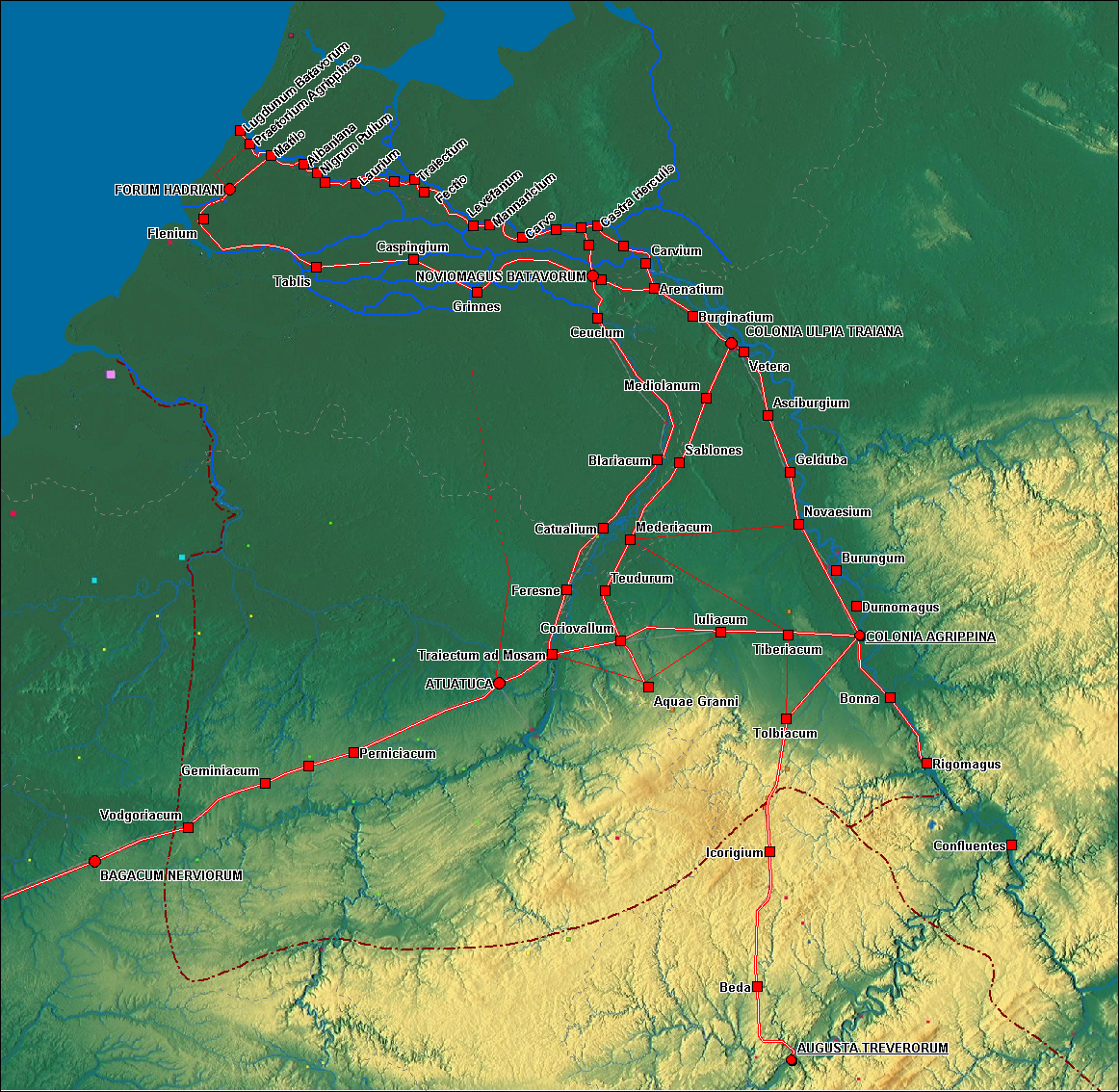
According to Ptolemy (2.9), Germania Inferior included the Rhine from its mouth up to the mouth of the Obringa, a river identified with either the Aar or the Moselle. The territory included modern-day Luxembourg, the southern Netherlands, part of Belgium, and part of North Rhine-Westphalia in Germany, west of the Rhine.
The principal settlements of the province were Castra Vetera, Colonia Ulpia Traiana (both near Xanten), Coriovallum (Heerlen), Albaniana (Alphen aan den Rijn), Lugdunum Batavorum (Katwijk), Forum Hadriani (Voorburg), Ulpia Noviomagus Batavorum (Nijmegen), Traiectum (Utrecht), Atuatuca Tungrorum (Tongeren), Bona (Bonn), and Colonia Agrippinensis (Cologne), the provincial capital.
History
Main article: Germani cisrhenani

Despite largely being occupied by Roman forces since the reign of Augustus, Germania Inferior was not integrated as a province until the reign of Domitian (r. 81-96 AD), ca. 85 AD. The province was split from Gallia Belgica following campaigns against the Chatti from 83-85 AD. This expansion led to the creation of two new imperial provinces, Germania Superior and Germania Inferior (Upper & Lower Germany respectively), known together as Germani Cisrhenani. The capitol of Germania Inferior was located at the city of Colonia Claudia Ara Agrippinensium, modern-day Cologne. The adjective Inferior refers to its position downstream of the Rhine relative to Germania Superior.
The army of Germania Inferior, typically shown on inscriptions as EX.GER.INF. (Exercitus Germaniae Inferioris), included several legions at various times: of these, Legions I Minervia and XXX Ulpia Victrix were the most permanent. The Roman Navy's Classis Germanica (Germanic fleet), charged with patrolling the Rhine and the North Sea coast, were based at Castra Vetera and later at Colonia Claudia Ara Agrippinensis.
As attested in the early 5th century document Notitia Dignitatum, the province was renamed Germania Secunda (Germania II) in the 4th century. It was administered by a consularis and formed part of the Diocese of Gaul. Up to the end of Roman control, it was an intensely garrisoned province that was inhabited by Romans and Ripuarian Franks in the 5th century. Its capital remained at Colonia Claudia Ara Agrippinensium, which also became the seat of a Christian bishopric, which was in charge of an ecclesiastical province that survived the fall of the Western Roman Empire.
After the final abandonment of the province it became the core of the Frankish Kingdom.
References
Bibliography
- Bechert, Tilmann (2007). Germania inferior. Eine Provinz an der Nordgrenze des Römischen Reiches [Germania inferior. A province on the northern frontier of the Roman Empire]. Mainz: Zabern, .
References
- [https://books.google.com/books?id=P4LZM4qKIRkC&pg=RA2-PA10 "Obringa"] in Bruzen la Martiniere, ''Le Grand Dictionnaire Geographique'' Volume 6, 1737; Albert Forbiger, ''Handbuch Der Alten Geographie'' Volume 3, Mayer und Wigand, 1848, [https://books.google.com/books?id=AvwoAAAAYAAJ&pg=PA127 fn (***) p. 126f.]
- Carroll, Maureen. (2002). "Romans, Celts & Germans: the German provinces of Rome". Tempus Publ.
This article was imported from Wikipedia and is available under the Creative Commons Attribution-ShareAlike 4.0 License. Content has been adapted to SurfDoc format. Original contributors can be found on the article history page.
Ask Mako anything about Germania Inferior — get instant answers, deeper analysis, and related topics.
Research with MakoFree with your Surf account
Create a free account to save articles, ask Mako questions, and organize your research.
Sign up freeThis content may have been generated or modified by AI. CloudSurf Software LLC is not responsible for the accuracy, completeness, or reliability of AI-generated content. Always verify important information from primary sources.
Report