From Surf Wiki (app.surf) — the open knowledge base
German Shorthaired Pointer
German breed of dog

German breed of dog
| Field | Value |
|---|---|
| name | German Shorthaired Pointer |
| image | Duitse staande korthaar 10-10-2.jpg |
| image_caption | Dog on point |
| altname | |
| country | Germany |
| maleheight | |
| femaleheight | |
| kc_name | Verband für das Deutsche Hundewesen |
| kc_std | https://www.vdh.de/welpen/mein-welpe/deutsch-kurzhaar |
| fcistd | http://www.fci.be/Nomenclature/Standards/119g07-en.pdf |
The German Shorthaired Pointer or Deutsch Kurzhaar is a German breed of continental pointing dog of Braque type. It originated in the nineteenth century in what is now Germany. It is of medium size, and is an all-purpose gun dog suitable for hunting and retrieving on both land and water. It may also be kept as a companion dog.
History
The pointing dog breeds of Europe all derive from the now-extinct Old Spanish Pointer, which spread through France and the Low Countries and reached the princely houses of the German-speaking world, where at first they were used in bird-hunting with nets or falcons, and later by huntsmen with guns. Bird dogs were also brought from England; , in his Aufrichtiger Lehrprinz of 1751, describes these as taller and stronger than the local type. In the nineteenth century large numbers of dogs of Burgos Pointing Dog type were brought to Germany. In the early part of that century, the resulting mixed population had no specific name – the dogs were called Hühnerhunde ('bird dogs') or Jagdhunde ('hunting dogs').
In 1878, at the annual dog show of the Verein zur Veredelung der Hunderassen in Frankfurt am Main, it was agreed that breed standards for German dogs would be established at the show to be held in Hannover in 1879; standards for both the Deutsch Kurzhaar and the Deutsch Langhaar were introduced in that year. The first stud-book for the Kurzhaar was published in 1897.
The Kurzhaar was definitively accepted by the Fédération Cynologique Internationale in 1954. In 2013, it was in twenty-second place on a list of the most-registered dog breeds worldwide. In the fifteen years from 2007 to 2021, the annual number of new registrations in Germany averaged about , with a low of and a high of .
It was recognised by the American Kennel Club in 1930; a three-year-old dog of this breed was classed "best in show" at the Westminster Kennel Club Dog Show in 2016.
Characteristics
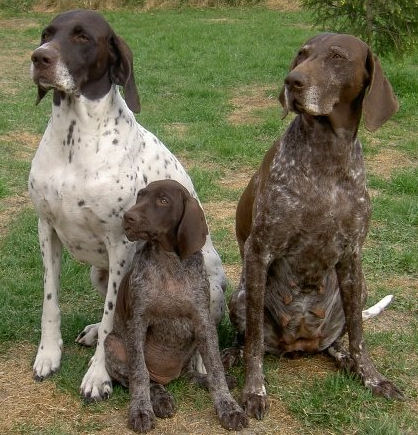

The German Shorthaired Pointer is of medium size: dogs stand some at the withers, bitches some 3 or 4 cm less. The coat is dense, short and rough-textured. It may be either brown or black, in any of three patterns: the solid-coloured, either with or without small flecks of white on the chest and legs; the white, with coloured head and coloured flecks or patches on the body; and the roan, either dark – in which coloured hairs predominate over white – or light, in which there are more white than coloured hairs.
The head is of moderate size, with a convex profile and a long, broad, and strong muzzle suitable for carrying game; the eyes are brown, the ears are rounded and set on high, and hang close to the head. Where not prohibited, the tail of a working dog may be docked to about half its length; it is carried roughly horizontally when the dog is moving and hangs down when it is at rest.
It is a tough, healthy dog. A 2024 UK study found a median longevity of 13.4 years for the breed, slightly above the average of 12.5 for all dogs. The breed has some genetic predisposition to neurological diseases including coccygeal muscle injury, GM2 gangliosidosis, hemivertebrae, pyogranulomatous meningoencephalomyelitis and sensory neuropathy. Other disorders associated with the breed include cataract, cranial cruciate ligament rupture, eversion of the cartilage of the nictitating membrane, hereditary lupoid dermatosis, progressive retinal atrophy, nasal carcinoma, oropharyngeal neoplasia, Von Willebrand's disease and XX sex reversal.
Uses
The German Shorthaired Pointer was bred to be a versatile all-round gun dog. It is capable of working in all weathers, on all terrains and in all types of cover; of finding and pointing to game, whether feathered or furred; of retrieving gently both in water and on land; of following a blood trail to find wounded game; and of defending against poachers and predators. Registration is subject to successful completion of a working trial.
In addition to hunting and field trials, German Shorthaired Pointer performs well in many dog sports such as agility, dock diving, and obedience. German Shorthaired Pointers are also used in law enforcement for nosework, such as the detection of illicit substances.
References
References
- Club, American Kennel. "German Shorthaired Pointer History & Training/Temperament".
- Sole, Sarah. (4 February 2019). "New K-9 Amigo has nose for law enforcement". GateHouse Media, LLC.
- D. Parra, S. Méndez, J. Cañón, S. Dunner (2008). [https://onlinelibrary.wiley.com/doi/epdf/10.1111/j.1365-2052.2007.01658.x Genetic differentiation in pointing dog breeds inferred from microsatellites and mitochondrial DNA sequence]. ''Animal Genetics''. '''39''' (1): 1-7. {{doi. 10.1111/j.1365-2052.2007.01658.x. {{subscription required>
- [https://web.archive.org/web/20240804085626/https://www.akc.org/dog-breeds/german-shorthaired-pointer/ German Shorthaired Pointer]. New York: American Kennel Club. Archived 4 August 2024.
- C. Bede Maxwell (1983 [1963]). [https://archive.org/details/newgermanshortha0000maxw/page/n13 ''The New German Shorthaired Pointer''], fourth edition. New York: Howell Book House. {{isbn. 0876051573.
- [https://www.fci.be/en/nomenclature/GERMAN-SHORT-HAIRED-POINTING-DOG-119.html FCI breeds nomenclature: Deutsch Kurzhaar (119)]. Thuin, Belgium: Fédération Cynologique Internationale. Accessed June 2024.
- [http://www.fci.be/Nomenclature/Standards/119g07-en.pdf FCI-Standard N° 119: Deutsch Kurzhaar (German Shorthaired Pointing Dog)]. Thuin, Belgium: Fédération Cynologique Internationale. Accessed June 2024.
- Gabriele Lehari (2013 [2009]). ''400 Hunderassen von A - Z'' (third edition, in German). Stuttgart (Hohenheim): Eugen Ulmer KG. {{isbn. 9783800178827.
- 9781405107488.
- 9783440067529.
- Carl von Heppe (1751). [https://archive.org/details/bub_gb_BvU6AAAAcAAJ/page/17/mode/1up ''Aufrichtiger Lehrprinz oder practische Abhandlung von dem Leithund als dem Fundament der edlen hirschgerechten Jaegerey''] (in German). Augspurg: Bey Johann Jacob Lotter sel. Erben.
- 9781119062042.
- [Svenska Kennelklubben] (2013). [https://web.archive.org/web/20221216042611/http://newsletter15.dogdotcom.be/en/skk.aspx Registration figures worldwide – from top thirty to endangered breeds]. ''FCI Newsletter'' 15. Thuin, Belgium: Fédération Cynologique Internationale. Archived 16 December 2022.
- Kirsten M. McMillan, Jon Bielby, Carys L. Williams, Melissa M. Upjohn, Rachel A. Casey, Robert M. Christley (2024). [https://www.ncbi.nlm.nih.gov/pmc/articles/PMC10834484/pdf/41598_2023_Article_50458.pdf Longevity of companion dog breeds: those at risk from early death]. ''Scientific Reports''. '''14''' (1): 531. {{doi. 10.1038/s41598-023-50458-w. {{issn. 2045-2322. {{open access
- [https://web.archive.org/web/20230221074607/https://www.vdh.de/ueber-den-vdh/welpenstatistik/?go=Go&sort=2011&suche Welpenstatistik] (in German). Dortmund: Verband für das Deutsche Hundewesen. Archived 21 February 2024.
- [https://web.archive.org/web/20231208021043/https://welpen.vdh.de/hunderassen/rasselexikon/ergebnis/deutsch-kurzhaar Deutsch Kurzhaar] (in German). Dortmund: Verband für das Deutsche Hundewesen. Archived 8 December 2023.
- [https://web.archive.org/web/20161105024259/http://www.westminsterkennelclub.org/breed-results/best-in-show/ WKC 2016 Best in Show]. Westminster Kennel Club. Archived 5 November 2016.
This article was imported from Wikipedia and is available under the Creative Commons Attribution-ShareAlike 4.0 License. Content has been adapted to SurfDoc format. Original contributors can be found on the article history page.
Ask Mako anything about German Shorthaired Pointer — get instant answers, deeper analysis, and related topics.
Research with MakoFree with your Surf account
Create a free account to save articles, ask Mako questions, and organize your research.
Sign up freeThis content may have been generated or modified by AI. CloudSurf Software LLC is not responsible for the accuracy, completeness, or reliability of AI-generated content. Always verify important information from primary sources.
Report