From Surf Wiki (app.surf) — the open knowledge base
German East Africa
1885–1918 German colony including modern Tanzania, Burundi and Rwanda
1885–1918 German colony including modern Tanzania, Burundi and Rwanda
| Field | Value |
|---|---|
| native_name | de |
| conventional_long_name | German East Africa |
| common_name | German East Africa |
| national_anthem | de |
| (English: "'Hail to Thee in the Victor's Crown") | |
| [[File:Heil_Dir_Im_Siegerkranz_(old_recording).ogg]] | |
| era | New Imperialism |
| empire | Germany |
| status | Colony |
| status_text | Colony of Germany |
| government_type | |
| year_start | 1885 |
| year_end | 1919 |
| event_start | Established by the DOAG |
| date_start | 27 February |
| event1 | Heligoland–Zanzibar Treaty |
| date_event1 | 1 July 1890 |
| event2 | Maji Maji Rebellion |
| date_event2 | 21 October 1905 |
| event3 | East African campaign |
| date_event3 | 3 August 1914 |
| event4 | Surrender |
| date_event4 | 25 November 1918 |
| event_end | Formal disestablishment |
| date_end | 28 June |
| p1 | German East Africa Company |
| p2 | Sultanate of ZanzibarZanzibar |
| p3 | Kingdom of RwandaRwanda |
| p4 | Kingdom of BurundiBurundi |
| s1 | Tanganyika TerritoryTanganyika |
| s2 | Ruanda-UrundiRuanda-Urundi |
| s3 | Portuguese MozambiqueMozambique |
| today | Burundi |
| Rwanda | |
| Tanzania | |
| Mozambique | |
| title_leader | Emperor |
| leader1 | Wilhelm I |
| year_leader1 | 1885–1888 |
| leader2 | Frederick III |
| year_leader2 | 1888 |
| leader3 | Wilhelm II |
| year_leader3 | 1888–1918 |
| title_deputy | Governor |
| deputy1 | Carl Peters |
| year_deputy1 | 1885–1891 (first) |
| deputy2 | Heinrich Schnee |
| year_deputy2 | 1912–1918 (last) |
| image_flag | Reichskolonialflagge.svg |
| flag_type | Service flag of the Colonial Office |
| image_coat | Wappen Deutsches Reich - Reichsadler 1889.svg |
| symbol_type | Coat of arms of the German Empire |
| image_map | German East Africa 1914.svg |
| image_map_caption | |
| capital | Bagamoyo (1885–1890) |
| Dar es Salaam (1890–1916) | |
| Tabora (1916, temporary) | |
| stat_year1 | 1912 |
| stat_area1 | 384171.648 mi2 |
| stat_year2 | 1912 |
| stat_pop2 | 7,700,000 |
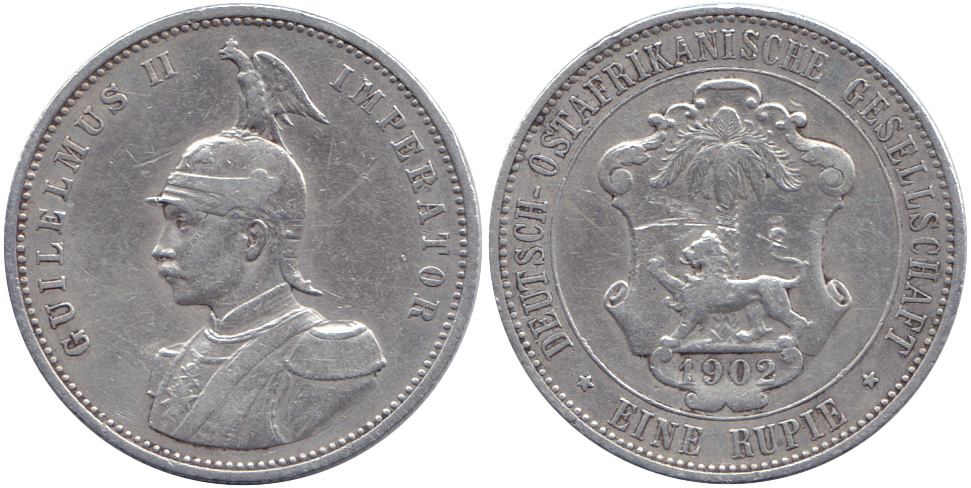
| currency | German East African rupie |
| common_languages | |
| religion | |
| life_span | 1885–1918 |
(English: "'Hail to Thee in the Victor's Crown")
Rwanda Tanzania Mozambique Dar es Salaam (1890–1916) Tabora (1916, temporary)
German East Africa (GEA; DOA) was a German colony in the African Great Lakes region, which included present-day Burundi, Rwanda, the Tanzania mainland, and the Kionga Triangle, a small region later incorporated into Mozambique. GEA's area was 994996 km2, which is nearly three times the area of present-day Germany and almost double the area of metropolitan Germany at the time.
The colony was organised when the German military was asked in the late 1880s to put down a revolt against the activities of the German East Africa Company. It ended with Imperial Germany's defeat in World War I. Ultimately the territory was divided amongst Britain, Belgium and Portugal, and was reorganised as a mandate of the League of Nations.
History
Main article: German East Africa Company, Abushiri revolt
Like other colonial powers, the Germans expanded their empire in the Africa Great Lakes region, ostensibly to explore the region's rich resources and its people. Unlike other imperial powers, however, they never formally abolished either slavery or the slave trade and preferred instead to curtail the production of new "recruits", regulating the existing business of slavery.
The colony began when Carl Peters, an adventurer and the founder of the Society for German Colonization, signed treaties with several native chieftains on the mainland which is opposite Zanzibar. On 3 March 1885, the German government announced that it had granted an imperial charter, which was signed by Chancellor Otto von Bismarck on 27 February 1885. The charter was granted to Peters' company and was intended to establish a protectorate in the African Great Lakes region. Peters then recruited specialists who began exploring south to the Rufiji River and north to Witu, near Lamu on the coast.
The Sultan of Zanzibar protested and claimed that he was the ruler of both Zanzibar and the mainland. Chancellor Bismarck sent five warships which arrived on 7 August 1885, training their guns on the Sultan's palace. The Sultan was forced to accept the German claims on the mainland outside a 10 mi-strip along the coast. In November 1886 Germany and Britain reached an agreement declaring they would respect the sovereignty of the Sultan of Zanzibar over his islands and the 10 mi-strip along the coast. They otherwise agreed on their spheres of interest along what is now the Tanzanian–Kenyan border.No. 123 Agreement between the British and German Governments, respecting the Sultanate of Zanzibar and the opposite East African Mainland, and their Spheres of Influence – 1st November 1886 (in: Map of Africa by Treaty Vol II, pp. 617, 620) https://archive.org/details/mapafricabytrea00britgoog
"3. Both powers agree to establish a delimitation of their respectives spheres of influence on this part of the East African Continent.....
The territory to which the arrangement is applied is bounded on the south by the Rovuma River, and on the North by a line which, starting from the mouth of the Tana River, follows the course of that river or its affluents to the point of intersection with the equator and the 38th degree of east longitude ...."
"Line of Demarcation.
The line of demarcation starts from the mouth of the River Wanga or Umbe, runs direct to Lake Jipe, passes thence along the eastern and round the northern side of the lake and crosses the Lumi River;
Teveita and Chagga (Kilimanjaro District)
After which it passes midway between [sic] the territories of Taveita and Chagga, skirts the northern base of the Kilimanjaro range, and thence is drawn direct to the point on the eastern side of Lake Victoria Nyanza which is intersected by the 1st degree of south latitude" The British and Germans agreed to divide the mainland between themselves, and the Sultan had no option but to agree.
German rule was established quickly over Bagamoyo, Dar es Salaam, and Kilwa. Oscar Baumann was sent to explore Masailand and Urundi. During his expedition he discovered the source of the Kagera river, the Alexandra Nile. The caravans of Tom von Prince, Wilhelm Langheld, Emin Pasha, and Charles Stokes were sent to dominate "the Street of Caravans". The Abushiri Revolt of 1888 was put down with British help the following year. In 1890, London and Berlin concluded the Heligoland–Zanzibar Treaty, which gave Heligoland to Germany and decided the border between GEA and the East Africa Protectorate controlled by Britain, although the exact boundaries remained unsurveyed until 1910.
The stretch of border between Kenya and Tanganyika, running from the sea to Lake Victoria, was surveyed by two British brothers: Charles Stewart Smith (British Consul at Mombasa) and his younger brother George Edward Smith (an officer and later a general with the Royal Engineers). Stewart Smith had been appointed British Commissioner in 1892 for the delimitation of the Anglo-German Boundary in Africa, and in the same year they both surveyed the 180 mi line from the sea to Mount Kilimanjaro. Twelve years later George Edward Smith returned to complete the survey of the remaining 300 mi from Kilimanjaro to Lake Victoria.

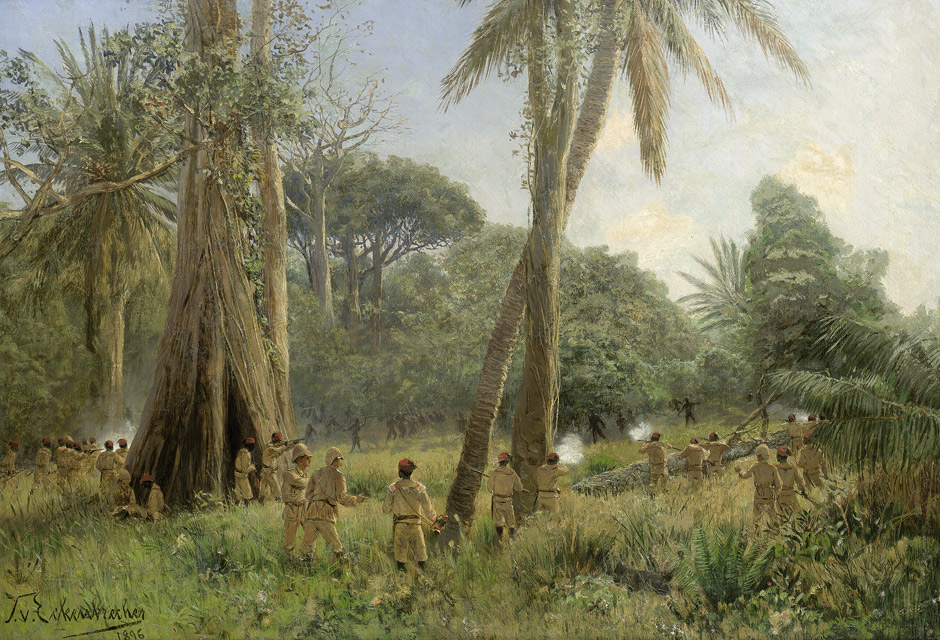
The German expansion was undertaken by military groups such as the notorious Wissmann Truppe, armed with modern weaponry. The Wissmann Truppe consisted of African soldiers led by German commanders. Under their command the Wissmann Truppe committed widespread atrocities. Between 1891 and 1894, the Hehe people which were led by Chief Mkwawa resisted German expansion. They were defeated because rival tribes supported the Germans. After years of guerrilla warfare, Mkwawa was cornered and committed suicide in 1898.
The colonial expansion led by Carl Peters came with considerable violence against the local populations. Carl Peters was infamous for his brutality, which had earned him the nickname "Mkono-wa-damu", or "Man with the blood-stained hands". He was known for leaving a path of destruction in his wake during his conquests, leaving entire villages slaughtered. Peters was also known for keeping a "harem" of local women, who would be completely at the mercy of Peters. In one instance, he had a woman flogged daily on suspicion of having sexual relations with another native. The native in question was hanged.
Other atrocities included rape, floggings and torture with iron rods. Flogging was so excessive that the German colonies were known by other European powers as the "flogging colonies".
These widespread atrocities caused several uprisings in the German colonies. The Maji Maji Rebellion occurred in 1905 and was put down by Governor Gustav Adolf von Götzen, who ordered measures to create a famine to crush the resistance. It may have cost as many 300,000 lives. Scandal followed with allegations of corruption and brutality. In 1907, Chancellor Bernhard von Bülow appointed Bernhard Dernburg to reform the colonial administration.

German colonial administrators relied heavily on native chiefs to keep order and collect taxes. By 1 January 1914, not including local police, the military garrisons of the Schutztruppen (protective troops) in Dar es Salaam, Moshi, Iringa, and Mahenge numbered 110 German officers (including 42 medical officers), 126 non-commissioned officers, and 2,472 Askari (native enlisted men).
Economic development
Germans promoted commerce and economic growth. Over 100000 acre were put under sisal cultivation which was the largest cash crop. Two million coffee trees were planted, rubber trees grew on 200000 acre, and there were large cotton plantations.
In the early years of the colony, hunting and gathering remained the basis of the export economy, and ivory and wild rubber were major exports. The African-owned plantations along the coast, on the other hand, suffered from the gradual abolition of slavery. The number of European-owned plantations rose steadily, but many of them proved unprofitable. Global markets for commodities like coffee and rubber were very unstable, and the soil and climate were not always favourable to the grower. It was only in sisal that the large plantations finally found a reliable source of income. Under the governorship of Albrecht von Rechenberg, from 1906 to 1912, the colonial administration began to place more emphasis on the economic potential of African small-holder agriculture, for which railway construction was an essential precondition. In his detailed study of the economic development of the colony, Rainer Tetzlaff came to the conclusion that "German East Africa never achieved any real significance for the German Empire, neither as a colony for the settlement of emigrants, nor as a supplier of raw materials, nor as a market for exports."
One of the great impediments to the development of plantation agriculture was the labour problem. The plantations could not function without a large African workforce, but employment conditions were often poor, not to say life-threatening. Local German officials frequently colluded with European landowners in forcing Africans to work on the plantations, although the government in Berlin had banned any form of forced labour. The various labour ordinances promulgated in Dar es Salaam were largely ignored in the interior. The social and economic impacts of large-scale labour migration on "labour reservoirs" such as Unyamwezi and Usukuma were often devastating.
Beginning in 1888 the Usambara Railway was built from Tanga to Moshi to bring these agricultural products to market. The Central Railroad covered 775 mi and linked Dar es Salaam, Morogoro, Tabora, and Kigoma. The final link to the eastern shore of Lake Tanganyika was completed in July 1914 and was cause for a huge and festive celebration in the capital with an agricultural fair and trade exhibition. Harbor facilities were built or improved with electrical cranes, with rail access and warehouses. Wharves were remodeled at Tanga, Bagamoyo, and Lindi. After 1891, the German colonial administration undertook efforts to overhaul the region's caravan routes, which had existed before European colonisation, into all-weather highways, although most of these projects proved to be unsuccessful and ended in failure.
In 1912, Dar es Salaam and Tanga received 356 freighters and passenger steamers and over 1,000 coastal ships and local trading-vessels. Dar es Salaam became the showcase city of all of tropical Africa. By 1914, Dar es Salaam and the surrounding province had a population of 166,000, among them 1,000 (0.6%) Germans. In all of the GEA, there were 3,579 Germans.
Gold mining in Tanzania in modern times dates back to the German colonial period, beginning with gold discoveries near Lake Victoria in 1894. The Kironda-Goldminen-Gesellschaft established one of the first gold mines in the colony, the Sekenke Gold Mine, which began operation in 1909 after the finding of gold there in 1907.
Slavery
In German Tanganyika, slavery was gradually phased out. New enslavement and commercial slave trade was banned in 1901, but private slave sales were not banned, and thousands of slaves, mostly women, were sold during 1911–1914; all slaves born after 1905 were born free; slaves who had been subjected to abuse were freed; slaves were permitted to ransom and buy their freedom, and thousand of slaves bought their freedom or left their enslavers when the Germans did not act to prevent them. In 1914, the Germans contemplated to ban slavery, but ultimately did not, since they did not consider it financially possible to compensate their owners.
Education
Germany developed an educational program for Africans that included elementary, secondary, and vocational schools. In 1924, ten years after the beginning of the First World War and six years into British rule, the visiting American Phelps-Stokes Commission reported, "In regards to schools, the Germans have accomplished marvels. Some time must elapse before education attains the standard it had reached under the Germans. Instructor qualifications, curricula, textbooks, teaching materials, all met standards unmatched anywhere in tropical Africa."
The Swahili word for school, shule, is derived from the German word Schule.
Population on the eve of World War I
In the most populous colony of the German Empire, there were more than 7.5 million locals. About 30% were Muslim and the remainder belonged to various tribal beliefs or Christian converts, compared to around 10,000 Europeans, who resided mainly in coastal locations and official residences. In 1913, only 882 German farmers and planters lived in the colony. Approximately 70,000 Africans worked on the plantations of GEA.
World War I
Main article: East African campaign (World War I)

General Paul von Lettow-Vorbeck had served in German South West Africa and Kamerun. He led the German forces in GEA during World War I. His military force consisted of 3,500 Europeans and 12,000 native Askaris and porters. The war strategy was to harry the British army of 40,000, which was at times commanded by the former Second Boer War commander Jan Smuts. One of Lettow-Vorbeck's greatest victories was at the Battle of Tanga (3–5 November 1914). In the battle, the German forces defeated a British force, which was more than eight times larger.
Lettow-Vorbeck's guerrilla warfare compelled Britain to commit significant resources to a minor colonial theatre throughout the war and inflicted more than 10,000 casualties. Eventually, the weight of numbers, especially after forces coming from the Belgian Congo had attacked from the west (Battle of Tabora), and dwindling supplies forced Lettow-Vorbeck to abandon the colony. He withdrew south into Portuguese Mozambique and then into Northern Rhodesia, where he agreed to a ceasefire after he had received news of the armistice between the warring nations three days earlier.
Currency had to be printed locally due to a significant lack of provisions resulting from the naval blockade.}}
After the war, Lettow-Vorbeck was acclaimed as one of Germany's heroes. His Schutztruppe was celebrated as the only colonial German force during World War I that was not defeated in open combat, but it often retreated when it was outnumbered. The Askari colonial troops who had fought in the East African campaign were later given pension payments by the Weimar Republic and West Germany.
The SMS Königsberg, a German light cruiser, also fought off the coast of the African Great Lakes region. She was eventually scuttled in the Rufiji delta in July 1915 after running low on coal and spare parts and was subsequently blockaded and bombarded by the British. The surviving crew stripped out the remaining ship's guns, mounted them on gun carriages, and joined the land forces, which added considerably to their effectiveness.

Another smaller campaign was conducted on the shores of southern Lake Tanganyika in 1914 and 1915. It involved a makeshift British and Belgian flotilla and the Reichsheer garrison at Bismarckburg (modern-day Kasanga).
Break-up of the colony
The Supreme Council of the 1919 Paris Peace Conference awarded all of German East Africa (GEA) to Britain on 7 May 1919, over the strenuous objections of Belgium. The British colonial secretary, Alfred Milner, and Belgium's minister plenipotentiary to the conference, , then negotiated the Anglo-Belgian agreement of 30 May 1919 where Britain ceded the north-western GEA districts of Ruanda and Urundi to Belgium. The conference's Commission on Mandates ratified this agreement on 16 July 1919. The Supreme Council accepted the agreement on 7 August 1919.
On 12 July 1919, the Commission on Mandates agreed that the small Kionga Triangle south of the Rovuma River would be given to Portugal; it eventually became part of independent Mozambique. The commission reasoned that Germany had virtually forced Portugal to cede the triangle in 1894.
The Treaty of Versailles was signed on 28 June 1919, although the treaty did not take effect until 10 January 1920. On that date, the GEA was transferred officially to Britain, Belgium, and Portugal. Also on the same day, "Tanganyika" became the name of the British territory.
German placenames
Some names in German East Africa continued to bear German spellings of the local names for a while, such as "Udjidji" for Ujiji and "Kilimandscharo" for Mount Kilimanjaro, "Kleinaruscha" for Arusha-Chini and "Neu-Moschi" for the city now known as Moshi. (Kigoma was known for a time as "Rutschugi".)
Many places were given African names or had their previous names reestablished:
- Alt Langenburg (Ikombe)
- Bergfrieden (Mibirizi)
- Bismarckburg (Kasanga) on the south-eastern end of Lake Tanganyika
- Emmaberg (Ilembule)
- Fischerstadt (Rombo)
- Friedberg (Nyakanazi)
- Gottorp or Neu-Gottorp (Uvinza) near the northeastern end of Lake Tanganyika
- Hohenfriedeberg (Mlalo)
- Hoffnungshöh (Kisarawe)
- Kaiseraue (Kazimzumbwi)
- Kirondathal (Kirondatal) gold mine
- Langenburg and Neu-Langenburg (Tukuyu) north of Lake Nyasa
- Leudorf (Liganga)
- Mariahilf (Igulwa)
- Marienthal (Ushetu)
- Neu-Bethel (Mnazi)
- Neu-Bonn (Mikese)
- Neu-Hornow (Shume) in the Pare Mountains in the northeast
- Neu-Langenburg (Lumbira)
- Neu-Trier (Mbulu)
- Peterswerft (Nansio)
- Sachsenwald (Sekenke) gold mine
- St. Moritz (Galula)
- Sphinxhafen (Liuli) on the eastern shore of Lake Nyasa
- Wiedhafen (Manda) on the eastern shore of Lake Nyasa
- Wilhelmstal or Wilhelmsdorf (Lushoto) on the Pangani River in the northeast
- Wißmannhafen, port of Bismarckburg (Kasanga) on the southeastern end of Lake Tanganyika
List of governors
The Imperial High Commissioners () and Imperial Governors () of German East Africa:
[[Reichskommissar]] (1885/1888–1891)
- 1888–1891: Hermann Wissmann
- Carl Peters, as sometimes claimed, was never Reichskommissar for German East Africa, but administrator from 27 May 1885 to 8 February 1888. On 18 March 1891, Dr. Peters was named "Reichskommissar for the Kilimanjaro Region" in Moshi, however subordinate to governor Freiherr von Soden. In 1892, he was recalled and returned to Germany. After three investigations, in 1897, he was officially deprived of his commission with the loss of his title and his pension rights. However, in 1905 Kaiser Wilhelm II awarded him the title of "retired Reichskommissar" and from 1914 he also received an annual pension.
Imperial Governors (1891–1918)
- 1891–1893: Julius von Soden
- 1893–1895: Friedrich von Schele
- 1895–1896: Hermann Wissmann
- 1896–1901: Eduard von Liebert
- 1901–1906: Gustav Adolf von Götzen
- 1906–1912: Albrecht von Rechenberg
- 1912–1918: Heinrich Schnee
Archived records
The administration of German East Africa from 1884 to 1917 is documented in a set of records now held by the Tanzania National Archives. In 1997, these German records were inscribed by UNESCO in its Memory of the World International Register, recognising them as documents of global importance.
Maps
File:German East Africa MKL Bd. 14 1890 (128624470).jpg|Historical map of the German East African coast, 1890 File:Deutsch Ost-Afrika,1892.jpg|Historical map of German East Africa, 1892 File:1911GermanEastAfrica.png|Historical map of German East Africa, 1911 File:World War I in East Africa.jpg|Map of the East African Theater in World War I
Gallery
|File:Bundesarchiv Bild 105-DOA0876, Deutsch-Ostafrika, Sisalfabrik.jpg|Sisal factory, |File:Bundesarchiv Bild 105-DOA3056, Deutsch-Ostafrika, Askarikompanie.jpg|Askari company, |File:Bundesarchiv Bild 105-DOA0184, Deutsch-Ostafrika, Wuga, Schule.jpg|Classroom in a German East African school, ||Usambara Railway, built in German East Africa |File:Bundesarchiv Bild 105-DOA3114, Deutsch-Ostafrika, Reiter zu Pferd.jpg|German colonial volunteer mounted patrol, 1914
Planned symbols for German East Africa
Main article: Armorial of Germany#Colonies
In 1914, a series of drafts were made for proposed coats of arms and flags for the German colonies. However, World War I broke out before the designs were finished and implemented, and the symbols were never actually used. Following its defeat in the war, Germany lost all its colonies and the prepared coats of arms and flags as a result were never used. Proposed Flag of German East Africa.svg|Proposed flag Proposed Coat of Arms East Africa 1914.svg|Proposed coat of arms
References
References
- Michael Pesek: ''Das Ende eines Kolonialreiches.'' Campus, Frankfurt a. M./New York 2010, ISBN 978-3-593-39184-7, S. 86/90.
- Roland Anthony Oliver. (1976). "History of East Africa, Volume 2". [[Clarendon Press]].
- (1965). "German Africa: A Selected Annotated Bibliography". [[Hoover Institution.
- Jan-Georg Deutsch. (2006). "Emancipation without Abolition in German East Africa, C. 1884–1914". [[James Currey]].
- Arne Perras. (2004). "Carl Peters and German Imperialism 1856-1918: A Political Biography". [[Clarendon Press]].
- Hartmut Pogge von Strandmann. (February 1969). "Domestic Origins of Germany's Colonial Expansion under Bismarck". [[Past & Present (journal).
- (1998). "The Imperialist Imagination: German Colonialism and Its Legacy". [[University of Michigan Press]].
- Dirk Göttsche. (2013). "Remembering Africa: The Rediscovery of Colonialism in Contemporary German Literature". [[Camden House]].
- James S. Olson. (1991). "Historical Dictionary of European Imperialism". [[Greenwood Publishing Group]].
- David R. Gillard. (October 1960). "Salisbury's African Policy and the Heligoland Offer of 1890". [[Oxford University Press]].
- [https://www.repository.cam.ac.uk/handle/1810/310854 ''The Last Time''] {{Webarchive. link. (13 August 2021 , Stewart Smith, J. (2019). ''The last time: memoirs of a colonial officer in Nigeria and the Southern Cameroons'', free ebook version via Cambridge University Centre for African Studies p. 36)
- "How East Africans countered German colonial repression – DW – 01/23/2024".
- Alison Redmayne. (1968). "Mkwawa and the Hehe Wars". [[The Journal of African History]].
- Davis, Christian S., Colonialism, Antisemitism, and Germans of Jewish Descent in Imperial Germany, University of Michigan Press, Ann Arbor, p. 1, 2012
- Iliffe, John. (1967). "The Organization of the Maji Maji Rebellion". [[The Journal of African History]].
- Iliffe, John. (1979). "A Modern History of Tanganyika". Cambridge University Press.
- Hull, Isabel V.. (2003). "The Specter of Genocide: Mass Murder in Historical Perspective". Cambridge University Press.
- John S. Lowry. (June 2006). "African Resistance and Center Party Recalcitrance in the Reichstag Colonial Debates of 1905/06". [[Central European History]].
- Walter Nuhn. (1998). "Flammen über Deutschost: der Maji-Maji-Aufstand in Deutsch-Ostafrika 1905–1906, die erste gemeinsame Erhebung schwarzafrikanischer Völker gegen weisse Kolonialherrschaft: ein Beitrag zur deutschen Kolonialgeschichte". [[Bernard & Graefe]].
- Werner Haupt. (1984). "Deutschlands Schutzgebiete in Übersee 1884–1918". Podzun-Pallas Verlag.
- BRODE, H.. (2016). "BRITISH AND GERMAN EAST AFRICA: their economic commercial relations (classic reprint)". FORGOTTEN BOOKS.
- "(HIS,P) Deutscher Kolonial-Atlas mit Jahrbuch (Atlas German Colonies, with Yearbook), edited by the German Colonial Society, 1905 - Deutsch-Ostafrika".
- John Iliffe, ''A Modern History of Tanganyika'' (Cambridge: Cambridge University Press, 1979), p.124-138.
- John Iliffe, ''Tanganyika under German Rule, 1905-1912'' (Cambridge: Cambridge University Press, 1969), p.69-81.
- Rainer Tetzlaff, ''Koloniale Entwicklung und Ausbeutung: Wirtschafts- und Sozialgeschichte Deutsch-Ostafrikas, 1885-1914'' (Berlin: Duncker & Humblot, 1970), p.191.
- John Iliffe, ''A Modern History of Tanganyika'' (Cambridge: Cambridge University Press, 1979), p.151-163.
- Juhani Koponen, ''Development for Exploitation: German Colonial Policies in Mainland Tanzania, 1884-1914'' (Helsinki: Tiedekirja; Hamburg: LIT Verlag, 1994), p.321-440.
- Thaddeus Sunseri, ''Vilimani: Labor Migration and Rural Change in Early Colonial Tanzania'' (Portsmouth, NH: Heinemann, 2002).
- John W. East (ed. and trans.), ''[https://www.academia.edu/37559841/The_Labour_Question_in_German_East_Africa_Tanzania_A_Collection_of_Primary_Historical_Sources_Translated_from_the_German The Labour Question in German East Africa (Tanzania): A Collection of Primary Historical Sources Translated from the German]'' (2018).
- (26 October 2022). "Colonial Schemes and African Realities: Vernacular Infrastructure and the Limits of Road Building in German East Africa". [[Journal of African History]].
- Charles Miller. (1974). "''Battle for the Bundu, The First World War in East Africa''". MacMillan Publishing Co., Inc..
- [http://www.tanzaniagold.com/tanzania_mining_history.html Tanzania Mining History] {{webarchive. link. (14 August 2010 tanzaniagold.com, retrieved 24 July 2010)
- Miers, S. (2003). Slavery in the Twentieth Century: The Evolution of a Global Problem. Storbritannien: AltaMira Press. p. 40
- "shule - Swahili-Old High German (ca. 750-1050) Dictionary". Glosbe.
- Längin, Bernd G.. (2005). "Die deutschen Kolonien".
- Edwin P. Hoyt. (1981). "Guerilla: Colonel von Lettow-Vorbeck and Germany's East African Empire". Macmillan.
- Brian M. DuToit. (1998). "The Boers in East Africa: ethnicity and identity". Bergin & Garvey.
- Michael S. Neiberg. (2001). "Warfare in World History". Routledge.
- Paul G. Halpern. (1995). "A naval history of World War I". UCL Press.
- Louis, William Roger. (2006). "Ends of British Imperialism: The Scramble for Empire, Suez, and Decolonization". [[I.B. Tauris]].
- "Papers Relating to the Foreign Relations of the United States, the Paris Peace Conference, 1919". United States Department of State.
- (1991). "Histoire sociale de l'Afrique de l'Est (XIXe-XXe siècle) : actes du colloque de Bujumbura, 17-24 octobre 1989.". Karthala.
- (1888). "Koloniales Jahrbuch". Berlin : C. Heymann.
- Germany. Reichstag. (1871). "Stenographische Berichte über die Verhandlungen des Deutschen Reichstages". Berlin: Verlag der Buchdruckerei der "Norddeutschen Allgemeinen Zeitung".
- (1920). "Deutsches Kolonial-Lexikon".
- Gustav Hermann Meinecke. (1901). "Deutscher kolonial-kalender und statistisches Handbuch...: Nach amtlichen Quellen neu Bearb". Deutscher kolonial -verlag.
- A. J. Dietz. "A postal history of the First World War in Africa and its aftermath - German colonies: II Kamerun". African Studies Centre, Repository, Leiden University.
- "German Records of the National Archives".
This article was imported from Wikipedia and is available under the Creative Commons Attribution-ShareAlike 4.0 License. Content has been adapted to SurfDoc format. Original contributors can be found on the article history page.
Ask Mako anything about German East Africa — get instant answers, deeper analysis, and related topics.
Research with MakoFree with your Surf account
Create a free account to save articles, ask Mako questions, and organize your research.
Sign up freeThis content may have been generated or modified by AI. CloudSurf Software LLC is not responsible for the accuracy, completeness, or reliability of AI-generated content. Always verify important information from primary sources.
Report