From Surf Wiki (app.surf) — the open knowledge base
German collective guilt
none
none
German collective guilt () refers to the contentious notion of a shared, collective responsibility attributed to the German people as a whole for the perpetration of the Holocaust and other atrocities committed by Nazi Germany during World War II.{{cite book |last=Rensmann |first=Lars |editor1=Nyla R. Branscombe |editor2=Bertjan Doosje |title=Collective Guilt: International Perspectives |url=https://books.google.com/books?id=cS5fqn3KJKIC&pg=PR169 |series=Studies in emotion and social interaction. |date=6 September 2004 |publisher=Cambridge University Press |isbn=978-0-521-52083-6 |pages=169–190 |chapter=10 - Collective Guilt, National Identity, and Political Processes in Contemporary Germany |chapter-url=https://www.cambridge.org/core/books/collective-guilt/collective-guilt-national-identity-and-political-processes-in-contemporary-germany/75549360195D96F75B1FF5EC6E8FA1C7
Advocates
Swiss psychoanalyst Carl Jung wrote an influential essay in 1945 about this concept as a psychological phenomenon, in which he asserted that the German people felt a collective guilt (Kollektivschuld) for the atrocities committed by their fellow countrymen, and so introduced the term into German intellectual discourse. Jung said collective guilt was "for psychologists a fact, and it will be one of the most important tasks of therapy to bring the Germans to recognize this guilt."
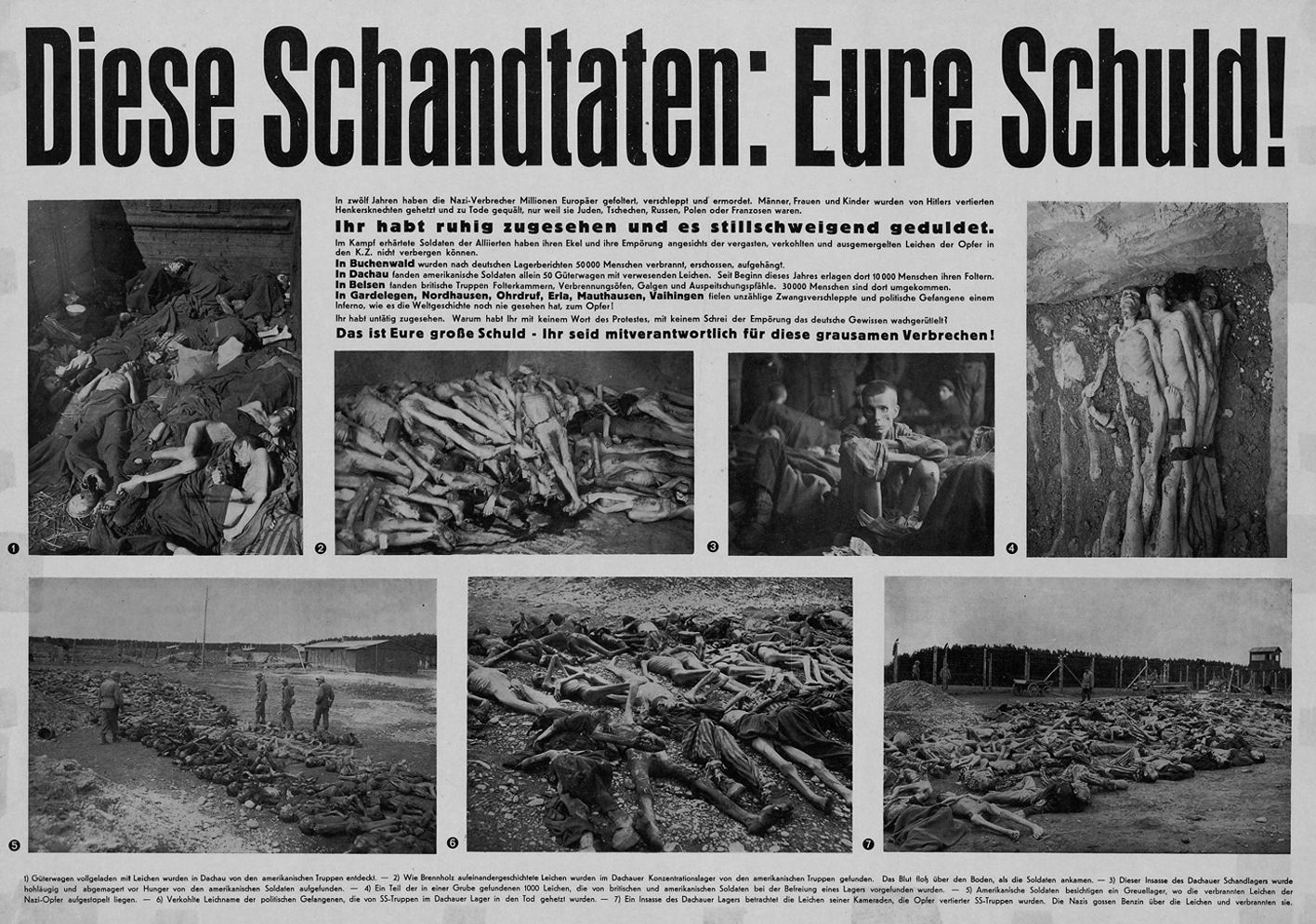
After the war, the Allied occupation forces in Allied-occupied Germany promoted shame and guilt with a publicity campaign, which included posters depicting Nazi concentration camps with slogans such as "These Atrocities: Your Fault!" (Diese Schandtaten: Eure Schuld!).
The theologian Martin Niemöller and other churchmen accepted shared guilt in the Stuttgarter Schuldbekenntnis (Stuttgart Declaration of Guilt) of 1945. The philosopher and psychologist Karl Jaspers delivered lectures to students in 1946 which were published under the title The Question of German Guilt. In this published work, Jaspers describes how "an acknowledgment of national guilt was a necessary condition for the moral and political rebirth of Germany". Additionally, Jaspers believed that no one could escape this collective guilt, and taking responsibility for it might enable the German people to transform their society from its state of collapse into a more highly developed and morally responsible democracy. He believed that those who committed war crimes were morally guilty, and those who tolerated them without resistance were politically guilty, leading to collective guilt for all.
The German collective guilt for the events of the Holocaust has long been an idea that has been pondered by famous and well-known German politicians and thinkers. In addition to those mentioned previously, German author and philosopher Bernhard Schlink describes how he sometimes feels as if being German is a huge burden, due to the country's past. According to Schlink, "the reason the European crisis is so agonising for Germany is that the country has been able to retreat from itself by hurling itself into the European project". Schlink also believes that "the burden of nationality has very much shaped the way in which Germans view themselves and their responsibilities within Europe", and he describes how Germans see themselves as Atlanticists or Europeans, rather than as Germans. Schlink sees this existing guilt becoming weaker from generation to generation. Thomas Mann also advocated for collective guilt:
Opponents
Björn Höcke, leader of the Thuringian state branch of the far-right Alternative for Germany party, has called the Holocaust memorial in Berlin a "monument of shame," and has called for a "180-degree change in memory policy." Höcke's comments were unanimously condemned by media and politicians across the political spectrum. The Buchenwald Memorial Foundation accused Höcke of defaming the public memory of the murdered Jews of Europe; Charlotte Knobloch accused him of "intolerable völkisch agitation", stating that the AfD is poisoning Germany's political culture with "right-wing extremist, racist, and anti-semitic theories and tirades." In response to his comments, the , an activist group, erected a replica of the Berlin Holocaust memorial within sight of Höcke's house.
In January 2025, at a campaign event which was staged by the political party Alternative for Germany, Elon Musk stated that "There is too much focus on past guilt, and we need to move beyond that". Musk's comments were also widely condemned.
References
cs:Kolektivní vina#Kolektivní vina v Německu de:Kollektivschuld#Kollektivschulddebatte zu Krieg und Holocaust
References
- (2019). "Allied Internment Camps in Occupied Germany: Extrajudicial Detention in the Name of Denazification, 1945–1950". Cambridge University Press.
- Muskat, Jörg. (20 August 2015). "Kollektivschuld am Holocaust. Warum das deutsche Volk eine moralische Gesamthaftung an den NS-Verbrechen trifft". GRIN Verlag.
- Jeffrey K. Olick, Andrew J. Perrin. (2010). "Guilt and Defense". Harvard University Press.
- Jeffrey K. Olick. (September 2003). "The Guilt of Nations?". [[Ethics & International Affairs]].
- Tracy Isaacs, Richard Vernon. (2011). "Accountability for Collective Wrongdoing". Cambridge University Press.
- "The Question of German Guilt {{!}} book by Jaspers".
- Connolly, Kate. (2012-09-16). "Bernhard Schlink: being German is a huge burden". The Guardian.
- (2019). "Hitler–Beneš–Tito: National Conflicts, World Wars, Genocides, Expulsions, and Divided Remembrance in East-Central and Southeastern Europe, 1848–2018". [[Austrian Academy of Sciences Press]].
- (18 January 2017). "Germany's Extreme Right Challenges Guilt Over Nazi Past". The New York Times.
- Troianovski, Anton. (2 March 2017). "The German Right Believes It's Time to Discard the Country's Historical Guilt". The Wall Street Journal.
- (26 January 2017). "Höcke bei Gedenktag in Buchenwald unerwünscht". [[Münchner Merkur]].
- (18 January 2017). "Charlotte Knobloch wirft AfD-Politiker 'völkische Hetze' vor". [[Heilbronner Stimme]].
- (22 November 2017). "Höcke soll auf die Knie gehen. Ist das Kunst?". [[Welt Online]].
- (26 January 2017). "Gedenktag für die Opfer des Holocaust: Höcke in Buchenwald unerwünscht". [[Die Tageszeitung.
- Frank, Arno. (2017-11-22). "Aktion des Zentrums für politische Schönheit: Ein Holocaust-Mahnmal – bei Björn Höcke vor der Haustür". [[Spiegel Online]].
- Contreras, Russell. (26 January 2025). "Musk tells far-right Germany AfD party "there's too much focus on past guilt"".
- Osborne, Samuel. (26 January 2025). "Musk urges German far-right supporters to move beyond 'past guilt' in surprise AfD campaign appearance". [[Sky News]].
- Tanno, Sophie. (27 January 2025). "Musk's comments that Germany should 'move beyond' Nazi guilt are dangerous, says Holocaust memorial chair". [[CNN]].
- (2025-01-27). "Elon Musk faces criticism for encouraging Germans to move beyond 'past guilt'". NPR.
This article was imported from Wikipedia and is available under the Creative Commons Attribution-ShareAlike 4.0 License. Content has been adapted to SurfDoc format. Original contributors can be found on the article history page.
Ask Mako anything about German collective guilt — get instant answers, deeper analysis, and related topics.
Research with MakoFree with your Surf account
Create a free account to save articles, ask Mako questions, and organize your research.
Sign up freeThis content may have been generated or modified by AI. CloudSurf Software LLC is not responsible for the accuracy, completeness, or reliability of AI-generated content. Always verify important information from primary sources.
Report