From Surf Wiki (app.surf) — the open knowledge base
Georgism
Economic philosophy centered on common ownership of land
.svg)
Economic philosophy centered on common ownership of land
Georgism, in modern times also called Geoism, and known historically as the single tax movement, is an economic ideology holding that persons should own the value that they produce themselves, while the economic rent derived from land—including from all natural resources, the commons, and urban locations—should belong equally to all members of society. Developed from the writings of American economist and social reformer Henry George, the Georgist paradigm seeks solutions to social and ecological problems based on principles of land rights and public finance that attempt to integrate economic efficiency with social justice.
Georgism is concerned with the distribution of economic rent caused by land ownership, natural monopolies, pollution rights, and control of the commons, including title of ownership for natural resources and other contrived privileges (e.g., intellectual property). Any natural resource that is inherently limited in supply can generate economic rent, but the classical and most significant example of land monopoly involves the extraction of common ground rent from valuable urban locations. Georgists argue that taxing economic rent is efficient, fair, and equitable. The main Georgist policy recommendation is a land value tax (LVT), the revenues from which can be used to reduce or eliminate existing taxes (such as on income, trade, or purchases) that are posited to be unfair and inefficient. Some Georgists also advocate the return of surplus public revenue to the people by means of a basic income or citizen's dividend.
George popularized the concept of gaining public revenues mainly from land and natural resource privileges with his first book, Progress and Poverty (1879). The philosophical basis of Georgism draws on thinkers such as John Locke, Baruch Spinoza, and Thomas Paine. Economists from Adam Smith and David Ricardo to Milton Friedman and Joseph Stiglitz have observed that a public levy on land value does not cause economic inefficiency, unlike other taxes. A land value tax also has progressive effects. Advocates of land value taxes argue that they reduce economic inequality, increase economic efficiency, remove incentives to under-utilize urban land, and reduce property speculation.
Georgist ideas were popular and influential in the late 19th and early 20th centuries. Political parties, institutions, and communities were founded on Georgist principles. Early devotees of George's economic philosophy were often termed Single Taxers for their political goal of raising public revenue mainly or only from a land-value tax, although Georgists endorsed multiple forms of rent capture (e.g. seigniorage) as legitimate. One contemporary and friend of Henry George who advocated strongly for the Single Tax movement, and lectured at related organizations such as the Manhattan Single Tax Club, was Charles Frederic Adams. The term Georgism was invented later, and some prefer the term geoism as more generic.
Main tenets

Henry George is best known for popularizing the argument that government should be funded by a tax on land rent rather than taxes on labor. He believed that although scientific experiments could not be performed in political economy, theories could be tested by comparing different societies with different conditions and by thought experiments about the effects of various factors. Applying this method, he concluded that many societal problems, such as poverty, inequality, and economic booms and busts, can be attributed to private ownership of the necessary resource: land rent. In his most celebrated book, Progress and Poverty, George argues that the appropriation of land rent for private use contributes to persistent poverty in spite of technological progress, and causes economies to tend toward boom-and-bust cycles. According to George, people justly own what they create, but natural opportunities and land belong equally to all.
George believed there is an important distinction between common and collective property. Although equal rights to land might be achieved by nationalizing land and then leasing it to private users, George preferred taxing unimproved land value and leaving the control of land mostly in private hands. His reason for leaving land in private control and slowly shifting to land value tax was that it would not penalize existing owners who had improved land and would also be less disruptive and controversial in a country where land titles have already been granted.
Georgists have observed that privately created wealth is socialized via the tax system (e.g., through income and sales tax), while socially created wealth in land values are privatized in the price of land titles and bank mortgages. The opposite would be the case if land rents replaced taxes on labor as the main source of public revenue; socially created wealth would become available for use by the community, while the fruits of labor would remain private. According to Georgists, a land value tax can be considered a user fee instead of a tax, since it is related to the market value of socially created locational advantage, the privilege to exclude others from locations. Assets consisting of commodified privilege can be considered wealth since they have exchange value, similar to taxi medallions. A land value tax, charging fees for exclusive use of land, as a means of raising public revenue is also a progressive tax tending to reduce economic inequality, since it applies entirely to ownership of valuable land, which correlates with income, and there is generally no means by which landlords can shift the tax burden onto tenants or laborers. Landlords cannot pass the tax on to tenants because the supply and demand of rented land is unchanged. Because the supply of land is perfectly inelastic, land rents depend on what tenants are prepared to pay, rather than on the expenses of landlords, and so the tax cannot be passed on to tenants.
Economic properties
Standard economic theory suggests that a land value tax would be extremely efficient—unlike other taxes, it does not reduce economic productivity. Milton Friedman called George's tax on unimproved land value the "least bad tax", since unlike other taxes, it would not impose an excess burden on economic activity (leading to zero or even negative "deadweight loss"); hence, a replacement of other more "distortionary" taxes with a land value tax would improve economic welfare. Joseph Stiglitz argues that a land value tax can improve the use of land and redirect investment toward productive, non-rent-seeking activities.{{cite report |last1=Stiglitz |first1=Joseph |title= New theoretical perspectives on the distribution of income and wealth among individuals: Part IV: Land and credit |date=May 2015 |url=http://www.nber.org/papers/w21192 |institution=National Bureau of Economic Research |type=Working paper |number=21192 |access-date=2025-02-17}} Because land value tax would apply to foreign land speculators, the Australian Treasury estimated that land value tax was unique in having a negative marginal excess burden, meaning that it would increase long-run living standards.
Adam Smith first noted the efficiency and distributional properties of a land value tax in The Wealth of Nations
Both ground-rents and the ordinary rent of land are a species of revenue which the owner, in many cases, enjoys without any care or attention of his own. Though a part of this revenue should be taken from him in order to defray the expenses of the state, no discouragement will thereby be given to any sort of industry. The annual produce of the land and labour of the society, the real wealth and revenue of the great body of the people, might be the same after such a tax as before. Ground-rents and the ordinary rent of land are, therefore, perhaps, the species of revenue which can best bear to have a peculiar tax imposed upon them. ... Nothing can be more reasonable than that a fund which owes its existence to the good government of the state should be taxed peculiarly, or should contribute something more than the greater part of other funds, towards the support of that government.|author=Adam Smith||source=The Wealth of Nations, Book V, Chapter 2}}
Benjamin Franklin and Winston Churchill made similar distributional and efficiency arguments for taxing land rents. They noted that the costs of taxes and the benefits of public spending always eventually apply to and enrich the owners of land. Therefore, they believed it would be best to defray public costs and recapture value of public spending by applying public charges directly to owners of land titles, rather than harming public welfare with taxes assessed against beneficial activities such as trade and labor.
Henry George wrote that his plan for a high land value tax would cause people "to contribute to the public, not in proportion to what they produce ... but in proportion to the value of natural [common] opportunities that they hold [monopolize]". He went on to explain that "by taking for public use that value which attaches to land by reason of the growth and improvement of the community", it would, "make the holding of land unprofitable to the mere owner, and profitable only to the user".
A high land value tax would discourage speculators from holding valuable natural opportunities (like urban real estate) unused or only partially used. Henry George claimed this would have many benefits, including the reduction or elimination of tax burdens from poorer neighborhoods and agricultural districts; the elimination of a multiplicity of taxes and expensive obsolete government institutions; the elimination of corruption, fraud, and evasion with respect to the collection of taxes; the enablement of true free trade; the destruction of monopolies; the elevation of wages to the full value of labor; the transformation of labor-saving inventions into blessings for all; and the equitable distribution of comfort, leisure, and other advantages that are made possible by an advancing civilization. In this way, the vulnerability that market economies have to credit bubbles and property manias would be reduced.
Sources of economic rent and related policy interventions
Income flow resulting from payments for restricted access to natural opportunities or for contrived privileges over geographic regions is termed economic rent. Georgists argue that economic rent of land, legal privileges, and natural monopolies should accrue to the community, rather than private owners. In economics, "land" is everything that exists in nature independent of human activity. George explicitly included climate, soil, waterways, mineral deposits, laws/forces of nature, public ways, forests, oceans, air, and solar energy in the category of land. While the philosophy of Georgism does not say anything definitive about specific policy interventions needed to address problems posed by various sources of economic rent, the common goal among modern Georgists is to capture and share (or reduce) rent from all sources of natural monopoly and legal privilege.
Henry George shared the goal of modern Georgists to socialize or dismantle rent from all forms of land monopoly and legal privilege. However, George emphasized mainly his preferred policy known as land value tax, which targeted a particular form of unearned income known as ground rent. George emphasized ground-rent because basic locations were more valuable than other monopolies and everybody needed locations to survive, which he contrasted with the less significant streetcar and telegraph monopolies, which George also criticized. George likened the problem to a laborer traveling home who is waylaid by a series of highway robbers along the way, each who demand a small portion of the traveler's wages, and finally at the very end of the road waits a robber who demands all that the traveler has left. George reasoned that it made little difference to challenge the series of small robbers when the final robber remained to demand all that the common laborer had left. George predicted that over time technological advancements would increase the frequency and importance of lesser monopolies, yet he expected that ground rent would remain dominant. George even predicted that ground-rents would rise faster than wages and income to capital, a prediction that modern analysis has shown to be plausible, since the supply of land is fixed.
Spatial rent is still the primary emphasis of Georgists because of its large value and the known dis-economies of misused land. However, there are other sources of rent that are theoretically analogous to ground-rent and are debated topics of Georgists. The following are some sources of economic rent.
- Extractable resources (minerals and hydrocarbons)
- Severables (forests and stocks of fish)
- Extraterrestrial domains (geosynchronous orbits and airway corridor use)
- Legal privileges that apply to specific location (taxi medallions, billboard and development permits, or the monopoly of electromagnetic frequencies)
- Restrictions/taxes of pollution or severance (tradable emission permits and fishing quotas)
- Right-of-way (transportation) used by railroads, utilities, and internet service providers
- Issuance of legal tender (see seigniorage)
- Privileges that are less location dependent but that still exclude others from natural opportunities (patents)
Where free competition is impossible, such as telegraphs, water, gas, and transportation, George wrote, "[S]uch business becomes a proper social function, which should be controlled and managed by and for the whole people concerned." Georgists were divided by this question of natural monopolies and often favored public ownership only of the rents from common rights-of-way, rather than public ownership of utility companies themselves.
Georgism and environmental economics
The early conservationism of the Progressive Era was inspired partly by Henry George, and his influence extended for decades afterward. Some ecological economists still support the Georgist policy of land value tax as a means of freeing or rewilding unused land and conserving nature by reducing urban sprawl.
Pollution degrades the value of what Georgists consider to be commons. Because pollution is a negative contribution, a taking from the commons or a cost imposed on others, its value is economic rent, even when the polluter is not receiving an explicit income. Therefore, to the extent that society determines pollution to be harmful, most Georgists propose to limit pollution with taxation or quotas that capture the resulting rents for public use, restoration, or a citizen's dividend.
Georgism is related to the school of ecological economics, since both propose market-based restrictions for pollution. The schools are compatible in that they advocate using similar tools as part of a conservation strategy, but they emphasize different aspects. Conservation is a central issue of ecology, whereas economic rent is the central issue of geoism. Ecological economists might price pollution fines more conservatively to prevent inherently unquantifiable damage to the environment, whereas Georgists might emphasize mediation between conflicting interests and human rights. Geolibertarianism, a market-oriented branch of Geoism, tends to take a direct stance against what it perceives as burdensome regulation and would like to see auctioned pollution quotas or taxes replace most command and control regulation.
Since ecologists are primarily concerned with conservation, they tend to emphasize less the issue of equitably distributing scarcity/pollution rents, whereas Georgists insist that unearned income not accrue to those who hold title to natural assets and pollution privilege. To the extent that geoists recognize the effect of pollution or share conservationist values, they will agree with ecological economists about the need to limit pollution, but geoists will also insist that pollution rents generated from those conservation efforts do not accrue to polluters and are instead used for public purposes or to compensate those who suffer the negative effects of pollution. Ecological economists advocate similar pollution restrictions but, emphasizing conservation first, might be willing to grant private polluters the privilege to capture pollution rents. To the extent that ecological economists share the geoist view of social justice, they would advocate auctioning pollution quotas instead of giving them away for free. This distinction can be seen in the difference between basic cap and trade and the geoist variation, cap and share, a proposal to auction temporary pollution permits, with rents going to the public, instead of giving pollution privilege away for free to existing polluters or selling perpetual permits.
Revenue uses
The revenue can allow the reduction or elimination of taxes, greater public investment/spending, or the direct distribution of funds to citizens as a pension or basic income/citizen's dividend.
In practice, the elimination of all other taxes implies a high land value tax, greater than any currently existing land tax. Introducing or increasing a land value tax would cause the purchase price of land to decrease. George did not believe landowners should be compensated and described the issue as being analogous to compensation for former slave owners. Other geoists disagree on the question of compensation; some advocate complete compensation while others endorse only enough compensation required to achieve Georgist reforms. Some geoists advocate compensation only for a net loss due to a shift of taxation to land value; most taxpayers would gain from the replacement of other taxes with a tax on land value. Historically, those who advocated for taxes on rent tax only great enough to replace other taxes were known as endorsers of single tax limited.
Synonyms and variants

Most early advocacy groups described themselves as single taxers and George reluctantly accepted the single tax as an accurate name for his main political goal—the repeal of all unjust or inefficient taxes, to be replaced with a land value tax (LVT).
Some modern proponents are dissatisfied with the name Georgist. While Henry George was well known throughout his life, he has been largely forgotten by the public and the idea of a single tax of land predates him. Some now prefer the term geoism, with geo (from Greek γῆ gē "earth, land") being the first compound of the name George
Compulsory fines and fees related to land rents are the most common Georgist policies, but some geoists prefer voluntary value capture systems that rely on methods such as non-compulsory or self-assessed location value fees, community land trusts and purchasing land value covenants. Some geoists believe that partially compensating landowners is a politically expedient compromise necessary for achieving reform. For similar reasons, others propose capturing only future land value increases, instead of all land rent.
Some libertarians and minarchists take the position that limited social spending should be financed using Georgist concepts of rent value capture, but that not all land rent should be captured. Today, this relatively conservative adaptation is usually considered incompatible with true geolibertarianism, which requires that excess rents be gathered and then distributed back to residents. During George's time, this restrained Georgist philosophy was known as "single tax limited", as opposed to "single tax unlimited." George disagreed with the limited interpretation, but accepted its adherents (e.g., Thomas Shearman) as legitimate "single-taxers."
Influence

Georgist ideas heavily influenced the politics of the early 20th century. Political parties that were formed based on Georgist ideas include the Commonwealth Land Party in the United States, the Henry George Justice Party in Victoria, the Single Tax League in South Australia, and the Justice Party in Denmark.
Michael D. Harter of Ohio, Tom L. Johnson of Ohio, James G. Maguire of California, J. De Witt Warner of New York, Charles Tracey of New York, and Jerry Simpson of Kansas.
In the United Kingdom, George's writings were praised by emerging socialist groups in 1890s such as the Independent Labour Party and the Fabian Society, which each helped form the modern-day Labour Party. The Liberal government included a land tax as part of several taxes in the 1909 People's Budget intended to redistribute wealth (including a progressively graded income tax and an increase of inheritance tax). This caused a political crisis that resulted indirectly in reform of the House of Lords. The budget passed eventually—but without the land tax. In 1931, the minority Labour government passed a land value tax as part III of the 1931 Finance act, but the National Government repealed it in 1934 before it could be implemented.
In Denmark, the Georgist Justice Party has been represented in Folketinget. It formed part of a centre-left government im 1957–60 and was represented in the European Parliament in 1978–79. George's influence has waned, but Georgist ideas still occasionally emerge in politics. In the United States 2004 presidential election, third-party presidential candidate Ralph Nader mentioned George in his policy statements.
Economists still generally favor a land value tax. Monetarist economist Milton Friedman publicly endorsed the Georgist land value tax as the "least bad tax". Economist Joseph Stiglitz said: "Not only was Henry George correct that a tax on land is non-distortionary, but in an equilibrium society … tax on land raises just enough revenue to finance the (optimally chosen) level of government expenditure." He dubbed this proposition the Henry George theorem.
Communities
.jpg)
Several communities were initiated with Georgist principles during the height of the philosophy's popularity. Two such communities that still exist are Arden, Delaware, which was founded in 1900 by Frank Stephens and William Lightfoot Price, and Fairhope, Alabama, which was founded in 1894 under the auspices of the Fairhope Single Tax Corporation. Some established communities in the United States also adopted Georgist tax policies. A Georgist in Houston, Texas, Joseph Jay "J.J." Pastoriza, promoted a Georgist club in that city established in 1890. Years later, in his capacity as a city alderman, he was selected to serve as Houston Tax Commissioner, and promulgated a "Houston Plan of Taxation" in 1912. Improvements to land and merchants' inventories were taxed at 25 percent of the appraised value, unimproved land was taxed at 70 percent of appraisal, and personal property was exempt. This was calculated using the Somers System. This Georgist tax continued until 1915, when two courts struck it down as violating the Texas Constitution in 1915. This quashed efforts in several other Texas cities towards implementing the Houston Plan: Beaumont, Corpus Christi, Galveston, San Antonio, and Waco.
The German protectorate of the Kiautschou Bay concession in Jiaozhou Bay, China, fully implemented Georgist policy. Its sole source of government revenue was the land value tax of six percent which it levied in its territory. The German colonial empire had previously had economic problems with its African colonies caused by land speculation. One of the main reasons for using the land value tax in Jiaozhou Bay was to eliminate such speculation, which the policy achieved. The colony existed as a German protectorate from 1898 until 1914, when seized by Japanese and British troops in World War I. In 1922, the territory was returned to the Republic of China.
Georgist ideas were also adopted to some degree in Australia, Hong Kong, Singapore, South Africa, South Korea, and Taiwan. In these countries, governments still levy some type of land value tax, albeit with exemptions. Many municipal governments of the United States depend on real-property tax as their main source of revenue, although such taxes are not Georgist as they generally include the value of buildings and other improvements. One exception is the town of Altoona, Pennsylvania, which for a time in the 21st century only taxed land value, phasing in the tax in 2002, relying on it entirely for tax revenue from 2011, and ending it 2017; the Financial Times noted that "Altoona is using LVT in a city where neither land nor buildings have much value".
In 2023, Detroit mayor Mike Duggan and Michigan State Representative Stephanie Young proposed replacing existing property taxes with a land-value tax. After the Great Recession and city's 2013 bankruptcy, speculators bought cheap property, expecting to profit from the city's recovery. This plan to shift the cost of municipal services to owners of empty land, while exempting community gardens and parks, will require approval from the Michigan Legislature and Detroit City Council before being added as a ballot measure for Detroit residents.
Institutes and organizations

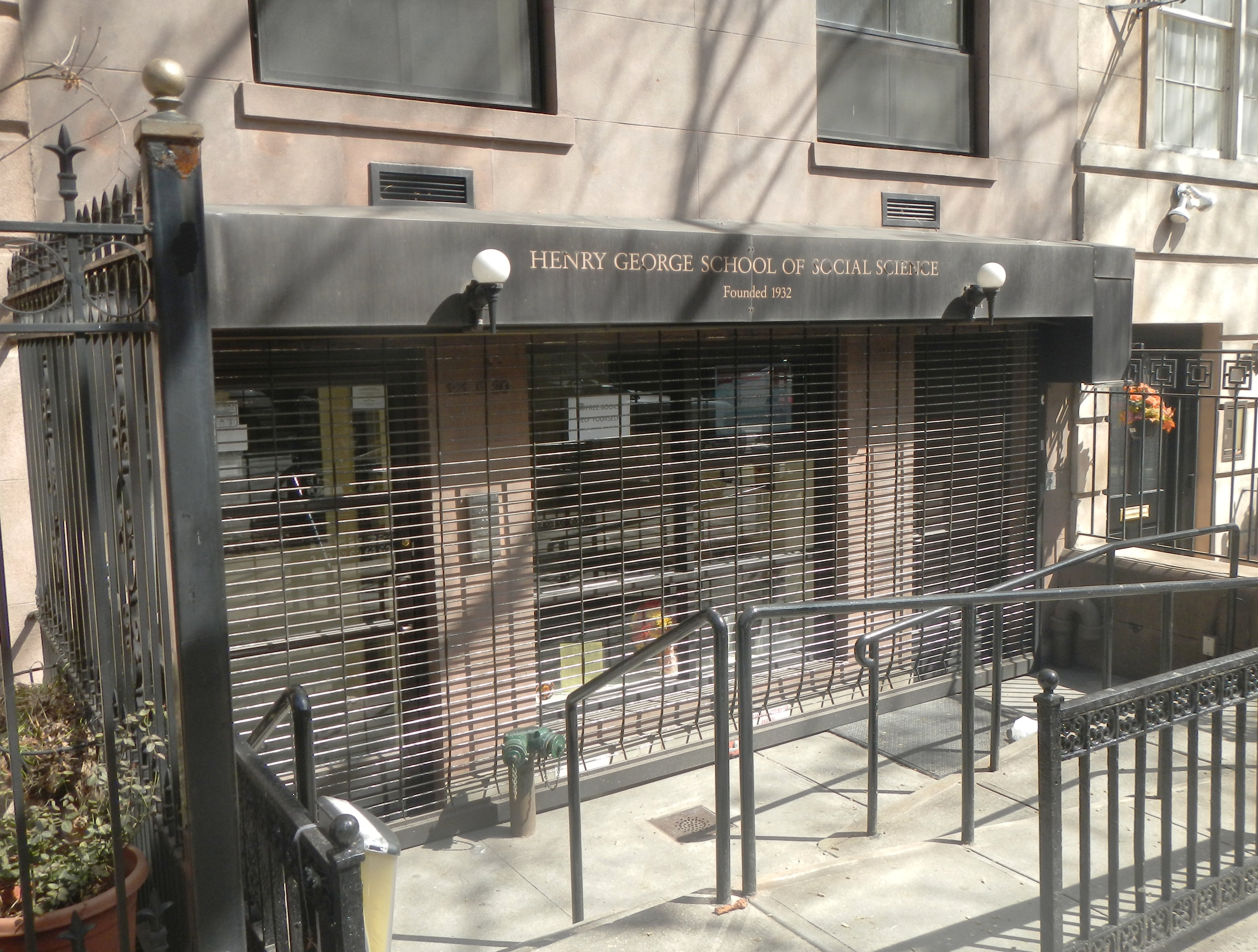
Various organizations exist that continue to promote George's ideas. According to The American Journal of Economics and Sociology, the periodical Land&Liberty, established in 1894, is "the longest-lived Georgist project in history". Founded during the Great Depression in 1932, the Henry George School of Social Science in New York offers courses, sponsors seminars, and publishes research in the Georgist paradigm. Also in the US, the Lincoln Institute of Land Policy was established in 1974 based on the writings of Henry George. It "seeks to improve the dialogue about urban development, the built environment, and tax policy in the United States and abroad".
Other major organizations include the Henry George Foundation, which continues to promote George's ideas in the United Kingdom. The IU, an international umbrella organization that brings together organizations worldwide that seek land-value tax reform. Prosper Australia, which has promoted George's ideas in Australia since the early 20th century. Common Ground USA, including its local chapters, and Common Wealth Canada, both of which are dedicated to spreading Georgist policies and views in their respective North American countries.
Reception
_Edit.jpg)
The economist Alfred Marshall believed that George's views in Progress and Poverty were dangerous, even predicting wars, terror, and economic destruction from the immediate implementation of its recommendations. Specifically, Marshall was upset about the idea of rapid change and the unfairness of not compensating existing landowners. In his lectures on Progress and Poverty, Marshall opposed George's position on compensation while fully endorsing his ultimate remedy. So far as land value tax moderately replaced other taxes and did not cause the price of land to fall, Marshall supported land value taxation on economic and moral grounds, suggesting that a three or four percent tax on land values would fit this condition. After implementing land taxes, governments would purchase future land values at discounted prices and take ownership after 100 years. Marshall asserted that this plan, which he strongly supported, would end the need for a tax collection department of government. For newly formed countries where land was not already private, Marshall advocated implementing George's economic proposal immediately.
Karl Marx considered the single-tax platform as a regression from the transition to communism and referred to Georgism as "capitalism's last ditch". Marx argued, "The whole thing is ... simply an attempt, decked out with socialism, to save capitalist domination and indeed to establish it afresh on an even wider basis than its present one." Marx also criticized the way land value tax theory emphasizes the value of land, arguing that George's "fundamental dogma is that everything would be all right if ground rent were paid to the state."
In The Natural Economic Order through Free Land and Free Money, Silvio Gesell disagreed with George that land value taxes could solve the problem of land rent, as he believed that such taxes could be passed onto the tenants. Instead, he proposed nationalizing all land from current landowners, with the purchases financed by land bonds that would be paid over 20 years from revenues raised by leasing the purchased land through competitive bidding. This would achieve many of the intended effects of Georgism, but with compensation for previous landowners, and with no need to repeatedly reappraise land values. Landowners would no longer own their land, but they would be compensated through the bond payments and could obtain private possession of their land if they pay the leases. Gesell also criticized Henry George for supporting the fructification theory of interest and believing that Georgism would be sufficient to eliminate interest, economic crises, and unemployment.
Richard T. Ely agreed with the economic arguments for Georgism but believed that correcting the problem the way George wanted, without compensation, was unjust to existing landowners. Ely wrote, "If we have all made a mistake, should one party to the transaction alone bear the cost of the common blunder?"
John R. Commons supported Georgist economics but opposed what he perceived as an environmentally and politically reckless tendency for advocates to rely on a one-size-fits-all approach to tax reform, specifically, the "single tax" framing. Commons concluded The Distribution of Wealth, with an estimate that "perhaps 95% of the total values represented by these millionaire [sic] fortunes is due to those investments classed as land values and natural monopolies and to competitive industries aided by such monopolies", and that "tax reform should seek to remove all burdens from capital and labour and impose them on monopolies." However, he criticized Georgists for failing to see that Henry George's anti-monopoly ideas must be implemented with a variety of policy tools. Commons wrote, "Trees do not grow into the sky—they would perish in a high wind; and a single truth, like a single tax, ends in its own destruction." Commons uses the natural soil fertility and value of forests as an example of this destruction, arguing that a tax on the in-situ value of those depletable natural resources can result in overuse or over-extraction. Instead, Commons recommends an income tax-based approach to forests similar to a modern Georgist severance tax.
Other contemporaries such as Austrian economist Frank Fetter and neoclassical economist John Bates Clark argued that it was impractical to maintain the traditional distinction between land and capital and used this as a basis to attack Georgism. Mark Blaug, a specialist in the history of economic thought, credits Fetter and Clark with influencing mainstream economists to abandon the idea "that land is a unique factor of production and hence that there is any special need for a special theory of ground rent" claiming that "this is in fact the basis of all the attacks on Henry George by contemporary economists and certainly the fundamental reason why professional economists increasingly ignored him".
Robert Solow endorsed the theory of Georgism, while being wary of the perceived injustice of expropriation. Solow said that taxing away expected land rents "would have no semblance of fairness" but that Georgism would be good to introduce where location values were not already privatized or if the transition could be phased in slowly.
George has also been accused of exaggerating the importance of his "all-devouring rent thesis" in claiming that it is the primary cause of poverty and injustice in society. He argued that the rent of land increased faster than wages for labor because the supply of land is fixed. Modern economists, including Ottmar Edenhofer have demonstrated that George's assertion is plausible but was more likely to be true during George's time than now.
An early criticism of Georgism was that it would generate too much public revenue and result in unwanted growth of government, but later critics argued that it would not generate enough income to cover government spending. Joseph Schumpeter concluded his analysis of Georgism by stating that, "It is not economically unsound, except that it involves an unwarranted optimism concerning the yield of such a tax." Land use economists conclude that Schumpeter's criticism is unwarranted because the rental yield from land is likely much greater than what modern critics such as Paul Krugman suppose. Krugman agrees that land value taxation is the best means of raising public revenue but asserts that increased spending has rendered land rent insufficient to fully fund government. Georgists have responded by citing studies and analyses implying that land values of nations like the United States, the United Kingdom and Australia are more than sufficient to fund all levels of government.
Anarcho-capitalist political philosopher and economist Murray Rothbard criticized Georgism in Man, Economy, and State as being philosophically incongruent with subjective value theory, and further stating that land is irrelevant in the factors of production, trade, and price systems, but this critique is seen by some, including other opponents of Georgism, as relying on false assumptions and flawed reasoning.
Austrian economist Friedrich Hayek credited early enthusiasm for George with developing his interest in economics. Later, Hayek said that Georgism would be very strong if assessment challenges did not result in unfair outcomes, but he believed that they would.
Economists Bryan Caplan and Zachary Gochenour have argued that a 100% Georgist tax would destroy the incentive to search for natural resources and discover optimal locations for businesses, as the additional profits that would result from such discoveries would lead to a corresponding increase in the unimproved value of the land, and so be taxed away. Georgist economist Fred Foldvary has responded by arguing that Caplan and Gochenour rely on a confused definition of land that includes produced capital goods. If land does not include any produced capital goods and is merely an unproduced natural resource, then their claim that LVT is distortionary does not follow. Additionally, Caplan and Gochenour build on Frank Knight's critique of Georgism, which Foldvary claims has been refuted.
List of Georgists
Economists
- Roger Babson
- Harry Gunnison Brown
- Stuart Chase
- John R. Commons
- Raymond Crotty
- Herman Daly
- Ottmar Edenhofer
- Mary Fels
- Michael Flürscheim
- Fred Foldvary
- Mason Gaffney
- Silvio Gesell
- Robert M. Haig
- Fred Harrison
- C. Lowell Harriss
- Max Hirsch
- J. A. Hobson
- Harold Hotelling
- Michael Hudson
- Wolf Ladejinsky
- Raymond Moley
- Edward J. Nell
- Thomas G. Shearman
- Donald Shoup
- Herbert A. Simon
- Joseph Stiglitz
- Taguchi Ukichi
- Nicolaus Tideman
- Thorstein Veblen
- William Vickrey
- Léon Walras
- Philip Wicksteed
Heads of government
- H. H. Asquith
- John Ballance
- Henry Campbell-Bannerman
- Chiang Kai-shek
- Winston Churchill
- Alfred Deakin
- Andrew Fisher
- George Grey
- Rutherford B. Hayes
- Billy Hughes
- Lee Jae Myung
- David Lloyd George
- Ramsay MacDonald
- Robert Stout
- Sun Yat-sen
- Wang Jingwei
Other political figures
- John Peter Altgeld
- Baldomero Argente
- Paddy Ashdown
- Warren W. Bailey
- Newton D. Baker
- Clitus Barbour
- Herbert S. Bigelow
- Louis Brandeis
- Willie Brown
- John Burns
- Clyde Cameron
- George F. Cotterill
- Robert Crosser
- Cunninghame Graham
- Frank de Jong
- Fred Dixon
- Francis Douglas
- Paul Douglas
- Charles R. Eckert
- Patrick Egan
- H. V. Evatt
- Seymour Farmer
- William Jay Gaynor
- Henry George Jr.
- Keir Hardie
- Michael D. Harter
- Arthur Henderson
- Daniel Hoan
- Frederic C. Howe
- Blas Infante
- Tom L. Johnson
- Samuel M. Jones
- John Seymour Keay
- Oscar Keller
- William Kent
- Ro Khanna
- Robert M. La Follette Jr.
- Franklin Knight Lane
- Andrew MacLaren
- James G. Maguire
- Richard McGhee
- Theodore L. Moritz
- Joaquim Nabuco
- Francis Neilson
- Joshua Nkomo
- George W. Norris
- Gerald Nye
- Patrick O'Regan
- Sydney Olivier
- Joseph Jay Pastoriza
- Hazen S. Pingree
- Jared Polis
- Louis F. Post
- Josiah Quincy VI
- Henry S. Reuss
- Thorold Rogers
- Edgar L. Ryder
- George A. Schilling
- Samuel Seabury
- James Sexton
- Jerry Simpson
- Philip Snowden
- L. D. Taylor
- Charles Tracey
- Charles Philips Trevelyan
- J. De Witt Warner
- Sidney Webb
- Josiah Wedgwood
- Chaim Weizmann
- John Henry Whitley
- Brand Whitlock
- William B. Wilson
- J. Stitt Wilson
Activists
- Mumia Abu-Jamal
- Charles Frederic Adams
- Jane Addams
- Peter Barnes
- Hubert Bland
- William Dwight Porter Bliss
- William F. Buckley Jr.
- Carrie Chapman Catt
- Henry Hyde Champion
- John Sherwin Crosby
- Clarence Darrow
- Michael Davitt
- Nellie Fassett
- Elizabeth and Alexis Ferm
- Sara Bard Field
- Samuel Gompers
- Bolton Hall
- Hubert Harrison
- Stewart Headlam
- Theodor Herzl
- Ami Mali Hicks
- John Haynes Holmes
- Ebenezer Howard
- Margrit Kennedy
- Martin Luther King Jr.
- Mary Elizabeth Lease
- Lizzie Magie
- Benjamin C. Marsh
- James Shaw Maxwell
- Edward McGlynn
- James Ferdinand Morton Jr.
- Albert Jay Nock
- Rolland O'Regan
- Thomas Mott Osborne
- Hugh O. Pentecost
- Amos Pinchot
- Terence V. Powderly
- George Lawrence Record
- Catherine Helen Spence
- Helen Taylor
- Norman Thomas
- William Simon U'Ren
- Ida B. Wells
- Frances Willard
Authors
- Charles Francis Adams Jr.
- Ernest Howard Crosby
- Arthur Desmond
- Charles Eisenstein
- Hamlin Garland
- James A. Herne
- Elbert Hubbard
- Aldous Huxley
- James Howard Kunstler
- Monteiro Lobato
- Edwin Markham
- José Martí
- William D. McCrackan
- Frank McEachran
- Kathleen Norris
- George Bernard Shaw
- Upton Sinclair
- Leo Tolstoy
- H. G. Wells
- Charles Erskine Scott Wood
Journalists
- Patrick Ford
- Timothy Thomas Fortune
- Harry Golden
- Michael Kinsley
- Suzanne La Follette
- Dylan Matthews
- George Monbiot
- William Marion Reedy
- Jacob Riis
- Charles Edward Russell
- Reihan Salam
- Lincoln Steffens
- Thomas Phillips Thompson
- Horace Traubel
- Martin Wolf
- Merryn Somerset Webb
- Tim Worstall
- Matthew Yglesias
Artists
- David Bachrach
- John Wilson Bengough
- Daniel Carter Beard
- Matthew Bellamy
- George de Forest Brush
- Henry Churchill de Mille
- William C. deMille
- Walter Burley Griffin
- John Hutchinson
- George Inness
- Emma Lazarus
- Agnes de Mille
- Eddie Palmieri
- Banjo Paterson
- Louis Prang
- William Lightfoot Price
- Frank Stephens
- Frank Lloyd Wright
Scientists
- Albert Einstein
- Jakob Emanuel Lange
- Donald Murray
- Silvanus P. Thompson
- Alfred Russel Wallace
Businesspeople
- Sam Altman
- Vitalik Buterin
- Joseph Fels
- Henry Ford
- John C. Lincoln
- George Foster Peabody
- Rory Sutherland
- Fiske Warren
- Vivienne Westwood
Military
- William C. Gorgas
- Buckey O'Neill
- Raymond A. Spruance
Philosophers
- Salem Bland
- Ralph Borsodi
- Ludwig Büchner
- Nicholas Murray Butler
- Frank Chodorov
- John B. Cobb
- John Dewey
- Spencer Heath
- Leon MacLaren
- Franz Oppenheimer
- Walter Rauschenbusch
- Bertrand Russell
- Hillel Steiner
- Philippe Van Parijs
- Curtis Yarvin
References
References
- "Seeing the Cat". Henry George Institute.
- (13 December 1888). "The Cat". The Valley Review.
- (1912). "Outlines of Lectures on the Taxation of Land Values". The Public.
- Foldvary, Fred. "Geoism Explained". The Progress Report.
- (14 June 2012). "Geoism Explained on Public Access TV by... Me (VIDEO)".
- "An Introduction to Georgist Philosophy & Activity". Council of Georgist Organizations.
- Heavey, Jerome F.. (July 2003). "Comments on Warren Samuels' "Why the Georgist movement has not succeeded"". American Journal of Economics and Sociology.
- "How the reputation of Georgists turned minds against the idea of a land rent tax".
- (1994). "The Corruption of Economics". Shepheard-Walwyn.
- Hudson, Michael; Feder, Kris; and Miller, George James (1994). ''[http://www.shepheard-walwyn.co.uk/product/philosophy-for-a-fair-society/ A Philosophy for a Fair Society] {{Webarchive. link. (2018-11-05''. Shepheard-Walwyn, London. {{ISBN). 978-0-85683-159-1.
- Locke, John. (1691). "Some Considerations of the Consequences of the Lowering of Interest and the Raising the Value of Money".
- Gaffney, Mason. "Logos Abused: The Decadence and Tyranny of Abstract Reasoning in Economics".
- Agrarian Justice, Wikisource edition, paragraph 12
- Smith, Adam. (1776). "The Wealth of Nations, Book V".
- (1994). ["Land and Taxation"]({{google books). Shepheard-Walwyn in association with Centre for Incentive Taxation.
- (2009). "Agricultural Land Redistribution : Toward Greater Consensus". World Bank.
- (March 2010). "Evidence on the Distributional Effects of a Land Value Tax on Residential Households". National Tax Journal.
- (2017). "Land Value Taxation: An Applied Analysis". [[Ashgate Publishing]].
- [http://onthecommons.org/magazine/forgotten-idea-shaped-great-us-cities The Forgotten Idea That Shaped Great U.S. Cities] by Mason Gaffney & Rich Nymoen, ''Commons'' magazine, October 17, 2013.
- ""Economics" and Political Economy".
- ''New-York Tribune. "''Dinner of the Manhattan Single Tax Club." Nov 16, 1892 · Page 7
- "Basic Principles of Geonomics".
- Casal, Paula. (2011). "Global Taxes on Natural Resources". [[Journal of Moral Philosophy]].
- "Progress and Poverty, Introduction".
- "Common Rights Vs. Collective Rights".
- "Poverty - Earthsharing Canada".
- Inman, Phillip. (16 September 2012). "Could we build a better future on a land value tax?". [[The Guardian]].
- (May 1974). "A New View of Property Tax Incidence". [[The American Economic Review]].
- [[Adam Smith]], [[The Wealth of Nations]] [[s:The Wealth of Nations/Book V/Chapter 2. Book V, Chapter 2]], Part 2, Article I: Taxes upon the Rent of Houses
- Foldvary, Fred E. "Geo-Rent: A Plea to Public Economists". ''Econ Journal Watch'' (April 2005)[http://econjwatch.org/issues/volume-2-issue-1-april-2005]
- "Re:Think. Tax discussion paper for March 2015". The Australian Government the Treasury.
- (1840). "Memoirs of Benjamin Franklin, Volume 2". McCarty & Davis.
- (1922). "Ideas of the founders of the American nation on landed property". University of Wisconsin.
- George, Henry. (1997). "An anthology of Henry George's thought". University of Rochester Press.
- George, Henry (1905). ''Protection or Free Trade''
- (1879). "Progress and Poverty". Cosimo.
- "The Science of Political Economy: What George "Left Out"".
- "The Compatibility of Georgist Economics and Ecological Economics".
- (1886). "Protection or Free Trade". Doubleday, Page & Co..
- (1997). "An Anthology of Henry George's Thought, Volume 1". [[University of Rochester Press]].
- (2013). "Financing Public Capital through Land Rent Taxation: A Macroeconomic Henry George Theorem". CESifo Working Paper.
- "Using Tax Policy to Promote Urban Growth".
- (3 July 2008). "The Hidden Taxable Capacity of Land: Enough and to Spare". [[International Journal of Social Economics]].
- "Total Resource Rents of Australia". Prosper Australia.
- (2006). "Nonrenewable Exhaustible Resources and Property Taxation". [[American Journal of Economics and Sociology]].
- (1997). "An Anthology of Henry George's Thought, Volume 1". [[University of Rochester Press]].
- "Scotland and Scotsmen".
- (1921). "To Hold the Sea In Fee Simple". The Single Tax Review.
- (14 January 2014). "How to Abolish Unfair Taxation".
- "Are you a Real Libertarian, or a ROYAL Libertarian?".
- "Outlines of Louis F. Post's Lectures".
- "Henry George's Concept of Money (Full Text) And Its Implications For 21st Century Reform". American Monetary Institute.
- "On Patents and Copyrights".
- "Henry George and the Intellectual Foundations of the Open Source Movement".
- Fox, Stephen R. The American Conservation Movement: John Muir and His Legacy. Madison, WI: U of Wisconsin, 1985.
- Daly, Herman E., and Joshua C. Farley. Ecological Economics: Principles and Applications. Washington: Island, 2004.
- (2 September 2013). "The Gypsy Rover, the Norman Yoke and the Land Value Tax".
- (29 January 2014). "Beaver, Rewilding & Land Value Tax have the answer to the UK's Flooding Problem.".
- "The Green Tax Shift: Winners and Losers".
- (2011). "Global Taxes on Natural Resources". Journal of Moral Philosophy.
- (1991). "Henry George's Contribution to Modern Environmental Policy: Part I, Theoretical Postulates.". Weborn <!--.
- "Herman Daly Festschrift: Ecological and Georgist Economic Principles: A Comparison".
- (2013). "Removing the Commons: A Lockean Left-Libertarian Approach to the Just Use and Appropriation of Natural Resources". [[Lexington Books]].
- (2012). "Ecodynamics: The Prigogine Legacy". [[WIT Press]].
- "A Primer on Henry George's "Single Tax"".
- "Citizen Dividends and Oil Resource Rents A Focus on Alaska, Norway and Nigeria".
- "A Cannan Hits the Mark".
- [http://www.truefreetrade.org/scg.htm Socialism, Capitalism, and Geoism] – by Lindy Davies
- {{LSJ. γῆ. ref.
- {{OEtymD. George
- [http://www.earthsharing.org.au/introduction/ Introduction to Earth Sharing] {{Webarchive. link. (2014-11-13 ,)
- "Jeffery J. Smith".
- Foldvary, Fred. "Geoism and Libertarianism".
- Curtis, Mike. "The Arden Land Trust".
- Adams, Martin. "Sharing the Value of Land: The Promise of Location Value Covenants".
- Kent, Deirdre. "Land and Money Reform Synergy in New Zealand". Smart Taxes.
- "Cooperative Individualism - Liberty Schools".
- "Location Value Covenants - Systemic Fiscal Reform".
- Foldvery, Fred. "Geoanarchism A short summary of geoism and its relation to libertarianism.".
- Bille, Frank F.. "The Danish-American Georgist".
- Miller, Joseph Dana. (1904). "Land and Freedom: An International Record of Single Tax Progress, Volume 4". Single Tax Publishing Company.
- Wolf, Martin. "Why we must halt the land cycle". [[Financial Times]].
- "The Followers of Henry George". Henry George News.
- (1913). "Great Debates in American History". [[Current Literature]].
- (16 March 1894). "HENRY GEORGE ON MONEY". The Paris Mercury.
- Thorpe, Andrew. (1997). "Creation and Early Years, 1900–14". Macmillan Education UK.
- (28 August 2004). "Fair Tax Where the Wealthiest and Corporations Pay their Share — Tax Wealth More than Work; Tax Activities We Dislike More than Necessities".
- (1 April 2015). "Why Henry George had a point". The Economist.
- "Land Value Tax".
- (1977). "The Economics of Public Services". Macmillan Publishers.
- (November 1979). "Aggregate Land Rents, Expenditure on Public Goods, and Optimal City Size". [[Quarterly Journal of Economics]].
- "Fairhope Single Tax Corporation".
- Lutz, H. L.. (1910). "The Somers System of Realty Valuation". The Quarterly Journal of Economics.
- [https://web.archive.org/web/20240109190622/https://casetext.com/case/city-of-houston-v-baker ''City of Houston v. Baker'']
- Davis, Stephen. (August 2018). "Joseph Jay Pastoriza and the Single Tax in Houston, 1911{{endash}}1917". Houston Review: history and culture of the Gulf Coast.
- (1984). "Land Reform in Kiaochow, China: From 1898 to 1914 the Menace of Disastrous Land Speculation was Averted by Taxation". [[The American Journal of Economics and Sociology]].
- Gaffney, M. Mason. "Henry George 100 Years Later". Association for Georgist Studies Board.
- Harding, Robin. (September 2014). "Property: Land of opportunity". [[Financial Times]].
- (6 June 2016). "City council decides to cut land value tax". Altoona Mirror.
- (2023). "The Land Value Tax Plan".
- Alsup, Alex. (17 October 2023). "Property Tax Burden Falls on Owners of Occupied Homes in Good Condition". [[Detroit Free Press]].
- Dougherty, Conor. (November 12, 2023). "The 'Georgists' Are Out There, and They Want to Tax Your Land". The New York Times.
- ''The American Journal of Economics and Sociology'', vol. 62, 2003, p. 615
- "About Us – Henry George School of Social Science". Henry George School of Social Science.
- "About the Lincoln Institute of Land Policy". Lincolninst.edu.
- "The Henry George Foundation".
- The IU. "The IU".
- (10 May 2016). "Our History".
- "Chapters".
- "About Us".
- "Common Wealth Canada".
- Marshall, Alfred. (1969). "Three Lectures on Progress and Poverty by Alfred Marshall". The Journal of Law & Economics.
- Marshall, Alfred. (1920). "Principles of Economics". Library of Economics and Liberty.
- Andelson, Robert V.. "Henry George and The Reconstruction Of Capitalism".
- Marx, Karl. "Letters: Marx-Engels Correspondence 1881".
- "The Natural Economic Order/Part I/Introduction - Wikilivres".
- "The Natural Economic Order/Part I/Chapter 11 - Wikilivres".
- Baynham, Jacob. (14 November 2023). "What If Money Expired?". Berggruen Institute.
- Sidman, Josh. (10 April 2024). ""Silvio Gesell: Beyond Capitalism vs Socialism" Class #7". Henry George School of Economics.
- Gesell, Silvio. (1916). "Die natürliche Wirtschaftsordnung durch Freiland und Freigeld".
- George, Henry. "A Response to Richard Ely On the Question of Compensation to Owners of Land".
- Commons, John Rogers. (1893). "The Distribution of Wealth". Macmillan and Company.
- (1922). "A Progressive Tax on Bare Land Values". [[Political Science Quarterly]].
- Andelson, Robert V.. (23 April 2004). "Studies in Economic Reform and Social Justice, Critics of Henry George: An Appraisal of Their Strictures on Progress and Poverty". Wiley.
- Foldvery, Fred E.. (2005). "Geo-Rent: A Plea to Public Economists". Econ Watch.
- (2003). "Critics of Henry George: An Appraisal of Their Strictures on Progress and Poverty". [[Wiley-Blackwell]].
- (1994). "A Philosophy for a Fair Society". Shepheard-Walwyn.
- Moore, Michael Scott. (2009-10-21). "This Land Is Your Land".
- Gaffney, Mason. (13 March 2009). "The hidden taxable capacity of land: enough and to spare". [[International Journal of Social Economics]].
- Foldvery, Fred. "The Ultimate Tax Reform: Public Revenue from Land Rent".
- "How Much Revenue would a Full Land Value Tax Yield? Analysis of Census and Federal Reserve Data". [[American Journal of Economics and Sociology]].
- Cord, Steven. (July–August 1991). "Land Rent is 20% of U.S. National Income for 1986". Incentive Taxation.
- (1990). "What Is the Value of all U.S. Real Estate?". Real Estate Review.
- (1988). "The Losses of Nations: Deadweight Politics versus Public Rent Dividends". Othila Press.
- Fitzgerald, Karl. "Total Resource Rents of Australia".
- Rothbard, Murray. (1962). "Man, Economy, and State: A Treatise on Economic Principles". [[Van Nostrand (publisher).
- (24 February 2004). "Murray Rothbard and Henry George".
- Andelson, Robert V.. (January 2000). "On Separating the Landowner's Earned and Unearned Increment: A Georgist Rejoinder to F. A. Hayek". [[American Journal of Economics and Sociology]].
- (4 February 2012). "A Search-Theoretic Critique of Georgism".
- Foldvary, Fred. (18 October 2013). "Reply to the Caplan and Gochenour critique of Georgism". The Review of Austrian Economics.
- (20 August 1943). "Roger Babson Sees Many Changes To Come After the War Has Ended".
- Brown, H. G.. (1936). "A Defense of the Single Tax Principle". The Annals of the American Academy of Political and Social Science.
- Westbrook, Robert B.. (1980). "Tribune of the Technostructure: The Popular Economics of Stuart Chase". American Quarterly.
- (1962). "His Assault on Laissez-faire". Oregon State University Press.
- (1982). "Land Value Taxation in Thought and Practice". [[University of Wisconsin Press]].
- (2012). "The Evolution of Economic Thought". Cengage Learning.
- (1988). "A Radical's Response". Poolbeg.
- (24 August 2014). "'Progress and Poverty' – Henry George and Land Reform in modern Ireland".
- (23 October 2015). "Smart Talk: Herman Daly on what's beyond GNP Growth". Henry George School of Social Science.
- Edenhofer, Ottmar. (2013). "Hypergeorgism: When is Rent Taxation as a Remedy for Insufficient Capital Accumulation Socially Optimal?".
- Edenhofer, Ottmar. (25 June 2013). "Financing Public Capital Through Land Rent Taxation: A Macroeconomic Henry George Theorem". CESifo Working Paper Series.
- Edenhofer, Ottmar. "The Triple Dividend Climate Change Mitigation, Justice and Investing in Capabilities".
- (22 December 1914). "MARY FELS, WIDOW OF SOAP KING, DECLARES SINGLE TAX IS SOLUTION OF INDUSTRIAL WAR". St. Louis Globe-Democrat.
- (October 1992). "Henry George and Europe: An Industrialist and Pioneer Social Reformer, Michael Flürscheim, Publicized George's Ideas in Germany". American Journal of Economics and Sociology.
- "Foldvary policy reforms".
- "Mason Gaffney's Website".
- Gaffney, Mason. "Henry George 100 Years Later: The Great Reconciler".
- Onken, Werner. "The Political Economy of Silvio Gesell: A Century of Activism." American Journal of Economics and Sociology 59.4 (2000): 609–622. Weborn 16 Aug. 2014.
- "DISCUSSION-SINGLE TАХ". The School of Cooperative Individualism.
- (27 April 2014). "Fred Harrison speaks at ALTER Spring Conference 2014".
- [http://www.nndb.com/people/585/000174063/ C. Lowell Harriss]. [[NNDB]]. Retrieved September 12, 2015.
- Airlie Worrall, ''The New Crusade: the Origins, Activities and Influence of the Australian Single Tax Leagues, 1889–1895'' (M.A. thesis, University of Melbourne, 1978).
- (1993). "The sociology and professionalization of economics". [[Routledge]].
- Turgeon, Lynn. Bastard Keynesianism : the evolution of economic thinking and policymaking since World War II. Westport, Conn: Praeger, 1997
- Gaffney, Mason. "Warm Memories of Bill Vickrey". Land & Liberty. http://www.cooperative-individualism.org/gaffney-mason_warm-memories-of-bill-vickrey-1997.htm {{Webarchive. link. (16 November 2016)
- Gaffney, Mason, and Fred Harrison. ''[[The Corruption of Economics]]'', London: Shepheard-Walwyn in association with Centre for Incentive Taxation, 2006
- Hotelling, Harold. (1938). "The General Welfare in Relation to Problems of Taxation and of Railway and Utility Rates". Econometrica.
- (1994). "A philosophy for a fair society (Georgist Paradigm Series)". Shepheard-Walwyn.
- "Has Georgism been hijacked by special interests?".
- Andelson, Robert V.. (2000). "Land-Value Taxation Around the World: Studies in Economic Reform and Social Justice Malden". [[Blackwell Publishers]] Inc..
- Lawson, R. (2006). "A commonwealth of hope : the New Deal response to crisis". [[Johns Hopkins University Press]].
- Nell, Edward. (2019). "Henry George and How Growth in Real Estate Contributes to Inequality and Financial Instability". Palgrave.
- (30 September 1900). "THOMAS G. SHEARMAN DEAD; Succumbs to an Operation at His Home in Brooklyn. Well-Known Lawyer and Political Economist Was Seized with His Fatal Illness While in Paris.". [[The New York Times]].
- "Pay As You Park: UCLA professor Donald Shoup inspires a passion for parking.".
- Shoup, Donald C. "The Ideal Source of Local Public Revenue." Regional Science and Urban Economics 34.6 (2004): 753-84.
- (7 August 2012). "The High Cost of Free Parking Chapters 19–22". Market Urbanism.
- [http://www.wealthandwant.com/themes/quotable_nobels.htm Quotes from Nobel Prize Winners] Herbert Simon stated in 1978: "''Assuming that a tax increase is necessary, it is clearly preferable to impose the additional cost on land by increasing the land tax, rather than to increase the wage tax—the two alternatives open to the City (of Pittsburgh). It is the use and occupancy of property that creates the need for the municipal services that appear as the largest item in the budget—fire and police protection, waste removal, and public works. The average increase in tax bills of city residents will be about twice as great with wage tax increase than with a land tax increase.''"
- (2 December 2010). "Working Paper No. 6: Principles and Guidelines for Deficit Reduction". The Roosevelt Institute.
- De Bary, William Theodore, [[Carol Gluck]] and Arthur E. Tiedemann eds. (2005). ''Sources of Japanese Tradition: Volume Two: 1600 to 2000''. Second Edition. New York: Columbia University Press. pp1227ff.
- Tideman, Nicolaus. "Global Economic Justice". Schalkenbach Foundation.
- (27 August 2010). "Henry George and the Development of Thorstein Veblen's Theory of Capital". Journal of the History of Economic Thought.
- "Bill Vickrey: "This paper would benefit from an application of Henry George's idea of taxing land values!"".
- (November 1996). "Remembering William Vickrey". Land Lines.
- Vickrey, William. "The Corporate Income Tax in the U.S. Tax System, 73 TAX NOTES 597, 603 (1996). Quote: "Removing almost all business taxes, including property taxes on improvements, excepting only taxes reflecting the marginal social cost of public services rendered to specific activities, and replacing them with taxes on site values, would substantially improve the economic efficiency of the jurisdiction."
- Cirillo, Renato. (Jan 1984). "Léon Walras and Social Justice". The American Journal of Economics and Sociology.
- Barker, Charles A., 1955. Henry George. New York: Oxford University Press
- MacLaren, Andrew. (2019-03-20). "Henry George and Churchill's "The People's Rights": Part 1". [[Hillsdale College]].
- Williams, Karl. "Geoists in History: Herbert Asquith (1852-1928)". Reprinted from PROGRESS, Summer 2014. https://cooperative-individualism.org/williams-karl_herbert-asquith-2014-summer.pdf
- Boast, Richard. (2008). "Buying the land, selling the land : governments and Maori land in the North Island 1865–1921". Victoria University Press, Victoria University of Wellington.
- Daunton, M. J. State and market in Victorian Britain : war, welfare and capitalism. Woodbridge, UK Rochester, NY: Boydell Press, 2008. Quote: "In the election of 1890 he campaigned for radical land reform, arguing for a tax on the 'unearned increment', and advocated the programme of Henry George as a means of 'bursting up the great estates'."
- Williams, Karl. "Geoists in History: Henry Campbell-Bannerman (1836-1908)". Reprinted from PROGRESS, Winter 2016. https://cooperative-individualism.org/williams-karl_henry-campbell-bannerman-2016-winter.pdf
- (January–February 1927). "Single-Tax Movement in China". Land and Freedom.
- [https://www.cooperative-individualism.org/churchill-winston_mother-of-all-monopolies-1909.htm "Winston S. Churchill / The Mother of all Monopolies -- 1909"].
- (Autumn 2001). "The People's Rights: Opportunity Lost?". Finest Hour.
- (March 17, 2013). "It's a Lonely Quest for Land-Tax Fans, But, by George, They Press On".
- Stevens, Elizabeth Lesly. "A Tax Policy With San Francisco Roots". July 30, 2011 https://www.nytimes.com/2011/07/31/us/31bcstevens.html Quote: "But Mr. Brown was certainly in good company as a Georgist. Devotees over the years have included Leo Tolstoy, Winston Churchill, Sun Yat-Sen, and the inventor of the board game that would become Monopoly."
- Murdoch, Walter. Alfred Deakin: a sketch. Melbourne, Vic: Bookman, 1999. [1923]
- Williams, Karl. "Geoists in History: Alfred Deakin (1857-1919)". Reprinted from PROGRESS, April-June 2012. https://cooperative-individualism.org/williams-karl_alfred-deakin-2012-apr-jun.pdf
- Bastian, Peter. (2009). "Andrew Fisher: An Underestimated Man". UNSW Press.
- [George, Henry, Jr. The Life of Henry George. New York: Doubleday & McClure, 1900.]
- Williams, Karl. "Geoists in History: Rolland O'Regan (1904-1902)". Reprinted from PROGRESS, Autumn 2016. https://www.cooperative-individualism.org/williams-karl_rolland-o'regan-2016-jul.pdf
- Hayes, Rutherford B.. "Henry George".
- Fitzhardinge, L. F.. (1983). "William Morris (Billy) Hughes (1862–1952)".
- (13 June 2025). "Did South Korea just elect a Georgist President". Substack.
- "What the Prime Minister Has Said: Mr Ramsay MacDonald's Declarations Recalled". Reprinted from Land & Liberty, June 1934. https://cooperative-individualism.org/macdonald-ramsay_statements-supporting-the-taxation-of-land-values-1934-jun.pdf
- Peter d’A. Jones. “Henry George and British Socialism.” The American Journal of Economics and Sociology, vol. 47, no. 4, 1988, pp. 473–91. JSTOR, http://www.jstor.org/stable/3486564. Accessed 11 Nov. 2025.
- (14 April 1885). "Address by the Hon. R. Stout". PAPERPAST.
- Trescott, Paul B.. (January 22, 1994). "Henry George, Sun Yat-sen and China: More Than Land Policy Was Involved". American Journal of Economics and Sociology.
- Trescott, Paul B.. (2007). "Jingji Xue: The History of the Introduction of Western Economic Ideas Into China, 1850–1950". Chinese University Press.
- (April 12, 1912). "Sun Yat Sen's Economic Program for China". The Public.
- Blanshard, Paul. (11 September 1927). "WANG CHING-WEI RISES IN CHINA; Trained by Sun Yat-sen, He Is Now Civil Head Of the Nationalist Party -- An Anti-Communist -- His Adventurous Career". [[The New York Times]].
- (1899). "Live Questions". Geo. S Bowen & Son.
- Chicago Single Tax Club collection, Special Collections and University Archives, University of Illinois at Chicago http://findingaids.library.uic.edu/ead/rjd1/ChiSingleTaxf.html
- Martín Rodríguez, Manuel. (2000). "La Liga Española para el Impuesto Único y la Hacienda Municipal de Sevilla en 1914". Revista de Estudios Regionales.
- "Land Value Taxation for Fairness". Reprinted from Land & Liberty, May-June, 1989. http://cooperative-individualism.org/ashdown-paddy_land-value-taxation-for-fairness-1989.htm
- "A Remembrance of Warren Worth Bailey". Reprinted from Land and Freedom, November–December, 1928. http://cooperative-individualism.org/anonymous_a-remembrance-of-warren-worth-bailey-1928.htm {{Webarchive. link. (2016-12-20)
- Finegold, Kenneth. (1995). "Experts and politicians: reform challenges to machine politics in New York, Cleveland, and Chicago". Princeton University Press.
- (20 May 1895). "SINGLE TAX SOCIETY". [[The San Francisco Call]].
- "Rev. Herbert S. Bigelow in the House of Representatives". Reprinted from Land and Freedom, July-August, 1937. https://cooperative-individualism.org/bigelow-herbert_address-in-the-u-s-house-of-representatives-1937-jul-aug.pdf
- Brandeis, Louis. (1971). "Letters of Louis D. Brandeis". State University of New York Press.
- "101+ Famous Thinkers on Owning Earth".
- Stevens, Elizabeth Lesly. (July–August 2012). "The Power Broker". Washington Monthly.
- Peter d’A. Jones. “Henry George and British Labor Politics.” The American Journal of Economics and Sociology, vol. 46, no. 2, 1987, pp. 245–56. JSTOR, http://www.jstor.org/stable/3485997. Accessed 11 Nov. 2025.
- "Revenue is not a Tax".
- (Mar 6, 1912}}{{Dead link). "Single Tax Loses, But Mayor Favoring This Reform Is Chosen By a Small Vote Margin".
- Arnesen, Eric. Encyclopedia of U.S. Labor and Working-class History. New York: Routledge, 2007
- Johnston, Robert D. The Radical Middle Class: Populist Democracy and the Question of Capitalism in Progressive Era Portland, Oregon. Princeton, N.J: Princeton University Press, 2003
- Candeloro, Dominic. “The Single Tax Movement and Progressivism, 1880-1920.” The American Journal of Economics and Sociology, vol. 38, no. 2, 1979, pp. 113–27. JSTOR, http://www.jstor.org/stable/3486892. Accessed 10 Nov. 2025.
- Peter d’A. Jones. “Henry George and British Labor Politics.” The American Journal of Economics and Sociology, vol. 46, no. 2, 1987, pp. 245–56. JSTOR, http://www.jstor.org/stable/3485997. Accessed 11 Nov. 2025.
- (20 June 2011). "Frank de Jong: Economic Rent Best Way to Finance Government".
- Naylor, James. "Dixon, Frederick John".
- Mills, Allen. (1980). "Single Tax, Socialism and the Independent Labour Party of Manitoba: The Political Ideas of F.J. Dixon and S. J. Farmer". Labour/Le Travail.
- Douglas, Francis. (1961). "Land Value Rating". Christopher Johnson Publishers Ltd..
- "Stimulus: The False and the True Mason Gaffney".
- Douglas, Paul. (1972). "In the fullness of time; the memoirs of Paul H. Douglas". Harcourt Brace Jovanovich.
- Eckert, Charles R. "Henry George, Sound Economics, and the 'New Deal'". Reprinted from the Congressional Record, July 2, 1935. https://cooperative-individualism.org/eckert-charles_henry-george-sound-economics-and-the-new-deal-1935-jul.pdf
- "The Life of Henry George".
- "Election Speeches · Herbert Evatt, 1955 · Museum of Australian Democracy at Old Parliament House".
- Gaynor, William Jay. Some of Mayor Gaynor's Letters and Speeches. New York: Greaves Pub., 1913. 214–221. https://books.google.com/books?id=-7kMAAAAYAAJ&pg=PA219
- George, Henry, Jr.. (1906). "The Menace of Privilege: A Study of the Dangers to the Republic from the Existence of a Favored Class". The MacMillan Company.
- (25 September 1895). "Socialism in England: James Keir Hardie Declares that it is Capturing that Country". The San Francisco Call.
- Peter d’A. Jones. “Henry George and British Socialism.” The American Journal of Economics and Sociology, vol. 47, no. 4, 1988, pp. 473–91. JSTOR, http://www.jstor.org/stable/3486564. Accessed 11 Nov. 2025.
- (1913). "Great Debates in American History". [[Current Literature]].
- Peter d’A. Jones. “Henry George and British Socialism.” The American Journal of Economics and Sociology, vol. 47, no. 4, 1988, pp. 473–91. JSTOR, http://www.jstor.org/stable/3486564. Accessed 11 Nov. 2025.
- "Excerpts from The Corruption of Economics".
- Howe, Frederic C. The Confessions of a Reformer. Kent, OH: Kent State UP, 1988.
- Arcas Cubero, Fernando: ''El movimiento georgista y los orígenes del Andalucismo : análisis del periódico "El impuesto único" (1911–1923)''. Málaga : Editorial Confederación Española de Cajas de Ahorros, 1980. {{ISBN. 84-500-3784-0
- [https://timesmachine.nytimes.com/timesmachine/1910/05/31/104936447.pdf "Single Taxers Dine Johnson"]. ''[[New York Times]]'' May 31, 1910.
- [http://www.ohiohistorycentral.org/entry.php?rec=165 "Henry George"]. ''Ohio History Central: An Online History of Ohio History''.
- Peter d’A. Jones. “Henry George and British Socialism.” The American Journal of Economics and Sociology, vol. 47, no. 4, 1988, pp. 473–91. JSTOR, http://www.jstor.org/stable/3486564. Accessed 11 Nov. 2025.
- "Excerpts from The Corruption of Economics".
- Candeloro, Dominic. “The Single Tax Movement and Progressivism, 1880-1920.” The American Journal of Economics and Sociology, vol. 38, no. 2, 1979, pp. 113–27. JSTOR, http://www.jstor.org/stable/3486892. Accessed 10 Nov. 2025.
- https://x.com/RoKhanna/status/1163060125130792966 {{Bare URL inline. (August 2024)
- La Follette, Robert M. "Unearned Increment". Reprinted from Land and Freedom, May-June, 1935. https://cooperative-individualism.org/lafollette-robert_unearned-increment-1935.htm
- "Henry George 100 Years Later: The Great Reconciler". Robert Schalkenbach Foundation.
- Stewart, John. (2001). "Standing for justice: a biography of Andrew MacLaren, MP". Shepheard-Walwyn.
- Lough, Alexandra W.. (September 2013). "The Federal Income Tax and the Georgist Movement".
- Philip J Waller, ''Democracy and Sectarianism: A Political and Social History of Liverpool 1868-1939''; Liverpool University Press, 1981 p.103
- Moritz, Theodore L. "Why I Introduced a Single Tax Bill in Congress". Reprinted from Real America, 1935. https://cooperative-individualism.org/moritz-theodore_why-i-introduced-a-single-tax-bill-in-congress-1935.pdf
- "JOAQUIM NABUCO: REVOLUCIONÁRIO CONSERVADOR (SUA FILOSOFIA POLÍTICA)".
- Peterson, V.G.. "Francis Neilson". Reprinted from The Henry George News, May 1961. https://cooperative-individualism.org/peterson-vi_a-remembrance-of-francis-neilson-1961-may.pdf
- [http://www.cooperativeindividualism.org/neilson-francis_henry-george-the-scholar-1940.html "Henry George, The Scholar"] {{webarchive. link. (2013-10-04 – A Commencement Address Delivered by Francis Neilson at the Henry George School of Social Science, June 3, 1940.)
- Neilson, Francis. (September 1939). "Albert Jay Nock on Henry George – Truth Sets Men Free". The Freeman.
- Baron, Ian. (September 1986). "Nkomo Debt to George in Banned Talk". HGFUK.
- (2 July 2015). "Summer Book List: Henry George (and George Norris) and the Crisis of Inequality".
- (2 July 2015). "Summer Book List: Henry George (and George Norris) and the Crisis of Inequality".
- Peter d’A. Jones. “Henry George and British Socialism.” The American Journal of Economics and Sociology, vol. 47, no. 4, 1988, pp. 473–91. JSTOR, http://www.jstor.org/stable/3486564. Accessed 11 Nov. 2025.
- (April 28, 1911). "J. J. Pastoriza".
- Gaffney, Mason. "What's the matter with Michigan? Rise and collapse of an economic wonder".
- Cleveland, Polly. "The Way Forward for Detroit? Land Taxes".
- Gaffney, Mason. "New Life in Old Cities". UC Riverside.
- (9 January 2024). "Polis lobbies property-tax commission to consider land value tax".
- Post, Louis F.. (2002). "The Prophet of San Francisco: Personal Memories & Interpretations of Henry George". The Minerva Group.
- "The Taxation of Ground Rent". April 27, 1905. http://cooperative-individualism.org/adams-charles-francis_taxation-of-ground-rent-1905-apr.pdf
- "The Sensible Tax". Reprinted from The Henry George News, October-November, 1979. http://cooperative-individualism.org/reuss-henry_sensible-tax-1979-oct-nov.pdf
- Williams, Karl. "Geoists in History: Thorold Rogers (1823-1890)". Reprinted from PROGRESS, January-March 2012. https://cooperative-individualism.org/williams-karl_thorold-rogers-2012-jan-mar.pdf
- (1943). "National Cyclopædia of American Biography". James T. White & Company.
- [https://archive.org/details/whoswhoinamerica02marq/page/996/mode/2up SCHILLING, Charles], in ''[[Who's Who in America]]'' (1901-02 edition), via [[archive.org]]
- Mitgang, Herbert. (1996). "The Man Who Rode the Tiger: The Life and Times of Judge Samuel Seabury". [[Fordham University Press]].
- Peter d’A. Jones. “Henry George and British Socialism.” The American Journal of Economics and Sociology, vol. 47, no. 4, 1988, pp. 473–91. JSTOR, http://www.jstor.org/stable/3486564. Accessed 11 Nov. 2025.
- Bryson, Phillip. (2011). "The economics of Henry George : history's rehabilitation of America's greatest early economist". [[Palgrave Macmillan]].
- Moore, Robert. (1974). "Pit-men, preachers & politics the effects of Methodism in a Durham mining community". [[Cambridge University Press]].
- Williams, Karl. "Geoists in History: Philip Snowden (1864-1937)". Reprinted from PROGRESS, May-June 2011. https://cooperative-individualism.org/williams-karl_philip-snowden-2011-may-jun.pdf
- Peter d’A. Jones. “Henry George and British Socialism.” The American Journal of Economics and Sociology, vol. 47, no. 4, 1988, pp. 473–91. JSTOR, http://www.jstor.org/stable/3486564. Accessed 11 Nov. 2025.
- "Eight Times Mayor of Vancouver: 'Single Tax' Taylor: Louis Denison Taylor 1857-1946". GroundSwell, May-June, 2001. https://cooperative-individualism.org/rawson-mary_eight-times-mayor-of-vancouver-2001-may-jun.pdf
- Peter d’A. Jones. “Henry George and British Socialism.” The American Journal of Economics and Sociology, vol. 47, no. 4, 1988, pp. 473–91. JSTOR, http://www.jstor.org/stable/3486564. Accessed 11 Nov. 2025.
- Peter d’A. Jones. “Henry George and British Socialism.” The American Journal of Economics and Sociology, vol. 47, no. 4, 1988, pp. 473–91. JSTOR, http://www.jstor.org/stable/3486564. Accessed 11 Nov. 2025.
- Cooke, W. Henry. "Book Review of 'The Last of the Radicals: Josiah Wedgwood, M.P.'". Reprinted from The Annals of the American Academy, May 1952. https://cooperative-individualism.org/cooke-w-henry_review-of-c-v-wedgwood-the-last-of-the-radicals-josiah-wedgwood-1952-may.pdf
- Langworth, Richard. (2019-03-21). "Henry George and Churchill's "The People's Rights": Part 2". [[Hillsdale College]].
- Williams, Karl. "Geoists in History: Chaim Weizmann (1874-1952)". Reprinted from PROGRESS, Spring 2017. https://cooperative-individualism.org/williams-karl_chaim-weizmann-2017-spring.pdf
- (1908). "His Majesty's Ministers and the Doctrines of Henry George". W.H. Allen.
- (January–February 1941). "Forty Years of the Struggle for Freedom". Land and Freedom.
- Filler, Louis. (1993). "The muckrakers". Stanford University Press.
- Miller, Joseph Dana (ed.), 1917. Single Tax Year Book. NY: Single Tax Review Publishing Company
- (2016). "Berkeley Mayor J. Stitt Wilson: Christian Socialist, Georgist, Feminist". American Journal of Economics and Sociology.
- "Some Suggestions for Reform of Taxation", Proceedings, 14th Annual Convention, League of California Municipalities, Santa Barbara, California, October 25, 1911, pp. 152–171. J. Stitt Wilson, "Report from California", The Single Tax Review, V.17, No.1, January–February 1917, pp. 50–52
- "Justice for Mumia Abu-Jamal".
- (19 June 2025). "Charles Frederic Adams: Man Against the Machine". New York Almanack.
- (Spring 1997). "Taxing Women: Thoughts on a Gendered Economy: Symposium: A Historical Outlook: Taxes and Peace" A Case Study of Taxing Women". Southern California Review of Law and Women's Studies Southern California Review of Law and Women's Studies.
- (2007). "Left and Right: A Journal of Libertarian Thought (Complete, 1965–1968)". [[Ludwig von Mises Institute]].
- Chris Oestereich. "With Liberty and Dividends for All: An Interview with Peter Barnes"; https://medium.com/@costrike/with-liberty-and-dividends-for-all-an-interview-with-peter-barnes-2d3cbd95028c
- Bland, Hubert. "The Faith I Hold". Reprinted from The New Age, January 25, 1908. https://cooperative-individualism.org/bland-hubert_faith-i-hold-1908.htm
- Bliss, W.D.P.. (1890). "What is Christian Socialism?". The Society of Christian Socialists.
- "Firing Line: Has New York Let Us Down?". [[PBS]], Robert Schalkenbach Foundation.
- "Excerpts from The Corruption of Economics".
- Peter d’A. Jones. “Henry George and British Labor Politics.” The American Journal of Economics and Sociology, vol. 46, no. 2, 1987, pp. 245–56. JSTOR, http://www.jstor.org/stable/3485997. Accessed 11 Nov. 2025.
- [http://digitalgallery.nypl.org/nypldigital/dgkeysearchdetail.cfm?trg=1&strucID=453398&imageID=1160286&total=109&num=0&parent_id=452324&word=&s=¬word=&d=&c=&f=&k=0&sScope=&sLevel=&sLabel=&lword=&lfield=&imgs=20&pos=16&snum=&e=w NYPL Digital Gallery: "The mission of Henry George"], addresses by John S. Crosby.
- How to Abolish Unfair Taxation: An Address Before a Los Angeles Audience, Delivered March 1913 https://books.google.com/books?id=rlOFHAAACAAJ
- "The Land Belongs To The People". Everyman.
- (August 1994). "The Centre for Incentive Taxation". [[Land&Liberty]].
- Lane, Fintan. ''The Origins of Modern Irish Socialism, 1881–1896''.Cork University Press, 1997 (pp. 79, 81).
- Jo Freeman. "The Rise of Political Woman in the Election of 1912". [[University of Illinois]].
- (1999). "Encyclopedia of Political Anarchy". ABC-CLIO.
- Beth Shalom Hessel. "Field, Sara Bard"; http://www.anb.org/articles/15/15-00220.html; American National Biography Online April 2014. Access Date: Mar 22 2015
- (1921). "Mr. Samuel Gompers Replies to Our Criticism". The Single Tax Review.
- (1986). "The Samuel Gompers Papers: The making of a union leader, 1850–86, Volume 1". University of Illinois Press.
- Williams, Karl. "Geoists in History: Samuel Gompers (1850-1924)". Reprinted from PROGRESS, January-March 2013. https://cooperative-individualism.org/williams-karl_samuel-gompers-2013-jan-mar.pdf
- Leubuscher, F. C. (1939). [http://www.cooperativeindividualism.org/leubuscher-frederic_bolton-hall.html Bolton Hall] {{webarchive. link. (December 14, 2010. ''The Freeman''. January issue.)
- (1921). "The Single Tax Review, Volumes 21–22".
- (1922). "Land and Freedom, Volumes 22–23".
- Thompson, Noel. ''Political economy and the Labour Party: The economics of démocratic socialism (1884–2005)''. Routlegde Ed., 2006, pp. 54–55.
- Haggard, Robert. (2001). "The persistence of Victorian liberalism : the politics of social reform in Britain, 1870–1900". Greenwood Press.
- Peter d’A. Jones. “Henry George and British Socialism.” The American Journal of Economics and Sociology, vol. 47, no. 4, 1988, pp. 473–91. JSTOR, http://www.jstor.org/stable/3486564. Accessed 11 Nov. 2025.
- "Henry George and Zionism".
- (1922). "Free Acres". Fiske Warren.
- "The Land Question Quotations from Historical and Contemporary Sources".
- "Henry George, Sound Economics and the "New Deal"".
- (June 2000). "Review Article: A hundred years of town planning and the influence of Ebenezer Howard". The British Journal of Sociology.
- (1999). "Regaining Paradise: Englishness and the Early Garden City Movement". [[Yale University Press]].
- (1963). "The Letchworth Achievement".
- Williams, Karl. "Geoists in History: Ebenezer Howard (1850-1928)". Reprinted from PROGRESS, Winter 2020. https://cooperative-individualism.org/williams-karl_ebenezer-howard-2020-winter.pdf
- Kennedy, Margrit. (11 December 2013). "Money & The Land Grab". Share the Rents.
- "Martin Luther King, Jr: Where Do We Go From Here? (1967)".
- Orr, B. S. (2006–2007). Mary Elizabeth Lease: Gendered discourse and Populist Party politics in Gilded Age America. Kansas History: A Journal of the Central Plains, 29, 246–265.
- Magie invented ''[[The Landlord's Game]]'', predecessor to ''[[Monopoly (game). Monopoly]]''
- Dodson, Edward J.. "How Henry George's Principles Were Corrupted Into the Game Called Monopoly".
- Caves, Roger W. Encyclopedia of the City. Abingdon, Oxon, OX: Routledge, 2005.
- Marsh, Benjamin Clarke. Lobbyist for the People; a Record of Fifty Years. Washington: Public Affairs, 1953.
- Peter d’A. Jones. “Henry George and British Socialism.” The American Journal of Economics and Sociology, vol. 47, no. 4, 1988, pp. 473–91. JSTOR, http://www.jstor.org/stable/3486564. Accessed 11 Nov. 2025.
- Gaffney, Mason. "Henry George Dr. Edward McGlynn & Pope Leo XIII".
- (Sep 8, 1912). "Single-Taxers again laud Henry George". Daily Standard Union.
- Lora, Ronald; Longton, William Henry, eds. (1999). ''The Conservative Press in Twentieth-century America''. Greenwood Publishing, Inc. p. 310. "Thus, the ''Freeman'' was to speak for the great tradition of classical liberalism, which [Albert Jay Nock and Francis Nielson] were afraid was being lost, and for the economics of Henry George, which both men shared."
- Williams, Karl. "Geoists in History: Albert Jay Nock (1870-1945)". Reprinted from PROGRESS, Summer 2016. https://cooperative-individualism.org/williams-karl_albert-jay-nock-2016-jan.pdf
- Jorgensen, Emil Oliver. The next Step toward Real Democracy: One Hundred Reasons Why America Should Abolish, as Speedily as Possible, All Taxation upon the Fruits of Industry, and Raise the Public Revenue by a Single Tax on Land Values Only. Chicago, IL: Chicago Singletax Club, 1920.
- Gorgas, William Crawford, and Lewis Jerome Johnson. Two Papers on Public Sanitation and the Single Tax. New York: Single Tax Information Bureau, 1914. https://books.google.com/books?id=v3NHAAAAYAAJ
- Ware, Louise. George Foster Peabody, Banker, Philanthropist, Publicist. Athens: U of Georgia, 1951. http://dlg.galileo.usg.edu/ugapressbks/pdfs/ugp9780820334561.pdf
- [https://timesmachine.nytimes.com/timesmachine/1887/06/20/104012097.pdf "Anti-Poverty's Apostles: Speeches at Two Meetings of the Society,"] ''New York Times'', June 20, 1887; [https://timesmachine.nytimes.com/timesmachine/1887/09/24/103145200.pdf "Talking to the Printers: Mr. Pentecost at an Anti-Poverty Meeting,"] ''New York Times'', September 24, 1887.
- Young, Arthur Nichols. (1916). "Single tax Movement in the United States". Hardpress Ltd.
- Thompson, John. (1987). "Reformers and war : American progressive publicists and the First World War". Cambridge University Press.
- (1889). "Thirty Years of Labor. 1859–1889". Excelsior publishing house.
- Record, George. (1936). "How to abolish poverty". The George L. Record Memorial Association.
- "Excerpts from The Corruption of Economics".
- Magarey, Susan. (1985). "Unbridling the tongues of women : a biography of Catherine Helen Spence". Hale & Iremonger.
- Wenzer, Kenneth. (1997). "An Anthology of Henry George's Thought (Volume 1)". University Rochester Press.
- Thomas, Norman. "Economic Policies for a Socialist Future". Reprinted from Land and Freedom, July-August 1928. https://cooperative-individualism.org/thomas-norman_economic-policies-for-a-socialist-future-1928-jul-aug.htm
- Thomas, Norman. "Landed versus Produced Property". Reprinted from the St. Louis Post-Dispatch, January 7, 1953. https://cooperative-individualism.org/thomas-norman_landed-versus-produced-property-1953-jan.htm
- "Excerpts from The Corruption of Economics".
- (2002). "Oregon Biographies: William S. U'Ren". Portland, Oregon: Oregon Historical Society.
- (April 1979). "The Single Tax Movement and Progressivism, 1880–1920". American Journal of Economics and Sociology.
- (September 11, 1920). "The Inquisitive Voter". The Great Adventure.
- Cunneen, Chris. (1981). "Arthur Desmond (c. 1859–1929)".
- Desmond, Arthur. (May 1890). "Arthur Desmond on Huxley's Criticism of Henry George in the Nineteenth Century". New Zealand Monthly Review.
- "Post-Capitalism".
- (November 1, 1897). "The Funeral Procession". New York Times.
- Newlin, Keith. (2008). "Hamlin Garland a life". University of Nebraska Press.
- "The Georgist Philosophy in Culture and History".
- (1907). "Little Journeys to the Homes of Great Reformers". The Roycrofters.
- Harrison, F. (May–June 1989). "[http://www.cooperativeindividualism.org/harrison-fred_aldous-huxley-on-the-land-question-1989.html Aldous Huxley on 'the Land Question'] {{webarchive. link. (2014-12-13". ''[[Land & Liberty]]''. "Huxley redeems himself when he concedes that, if he were to rewrite the book, he would offer a third option, one which he characterised as 'the possibility of sanity.' In a few bold strokes he outlines the elements of this model: 'In this community economics would be decentralist and Henry Georgian, politics Kropotkinesque and co-operative.'")
- Kunstler, James Howard. (1998). "Home from Nowhere: Remaking Our Everyday World For the 21st Century". [[Simon & Schuster]].
- Lobato, Monteiro. (13 July 2012). "O escândalo do petróleo e Georgismo e comunismo". Globo Livros.
- [https://babel.hathitrust.org/cgi/pt?id=hvd.hnpwj4&seq=306 The Single Tax Review Volume 15. New York: Publ. Off., 1915]
- "The economic thinking of Jose Marti: Legacy foundation for the integration of America".
- (15 January 2000). "Speech to the Communist Party of Cuba".
- "Henry George and Karl Marx".
- "The Impotence of Men".
- Norris, Kathleen. "The Errors of Marxism".
- (1911). "George Bernard Shaw, his life and works". Stewart & Kidd Company.
- Williams, Karl. "Geoists in History: George Bernard Shaw (1856-1950)". Reprinted from PROGRESS, July-September 2012. https://cooperative-individualism.org/williams-karl_george-bernard-shaw-2012-jul-sep.pdf
- Peter d’A. Jones. “Henry George and British Socialism.” The American Journal of Economics and Sociology, vol. 47, no. 4, 1988, pp. 473–91. JSTOR, http://www.jstor.org/stable/3486564. Accessed 11 Nov. 2025.
- "The Consequences of Land Speculation are Tenantry and Debt on the Farms, and Slums and Luxury in the Cities".
- "Excerpts from The Corruption of Economics".
- [https://books.google.com/books?id=9jAfAQAAMAAJ&q=%22people+do+not+argue%22&pg=PA314 ''A Great Iniquity.'']. Leo Tolstoy once said of George, "''People do not argue with the teaching of George, they simply do not know it''".
- "Leo Tolstoy and Henry George".
- Williams, Karl. "Geoists in History: H. G. Wells (1866-1946)". Reprinted from PROGRESS, July-August 2011. https://cooperative-individualism.org/williams-karl_h-g-wells-2011-jul-aug.pdf
- Peter d’A. Jones. “Henry George and British Socialism.” The American Journal of Economics and Sociology, vol. 47, no. 4, 1988, pp. 473–91. JSTOR, http://www.jstor.org/stable/3486564. Accessed 11 Nov. 2025.
- Starr, Kevin. (1997). "The dream endures : California enters the 1940s". Oxford University Press.
- "C.E.S. Wood (1852–1944)". The Oregon Encyclipedia.
- (6 October 1886). "Henry George in the Field". [[New-York Tribune]].
- Perry, Jeffrey. (2009). "Hubert Harrison the voice of Harlem radicalism, 1883–1918". Columbia University Press.
- Jan Onofrio. (2000). "North Carolina Biographical Dictionary". Somerset Publishers.
- (Jun 13, 2012). "Inequality: It's Even Worse Than We Thought". Bloomberg.
- "The Capital-Gains Tax: A Tragedy in Two Acts".
- "The Land Question Quotations from Historical and Contemporary Sources".
- (1965). "Farewell To Reform". Quadrangle Books.
- (May 2003). "Lochner's Feminist Legacy". Michigan Law Review.
- (January 7, 2014). "Five conservative reforms millennials should be fighting for". The Washington Post.
- Matthews, Dylan. (20 December 2013). "@Bencjacobs @mattyglesias I think we've both been Georgists for a while now, though @AshokRao95 led me to revisit this stuff".
- Monbiot, George. "Why We Need Land Value Taxation". Reprinted from The Guardian, January 22, 2013. https://cooperative-individualism.org/monbiot-george_why-we-need-land-value-taxation-2013-jan.pdf
- Faherty, William. (2001). "The St. Louis Irish: An Unmatched Celtic Community". Missouri Historical Society Press Distributed by University of Missouri Press.
- Riis, Jacob A. "The Unemployed: a Problem". (In Peters, John P., ''Labor and Capital'', a chapter on "Socialism and the Single Tax", pp. 425-431. New York, 1902. 12°. Questions of the day, no. 98.)
- Burrows, Edwin. (1999). "Gotham : a history of New York City to 1898". [[Oxford University Press]].
- Mowry, George. (1958). "The era of Theodore Roosevelt and the birth of modern America, 1900–1912". [[Harper & Row]].
- (July 15, 2010). "On Property Taxes".
- Candeloro, Dominic. “The Single Tax Movement and Progressivism, 1880-1920.” The American Journal of Economics and Sociology, vol. 38, no. 2, 1979, pp. 113–27. JSTOR, http://www.jstor.org/stable/3486892. Accessed 10 Nov. 2025.
- O'Shea, Christopher. "Thompson, Thomas Phillips".
- (1896). "Progress and Poverty". The Conservator.
- Martin Wolf. (8 July 2010). "Why we must halt the land cycle". The Financial Times.
- Merryn Somerset Webb. (27 September 2013). "How a levy based on location values could be the perfect tax". The Financial Times.
- ©ommons $ense 🔰. (19 May 2014). "Closet georgist, @MerrynSW, on an entertaining BBC program "Simon Evans Goes to Market", about investing in land #LVT".
- (22 December 2012). "What Michael Kinsley Gets Wrong About Taxation".
- Matthew, Yglesias. (23 October 2013). "My Five-Point Plan for Fixing Everything". Slate.
- "Twitter / Mattyglesias: WSJ story on Georgism fails".
- Wineapple, Brenda. Sister Brother: Gertrude and Leo Stein. Lincoln: U of Nebraska, 2008.
- Mills, Allen. "Single Tax, Socialism and the Independent Labour Party of Manitoba: The Political Ideas of F.J. Dixon and S.J. Farmer." Labour / Le Travail 5 (1980): 33–56. JSTOR. Weborn 04 Dec. 2014. https://www.jstor.org/stable/10.2307/25139947?ref=no-x-route:ace15c2e1d6b230b7bafc46e82f39f89
- Smith, Carl. (2008). "Urban Disorder and the Shape of Belief: The Great Chicago Fire, the Haymarket Bomb, and the Model Town of Pullman, Second Edition". University of Chicago Press.
- Walthausen, Abigail. "Moonblight and Six Feet of Romance: Dan Carter Beard's Foray into Fiction".
- J. R. LeMaster, James Darrell Wilson, C. G. H. (1903). The Mark Twain Encyclopedia.
- [https://archive.today/20110516052501/http://entertainment.timesonline.co.uk/tol/arts_and_entertainment/music/article6802083.ece Muse return with new album The Resistance] "''Sure, he has already launched into a passionate soliloquy about Geoism (the land-tax movement inspired by the 19th-century political economist Henry George)''".
- Caldwell, John. (1994). "American paintings in the Metropolitan Museum of Art". The Museum in association with Princeton University Press.
- Eyman, Scott. (2010). "Empire of Dreams: The Epic Life of Cecil B. DeMille". Simon and Schuster.
- Easton, Carol. (1996). "No Intermissions The Life of Agnes de Mille". Da Capo Press.
- Louvish, Simon. (2008). "Cecil B. DeMille: A Life in Art". Macmillan.
- Eyman, Scott. (2010). "Empire of Dreams: The Epic Life of Cecil B. DeMille". Simon and Schuster.
- Co-founder of the [https://archive.today/20120525163651/http://www.hgclub.com.au/history.htm Henry George Club], Australia.
- Williams, Karl. "Walter Burley Griffin".
- "Henry George, our hero in the battle for the right (Songs of the Hutchinsons)".
- (December 2012). "George Inness (1825–1894)". The Metropolitan Museum of Art.
- Schor, Esther. (2006). "Emma Lazarus". [[Random House]].
- (March–April 2007). "Emma Lazarus". Tikkun.
- Schwartzman, Jack. "A Remembrance of Anna George de Mille and Agnes de Mille".
- "Happy Birthday, Eddie Palmieri! Alt.Latino Helps El Maestro Blow Out 81 Candles". WMOT.
- McQueen, Humphrey. A New Britannia. St. Lucia, Qld.: U of Queensland, 2004.
- (1911). "Louis Prang, Popularizer of Art". Vocations, Vocational Guidance, Hall & Locke Company.
- Taylor, Mark. (2010). "Arden". Arcadia Publishing.
- Shields, Jerry. "Forgotten Writings of Arden's Frank Stephens". Collecting Delaware Books.
- "Frank Lloyd Wright on Henry George's Remedy". Wealthandwant.com.
- [http://www.cooperativeindividualism.org/einstein-albert_letters-to-anna-george-demille-1934.html Two letters written in 1934 to Henry George's daughter, Anna George De Mille] {{webarchive. link. (12 April 2011. In one letter Einstein writes, "The spreading of these works is a really deserving cause, for our generation especially has many and important things to learn from Henry George.")
- (February 4, 1955). "Earth Is the Lord's". Newspapers.com.
- (1917-01-01). "Single Tax Year Book (quinquennial): The History, Principles and Application of the Single Tax Philosophy". Single Tax Review Publishing Company.
- (November 2015). "Donald Murray – Printing Telegraphy Pioneer". [[University of Auckland]].
- Stanley, Buder. (1990). "Visionaries and Planners: The Garden City Movement and the Modern Community". [[Oxford University Press]].
- Altman, Sam. (25 April 2024). "Moore's Law for Everything".
- (27 June 2022). "Vitalik Buterin on Georgism".
- Dudden, Arthur. (1971). "Joseph Fels and the single tax movement". [[Temple University Press]].
- (September 5, 1942). "Henry Ford Talks About War and Your Future".
- Lincoln, John. "Fighting For Fundamentals".
- (12 March 2025). "Why Has Advertising Become Political? - Rory Sutherland (2025)".
- (April 16, 1916). "American Single Taxers Invade Tiny Andorra; Fiske Warren Carries Their Gospel to the Republic Hidden for Twelve Centuries in the Pyrenees Between France and Spain". [[The New York Times]].
- "The Consequences of Land Speculation are Tenantry and Debt on the Farms, and Slums and Luxury in the Cities".
- (3 January 2023). "Vivienne Westwood and Her Cure for the Boom/Bust Cycle".
- Monroe, John Lawrence "Footnote to Fame". Reprinted from The Henry George News, June, 1951. https://cooperative-individualism.org/monroe-john-lawrence_a-remembrance-of-william-gorgas-1951-jun.pdf
- (May 8, 1909). "Offers $250,000 For a Single Tax Campaign: Joseph Fels Pledges That Sum for Five Years Here and in England. If There Is An Equal Fund Commission of Single Taxers Formed to Raise the Fund – Roosevelt, Taft, and Hughes Said to be Friendly.". The New York Times.
- Buell, Thomas B.. (1974). "The Quiet Warrior". Little, Brown.
- Goldsborough, Gordon. (2016). "Salem Goldworth Bland (1859–1950)". Manitoba Historical Society.
- Carlson, Allan. (2004). "The New Agrarian Mind: The Movement Toward Decentralist Thought in Twentieth-Century America". Transaction Publishers.
- (1993). "Henry George and Europe: Early Efforts to Organize Germany's Land Reformers Failed, but the Pioneers Won a National Demonstration". The American Journal of Economics and Sociology.
- Buttenheim, Harold S.. (March 1934). "The Relation of Housing to Taxation". Law and Contemporary Problems.
- Butler, Nicholas. "Progress and Poverty". Commencement Speech, Columbia University (1931).
- "Frank Chodorov".
- "Frank Chodorov".
- Daly, Herman. (1994). "For the Common Good: Redirecting the Economy Toward Community, the Environment, and a Sustainable Future". [[Beacon Press]].
- "John Dewey: An Appreciation of Henry George".
- Williams, Karl. "Geoists in History: John Dewey (1859-1952)". Reprinted from PROGRESS, September-November 2011. https://cooperative-individualism.org/williams-karl_john-dewey-2011-sep-nov.pdf
- (Summer–Fall 1997). "The Alternative Georgist Tradition". Fragments.
- (April 2004). "Heath: Estranged Georgist". American Journal of Economics and Sociology.
- "The Life of Leon MacLaren".
- "The School of Economic Science".
- Williams, Karl. "Geoist in History: Franz Oppenheimer (1864-1943)". Reprinted from PROGRESS, Summer 2020. https://cooperative-individualism.org/williams-karl_franz-oppenheimer-2020-summer.pdf
- Russel, Bertrand. (1992). "The Basic Writings of Bertrand Russell, 1903–1959". [[Psychology Press]].
- Russel, Bertrand. (1962). "Freedom versus Organization". [[W. W. Norton & Company]].
- "from: The Earl Russel, O.M., F.R.S.".
- Vallentyne, Peter. ''Left-libertarianism: A Primer''. In Vallentyne, Peter; Steiner, Hillel (2000). "[http://klinechair.missouri.edu/docs/ll_primer.pdf Left-libertarianism and Its Critics: The Contemporary Debate]". Houndmills, Basingstoke, Hampshire: Palgrave Publishers Ltd. "''Georgist libertarians''—such as eponymous George (1879, 1892), Steiner (1977, 1980, 1981, 1992, 1994), and Tideman (1991, 1997, 1998)—hold that agents may appropriate unappropriated natural resources as long as they pay for the competitive value of the rights they claim."
- Van Parijs, Philippe. (1992). "Introduction to Arguing for Basic Income". Verso.
- Sterba, James P.. (2013). "From Rationality to Equality". [[Oxford University Press]].
- Yarvin, Curtis, [https://www.unqualified-reservations.org/2007/05/good-government-as-good-customer Good government as good customer service]
- Yarvin, Curtis, [https://www.unqualified-reservations.org/2007/08/against-political-freedom Against political freedom]

This article was imported from Wikipedia and is available under the Creative Commons Attribution-ShareAlike 4.0 License. Content has been adapted to SurfDoc format. Original contributors can be found on the article history page.
Ask Mako anything about Georgism — get instant answers, deeper analysis, and related topics.
Research with MakoFree with your Surf account
Create a free account to save articles, ask Mako questions, and organize your research.
Sign up freeThis content may have been generated or modified by AI. CloudSurf Software LLC is not responsible for the accuracy, completeness, or reliability of AI-generated content. Always verify important information from primary sources.
Report