From Surf Wiki (app.surf) — the open knowledge base
Georgetown University School of Medicine
Medical school in Washington, D.C., US
.jpg)
Medical school in Washington, D.C., US
| Field | Value |
|---|---|
| name | Georgetown University School of Medicine |
| image_name | Georgetown University Seal.svg |
| image_size | 150px |
| image_alt | A vertical oval-shaped black and white design with a bald eagle whose wings are spread and who is grasping a globe and a cross with its claws. Around the seal are leaves and the numbers 17 and 89 appear on either side. |
| caption | Seal of Georgetown University |
| established | |
| type | Private |
| parent | Georgetown University |
| affiliation | Roman Catholic (Jesuit) |
| dean | Lee Jones |
| students | 756 |
| city | Washington, D.C. |
| country | USA |
| campus | Urban |
| website | |
| faculty | 1,638 |
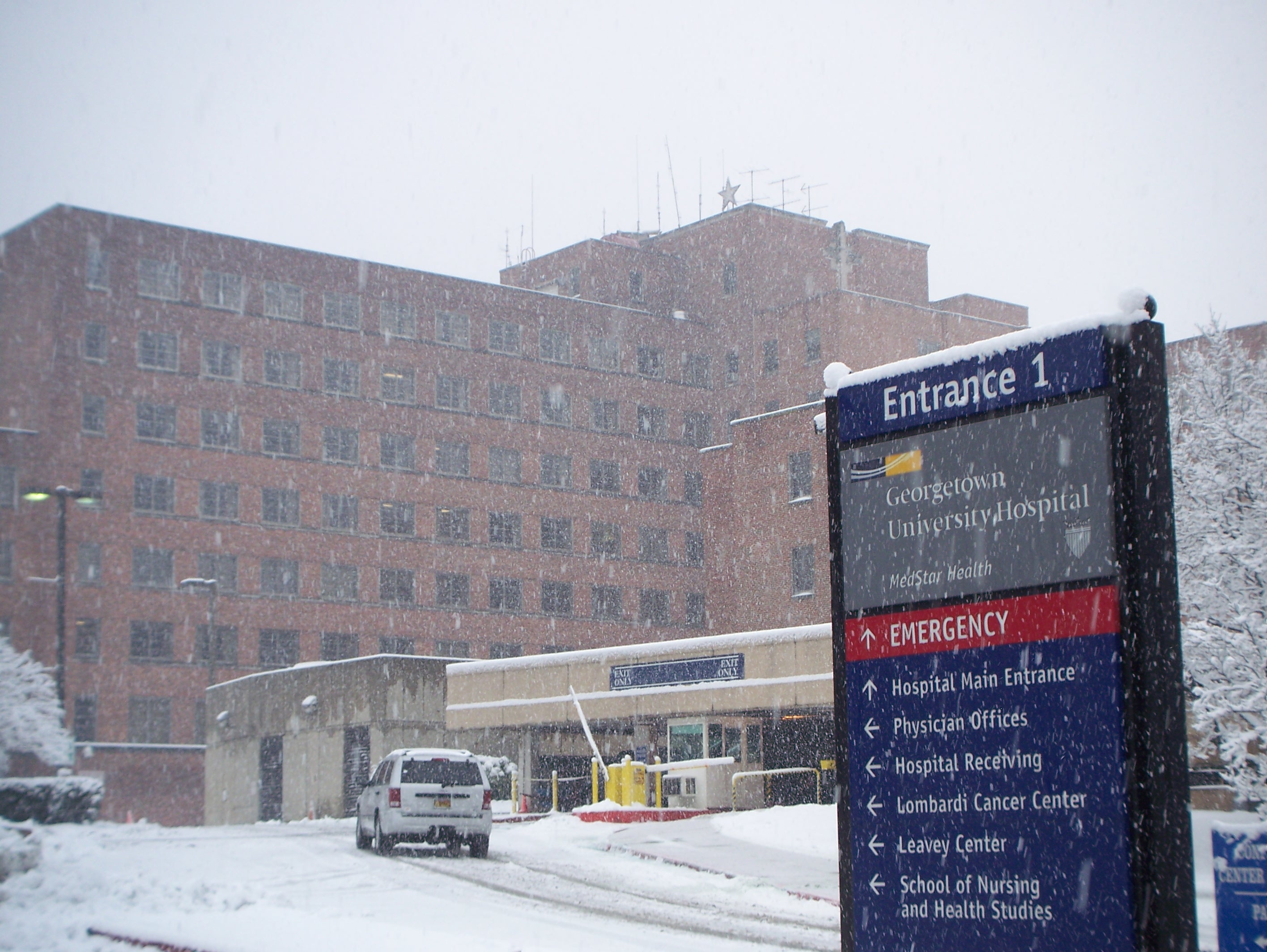
Georgetown University School of Medicine is a private medical school in Washington, D.C. Founded in 1851, it is one of Georgetown University's five graduate schools. It is located on Reservoir Road in the Georgetown neighborhood adjacent to the university's main campus. The School of Medicine works in association with the 609-bed MedStar Georgetown University Hospital, MedStar Washington Hospital Center, and nine other affiliated federal and community hospitals in the Washington metropolitan area. Georgetown is the oldest Catholic medical school in the United States.
The School is part of the Georgetown University Medical Center, which comprises roughly 80% of the research initiatives occurring at Georgetown University as a whole. It is the closest academic medical center in proximity to the National Institutes of Health. Georgetown and the NIH offer a combined GU-NIH PhD program in biomedical research to foster direct collaboration between the neighboring institutions.
Technology leading to the introduction of the HPV vaccine, was developed at Georgetown Medical Center by Richard Schlegel.
History
.jpg)
In 1849, four Catholic doctors frustrated with what they felt were discriminatory practices at neighboring Columbian College, limiting Catholic doctors' access to the clinical facilities of the Washington Infirmary, petitioned Georgetown President James A. Ryder to found a medical program. Classes commenced in May 1851 and were only held at night until 1895. In 1852, the school awarded its first medical doctorates.
In 1898 the Georgetown University Hospital was established. A dental department was created in 1901, which became independent of the School of Medicine in 1951 as the School of Dentistry. In 1930, classes moved to the main campus. In July 2000, Georgetown University and MedStar Health, a not-for-profit organization of seven Baltimore and Washington hospitals, entered into a clinical partnership to provide management of clinical care and clinical education at Georgetown University Hospital. In 2004, the School of Medicine opened the Integrated Learning Center (ILC), which supports the School of Medicine's emphasis on a patient-centered, competence-based curriculum and provides the latest methods of clinical teaching and evaluation.
Curriculum
The Georgetown University School of Medicine Faculty includes 1,638 faculty members from 8 basic science and 16 clinical departments, an NCI-designated Comprehensive Cancer Center, and two Interdisciplinary Training Program Grants funded by the NIH – one in Neuroscience, and one in Tumor Biology.
The School of Medicine offers an MD with a Research Track where MD students spend time in the laboratory and develop a research thesis in their specialty. This is different from the MD/PhD program, which is longer and requires a PhD thesis.
The School of Medicine and the Graduate School of Arts & Sciences cooperate to offer a combined-degree program that leads to an MD and a PhD in a chosen concentration. A spot is reserved in this program each year for one student interested in pursuing a Philosophy & Bioethics PhD; all other spots are undifferentiated but must be directed toward a scientific specialty. Research at Georgetown is especially strong in the areas of cancer and the neurosciences. Other combined degree programs include BA/MD (early selection route for Georgetown University undergraduates), MD/MBA, and MD/MS.
Programs
- Anesthesia
- Biochemistry & Molecular Biology
- Biomathematics & Statistics
- Cell Biology
- Dermatology
- Emergency Medicine
- Family Medicine
- Graduate Biomedical Education
- Medicine
- Microbiology & Immunology
- Neurology
- Neurosurgery
- Obstetrics & Gynecology
- Oncology
- Ophthalmology
- Orthopaedic Surgery
- Otolaryngology
- Pathology
- Pediatrics
- Pharmacology
- Physiology & Biophysics
- Psychiatry
- Radiation Medicine
- Radiology
- Surgery
- Urology
Campus

Georgetown University Medical Center comprises the School of Medicine, School of Nursing & Health Studies (founded in 1903), Georgetown Lombardi Comprehensive Cancer Center and Biomedical Graduate Education. In 2008, GUMC brought in $132 million in sponsored research funds, most of which was federally funded. Clinical care is provided at MedStar Georgetown University Hospital and other locations through a partnership with MedStar Health.
List of deans
| No. | Name | Years | Norman J. Beauchamp Jr. | ||
|---|---|---|---|---|---|
| 1 | 1851–1876 | ||||
| 2 | 1876–1877 | ||||
| 3 | 1877–1883 | ||||
| 4 | 1883–1888 | ||||
| 5 | 1888–1901 | ||||
| 6 | 1901–1928 | ||||
| 7 | 1929–1931 | ||||
| 8 | 1931–1935 | ||||
| 9 | 1935–1946 | ||||
| 10 | 1946–1953 | ||||
| 11 | 1953–1958 | ||||
| 12 | 1958–1963 | ||||
| 13 | 1963–1974 | ||||
| 14 | 1974–1979 | ||||
| 15 | 1979–1984 | ||||
| 16 | 1984–1989 | ||||
| 17 | 1989–1998 | ||||
| 18 | 1998–2002 | ||||
| 19 | 2002–2020 | ||||
| 20 | 2021– | ||||
| 21 | 2021–present |
Notable alumni
Main article: List of Georgetown University alumni
| Name | Degree and year received | Accomplishments |
|---|---|---|
| John Barrasso | C 1974, M 1978 | United States Senator from Wyoming, 2007–present |
| Mark R. Dybul | C 1985, M 1992 | United States Global AIDS Coordinator, U.S. Department of State, 2006–2008 |
| David John Doukas | M 1983 | Tulane University; Director of the Program in Medical Ethics and Human Values, James A. Knight Chair in Medical Humanities and Ethics |
| Marguerite M. Engler | Ph.D. – 1988 | Nurse scientist and physiologist, acting scientific director of the National Institute of Nursing Research's division of intramural research, 2012 |
| Marie R. Griffin | M 1976 | Vaccine researcher; Professor of Medicine and Endowed Director of Public Health Research and Education at Vanderbilt University Medical Center |
| David A. Hidalgo | C 1974, M 1978 | Reconstructive and aesthetic plastic surgeon, author, and visual artist; Clinical Professor of Surgery at Weill Cornell Medical College |
| Susan Hockfield | Med Ph.D. – 1979 | Neuroscientist; President, MIT, 2004–2012; Provost, Yale University, 2003–04; Dean, Yale Graduate School of Arts and Sciences, 1998–2000; |
| Thea L. James | M 1991 | Associate Professor, Associate Chief Medical Officer, and Vice President of the Mission at the Boston Medical Center |
| Kevin C. Kiley | M 1976 | Lt. Gen. Kiley is the 41st Surgeon General of the Army and Commander, U.S. Army Medical Command, 2004–2007 |
| Antonia Novello | Hospital Fellow 1975 | Surgeon General of the United States, 1990–93 |
| Esam Omeish | C 1989, M 1993 | former President of the Muslim American Society |
| Thomas Parran Jr. | M 1915 | Surgeon General of the United States, 1936–48 |
| Sean P. Pinney | C 1990, M 1994 | Cardiologist |
| Robert R. Redfield | C 1973, M 1977 | Director of the Centers for Disease Control and Prevention, 2018–2021 |
| John J. Ring | C 1949, M 1953 | former President, American Medical Association |
| Jordan Shlain | M 1994 | Primary care physician; chairman and founder of Private Medical, a family office for health and medicine; founder of HealthLoop, a cloud-based clinical engagement platform |
| Lana Skirboll | Ph.D – 1977 | former Director, National Institutes of Health Office of Science Policy |
| William Kennedy Smith | M 1991 | Founder, Center for International Rehabilitation and Physicians Against Land Mines; member of the Kennedy family |
| Solomon Snyder | C 1959, M 1962 | Neuroscientist |
| Robert Stein | M 1866 | German-American translator, interpreter of Eskimo–Aleut languages, and amateur Arctic explorer |
| Andrew von Eschenbach | M 1967 | Director, Food and Drug Administration, 2006–2009; Director, National Cancer Institute, 2002–05; Director, BioTime, a biotechnology company, 2011–present |
| William B. Walsh | M 1943 | Founder of Project HOPE; humanitarian aid activist; first U.S. physician on the ground in Hiroshima after the atomic bomb was dropped; recipient of the Presidential Medal of Freedom |
References
Citations
Sources
References
- "GU-NIH Graduate Partnership Programs in Biomedical Sciences". [[Peterson's]].
- (Winter 2011–12). "Alum Dick Schlegel Gives Cancer Prevention His Best Shot". Northwestern University.
- (2003). "Georgetown University". Arcadia Publishing.
- Shea, John Gilmary. (1891). "Memorial of the First Century of Georgetown College, D.C.: Comprising a History of Georgetown University". [[Peter Fenelon Collier.
- "Dental Alumni History: 1930–1960".
- (18 February 2000). "MedStar, GU Strike Hospital Deal". [[The Washington Post]].
- "M.D./Ph.D. Program".
- {{Harvnb. Curran. 2010a. ()
- {{Harvnb. Curran. 2010b
- {{Harvnb. Curran. 2010c
- (June 22, 2020). "Hoya Saxa: An Interview with Dean Stephen Ray Mitchell". Georgetown Medical Review.
- (March 30, 2021). "Meet Leon 'Lee' Jones, Georgetown's New Dean for Medical Education".
- "The Deans".
This article was imported from Wikipedia and is available under the Creative Commons Attribution-ShareAlike 4.0 License. Content has been adapted to SurfDoc format. Original contributors can be found on the article history page.
Ask Mako anything about Georgetown University School of Medicine — get instant answers, deeper analysis, and related topics.
Research with MakoFree with your Surf account
Create a free account to save articles, ask Mako questions, and organize your research.
Sign up freeThis content may have been generated or modified by AI. CloudSurf Software LLC is not responsible for the accuracy, completeness, or reliability of AI-generated content. Always verify important information from primary sources.
Report