From Surf Wiki (app.surf) — the open knowledge base
Georgetown Hoyas men's basketball
Men's basketball team of Georgetown University

Men's basketball team of Georgetown University
| Field | Value |
|---|---|
| name | Georgetown Hoyas |
| current | 2025–26 Georgetown Hoyas men's basketball team |
| logo | Georgetown Hoyas logo.svg |
| logo_size | 150 |
| university | Georgetown University |
| firstseason | 1906–07 |
| record | |
| conference | Big East |
| location | Washington, D.C. |
| athletic_director | Lee Reed |
| coach | Ed Cooley |
| tenure | 3rd |
| arena | Capital One Arena |
| capacity | 20,356 |
| nickname | Hoyas |
| bestfinish | 1 |
| NCAAchampion | 1984 |
| NCAArunnerup | 1943, 1982, 1985 |
| NCAAfinalfour | 1943, 1982, 1984, 1985, 2007 |
| NCAAeliteeight | 1943, 1980, 1982, 1984, 1985, 1987, 1989, 1996, 2007 |
| NCAAsweetsixteen | 1980, 1982, 1984, 1985, 1987, 1989, 1995, 1996, 2001, 2006, 2007 |
| NCAAtourneys | 1943, 1975, 1976, 1979, 1980, 1981, 1982, 1983, 1984, 1985, 1986, 1987, 1988, 1989, 1990, 1991, 1992, 1994, 1995, 1996, 1997, 2001, 2006, 2007, 2008, 2010, 2011, 2012, 2013, 2015, 2021 |
| conference_tournament | 1975, 1976, 1979, 1980, 1982, 1984, 1985, 1987, 1989, 2007, 2021 |
| conference_season | 1939, 1980, 1984, 1987, 1989, 1992, 2007, 2008, 2013 |
| division_season | 1996, 1997 |
| h_body | BBBCBC |
| h_shorts | BBBCBC |
| h_pattern_b | _thinmidnightbluesides |
| h_pattern_s | _midnightbluesides |
| a_body | 041E42 |
| a_shorts | 041E42 |
| a_pattern_b | _silversides |
| a_pattern_s | _graysides |
| 3_body | 00B5E2 |
| 3_shorts | 00B5E2 |
| 3_pattern_b | _thinmidnightbluesides |
| 3_pattern_s | _midnightbluesides |
The Georgetown Hoyas men's basketball program represents Georgetown University in NCAA Division I men's intercollegiate basketball and the Big East Conference. Georgetown has competed in men's college basketball since 1907. The current head coach of the program is Ed Cooley.
Georgetown won the national championship in 1984 and has made the Final Four on five occasions. They have won the Big East Conference tournament a record eight times, and have also won or shared the Big East regular season title ten times. They have appeared in the NCAA tournament 31 times and in the National Invitation Tournament 13 times.
The Hoyas historically have been well regarded not only for their team success, but also for generating players that have succeeded both on and off the court, producing NBA legends such as Patrick Ewing, Dikembe Mutombo, Alonzo Mourning, and Allen Iverson, as well as United States Congressman Henry Hyde and former NFL Commissioner Paul Tagliabue. Seven former Hoya players or coaches are members of the Basketball Hall of Fame.
History
Early years (1907–1943)
Founded in the fall of 1906, the Georgetown men's basketball team played its first game on February 9, 1907, defeating the University of Virginia by a score of 22–11. In its first 60-some years, the program displayed only sporadic success. Until McDonough Gymnasium opened on campus for the 1950–51 season, the team changed home courts frequently, playing on campus at Ryan Gymnasium and off campus at McKinley Technology High School, Uline Arena, and the National Guard Armory, as well as playing individual home games at the University of Maryland's Ritchie Coliseum and The Catholic University of America's Brookland Gymnasium, among others. The downtown locations of these venues was also influenced by the number of Law School students who played on the team in this era. From 1918 through 1923, while on campus at Ryan Gymnasium, Georgetown managed a 52–0 home record under coach John O'Reilly. A large on-campus arena was proposed in 1927, but it was shelved during the Great Depression.
The team recruited its first All-American, Ed Hargaden, in 1931. In 1942, a Hoya went pro for the first time, when three seniors, Al Lujack, Buddy O'Grady, and Dino Martin, were drafted professionally upon graduation.
The next year the team, led by future congressman Henry Hyde, reached new heights and posted its first 20-win season ever, going 22–5 on the year. This success translated into a berth into the 1943 NCAA tournament, the school's first postseason appearance. Taking advantage of the opportunity, the Hoyas made it all the way to the National Championship game, where they ultimately lost to Wyoming. Georgetown's coach of this squad, Elmer Ripley, was later inducted into the Basketball Hall of Fame in 1973.
World War II and the lean years (1943–1972)

Coming off of the best season in school history, momentum was stalled as the program was suspended from 1943 to 1945 because of World War II. Following the hiatus the program struggled to find its footing, and it was rarely successful over the next three decades, only making two postseason appearances during this time period.
In 1953, former Baltimore Bullets player Buddy Jeannette coached the team to its first National Invitation Tournament invitation, but the team lost in the first round to Louisville.
John Thompson era (1972–1999)
.jpg)
John Thompson Jr., played two seasons with the Boston Celtics before he achieved local notability coaching St. Anthony's High School in Washington, D.C. to several very successful seasons. Thompson was hired to coach Georgetown in 1972, and with recruits from St. Anthony's like Merlin Wilson, quickly and dramatically improved the team. Georgetown, while still independent, participated in the Eastern College Athletic Conference′s 1975 postseason ECAC South tournament, and after a 16–9 regular season found itself facing West Virginia in the conference tournament championship. Derrick Jackson's buzzer beater won Georgetown its first tournament championship, and a bid to the 1975 NCAA tournament.
1979-80 Season: birth of a historic rivalry and champions of the inaugural Big East regular season and tournament
Prior to the 1979–80 season, Georgetown joined with six other schools, Providence, St. John's, Syracuse, Seton Hall, Connecticut, and Boston College to found a conference focused primarily on basketball. The Big East Conference provided Georgetown increased competition, and several of its longest rivalries. For example, prior to the formation of the Big East, Georgetown had only played national powerhouse Syracuse 18 times in the previous 51 years, and only twice in the prior decade. After the start of the Big East, they played Syracuse 27 times in the next 10 years.
On February 13, 1980, Syracuse had won 57 straight games on its home court of Manley Field House: the longest winning streak in Division 1 basketball. The team was about to move to the new Carrier Dome. Its last game of the Big East regular season and its final ever at Manley was supposed to be a celebration of the winning streak and the school's success. With Syracuse ranked #2 in the country and almost invincible at Manley, they were expected to readily beat Georgetown. Syracuse seniors had never lost a home game in their entire careers. Hoyas radio announcer Rich Chvotkin said, "Everybody was pointing to Syracuse continuing that streak, and closing Manley Field House on a high note." Years later, Thompson said in the lead-up to the game, he was extremely nervous because of how crazy the crowd would be: “My nerves were at the height at that point saying: ‘What the hell am I doing closing this place? The place is going to be, you know, going mad.’”
Behind by 14 points at the half, and by many points late in the game, Georgetown mounted a surprise, rapid comeback. After Georgetown star Sleepy Floyd scored two last-second free-throws to win, Coach Thompson grabbed a microphone and declared "Manley Field House is officially closed" to an audience of stunned, silent Syracuse supporters. ESPN columnist Eamonn Brennan, wrote that Manley Field House “is most famous for its service to the Georgetown-Syracuse blood feud.” He said: “Before 1980, the Hoyas and Orange were competitors, and little more. When John Thompson delivered his famous 'Manley Field House is officially closed,' he managed to pack so much ether into six words that a rivalry was born on the spot. It's been that way ever since."
Syracuse professor Lawrence Mason said, "There was no rivalry at all until that Manley Field House game." Chvotkin agreed: "I think the rest of that Georgetown-Cuse rivalry was predicated on closing Manley Field House." Doug Logan, the Syracuse radio announcer for 24 years, said: "It was Syracuse and Georgetown and that hated, bitter rivalry that made the Big East a national phenomenon." ESPN analyst and Syracuse graduate Mike Tirico commented: "Without John’s larger than life personality, his great players, his steadfastness in the John Thompson way of doing things, it wouldn’t have built the rivalry and wouldn't have built the Big East to what it became for the 80s and the 90s."
The Manley upset also made Georgetown co-champions of the first Big East regular season. Three weeks later, Georgetown faced Syracuse again in the finals of the first Big East tournament. With Syracuse ranked #3 in the country and Georgetown #20, the Hoyas were again the underdogs. But they pulled off another upset, winning 87–81 behind 21 points from Floyd to become the first Big East tournament champions. In the 1980 NCAA tournament, the team advanced to the Elite Eight, where they fell to the Iowa Hawkeyes on a last second foul call.
1981-82 Season
The team moved its home arena in the 1981-82 season to the Capital Centre in Landover, Maryland, to accommodate its growing fan base. It also marked the arrival of heralded recruit, Patrick Ewing, who became one of the first college players to start and star on a varsity team as a freshman. That year, Ewing led the Hoyas to their second Big East tournament title in school history, and a No. 1 seed in the NCAA tournament.
In the tournament, the Hoyas advanced to their first Final Four since 1943, where they defeated the University of Louisville 50–46, to set up a showdown in the NCAA Final against the University of North Carolina. In one of the most star-studded championship games in NCAA history, Ewing was called for goaltending five times in the first half (later revealed to be intentional at the behest of coach Thompson), setting the tone for the Hoyas and making his presence felt. The Hoyas led by one point late in the game, but a jumpshot by future NBA superstar Michael Jordan gave North Carolina the lead. Georgetown still had a chance at winning the game in the final seconds, but Freddy Brown mistakenly threw a bad pass directly to opposing player James Worthy, and North Carolina won 63–62.
1982-83 Season
For the 1982-83 season, Georgetown began the season as the No. 2 ranked team in the country. The early season included a highly anticipated matchup with No. 1 Virginia, and highly regarded center Ralph Sampson. Arenas nationwide jockeyed to host the matchup but Georgetown insisted on hosting it at the Capital Centre. WTBS won the rights to broadcast the game with a $550,000 bid, and it was billed as the "Game of the Decade". It became the first major college sports event telecasted exclusively on cable television. In the game, held on December 11, 1982, Virginias veteran team won, 68–63.
The Hoyas went on to post a 22–10 record for the season and made another NCAA Tournament appearance, but were defeated in the second round of the tournament by Memphis State. This was the only season in Ewing's four-year Georgetown career where the team did not make it as least as far as the National Championship game.
1983-84 Season: National Champions
In the 1983-84 season Georgetown again won the Big East conference regular season title, and faced Syracuse for the Big East tournament championship. In a physical and tightly contested contest, Georgetown won 82–71 in overtime, securing their third tournament title in the first five years of the newly formed conference.
In the NCAA tournament, the No. 1 seeded Hoyas ultimately advanced to the Final Four for the third time in school history to face Kentucky, a team which had never lost a national semifinal game and was led by the "Twin Towers," Sam Bowie and Melvin Turpin. Georgetown was able to turn an early 12 point deficit into a 53–40 win to advance to the National Championship game. In the final, the Hoyas faced the University of Houston and future Hall of Fame center Hakeem Olajuwon, who were making their second straight National Championship game appearance. Georgetown led comfortably throughout the final, and went on to an 84–75 victory, giving the school its first NCAA Championship. Ewing was named the tournament's Most Outstanding Player, while Thompson became the first African-American coach to win an NCAA Division I title. Freddy Brown, who made the key turnover in the title game two years prior, was given the chance to raise the trophy first.
1984-85 Season
To begin the 1984-85 season, the defending champions opened the season as the No. 1 ranked team and won their first 18 games. On January 26, 1985, St. John's University snapped the Hoyas' 29 game win streak (dating back to the prior season), in what was the first of an unprecedented four contests this season. Their next meeting on February 27, 1985, was one of the most anticipated games in college basketball history, with Georgetown and St. John's ranked No. 2 and No. 1 respectively. Coach Thompson entered Madison Square Garden wearing a shirt under his blazer in the same sweater pattern as St. John's coach Lou Carnesecca, and as a result the game became known as "the sweater game." The Hoyas easily won the game 85–69, and then defeated the Redmen again just a few weeks later in the 1985 Big East tournament finals, capturing their fourth title in six years. The teams met one more time, after both advanced to the Final Four in the NCAA tournament. Again No. 1 Georgetown was victorious, easily handling St. John's 77–59.
In the title game the Hoyas found themselves matched up with another conference rival in Villanova, whom they had beaten twice that season. An overwhelming favorite going into the game, Georgetown was upset by the Wildcats 66–64, who shot a record 78.6 percent (22 of 28) from the floor, denying Georgetown back-to-back titles. Ewing graduated, having helped his team to a 121–23 record in his four years, and was the first player in school history to be drafted with the first overall pick.

Continued Success Under Coach Thompson
Following the enormous heights of Ewing's four-year run, the program continued its success in the years that followed. Senior Reggie Williams led the Hoyas to both Big East regular season and tournament championships in the 1986–87 season. Freshman Alonzo Mourning and sophomore Dikembe Mutombo helped win both titles in the 1988–89 season. Mourning and Mutombo were both excellent shot blockers; Mourning led the nation in 1988–89, and fans created a "Rejection Row" section under the basket. They repeated both championships in the 1989–90 season and won the regular season title in the 1991-92 season.
In the 1994–95 season, newcomer Allen Iverson won the Big East Rookie of the Year award. During his two years at Georgetown, Iverson scored a Georgetown-record 22.9 points per game. In 1995–96, he propelled the Hoyas to a major upset over the Connecticut Huskies during the season, but Georgetown later lost to the Huskies in the final seconds of that year's Big East tournament. In the NCAA tournament, the Hoyas came up one game short of the Final Four, losing to the University of Massachusetts, the top ranked team in the country.
In the 1996–97 season, with an 11–7 conference record, the Hoyas won the regular season Big East 7 Division title for the second year in a row, but fell in the first round of the 1997 NCAA tournament. In December 1997, just after the beginning of the 1997-98 season, the team moved back into Washington, D.C., with the construction of a new arena, the Verizon Center (originally MCI Center), in Chinatown. The 1997-98 campaign ended in an overtime loss to Georgia Tech in the NIT.
Thompson retired abruptly in the midst of the 1998–99 season on January 8, 1999, citing marital problems, and was replaced by his assistant Craig Esherick. Under Thompson, 26 players were chosen in the NBA draft, eight in the first round, including two players selected first overall; Ewing by the New York Knicks in 1985 and Iverson by the Philadelphia 76ers in 1996. Over his seasons, Thompson's Hoyas went an impressive 596–239 (.714), running off a streak of 24 postseason appearances with 20 in the NCAA tournament and four in the NIT. He was honored as the National Coach of the Year three times during his career at Georgetown, and was inducted into the Basketball Hall of Fame in 1999.
Craig Esherick era (1999–2004)
Craig Esherick coached the Georgetown Hoyas basketball squad from January 1999 to March 2004. Esherick was a four-year player for the men's basketball team from 1974 to 1978 and then the lead assistant coach under John Thompson Jr. from 1981 to 1999. The team finished with a 15–15 record in his first season – going 8–10 after Thompson resigned and Esherick took over –before losing to Princeton in the first round of the 1999 NIT. They improved in 1999-2000, going 19–15 and accepting an invitation to the 2000 NIT. After winning the first-round game in triple overtime over Virginia, the Hoyas lost in the second-round game to California.
2000-01 Season
In 2000–01, led by future top NBA Draft pick Michael Sweetney, they made the NCAA tournament after finishing 23–7 in the regular season. In the opening round of the NCAA tournament the 7th-seeded Hoyas advanced past 10th-seeded Arkansas on a game-winning shot at the buzzer by Nat Burton. The Hoyas subsequently beat Hampton, and then lost to third-seeded Maryland in the Sweet Sixteen.
Esherick's Final Years
In 2001–02, the Hoyas went 19–11, barely missing an NCAA tournament bid. The team rejected a bid to the 2002 NIT bid because of travel-arrangement issues associated with the players' ability to attend classes, resulting in their first season without a postseason tournament since 1973-74. In 2002-03, the Hoyas finished the regular season with a 19–15 record, and accepted a bid to the 2003 NIT, where they made it to the final but lost to Big East rival St. John's. Sweetney was named a second-team All-American and was drafted with the ninth pick in the 2002 NBA draft by the New York Knicks.
In Esherick's final season, 2003–04, the Hoyas struggled to a 13–15 overall record and a dismal 4–12 Big East record, and for the first time since the 1973–74 season received no invitation to either the NCAA tournament or the NIT. The 13 wins were the team's fewest since the 1973–74 season and Esherick was fired after seasons as head coach on March 15, 2004, five days after an opening-round loss in the Big East tournament to Boston College. He had posted a 103–74 (.597) record during his tenure as head coach. Georgetown began a national search for a new coach after Esherick's firing that resulted in the hiring of John Thompson III.
John Thompson era (2004–2017)

On April 21, 2004, John Thompson III was selected as the head coach of the Hoyas. The son of the legendary Hoyas coach took over the position after over a decade at Princeton University. The younger Thompson was a player for the Tigers from 1984 to 1988, was an assistant coach at Princeton from 1995 to 2000, and then took over as head coach at Princeton until his move to the Hoyas. Thompson's head coaching stint at Princeton was marked with success as he led the Tigers to three Ivy League titles, two NCAA Tournament appearances and one NIT appearance.
Thompson brought with him an adaptation of the Princeton offense as an offensive philosophy to Georgetown. He had learned it under the tutelage of legendary coach Pete Carril at Princeton and began to adjust the strategy to the more athletic players he would be coaching at Georgetown. Thompson III also immediately brought two new assistant coaches to Georgetown in Robert Burke and Kevin Broadus.
Thompson inherited four players that Esherick had recruited: Jeff Green, Roy Hibbert, Tyler Crawford and RaMell Ross. He also brought with him a former Princeton recruit, Jonathan Wallace and saw the return of two major contributors from the previous Georgetown team in Brandon Bowman, Ashanti Cook, and Darrel Owens. John Thompson III's first notable win with the team took place on January 21, 2006, in the 16th game of the 2005–06 season, when unranked Georgetown upset No. 1 Duke. This was Georgetown's first win over a No. 1 ranked team in 21 years.

2006-07 Season
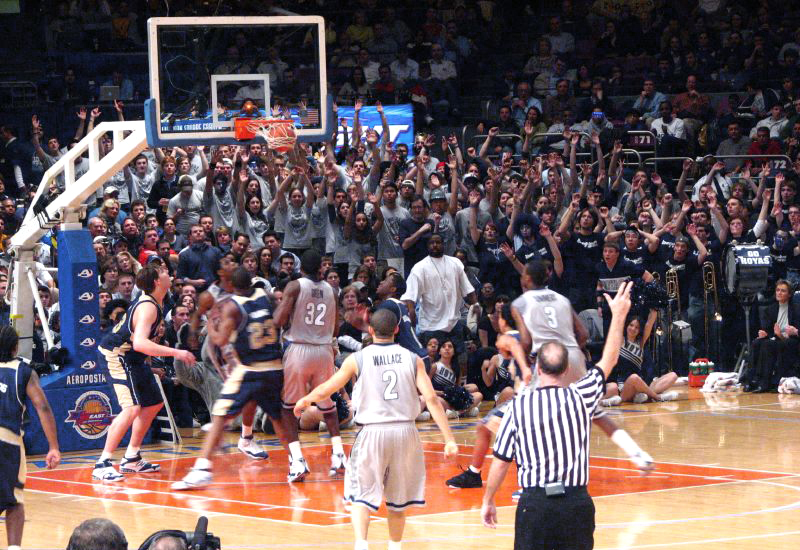
The 2006–07 season marked the centennial of Hoya hoops, which was celebrated by honoring some of the team's most famous alumni at the Georgetown-Marquette game on February 10, 2007. Led by juniors Green, Hibbert, Wallace, Patrick Ewing Jr., the son of the Georgetown player from the elder Thompson era, the Hoyas won their first regular-season Big East Championship since 1992 and defeated Pittsburgh to win their first Big East tournament championship since 1989. Jeff Green was named the Big East Player of the Year and the tournament's Most Outstanding Player. In the NCAA tournament, the Hoyas beat North Carolina in the Regional Final when their defense caused North Carolina to suffer an improbable collapse in which UNC missed 22 of their final 23 field goal attempts. The Hoyas then advanced to the Final Four where they fell to an Ohio State team led by Greg Oden.
2007-08 Season
The 2007–08 Hoyas finished with a regular season record of 27–5, and again won the conference regular season title. They lost to Pittsburgh in the Big East tournament championship game. They received a No. 2 seed in the NCAA tournament, where they lost their second-round game. After the season, Roy Hibbert, Jonathan Wallace, and Patrick Ewing Jr. all graduated, while Vernon Macklin and Jeremiah Rivers both transferred from the school.
2008-09 Season
The Hoyas began their 2008–09 season ranked No. 22 AP/No. 18 Coaches, however, college basketball's toughest strength of schedule eventually wore down a team that was also one of the youngest. The Hoyas were 7–11 in Big East play for a 12th-place finish, followed by a first-round loss in the Big East tournament. The Hoyas accepted a bid to the NIT, but lost in the first round to Baylor.
2009-10 Season
In 2009–10, the team finished the season 23–11, and 10–8 in Big East play. They advanced to the championship game of the Big East tournament before losing to West Virginia. They received an at–large bid to the NCAA tournament, earning a No. 3 seed in the Midwest Region, where they were upset by No. 14 seed Ohio in the first round. Standout center Greg Monroe entered the NBA draft as a sophomore and was selected by the Detroit Pistons.
2010-11 Season
The 2010–11 team was led by Austin Freeman and Chris Wright. The team scored multiple early wins over ranked teams, including an overtime win at No. 9 Missouri, but their stumbles at the end of the season coincided with Wright breaking his hand and missing three games. The team received an at-large bid as a No. 6 seed, but lost in their first game of the NCAA tournament to No. 11-seeded and eventual Final Four participant VCU.
2011-12 Season
Prior to the 2011–12 season, the Hoyas made a goodwill trip to China for several matches with local teams. U.S. Vice President Joe Biden attended their first game, a win over the Shanxi Zhongyu Brave Dragons. Their second game against the Bayi Rockets, however, ended in a brawl, causing the team to leave the court while Chinese fans threw garbage and debris. Georgetown won its final games, against the Liaoning Dinosaurs and the Taiwanese national team without incident. The Hoyas finished the season in fourth place in the Big East and received a bid to the NCAA tournament as a No. 3 seed in the Midwest. After a win in the second round, they were upset by No. 11-seeded NC State.
2012-13 Season
The 2012–13 season saw the Hoyas as the top overall seed in the Big East tournament based on a tiebreaker, but lost in the semifinals. Georgetown received a bid as a No. 2 seed in the South bracket in the NCAA tournament, facing tournament newcomer Florida Gulf Coast University in the second round. Georgetown lost to the 15th-seeded Eagles 78–68, the seventh number two seed to lose to a 15 seed. It was the fourth consecutive season the Hoyas were eliminated by a double-digit seed in the NCAA tournament.
2013-14 Season
The 2013–14 season was the team's first after Georgetown and six other schools left the original Big East Conference and joined Butler, Creighton, and Xavier in forming the new Big East Conference – part of a major conference realignment in which several other teams moved to the Atlantic Coast Conference from the old Big East and the old Big East became the American Athletic Conference.
Like the previous year, the 2013–14 season started abroad, with the Hoyas playing in the Armed Forces Classic at Camp Humphreys near Pyeongtaek, South Korea. After a 17–13 regular-season record followed by an upset in the first round of the Big East tournament at the hands of last-place DePaul, the team received a No. 4 seed in the NIT, losing in the second round to top-seeded Florida State.
John Thompson III's Final Years
In 2014–15, the Hoyas rebounded from their previous season's performance. Ranked as high as No. 21 at times, they completed the regular season with a 20–7 record and a second-place finish in the Big East, and advanced to the semifinals of the Big East tournament before losing to Xavier. Ranked No. 22 in the country, they received a No. 4 seed in the NCAA tournament, but lost to Utah in the third round.
The Hoyas under Thompson III struggled for the next two years. They began their 2015–16 season with a four-game exhibition trip to Italy and Switzerland, and early in the regular season defeated No. 14 Syracuse, but then staggered to a 15–18 finish. They failed to receive an invitation to either the NCAA tournament or the NIT for the first time since 2004 and only the second time since 1974.
During the 2016–17 season, Georgetown defeated three ranked teams—No. 13 Oregon, No. 16 Creighton, and No. 11 Butler—as well as their former Big East rivals Syracuse and Connecticut, but they finished ninth in the Big East with a 5–13 conference record—the most losses they had ever suffered in a season in either version of the Big East Conference—and lost to St. John's in the first round of the 2017 Big East tournament to finish 14–18. They missed both the NCAA tournament and the NIT for the second straight year, the first time they had missed the postseason in back-to-back seasons since 1974.
Thompson became the first Georgetown head coach to preside over consecutive losing seasons since John "Jack" Magee in 1970–71 and 1971–72. On March 23, 2017, Georgetown officials announced that Thompson had been fired.
Patrick Ewing era (2017–2023)
.jpg)
On April 3, 2017, Georgetown University announced that it had hired Patrick Ewing, the school's most decorated player, as its head coach. In his four years as a player at Georgetown, Ewing led the Hoyas to three Big East championships, three Final Fours, and the 1984 National Championship. Prior to taking over as the program's head coach, Ewing had spent the previous thirteen years as an assistant coach in the NBA, working for four different franchises under the tutelage of coaches such as Jeff Van Gundy, Stan Van Gundy, and Steve Clifford.
2017-18 Season
In 2017–18, Georgetown finished with a 15–15 record and 5–13 in the Big East. The Hoyas won the first eight games of Ewing's tenure and finished their non-conference schedule with a 10–1 record, but struggled in conference play. The season ended with a 88–77 loss to St. John's in the first round of the Big East tournament. The team did not participate in any postseason tournament.
2018-19 Season
In Ewing's second season, the 2018–19 team finished 19–12 and 9–9 in the Big East, in a four-way tie for third place in the conference, their highest finish since 2015. At the conclusion of the conference schedule, Jesse Govan was named First Team All-Big East, James Akinjo was named Big East Freshman of the Year, and Mac McClung and Josh LeBlanc were named to the All-Big East Freshman Team. The Hoyas lost their first game in the 2019 Big East tournament to Seton Hall 73–57. They were selected to play in the 2019 NIT, their first postseason appearance since 2015, but dropped their first-round game 71–68 to Harvard.
2019-20 Season
The following season the 2019–20 Hoyas finished 15–17 and 5–13 in the Big East. In November, the team participated in the Empire Classic at Madison Square Garden in New York City where they beat No. 22 Texas 82–66 and moved to the final to face No. 1 Duke. Despite having a double-digit lead in the first half vs Duke, the Hoyas ultimately fell 81–73. Playing with only 9 scholarship players following several defections and injuries, the Hoyas lost their final 7 games, including a 75–62 loss in the opening round of the 2020 Big East tournament to St. John's. All postseason tournaments were subsequently cancelled due to the COVID-19 pandemic.
2020-21 Season
The 2020–21 Hoyas finished the season 10–13 and 7–9 in the Big East. Before the season started, leading scorer Mac McClung announced his decision to transfer to Texas Tech. Because of COVID-19 protocols, the team played all of its home games on campus at McDonough Arena without fans. After a 74–69 loss at Syracuse, the team went on a 21-day pause due to COVID-19 protocols. After the hiatus, the team returned to win six of its next ten games. The Hoyas' 7–9 record resulted in an eighth-place finish in the conference. At the 2021 Big East tournament, the team won its first tournament game under Ewing, with a 68–49 victory over Marquette in the opening round, then followed that up with wins against top-seeded Villanova and Seton Hall, sending them to the title game where they defeated Creighton 73–48 for their first title since 2007, and the eighth in school history, extending their own conference record. The Hoyas earned a 12 seed in the NCAA tournament, where they lost their opening round game to Colorado 96–73.
Ewing's Final Years as Coach: Historic Struggles
The following season, the Hoyas were unable to build off their unlikely March run the prior season and suffered their worst season in school history. Georgetown lost all 19 conference games they played in 2021-22. They also set a school record for most losses in a season with 25, finishing the year at 6–25. The season ended with a 57–53 loss in the 2022 Big East tournament to Seton Hall. Despite some rumblings about his job security, Ewing was retained by the university for the following season.
Despite some optimism with several high-impact transfers brought in over the off-season, the 2022–23 Hoyas failed to improve from the prior year's low. The team would lose its first 9 conference games, extending the record of consecutive conference game losses to 29, until they eventually beat DePaul 81–76 on January 24, at Capital One Arena. The Hoyas would only win more game after this point and finished the year at 7–25, matching the program's high water mark for losses, just set the previous season. The team lost in the 2023 Big East tournament 48–80 to Villanova.
The following day, the university announced that Ewing would not return as coach, ending his six-year run at his alma mater. His Georgetown coaching career ended with a record of 75–109 (.408) and 28–81 (.257) in the Big East; both are the lowest winning percentages for a coach in the modern era of the program.
Ed Cooley era (2023–present)

On March 20, 2023, Ed Cooley accepted an offer to become the new head coach of the Georgetown Hoyas men's basketball team after 12 years in the same role at conference rival Providence College. The decision to hire Cooley was praised as a move likely to strengthen the program.
2023-24 Season
The 2023–2024 Hoyas started the season 7–4, with a notable last second win at Notre Dame, its first victory over the Irish on the road since the 2013 season (when they were a fellow member of the Big East). The team lost several close games in conference play, including its much anticipated matchup against Providence, one of the most watched college basketball games of the season. Ultimately Georgetown finished 2–18 in the league and 9–23 overall. The two league wins however matched the number of wins the Hoyas had the prior two seasons combined in Big East play.
2024-25 Season
The team's roster was completely overhauled before the 2024–2025 season. Headlined by Top 50 high school recruit Thomas Sorber, reigning Ivy League freshman of the year Malik Mack (from Harvard), and highly regarded graduate transfer Micah Peavy (from TCU), the recruiting class was ranked as the 29th best in the country. The Hoyas got out to their best start in over a decade, as they began the year 12–2. The strong start included Cooley's first win at rival Syracuse in the 100th matchup of the storied rivalry, and a 3–0 record to begin Big East play with wins over Creighton, Seton Hall and Xavier.
Georgetown struggled with injuries down the stretch, most significantly losing Sorber for the season in early February. Georgetown was selected to play in the inaugural 2025 College Basketball Crown postseason tournament in Las Vegas, Nevada. The Hoyas won their opening round game versus Washington State, 85–82 before losing in the Quarterfinals to Nebraska 81–69. The finished the year 18-16 (8-12 in the Big East).
In June, two Hoyas were selected in June at the 2025 NBA Draft. Sorber was chosen 15th overall by the Oklahoma City Thunder, and Peavy went 40th overall to the New Orleans Pelicans. Sorber's selection made him the first player in program history to be drafted directly into the NBA as a freshman. The 2025 draft marked the sixth time since 1980 (and the first time since 2008) that a pair of Georgetown teammates were selected in the same draft.
Awards and honors
Naismith Player of the Year Award
- 1985 - Patrick Ewing
Associated Press Player of the Year
- 1985 - Patrick Ewing
Most Outstanding Player of the NCAA tournament
- 1984 - Patrick Ewing
Big East Player of the Year
- 1980 - John Duren
- 1984 - Patrick Ewing
- 1985 - Patrick Ewing
- 1987 - Reggie Williams
- 1989 - Charles Smith
- 1992 - Alonzo Mourning
- 2007 - Jeff Green
- 2013 - Otto Porter
Big East Rookie of the Year
- 1981 - Fred Brown
- 1982 - Patrick Ewing
- 1993 - Othella Harrington
- 1995 - Allen Iverson
- 2005 - Jeff Green
- 2009 - Greg Monroe
- 2019 - James Akinjo
Big East Defensive Player of the Year
- 1982 - Patrick Ewing
- 1983 - Patrick Ewing
- 1984 - Patrick Ewing
- 1985 - Patrick Ewing
- 1989 - Alonzo Mourning
- 1990 - Alonzo Mourning & Dikembe Mutombo
- 1991 - Dikembe Mutombo
- 1992 - Alonzo Mourning
- 1996 - Allen Iverson
First Team All-American
- 1943 - John Mahnken
- 1982 - Eric "Sleepy" Floyd
- 1983 - Patrick Ewing
- 1984 - Patrick Ewing
- 1985 - Patrick Ewing
- 1987 - Reggie Williams
- 1992 - Alonzo Mourning
- 1996 - Allen Iverson
- 2013 - Otto Porter
Second Team All-American
- 1947 - Dan Kraus
- 1981 - Eric "Sleepy" Floyd
- 1982 - Patrick Ewing
- 1989 - Charles Smith
- 1990 - Alonzo Mourning
- 2008 - Roy Hibbert
Third Team All-American
- 1989 - Alonzo Mourning
- 1991 - Dikembe Mutombo
- 2007 - Jeff Green
- 2010 - Greg Monroe
Honorable Mention All-American
- 1934 - Ed Hargaden
- 1955 - Warren Buehler
- 1963 - Jim Barry
- 1980 - John Duren & Craig Shelton
- 1985 - Bill Martin
- 1986 - Reggie Williams
- 1988 - Perry McDonald
- 1990 - Mark Tillmon & Dikembe Mutombo
- 1995 - Allen Iverson
- 1997 - Victor Page
- 2003 - Mike Sweetney
- 2011 - Austin Freeman
National Coach of the Year
- 1982 - John Thompson
- 1985 - John Thompson
- 1987 - John Thompson
Big East Coach of the Year
- 1980 - John Thompson
- 1987 - John Thompson
- 1992 - John Thompson
- 2013 - John Thompson III
Season-by-season results
Main article: List of Georgetown Hoyas men's basketball seasons
| Season | Head coach | Conference | Season results | Tournament results | Final pollThe Associated Press began men's basketball team rankings during the 1948–49 season. The Coaches' Poll began publishing its rankings during the 1950–51 season. | Overall | Conference | Conference | Postseason | AP | Coaches' | Wins | Losses | % | Wins | Losses | % | Finish | |
|---|---|---|---|---|---|---|---|---|---|---|---|---|---|---|---|---|---|---|---|
| 1906–07 | No coachAn elected student manager led the team during the 1906-07 season. | Independent | 2 | 2 | .500 | — | — | — | — | — | — | none | none | ||||||
| 1907–08 | Maurice Joyce | Independent | 5 | 1 | .833 | — | — | — | — | — | — | none | none | ||||||
| 1908–09 | Maurice Joyce | Independent | 9 | 5 | .643 | — | — | — | — | — | — | none | none | ||||||
| 1909–10 | Maurice Joyce | Independent | 5 | 7 | .417 | — | — | — | — | — | — | none | none | ||||||
| 1910–11 | Maurice Joyce | Independent | 13 | 7 | .650 | — | — | — | — | — | — | none | none | ||||||
| 1911–12 | James Colliflower | Independent | 11 | 6 | .647 | — | — | — | — | — | — | none | none | ||||||
| 1912–13 | James Colliflower | Independent | 11 | 5 | .688 | — | — | — | — | — | — | none | none | ||||||
| 1913–14 | James Colliflower | Independent | 10 | 6 | .625 | — | — | — | — | — | — | none | none | ||||||
| 1914–15 | John O'Reilly | Independent | 8 | 8 | .500 | — | — | — | — | — | — | none | none | ||||||
| 1915–16 | John O'Reilly | Independent | 9 | 6 | .600 | — | — | — | — | — | — | none | none | ||||||
| 1916–17 | John O'Reilly | Independent | 8 | 4 | .667 | — | — | — | — | — | — | none | none | ||||||
| 1917–18 | John O'Reilly | Independent | 8 | 6 | .571 | — | — | — | — | — | — | none | none | ||||||
| 1918–19 | John O'Reilly | Independent | 9 | 1 | .900 | — | — | — | — | — | — | none | none | ||||||
| 1919–20 | John O'Reilly | Independent | 13 | 1 | .929 | — | — | — | — | — | — | none | none | ||||||
| 1920–21 | John O'Reilly | Independent | 10 | 4 | .714 | — | — | — | — | — | — | none | none | ||||||
| 1921–22 | James Colliflower | Independent | 11 | 3 | .786 | — | — | — | — | — | — | none | none | ||||||
| 1922–23 | Jock Maloney | Independent | 8 | 3 | .727 | — | — | — | — | — | — | none | none | ||||||
| 1923–24 | John O'Reilly | Independent | 6 | 3 | .667 | — | — | — | — | — | — | none | none | ||||||
| 1924–25 | John O'Reilly | Independent | 6 | 2 | .750 | — | — | — | — | — | — | none | none | ||||||
| 1925–26 | John O'Reilly | Independent | 5 | 8 | .385 | — | — | — | — | — | — | none | none | ||||||
| 1926–27 | John O'Reilly | Independent | 5 | 4 | .556 | — | — | — | — | — | — | none | none | ||||||
| 1927–28 | Elmer Ripley | Independent | 12 | 1 | .923 | — | — | — | — | — | — | none | none | ||||||
| 1928–29 | Elmer Ripley | Independent | 12 | 5 | .706 | — | — | — | — | — | — | none | none | ||||||
| 1929–30 | Bill Dudack | Independent | 13 | 12 | .520 | — | — | — | — | — | — | none | none | ||||||
| 1930–31 | John Colrick | Independent | 5 | 16 | .238 | — | — | — | — | — | — | none | none | ||||||
| 1931–32 | Fred Mesmer | Independent | 6 | 11 | .353 | — | — | — | — | — | — | none | none | ||||||
| 1932–33 | Fred Mesmer | Eastern Intercollegiate Conference | 6 | 11 | .353 | 3 | 5 | .375 | 4th | — The Eastern Intercollegiate Conference never held a post-season tournament during its seven seasons of existence. | — | none | none | ||||||
| 1933–34 | Fred Mesmer | Eastern Intercollegiate Conference | 12 | 11 | .522 | 5 | 5 | .500 | T-3rd | — | — | none | none | ||||||
| 1934–35 | Fred Mesmer | Eastern Intercollegiate Conference | 6 | 13 | .316 | 1 | 7 | .125 | 5th | — | — | none | none | ||||||
| 1935–36 | Fred Mesmer | Eastern Intercollegiate Conference | 7 | 11 | .389 | 5 | 5 | .500 | 5th | — | — | none | none | ||||||
| 1936–37 | Fred Mesmer | Eastern Intercollegiate Conference | 9 | 8 | .529 | 3 | 7 | .300 | T-5th | — | — | none | none | ||||||
| 1937–38 | Fred Mesmer | Eastern Intercollegiate Conference | 7 | 11 | .389 | 5 | 5 | .500 | T-3rd | — | — | none | none | ||||||
| 1938–39 | Elmer Ripley | Eastern Intercollegiate Conference | 13 | 9 | .591 | 6 | 4 | .600 | T-1stIn previous seasons, the Eastern Intercollegiate Conference had held a single-game playoff to determine the conference champion in the event of a first-place tie at the end of the regular season. At the end of the 1938-39 season, Georgetown and Carnegie Tech finished tied for first with identical 6-4 conference records, but no playoff game took place. Instead, the teams were declared conference co-champions. | — | — | none | none | ||||||
| 1939–40 | Elmer Ripley | Independent | 8 | 10 | .444 | — | — | — | — | — | — | none | none | ||||||
| 1940–41 | Elmer Ripley | Independent | 16 | 4 | .800 | — | — | — | — | — | — | none | none | ||||||
| 1941–42 | Elmer Ripley | Independent | 9 | 11 | .450 | — | — | — | — | — | — | none | none | ||||||
| 1942–43 | Elmer Ripley | Independent | 22 | 5 | .815 | — | — | — | — | — | NCAA Runner-Up | none | none | ||||||
| 1943–44 | Basketball program suspended due to World War II Georgetown suspended all of its athletic programs from 1943 to 1945 because of World War II. | ||||||||||||||||||
| 1944–45 | Basketball program suspended due to World War II | ||||||||||||||||||
| 1945–46 | Ken Engles | Independent | 11 | 9 | .550 | — | — | — | — | — | — | none | none | ||||||
| 1946–47 | Elmer Ripley | Independent | 19 | 7 | .731 | — | — | — | — | — | — | none | none | ||||||
| 1947–48 | Elmer Ripley | Independent | 13 | 15 | .464 | — | — | — | — | — | — | none | none | ||||||
| 1948–49 | Elmer Ripley | Independent | 9 | 15 | .375 | — | — | — | — | — | — | — First season for the AP Poll | none | ||||||
| 1949–50 | Buddy O'Grady | Independent | 12 | 12 | .500 | — | — | — | — | — | — | — | none | ||||||
| 1950–51 | Buddy O'Grady | Independent | 8 | 14 | .364 | — | — | — | — | — | — | — | — First season for the Coaches' Poll | ||||||
| 1951–52 | Buddy O'Grady | Independent | 15 | 10 | .600 | — | — | — | — | — | — | — | — | ||||||
| 1952–53 | Buddy Jeannette | Independent | 13 | 7 | .650 | — | — | — | — | — | NIT first round | — | — | ||||||
| 1953–54 | Buddy Jeannette | Independent | 11 | 18 | .379 | — | — | — | — | — | — | — | — | ||||||
| 1954–55 | Buddy Jeannette | Independent | 12 | 13 | .480 | — | — | — | — | — | — | — | — | ||||||
| 1955–56 | Buddy Jeannette | Independent | 13 | 11 | .542 | — | — | — | — | — | — | — | — | ||||||
| 1956–57 | Tom Nolan | Independent | 11 | 11 | .500 | — | — | — | — | — | — | — | — | ||||||
| 1957–58 | Tom Nolan | Independent | 10 | 11 | .476 | — | — | — | — | — | — | — | — | ||||||
| 1958–59 | Tom Nolan | Independent | 8 | 15 | .348 | — | — | — | — | — | — | — | — | ||||||
| 1959–60 | Tom Nolan | Independent | 11 | 12 | .478 | — | — | — | — | — | — | — | — | ||||||
| 1960–61 | Tommy O'Keefe | Independent | 11 | 10 | .524 | — | — | — | — | — | — | — | — | ||||||
| 1961–62 | Tommy O'Keefe | Independent | 14 | 9 | .609 | — | — | — | — | — | — | — | — | ||||||
| 1962–63 | Tommy O'Keefe | Independent | 13 | 13 | .500 | — | — | — | — | — | — | — | — | ||||||
| 1963–64 | Tommy O'Keefe | Independent | 15 | 10 | .600 | — | — | — | — | — | — | — | — | ||||||
| 1964–65 | Tommy O'Keefe | Independent | 13 | 10 | .565 | — | — | — | — | — | — | — | — | ||||||
| 1965–66 | Tommy O'Keefe | Independent | 16 | 8 | .667 | — | — | — | — | — | — | — | — | ||||||
| 1966–67 | John Magee | Independent | 12 | 11 | .522 | — | — | — | — | — | — | — | — | ||||||
| 1967–68 | John Magee | Independent | 11 | 12 | .478 | — | — | — | — | — | — | — | — | ||||||
| 1968–69 | John Magee | Independent | 12 | 12 | .500 | — | — | — | — | — | — | — | — | ||||||
| 1969–70 | John Magee | Independent | 18 | 7 | .720 | — | — | — | — | — | NIT first round | — | — | ||||||
| 1970–71 | John Magee | Independent | 12 | 14 | .462 | — | — | — | — | — | — | — | — | ||||||
| 1971–72 | John Magee | Independent | 3 | 23 | .115 | — | — | — | — | — | — | — | — | ||||||
| 1972–73 | John Thompson Jr. | Independent | 12 | 14 | .462 | — | — | — | — | — | — | — | — | ||||||
| 1973–74 | John Thompson Jr. | Independent | 13 | 13 | .500 | — | — | — | — | — | — | — | — | ||||||
| 1974–75 | John Thompson Jr. | Independent | 18 | 10 | .643 | — | — | — | — | ECAC South Region | |||||||||
| Tournament ChampionsAlthough remaining an independent, Georgetown participated annually from 1975 through 1979 in one of the regional ECAC Men's Basketball Tournaments. The Eastern College Athletic Conference (ECAC) – not a true athletic conference, but rather a loose sports federation of colleges and universities in the eastern United States – organized these tournaments beginning in 1975 so that ECAC members who were NCAA Division I independents in basketball could play in post-season tournaments that gave their winners automatic bids to the NCAA Division I men's basketball tournament. In this way, these ECAC tournaments played the same role for independents that conference tournaments did for members of basketball conferences. | NCAA first round | — | — | ||||||||||||||||
| 1975–76 | John Thompson Jr. | Independent | 21 | 7 | .750 | — | — | — | — | ECAC South Region | |||||||||
| Tournament Champions | NCAA first round | — | — | ||||||||||||||||
| 1976–77 | John Thompson Jr. | Independent | 19 | 9 | .679 | — | — | — | — | ECAC South Region | |||||||||
| Tournament Semifinal | NIT first round | — | — | ||||||||||||||||
| 1977–78 | John Thompson Jr. | Independent | 23 | 8 | .742 | — | — | — | — | ECAC South-Upstate Region | |||||||||
| Tournament Semifinal | NIT Fourth Place | — | 20 | ||||||||||||||||
| 1978–79 | John Thompson Jr. | Independent | 24 | 5 | .828 | — | — | — | — | ECAC South-Upstate Region | |||||||||
| Tournament Champions | NCAA second round | — | 12 | ||||||||||||||||
| 1979–80 | John Thompson Jr. | Big East ConferenceGeorgetown was a founding member of the original Big East Conference of 1979-2013. In 2013, Georgetown left the original Big East to become a founding member of the new Big East Conference. The original Big East Conference then was renamed the American Athletic Conference. | 26 | 6 | .813 | 5 | 1 | .833 | T-1st | Champions | NCAA Regional Final | 11 | 10 | ||||||
| 1980–81 | John Thompson Jr. | Big East Conference | 20 | 12 | .625 | 9 | 5 | .643 | 2nd | Semifinal | NCAA first round | — | — | ||||||
| 1981–82 | John Thompson Jr. | Big East Conference | 30 | 7 | .811 | 10 | 4 | .714 | 2nd | Champions | NCAA Runner-Up | 6 | 7 | ||||||
| 1982–83 | John Thompson Jr. | Big East Conference | 22 | 10 | .688 | 11 | 5 | .688 | 4th | Quarterfinal | NCAA second round | 20 | 20 | ||||||
| 1983–84 | John Thompson Jr. | Big East Conference | 34 | 3 | .919 | 14 | 2 | .875 | 1st | Champions | **NCAA National Champions** | 2 | 2 | ||||||
| 1984–85 | John Thompson Jr. | Big East Conference | 35 | 3 | .921 | 14 | 2 | .875 | 2nd | Champions | NCAA Runner-Up | 1 | 1 | ||||||
| 1985–86 | John Thompson Jr. | Big East Conference | 24 | 8 | .750 | 11 | 5 | .688 | 3rd | Semifinal | NCAA second round | 13 | 15 | ||||||
| 1986–87 | John Thompson Jr. | Big East Conference | 29 | 5 | .853 | 12 | 4 | .750 | T-1st | Champions | NCAA Regional Final | 4 | 4 | ||||||
| 1987–88 | John Thompson Jr. | Big East Conference | 20 | 10 | .667 | 9 | 7 | .563 | T-3rd | Quarterfinal | NCAA second round | — | — | ||||||
| 1988–89 | John Thompson Jr. | Big East Conference | 29 | 5 | .853 | 13 | 3 | .813 | 1st | Champions | NCAA Regional Final | 2 | 2 | ||||||
| 1989–90 | John Thompson Jr. | Big East Conference | 24 | 7 | .774 | 11 | 5 | .688 | 3rd | Semifinal | NCAA second round | 8 | 6 | ||||||
| 1990–91 | John Thompson Jr. | Big East Conference | 19 | 13 | .594 | 8 | 8 | .500 | 6th | Final | NCAA second round | — | 23 | ||||||
| 1991–92 | John Thompson Jr. | Big East Conference | 22 | 10 | .688 | 12 | 6 | .667 | T-1st | Final | NCAA second round | 22 | 18 | ||||||
| 1992–93 | John Thompson Jr. | Big East Conference | 20 | 13 | .606 | 8 | 10 | .444 | 8th | Quarterfinal | NIT Final | — | — | ||||||
| 1993–94 | John Thompson Jr. | Big East Conference | 19 | 12 | .613 | 10 | 8 | .556 | T-4th | Final | NCAA second round | — | — | ||||||
| 1994–95 | John Thompson Jr. | Big East Conference | 21 | 10 | .677 | 11 | 7 | .611 | 4th | Semifinal | NCAA Regional Semifinal | 22 | 16 | ||||||
| 1995–96 | John Thompson Jr. | Big East Conference | 29 | 8 | .853 | 13 | 5 | .813 | 1st | ||||||||||
| Big East 7 | |||||||||||||||||||
| Division | Final | NCAA Regional Final | 4 | 7 | |||||||||||||||
| 1996–97 | John Thompson Jr. | Big East Conference | 20 | 10 | .667 | 11 | 7 | .611 | 1st | ||||||||||
| Big East 7 | |||||||||||||||||||
| Division | Semifinal | NCAA first round | — | — | |||||||||||||||
| 1997–98 | John Thompson Jr. | Big East Conference | 16 | 15 | .516 | 6 | 12 | .333 | T-5th | ||||||||||
| Big East 7 | |||||||||||||||||||
| Division | Quarterfinal | NIT second round | — | — | |||||||||||||||
| 1998–99 | John Thompson Jr. | ||||||||||||||||||
| Craig EsherickThompson resigned on January 8, 1999, and Esherick immediately succeeded him as head coach. | Big East Conference | 15 | 16 | .484 | 6 | 12 | .333 | 10th | Quarterfinal | NIT first round | — | — | |||||||
| 1999–2000 | Craig Esherick | Big East Conference | 19 | 15 | .559 | 6 | 10 | .375 | T-8th | Semifinal | NIT second round | — | — | ||||||
| 2000–01 | Craig Esherick | Big East Conference | 25 | 8 | .758 | 10 | 6 | .625 | T-2nd | ||||||||||
| West Division | Quarterfinal | NCAA Regional Semifinal | 21 | 17 | |||||||||||||||
| 2001–02 | Craig Esherick | Big East Conference | 19 | 11 | .633 | 9 | 7 | .563 | T-3rd | ||||||||||
| West Division | Quarterfinal | — | — | — | |||||||||||||||
| 2002–03 | Craig Esherick | Big East Conference | 19 | 15 | .559 | 6 | 10 | .375 | 5th | ||||||||||
| West Division | Quarterfinal | NIT Final | — | — | |||||||||||||||
| 2003–04 | Craig Esherick | Big East Conference | 13 | 14 | .481 | 4 | 12 | .250 | T-12th | First round | — | — | — | ||||||
| 2004–05 | John Thompson III | Big East Conference | 19 | 15 | .559 | 8 | 8 | .500 | T-7th | Quarterfinal | NIT Quarterfinal | — | — | ||||||
| 2005–06 | John Thompson III | Big East Conference | 23 | 10 | .697 | 10 | 6 | .625 | T-4th | Semifinal | NCAA Regional Semifinal | 23 | 16 | ||||||
| 2006–07 | John Thompson III | Big East Conference | 30 | 7 | .811 | 13 | 3 | .813 | 1st | Champions | NCAA Final Four | 8 | 4 | ||||||
| 2007–08 | John Thompson III | Big East Conference | 28 | 6 | .824 | 15 | 3 | .833 | 1st | Final | NCAA second round | 8 | 12 | ||||||
| 2008–09 | John Thompson III | Big East Conference | 16 | 15 | .516 | 7 | 11 | .389 | T-11th | First round | NIT first round | — | — | ||||||
| 2009–10 | John Thompson III | Big East Conference | 23 | 11 | .676 | 10 | 8 | .556 | T-7th | Final | NCAA first round | 14 | — | ||||||
| 2010–11 | John Thompson III | Big East Conference | 21 | 11 | .656 | 10 | 8 | .556 | T-6th | Second round | Round of 64 | — | — | ||||||
| 2011–12 | John Thompson III | Big East Conference | 24 | 9 | .727 | 12 | 6 | .667 | T-4th | Quarterfinal | Round of 32 | 15 | 17 | ||||||
| 2012–13 | John Thompson III | Big East Conference | 25 | 6 | .806 | 14 | 4 | .778 | T-1st | Semifinal | Round of 64 | 8 | 17 | ||||||
| 2013–14 | John Thompson III | Big East Conference | 18 | 15 | .545 | 8 | 10 | .444 | 7th | First round | NIT second round | – | – | ||||||
| 2014–15 | John Thompson III | Big East Conference | 22 | 11 | .667 | 12 | 6 | .667 | T-2nd | Semifinal | Round of 32 | 22 | 24 | ||||||
| 2015–16 | John Thompson III | Big East Conference | 15 | 18 | .455 | 7 | 11 | .389 | 8th | Quarterfinal | – | – | – | ||||||
| 2016–17 | John Thompson III | Big East Conference | 14 | 18 | .438 | 5 | 13 | .278 | 9th | First round | – | – | – | ||||||
| 2017–18 | Patrick Ewing | Big East Conference | 15 | 15 | .500 | 5 | 13 | .278 | 8th | First round | – | – | – | ||||||
| 2018–19 | Patrick Ewing | Big East Conference | 19 | 14 | .576 | 9 | 9 | .500 | T-3rd | Quarterfinal | NIT first round | – | - | ||||||
| 2019–20 | Patrick Ewing | Big East Conference | 15 | 17 | .469 | 5 | 13 | .278 | T-8th | First round | Postseason cancelled (COVID-19) | - | - | ||||||
| 2020-21 | Patrick Ewing | Big East Conference | 13 | 13 | .500 | 7 | 9 | .438 | 8th | Champions | NCAA first round | – | - | ||||||
| 2021–22 | Patrick Ewing | Big East Conference | 6 | 25 | .194 | 0 | 19 | .000 | 11th | First round | – | – | - | ||||||
| 2022–23 | Patrick Ewing | Big East Conference | 7 | 25 | .219 | 2 | 18 | .100 | 11th | First round | – | – | - | ||||||
| 2023–24 | Ed Cooley | Big East Conference | 9 | 23 | .281 | 2 | 18 | .100 | 10th | First round | – | – | - | ||||||
| 2024–25 | Ed Cooley | Big East Conference | 18 | 16 | .529 | 8 | 12 | .400 | 7th | First round | CBC Quarterfinal | – | - |
| Legend |
|---|
Conference Championships: 11
- Eastern Intercollegiate Conference (1932-1939): 1
- Big East Conference (1979–2013): 10
- Big East Conference (2013–): 0 Conference tournament championships: 11
- ECAC Regional Tournaments: 3As an independent, Georgetown won three ECAC regional basketball tournaments, in 1975, 1976, and 1979.
- Big East Conference (1979–2013): 7
- Big East Conference (2013–): 1 NCAA Tournament
- Appearances: 31
- Final Four appearances: 5
- National runners-up: 3
- National championships: 1
- Overall record: 47–30 National Invitation Tournament
- Appearances: 13
- Runners-up: 2
- Championships: 0
- Overall record: 15–14
Postseason history
NCAA tournament seeds
The NCAA began seeding the tournament with the 1979 edition.
| Year | '79 | '80 | '81 | '82 | '83 | '84 | '85 | '86 | '87 | '88 | '89 | '90 | '91 | '92 | '94 | '95 | '96 | '97 | '01 | '06 | '07 | '08 | '10 | '11 | '12 | '13 | '15 | '21 | |
|---|---|---|---|---|---|---|---|---|---|---|---|---|---|---|---|---|---|---|---|---|---|---|---|---|---|---|---|---|---|
| Seed # | 3 | 3 | 7 | 1 | 5 | 1 | 1 | 4 | 1 | 8 | 1 | 3 | 8 | 6 | 9 | 6 | 2 | 10 | 10 | 7 | 2 | 2 | 3 | 6 | 3 | 2 | 4 | 12 |
NCAA tournament results
Georgetown has made 31 appearances in the NCAA Division I men's basketball tournament. They have a record of 47–30. The Hoyas won the national championship in 1984.
| 2021 | First round | Colorado | L 73–96 |
|---|
NIT results
The Hoyas have gone to the National Invitation Tournament 13 times and declined their invitation on a 14th occasion. They have a record of 15–14.
| 2019 | First round | Harvard | L 68–71 |
|---|
CBC results
Georgetown has appeared in the College Basketball Crown once. Their overall record is 1–1.
| 2025 | First Round |
|---|---|
| Quarterfinals | Washington State |
| Nebraska | W 85–82 |
| L 69–81 |
Coaches
Main article: List of Georgetown Hoyas men's basketball head coaches
- No coach (1906–1907) – student manager Lou Murray ran the team
- Maurice Joyce (1907–1911)
- James Colliflower (1911–1914, 1921–1922)
- John D. O'Reilly (1914–1921, 1923–1927)
- Jock Maloney (1922–1923)
- Elmer Ripley (1927–1929, 1938–1943, 1946–1949)
- Bill Dudak (1929–1930)
- John T. Colrick (1930–1931)
- Fred Mesmer (1931–1938)
- Program suspended (1943–1945) due to World War II
- Ken Engles (1945–1946)
- Buddy O'Grady (1949–1952)
- Buddy Jeannette (1952–1956)
- Tommy Nolan (1956–1960)
- Tommy O'Keefe (1960–1966)
- Jack Magee (1966–1972)
- John Thompson Jr. (1972–1999)
- Craig Esherick (1999–2004)
- John Thompson III (2004–2017)
- Patrick Ewing (2017–2023)
- Ed Cooley (2023–present)
Traditions
Rivalries
Syracuse University Main article: Georgetown–Syracuse men's basketball rivalry
Georgetown's biggest rival is Syracuse. The two schools have been playing each other since 1930, but their rivalry was solidified in the 1980s as the respective programs were the leading powers during the infancy of the newly formed Big East conference. In 1980, the first season of new conference, Georgetown famously ended Syracuse's 57-game home winning streak in the final game to be played at Manley Field House before moving to the Carrier Dome. After the win, Georgetown coach John Thompson declared, "Manley Field House is officially closed". Weeks later, the two schools met in the inaugural Big East Championship, with Georgetown prevailing 87–81. The teams met in four Big East tournament championship games during the 1980s, with Georgetown winning all four contests.
The animosity between the programs was further extended when Syracuse announced their decision to leave the Big East effective in 2013 to join the ACC, forcing the split of "Catholic Seven" and the football-playing schools. This led to the creation of the reformed Big East Conference and the American Athletic Conference. However, Georgetown and Syracuse have continued to play each other in all but one of the years following their exit from the conference. The rivalry is currently renewed through the 2024–25 season.
Villanova University
As a fellow Catholic institution and conference foe, Villanova has been a natural rival for the Hoyas for many years. The schools are arguably two of the most successful programs among the group of teams that currently make up the Big East Conference. The rivalry is best known for the 1985 NCAA Championship Game where No. 8-seeded Villanova shocked the highly favored and top-ranked Hoyas 66–64, preventing Georgetown from winning back-to-back titles.
Among current Big East Conference foes, Georgetown and Villanova are the closest in proximity, with roughly 100 miles separating the campuses.
St. John's University Main article: Georgetown–St. John's men's basketball rivalry
Having first played each other in 1909, St. John's is one of Georgetown's oldest rivals. The two teams played off and on since that first contest until 1965, when they began annually scheduled games, and they only intensified when both programs became founding members of the Big East Conference in 1979. The rivalry was brought to national attention during the 1984-85 NCAA Division I men's basketball season when both programs were ranked No. 1 and No. 2 throughout the season and met on a total of four occasions, including the famous "Sweater Game" at Madison Square Garden, the 1985 Big East Championship, and the 1985 Final Four. The Hoyas won 3 of the 4 matchups that year.
The rivalry gained renewed interest when both schools remained in the new Big East Conference following the many iterations of conference alignment.
University of Connecticut Main article: Georgetown–UConn men's basketball rivalry
An original member of the Big East, UConn and Georgetown battled for conference supremacy for multiple decades, until UConn left the conference to join the American Athletic Conference in 2013. One of the most intense periods for the rivalry was the 1995–1996 season where both teams found themselves ranked in the Top 5 throughout most of the year, led by stars Allen Iverson and Ray Allen respectively. During the regular season, Georgetown upset then ranked No. 3 UConn in Washington, D.C., but a few weeks later at Madison Square Garden, UConn prevailed in a classic Big East tournament Final 75–74, on a last second shot by Allen.
UConn is the only team to match Georgetown's record of 10 regular season titles and 8 conference tournament titles. The schools continued to play each other in their non-conference schedule, and have renewed their rivalry now that UConn has returned to the league in 2020.
Blue and gray

Georgetown's official colors are blue and gray. The colors were selected in 1876 by the Georgetown College Boat Club (the original crew team) in honor of Georgetown students and alumni who wore the Union blue and Confederate gray in the Civil War. A student committee declared blue and gray "as appropriate colors for the Boat Club and expressive of the feeling of unity between the Northern and Southern boys of the College", and recommended its adoption for the team. By the time the men's varsity basketball team was formed, the blue and gray colors were already widely adopted by the school.
Presently, Georgetown is one of the few teams to wear gray as their primary home uniform color, as traditionally teams wear white uniforms at home (though the Hoyas do have a white alternate jersey that is worn on occasion). Fans are generally encouraged to wear gray to home games, and sellouts are referred to as a "gray out."
Kenner League
Each summer Georgetown University's McDonough Gymnasium hosts the Kenner League. Named after one of the founders and first director of the Metropolitan Police Boys' and Girls' Club of Washington, D.C., the Kenner league is the only NCAA sanctioned summer league in Washington, D.C. Formed in 1982, the league allows Georgetown players to continue their development in an NCAA-structured environment, and to stay within view of watchful eyes on a college campus (even if the coaches were not allowed there by NCAA rules). From its humble beginnings, the Kenner legacy continued to build throughout the 1980s, with coverage in The Washington Post beginning around 1986, then a high school bracket following soon thereafter, and ultimately the arrival of "senior" teams featuring a mix of former Georgetown players, visiting NBA stars, and local hoop legends.
Kenner continued to grow, with more fans making the trip weekly to the gymnasium for a series of weeknight and weekend games each summer. As new recruits arrived at Georgetown, following them at the Kenner League became a priority for fans. Many fans might think Georgetown runs the Kenner League, but it does not. The league is an independent effort, whose organizers must raise money from Nike and team sponsors to cover the cost of officials, jerseys, and other organizational costs, and maintain NCAA certification. As summer leagues go, Kenner is among the longest running of its kind. Since the league has been in existence, nearly 200 Georgetown players have played in the Kenner League. After nearly a two-year break due to COVID-19, Kenner League returned in the summer of 2022.
Alumni
Main article: List of Georgetown Hoyas in the NBA and WNBA drafts

thumb|Alonzo Mourning

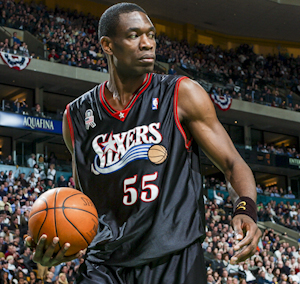
The Hoyas have an excellent history of preparing players for the NBA. Two Hoyas were the NBA first overall draft picks: Patrick Ewing in 1985 and Allen Iverson in 1996. Alonzo Mourning was the second overall pick in the 1992 draft. Dikembe Mutombo also was drafted in the first round, 4th overall Other alumni have gone undrafted, but entered the NBA later, such as Jaren Jackson in 1989 and Henry Sims and Chris Wright in 2013, and 3-time NBA Dunk Contest champion, Mac McClung
Several Hoya basketball players are famous purely for their off-court accomplishments. Brendan Gaughan, who walked onto the basketball squad, is a driver in NASCAR's Truck Series and also raced one season in the Cup Series. James L. Jones, who played for the Hoyas in the mid-1960s before joining the Marine Corps, went on to become Commandant of the Marine Corps, Supreme Allied Commander Europe, and President Obama's National Security Advisor. Paul Tagliabue, who played in the early 1960s and was one of the leading rebounders in school history, became Commissioner of the National Football League from 1989 to 2006 and later served as Georgetown's Chairman of the board of directors. Henry Hyde, who led Georgetown to its first national final, was elected a member of Congress from Illinois and Chairman of House Judiciary Committee. He received the nation's highest civilian honor, the Medal of Freedom. William Shea, who played in the 1920s, was the New York attorney who brought the New York Mets to the city. Shea Stadium, now demolished and replaced on-site by the Mets' current home of Citi Field, was named in his honor.
NBA draft picks
| Year | Round | Pick | Overall | Name | Team |
|---|---|---|---|---|---|
| 2025 | 2 | 10 | 40 | Washington Wizards | |
| 2025 | 1 | 15 | 15 | Oklahoma City Thunder | |
| 2013 | 1 | 3 | 3 | Washington Wizards | |
| 2010 | 1 | 7 | 7 | Detroit Pistons | |
| 2009 | 2 | 5 | 35 | Detroit Pistons | |
| 2008 | 1 | 17 | 17 | Indiana Pacers | |
| 2008 | 2 | 13 | 42 | Sacramento Kings | |
| 2007 | 1 | 5 | 5 | Boston Celtics | |
| 2003 | 1 | 9 | 9 | New York Knicks | |
| 2001 | 2 | 21 | 50 | Portland Trail Blazers | |
| 1998 | 2 | 14 | 43 | Washington Wizards | |
| 1996 | 1 | 1 | 1 | Philadelphia 76ers | |
| 1996 | 1 | 26 | 26 | Detroit Pistons | |
| 1996 | 2 | 1 | 30 | Houston Rockets | |
| 1995 | 2 | 29 | 58 | Detroit Pistons | |
| 1992 | 1 | 2 | 2 | Charlotte Hornets | |
| 1991 | 1 | 4 | 4 | Denver Nuggets | |
| 1987 | 1 | 4 | 4 | Los Angeles Clippers | |
| 1986 | 2 | 20 | 44 | Philadelphia 76ers | |
| 1986 | 2 | 23 | 47 | New York Knicks | |
| 1986 | 4 | 6 | 76 | Seattle SuperSonics | |
| 1986 | 7 | 3 | 142 | Cleveland Cavaliers | |
| 1985 | 1 | 1 | 1 | New York Knicks | |
| 1985 | 2 | 2 | 26 | Indiana Pacers | |
| 1984 | 5 | 1 | 94 | Indiana Pacers | |
| 1984 | 9 | 11 | 195 | Atlanta Hawks | |
| 1982 | 1 | 13 | 13 | New Jersey Nets | |
| 1982 | 4 | 10 | 79 | Portland Trail Blazers | |
| 1982 | 8 | 23 | 184 | Boston Celtics | |
| 1981 | 10 | 6 | 209 | Atlanta Hawks | |
| 1980 | 1 | 19 | 19 | Utah Jazz | |
| 1980 | 2 | 5 | 28 | Atlanta Hawks | |
| 1980 | 8 | 16 | 176 | Seattle SuperSonics | |
| 1979 | 10 | 18 | 202 | Washington Bullets | |
| 1978 | 4 | 11 | 77 | Golden State Warriors | |
| 1978 | 7 | 14 | 145 | Washington Bullets | |
| 1976 | 8 | 15 | 137 | Washington Bullets | |
| 1972 | 4 | 16 | 63 | Milwaukee Bucks | |
| 1970 | 16 | 3 | 225 | Cincinnati Royals | |
| 1969 | 11 | 8 | 149 | Cincinnati Royals | |
| 1967 | 2 | 2 | 14 | Detroit Pistons | |
| 1967 | 8 | 7 | 86 | Cincinnati Royals | |
| 1964 | 10 | 1 | 78 | New York Knicks | |
| 1962 | 7 | 5 | 57 | Syracuse Nationals | |
| Active players Top overall pick |
Basketball Hall of Fame inductees
- Elmer Ripley (coach) - inducted in 1973
- Buddy Jeannette (coach) - inducted in 1994 (as a player)
- John Thompson (coach) - inducted in 1999
- Patrick Ewing - inducted in 2008
- Alonzo Mourning - inducted in 2014
- Dikembe Mutombo - inducted in 2015
- Allen Iverson - inducted in 2016
Notes
References
References
- (March 9, 2013). "Georgetown Captures Top Seed For BIG EAST Championship". [[Big East Conference (1979–2013).
- (February 10, 2007). "A Century of Georgetown Basketball". [[The Washington Post]].
- (May 11, 2013). "Home Courts". Georgetown Basketball History.
- (1998). "The Ryan Gymnasium Years". Georgetown Basketball History.
- (January 23, 2011). "Games By Decade, 1970s". Georgetown Basketball History.
- Waters, Mike. (December 13, 2024). "As the Syracuse-Georgetown rivalry marks its 100th edition, what does the rivalry need to burn hotter?".
- Post, Washington. (March 8, 2013). "John Thompson Jr., Jim Boeheim and the end of the Georgetown-Syracuse rivalry".
- Karam, Michael. (January 13, 2009). "Georgetown v. Syracuse". [[Georgetown Hoyas]].
- Bancroft, Bobby. (December 3, 2015). "Georgetown - Syracuse: The Rivalry Returns".
- Brennan, Eamonn. (June 18, 2013). "Life after the Carrier Dome?".
- (March 17, 1980). "Iowa Trips Georgetown, 81-80". The Washington Post.
- "The Georgetown Basketball History Project: The Top 100: 1. Patrick Ewing".
- "The Georgetown Basketball History Project: Classic Games".
- "Kentucky vs. Georgetown (March 31, 1984)".
- Feinstein, John. (April 3, 1984). "Georgetown's Pressure Cooks Up a Title". [[The Washington Post]].
- (2002). "Classic Games". Georgetown Basketball History.
- (November 19, 2012). "Patrick Ewing among Hall inductees". [[ESPN]].
- (December 22, 2009). "Alonzo Mourning Named to the Virginia Sports Hall of Fame". [[Georgetown Hoyas]].
- Davis, Ken. (February 12, 1989). "Georgetown Has an Impenetrable Wall With Mourning, Mutombo". [[Los Angeles Times]].
- Check Out These Stories from Our Partners. (December 10, 2009). "Allen Iverson Rewind: Georgetown University". The Hoop Doctors.
- (December 3, 2010). "Allen Iverson". Georgetown Basketball History.
- (February 19, 2013). "1990's". Georgetown Basketball History.
- Frey, Jennifer. (February 27, 2005). "Like Father , Like Son". [[The Washington Post]].
- (March 16, 2000). "Georgetown nips Virginia 115–111 in triple-OT thriller".
- (March 22, 2000). "Cal's defense smothers Hoyas". [[Deseret News]].
- Miech }}{{dead link, Rob. (March 23, 2001). "Georgetown: A glance at 2001–02". [[CBSSports.com]].
- (March 11, 2002). "Hoyas Refuse N.I.T. Bid As Atlantic 10 Gets Five". [[The New York Times]].
- Szulszteyn, Andrea. (April 3, 2003). "Hatten, St. John's hang on to win NIT title at Garden".
- Isola, Frank. (June 27, 2003). "Sweetney may sub for McDyess". [[New York Daily News]].
- Williams, Lena. (April 21, 2004). "Familiar Name Back With Hoyas". [[The New York Times]].
- Weiss, Dick. (November 5, 2006). "Thompson III following in dad's footsteps". [[New York Daily News]].
- ''[[Washington Post]]'', Jan 22, 2006, Page E-1, "[https://www.washingtonpost.com/wp-dyn/content/article/2006/01/21/AR2006012100759.html Hoyas KO the Big 1]"
- (March 25, 2007). "Hoyas climb out of hole, hammer Heels in OT". [[ESPN]].
- (March 15, 2008). "Pitt wins second title after eight championship game appearances". [[ESPN]].
- Powell, Camille. (May 8, 2008). "Georgetown's Rivers to Transfer". [[The Washington Post]].
- Heaps, Bailey. (February 28, 2009). "Harassing Georgetown Defense Propels Hoyas to Ugly Win". [[The Hoya]].
- Yanda, Steve. (March 19, 2011). "VCU ends Georgetown's season with convincing win". [[The Washington Post]].
- Wang, Gene. (August 18, 2011). "Georgetown basketball exhibition in China ends in brawl". [[The Washington Post]].
- Yiu, Karson. (August 21, 2011). "Basketball Brawl Makes Georgetown Hoyas a Hot Ticket in China". [[ABC News (United States).
- Staihar, Janet. (August 23, 2011). "Georgetown plays Taiwan team ... in Shanghai". The Georgetown Dish.
- Katz, Andy. (July 31, 2013). "U.S. Army hosts game in South Korea". [[ESPN]].
- (March 24, 2014). "Florida State defeats Georgetown 101-90 in NIT". ESPN.
- (2015-03-21). "No. 5 seed Utah gets by No. 4 seed Georgetown to return to Sweet 16 {{!}} FOX Sports". FOX Sports.
- Jeff Goodman and Jeff Borzello. (2017-03-23). "Hoyas dismiss coach John Thompson III after 13 seasons". [[ESPN]].
- (March 24, 2017). "John Thompson III Fired After 2 Consecutive Losing Seasons".
- "Anonymous, "Georgetown fires head coach John Thompson III after 13 years," si.com, March 23, 2017.".
- "Georgetown fires head coach Patrick Ewing after 6 seasons".
- "Georgetown hires Providence coach Ed Cooley to replace Patrick Ewing".
- (2023-03-20). "Georgetown hires Ed Cooley: Providence coach leaving Friars after 12 seasons to take over Hoyas program".
- "2024 Georgetown Hoyas Basketball Industry Comparison Commits".
- Caleigh Keating. (February 25, 2025). "DEVELOPING: Sorber Out for Season with Left Foot Injury".
- "Draft Picks From Georgetown". [[basketball-reference.com]].
- (June 26, 2025). "Micah Peavy Headed to the New Orleans Pelicans with No. 40 Pick in 2025 NBA Draft".
- "The Georgetown Basketball History Project: Head Coaches".
- "Georgetown Basketball History Project".
- "2013-14 Men's College Basketball AP Polls".
- "Georgetown and Syracuse Renew Rivalry Through 2022-23".
- "Georgetown Basketball History Project".
- "Georgetown Basketball History Project".
- "Kenner League Returns to McDonough Arena".
- (2008). "Hoyas in the Pros". [[Georgetown Hoyas]].
- Graham, Glenn. (March 3, 2013). "Mount St. Joseph grad Henry Sims signs 10-day contract with Hornets". [[The Baltimore Sun]].
- Stein, Marc. (March 10, 2013). "Sources: Mavs to sign PG Chris Wright". ESPNDallas.com.
- (October 28, 2008). "Basketball Record Book". [[Georgetown Hoyas]].
- (2013). "NBA Draft Index". Basketball Reference.
This article was imported from Wikipedia and is available under the Creative Commons Attribution-ShareAlike 4.0 License. Content has been adapted to SurfDoc format. Original contributors can be found on the article history page.
Ask Mako anything about Georgetown Hoyas men's basketball — get instant answers, deeper analysis, and related topics.
Research with MakoFree with your Surf account
Create a free account to save articles, ask Mako questions, and organize your research.
Sign up freeThis content may have been generated or modified by AI. CloudSurf Software LLC is not responsible for the accuracy, completeness, or reliability of AI-generated content. Always verify important information from primary sources.
Report