From Surf Wiki (app.surf) — the open knowledge base
George H. Pendleton
American lawyer, politician and businessman
American lawyer, politician and businessman
| Field | Value |
|---|---|
| name | George H. Pendleton |
| image | GeorgeHPendleton.png |
| office | United States Minister to Germany |
| president | Grover Cleveland |
| Benjamin Harrison | |
| term_start | June 21, 1885 |
| term_end | April 25, 1889 |
| predecessor | John A. Kasson |
| successor | William Phelps |
| office1 | Chairman of the Senate Democratic Caucus |
| term_start1 | March 4, 1881 |
| term_end1 | March 3, 1885 |
| predecessor1 | William A. Wallace |
| successor1 | James B. Beck |
| jr/sr2 | United States Senator |
| state2 | Ohio |
| term_start2 | March 4, 1879 |
| term_end2 | March 3, 1885 |
| predecessor2 | Stanley Matthews |
| successor2 | Henry B. Payne |
| state3 | Ohio |
| district3 | |
| term_start3 | March 4, 1857 |
| term_end3 | March 3, 1865 |
| predecessor3 | Timothy C. Day |
| successor3 | Benjamin Eggleston |
| state_senate4 | Ohio |
| district4 | 1st |
| term_start4 | January 2, 1854 |
| term_end4 | January 6, 1856 |
| Served with John Schiff, William Converse | |
| predecessor4 | Edwin Armstrong |
| Adam Riddle | |
| John Vattier | |
| successor4 | Stanley Matthews |
| George Holmes | |
| William Converse | |
| birth_name | George Hunt Pendleton |
| birth_date | |
| birth_place | Cincinnati, Ohio, U.S. |
| death_date | |
| death_place | Brussels, Belgium |
| resting_place | Spring Grove Cemetery |
| Cincinnati, Ohio, U.S. | |
| party | Democratic |
| parents | Jane Frances Hunt Pendleton |
| Nathanael Greene Pendleton | |
| spouse | Alice Key |
| relatives | Francis Scott Key (father-in-law) |
| education | University of Cincinnati |
| Heidelberg University | |
| signature | George H. Pendleton signature 1859.jpg |
Benjamin Harrison | jr/sr2 = United States Senator Served with John Schiff, William Converse Adam Riddle John Vattier George Holmes William Converse Cincinnati, Ohio, U.S. Nathanael Greene Pendleton Heidelberg University George Hunt Pendleton (July 19, 1825November 24, 1889) was an American politician, lawyer and diplomat. He represented Ohio in both houses of Congress and was the Democratic nominee for Vice President of the United States in 1864.
After studying at the University of Cincinnati and Heidelberg University in Europe, Pendleton practiced law in his hometown of Cincinnati, Ohio. He was the son of Congressman Nathanael G. Pendleton and the son-in-law of poet Francis Scott Key. After serving in the Ohio Senate, Pendleton was elected to the United States House of Representatives. During the Civil War, he emerged as a leader of the Copperheads, a group of Democrats who favored peace with the Confederacy. After the war, he opposed the Thirteenth Amendment and the Civil Rights Act of 1866.
The 1864 Democratic National Convention nominated a ticket of George B. McClellan, who favored continuing the war, and Pendleton, who opposed it. The ticket lost to the National Union ticket of Abraham Lincoln and Andrew Johnson, and Pendleton's term as a Congressman expired shortly thereafter. Pendleton was a strong contender for the presidential nomination at the 1868 Democratic National Convention, but was defeated by New York Governor Horatio Seymour. After Pendleton lost the 1869 Ohio gubernatorial election, he temporarily left politics.
He served as the president of the Kentucky Central Railroad before returning to Congress. Pendleton was elected to the U.S. Senate in 1879 and served a single term, becoming Chairman of the Senate Democratic Conference. After the assassination of President James A. Garfield, he wrote and helped pass the Pendleton Civil Service Reform Act of 1883. The act required that many civil service be based on merit rather than political connections. Passage of the act lost him support in Ohio and he was not nominated for a second Senate term. President Grover Cleveland appointed him ambassador to the German Empire. He served in that position until 1889, dying later that year.
Early life
Pendleton was born in Cincinnati on July 19, 1825. He was the son of Jane Frances (née Hunt) Pendleton (1802–1839) and U.S. Representative Nathanael Greene Pendleton (1793–1861).
He attended the local schools and Cincinnati College and the University of Heidelberg in Germany. Pendleton studied law, was admitted to the bar in 1847, and commenced practice in Cincinnati.
Career
Pendleton was elected as a member of the Ohio Senate, serving from 1854 to 1856. His father had been a member of the Ohio Senate from 1825 until 1827. In 1854, he ran unsuccessfully for the Thirty-fourth United States Congress. Two years later, he was elected as a Democrat to the Thirty-fifth Congress. He was reelected to the three following Congresses (March 4, 1857 – March 3, 1865). During his time in the House, he was one of the managers appointed in 1862 to conduct the impeachment proceedings against West H. Humphreys, a US judge for several districts of Tennessee.
In the 1850s, Pendleton actively opposed measures to prohibit slavery in the Western United States. he was a leader of his party's "peace" faction during the Civil War, with close ties to the Copperheads. He voted against the Thirteenth Amendment, which outlawed slavery and involuntary servitude.
National politics
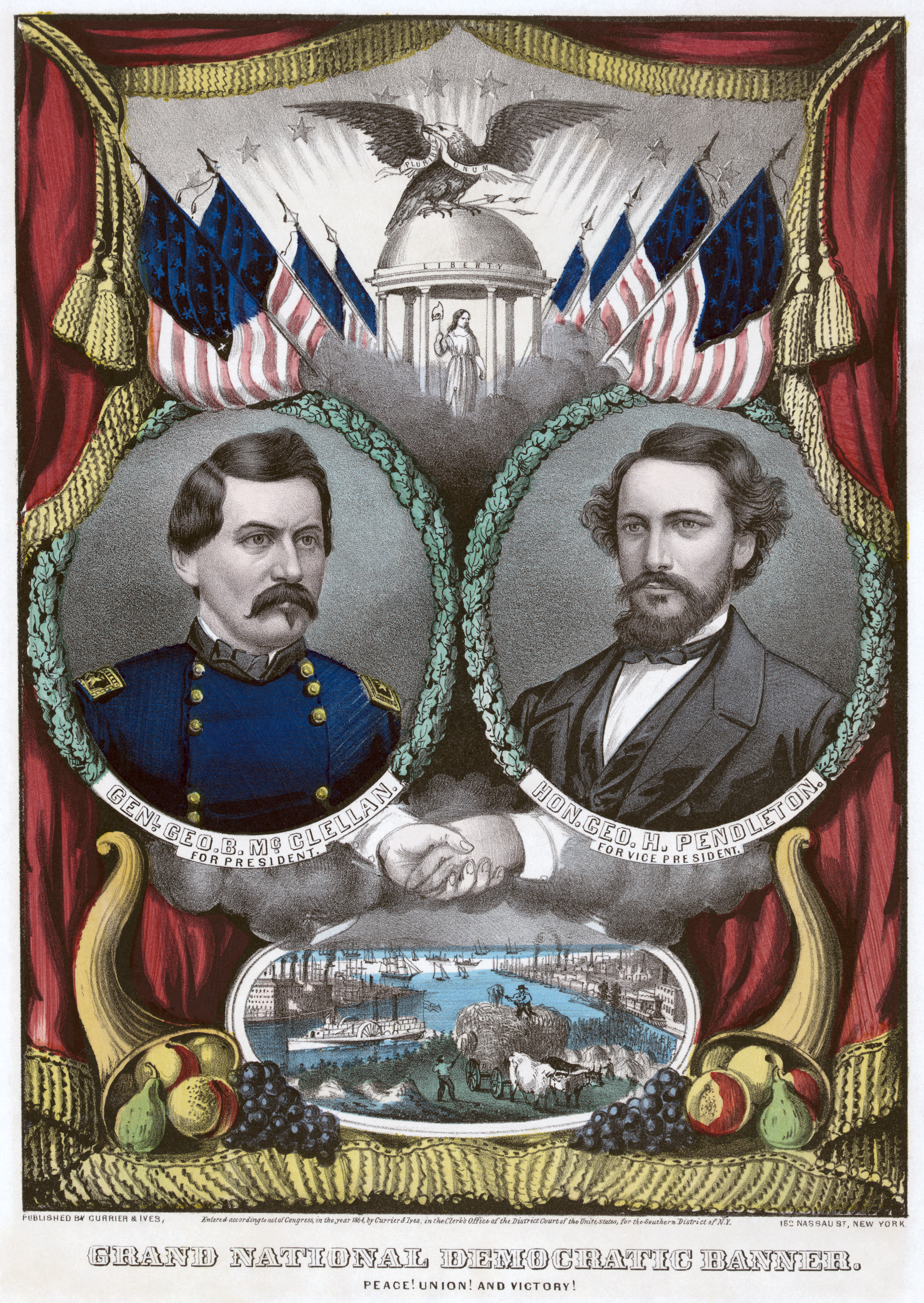
Pendleton, a nationally prominent Extreme Peace Democrat, was nominated as the vice-presidential running mate of George McClellan, a War Democrat, in the 1864 presidential election. McClellan, age 37 at the time of the convention, and Pendleton, age 39, are the youngest major-party presidential ticket ever nominated in the United States. Their National Union opponents were President Lincoln and Andrew Johnson. McClellan and Pendleton lost, receiving about 45% of the popular vote and less than 10% of the electoral vote.
Since Pendleton was the Democratic vice-presidential nominee, he was not a candidate for reelection to the Thirty-ninth Congress. George E. Pugh, the Democrat nominated to run for Pendleton's seat, lost to Republican Benjamin Eggleston.
Out of office
Out of office for the first time in a decade, Pendleton ran for his old House seat in 1866 but lost. In 1868, he sought the Democratic Party's presidential nomination. He led for the first 15 ballots but his support disappeared and he lost to Horatio Seymour, primarily for his support of the "Ohio idea." In 1869, he was the Democratic nominee for Governor of Ohio and lost to Rutherford B. Hayes.
Pendleton stepped away from politics, and in 1869, he became president of the Kentucky Central Railroad.
Political comeback
In 1879, Pendleton was elected to the United States Senate. During his only term, from 1881 to 1885, he served concurrently as the Chairman of the Democratic Conference. Following the 1881 assassination of James A. Garfield, he passed his most notable legislation, the Pendleton Act of 1883, requiring civil service exams for government positions. The Act helped put an end to the system of patronage in widespread use at the time, but it cost Pendleton politically, as many members of his party preferred the spoils system. He was thus not renominated to the Senate.
Later life

President Grover Cleveland appointed Pendleton Envoy Extraordinary and Minister Plenipotentiary to Germany the year he left office. He served until April 1889. Five months later, during his return trip to the United States, he died in Brussels, Belgium.
Beliefs
Pendleton had a very Jacksonian commitment to the Democratic Party as the best and perhaps only mechanism through which ordinary Americans could shape government policies. Mach (2007) argues that Pendleton's chief contribution was to demonstrate the Whig Party's willingness to use its power in government to achieve Jacksonian ideals.
While his Jacksonian commitment to states' rights and limited government made him a dissenter during the Civil War, what Mach calls Pendleton's Jacksonian "ardor to expand opportunities for ordinary Americans" was the basis for his leadership in civil service reform and his controversial plan to use greenbacks to repay the federal debt. What appeared to be a substantive ideological shift, Mach argues, represented Pendleton's pragmatic willingness to use new means to achieve old ends.
Personal life

In 1846, Pendleton married Mary Alicia Key, the daughter of Francis Scott Key, the lawyer, author, and amateur poet best known for writing the poem that later became the lyrics of the United States' national anthem, "The Star-Spangled Banner." George and Alicia were the parents of:
- Sarah Pendleton (born in Ireland, about 1846)
- Francis Key Pendleton (1850–1930), who was born in Cincinnati and became prominent in New York society during the Gilded Age.
- Mary Lloyd Pendleton (1852–1929), who was born in Cincinnati.
- Jane Francis Pendleton (1860–1950), who was born in the District of Columbia, April 22, 1860.
- George Hunt Pendleton (1863–1868)
Pendleton became a member of the New York Society of the Cincinnati in 1886 by right of his descent from Captain Nathaniel Pendleton of the Continental Army.
At the end of his life, Pendleton suffered a stroke. He died in Brussels, Belgium, on November 24, 1889. He is interred in Spring Grove Cemetery, Cincinnati, Ohio.
Memorials
The city of Pendleton, Oregon, is named after him.
The George H. Pendleton House in Cincinnati is a National Historical Landmark and was listed on the National Register of Historic Places in 1966.
In popular culture
In Steven Spielberg's 2012 film Lincoln, Pendleton is played by Peter McRobbie and portrayed as one of the most notable opponents of the Thirteenth Amendment and the Civil Rights Act of 1866.
References
Sources
- Mach, Thomas S. "Gentleman George" Hunt Pendleton: Party Politics and Ideological Identity in Nineteenth-Century America, Kent State University Press, 2007, , 317 pp. excerpt; also online review
References
- Searles, Harry; Mangus, Mike (April 9, 2012). [https://www.ohiocivilwarcentral.com/entry.php?rec=934 George Hunt Pendleton (July 19, 1825 – November 24, 1889)]. ''Ohio Civil War Central''. Retrieved January 27, 2022.
- "PENDLETON, Nathanael Greene - Biographical Information". [[Biographical Directory of the United States Congress]].
- A leading defender of slavery,December 4, 2012. [https://www.eastoregonian.com/opinion/editorials/pendleton-namesake-fought-for-slavery/article_9c76e429-ca15-50ea-b217-c477da97a448.html Pendleton namesake fought for slavery]. ''East Oregonian''. Retrieved January 27, 2022.
- (December 8, 2005). "Recognizing the Anniversary of the 13th Amendment (Extensions of Remarks)". Government Printing Office.
- (1877). "Charter of the Kentucky Central Railroad Company: To which is Added the General Laws of Kentucky Relating to Railroad Interests, and an Abstract of Decisions of the Court of Appeals Thereon. Also, Charters of the Maysville and Lexington Railroad Companies, North and Southern Divisions". Printed at the Western Methodist Book Concern.
- "PENDLETON, George Hunt - Biographical Information". [[Biographical Directory of the United States Congress]].
- (16 February 1892). "THE ONLY FOUR HUNDRED {{!}} WARD M'ALLISTER GIVES OUT THE OFFICIAL LIST. HERE ARE THE NAMES, DON'T YOU KNOW, ON THE AUTHORITY OF THEIR GREAT LEADER, YOU UNDER- STAND, AND THEREFORE GENUINE, YOU SEE.". [[The New York Times]].
- (2000). "The First Four Hundred: Mrs. Astor's New York in the Gilded Age". Random House Incorporated.
- "RootsWeb's WorldConnect Project: Janet Ariciu family Bush". Wc.rootsweb.ancestry.com.
- (9 January 2017). "Name from History: The Pendletons led remarkable lives that shaped region, U.S. history". WCPO.
- (November 26, 1889). "DEATH OF A DIPLOMAT {{!}} END OF GEORGE H. PENDLETON'S CAREER.THE EX-MINISTER TO GERMANY DYING AT BRUSSELS—HIS LIFE WORK AT HOME AND ABROAD.". [[The New York Times]].
- "History of Pendleton".
- ["National Historic Landmark nomination for George H. Pendleton House"]({{NHLS url). National Park Service.
This article was imported from Wikipedia and is available under the Creative Commons Attribution-ShareAlike 4.0 License. Content has been adapted to SurfDoc format. Original contributors can be found on the article history page.
Ask Mako anything about George H. Pendleton — get instant answers, deeper analysis, and related topics.
Research with MakoFree with your Surf account
Create a free account to save articles, ask Mako questions, and organize your research.
Sign up freeThis content may have been generated or modified by AI. CloudSurf Software LLC is not responsible for the accuracy, completeness, or reliability of AI-generated content. Always verify important information from primary sources.
Report