From Surf Wiki (app.surf) — the open knowledge base
Geography of Ukraine
none

none
2,061 m -5 m 981 km (within Ukraine) 149 km2
Ukraine is the second-largest European country, after Russia. Its various regions have diverse geographic features ranging from highlands to lowlands, as well as climatic range and a wide variety in hydrography. Most of the country lies within the East European Plain.
Lying between latitudes 44° and 53° N, and longitudes 22° and 41° E, Ukraine covers an area of 603628 km2, with a coastline of 2782 km.
The landscape of Ukraine consists mostly of fertile steppes and plateaus, crossed by rivers such as the Dnieper, Siverskyi Donets, Dniester and the Southern Bug as they flow south into the Black Sea and the smaller Sea of Azov. To the southwest, the delta of the Danube forms the border with Romania. The country's only mountains are the Carpathian Mountains in the west, of which the highest is Hoverla at 2061 m, and the Crimean Mountains, in the extreme south along the coast.
Ukraine also has a number of highland regions such as the Volyn-Podillia Upland (in the west) and the Dnieper Upland (on the right bank of the Dnieper). To the east there are the south-western spurs of the Central Russian Upland, over which runs the border with the Russia. Near the Sea of Azov can be found the Donets Ridge and the Azov Upland. The snow melt from the mountains feeds the rivers and their waterfalls.
Significant natural resources in Ukraine include lithium, natural gas, kaolin, timber, and an abundance of arable land. Despite this, the country faces a number of major environmental issues such as inadequate supplies of potable water, air and water pollution, deforestation, and radioactive contamination in the north-east from the 1986 accident at the Chernobyl Nuclear Power Plant.
Geographic location
Ukraine is located in Eastern Europe: lying on the northern shores of the Black Sea and the Sea of Azov. The country borders Belarus in the north, Poland, Slovakia and Hungary in the west, Moldova and Romania in the south-west, and Russia in the east.
The total geographic area of Ukraine is {{convert|603700 |km2|sp=us}}. Ukraine has an Exclusive Economic Zone of 147,318 km2 in the Black Sea.
The land border of Ukraine totals 6993 km. The border lengths with each country are: Belarus 891 km, Hungary 103 km, Moldova 939 km, Poland 428 km, Romania 169 km on the south and 362 km on the west, Russia 1974 km, and Slovakia 90 km. Ukraine is also bordered by 3783 km of coastline. The border with Russia, part of which runs through the Sea of Azov, is the country's longest border.
The village of Vel'ké Slemence is split between Slovakia and Ukraine.
Relief
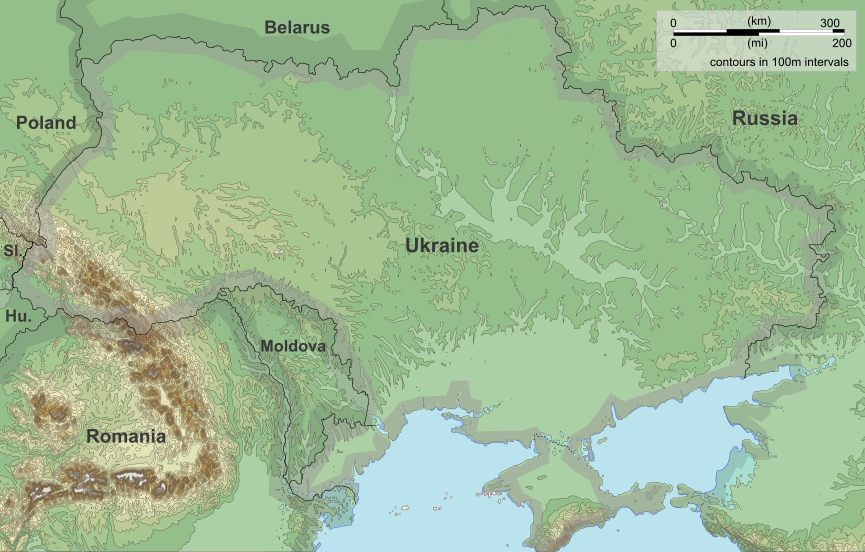

Most of its territory lies within the Great European Plain, while parts of western regions and southern regions lay within the Alpine system. In general Ukraine comprises two different biomes: mixed forest towards the middle of the continent, and steppe towards the Black Sea littoral. Major provinces include, Polesian Lowland, Dnieper Lowland, Volhynia-Podolie Plateau, Black Sea-Azov Lowland, Donets-Azov Plateau, Central Russian Upland, Carpathians, and Pannonian Basin.
The western regions feature an alpine-like section of Carpathian Mountains, the Eastern Carpathians that stretches across Poland, Ukraine and Romania. The highest peak is Mount Hoverla, which at 2061 m above sea level is the highest point in the country. Mountains are limited to the west, the southern tip of Ukraine on the Sea of Azov. The western region has the Carpathian Mountains, and some eroded mountains from the Donets Ridge are in the east near the Sea of Azov.
Most of Ukraine's area is taken up by the steppe-like region just north of the Black Sea. Most of Ukraine consists of fertile plains (or steppes) and plateaus. In terms of land use, 58% of Ukraine is considered arable land; 2% is used for permanent crops, 13% for permanent pastures, 18% is forests and woodland, and 9% is other.
Physiographic division of Ukraine
Most of Ukraine consists of regular plains with an average height above sea level being 175 m. It is surrounded by mountains to its west and extreme south. Wide spaces of the country's plains are located in the south-western part of the East European Plain. The plains have numerous highlands and lowlands caused by the uneven crystallized base of the East European craton. The highlands are characterized by Precambrian basement rocks from the Ukrainian Shield.
Plains are considered elevations of no more than 0-600 m among which there are recognized lowlands (plains) and uplands (plateaus, ridges, hill ridges).
[[Great European Plain]] (subregion [[East European Plain]])
- Volhynia-Podillia Upland (Volhynia-Podillia Plateau)
- Volhynian Upland
- Podolian Upland
- Small Polesia Plain
- Khotyn Upland (part of Moldavian Plateau)
- Roztocze
- Sian-Dniester Lowland
- Eastern Carpathian Foothills
- Polesian Lowland
- Dnieper Upland
- Dnieper Lowland
- Central Russian Upland
- Donets-Azov Plateau
- Donets Upland
- Azov Upland
- Donets Ridge
- Black Sea-Azov Lowland
- Black Sea Lowland
- Crimean Lowland
- Azov Lowland
Alpine system
- Transcarpathian Lowland (extension of Great Hungarian Plain, part of Eastern Pannonian Basin)
- Eastern Carpathians (part of Carpathian Mountains)
- Outer Eastern Carpathians (more Eastern Beskids and the Ukrainian Carpathians)
- Inner Eastern Carpathians (more Vihorlat-Gutin Area)
- Crimean Mountains
Soil

From northwest to southeast the soils of Ukraine may be divided into three major aggregations:

- a zone of sandy podzolized soils
- a central belt consisting of the extremely fertile Ukrainian black earth (chernozems)
- a zone of chestnut and salinized soils
As much as two-thirds of the country's surface land consists of black earth, a resource that has made Ukraine one of the most fertile regions in the world and well known as a "breadbasket". These soils may be divided into three broad groups:
- in the north, a belt of deep chernozems, about 5 ft thick and rich in humus
- south and east of the former, a zone of prairie, or ordinary, chernozems, which are equally rich in humus but only about 3 ft thick
- the southernmost belt, which is even thinner and has still less humus
Interspersed in various uplands and along the northern and western perimeters of the deep chernozems are mixtures of gray forest soils and podzolized black-earth soils, which together occupy much of Ukraine's remaining area. All these soils are very fertile when sufficient water is available. However, their intensive cultivation, especially on steep slopes, has led to widespread soil erosion and gullying.
The smallest proportion of the soil cover consists of the chestnut soils of the southern and eastern regions. They become increasingly salinized to the south as they approach the Black Sea.
Hydrography

The territory of Ukraine is bordered by the waters of the Black Sea and the Sea of Azov. More than 95% of the rivers are part of those two seas' drainage basins. A few rivers are part of the Baltic Sea basin. There are seven major rivers in Ukraine: Desna, Dnipro, Dnister, Danube, Prypiat, Siverian Donets, and Southern Buh.
Climate


| Location | July (°C) | July (°F) | January (°C) | January (°F) |
|---|---|---|---|---|
| Kyiv | 27/17 | 80/62 | −1/−6 | 31/22 |
| Kharkiv | 27/17 | 81/62 | −2/−7 | 28/20 |
| Dnipro | 29/17 | 84/63 | −1/−6 | 30/21 |
| Odesa | 28/19 | 82/66 | 2/−3 | 36/27 |
| Donetsk | 27/16 | 81/61 | −1/−6 | 29/20 |
| Zaporizhzhia | 28/16 | 83/61 | −0/−5 | 31/21 |
| Lviv | 24/13 | 75/56 | −1/−8 | 32/21 |

Ukraine is firmly in the mid-latitudes, and generally has a continental climate, except for its southern coasts, which feature cold semi-arid and humid subtropical climates. Average annual temperatures range from 5.5 – in the north, to 11 – in the south. Precipitation is disproportionately distributed; it is highest in the west and north and lowest in the east and southeast. Western Ukraine, particularly in the Carpathian Mountains, receives around 1200 mm of precipitation annually, while Crimea and the coastal areas of the Black Sea receive around 400 mm.
Water availability from the major river basins is expected to decrease, especially in summer. This poses risks to the agricultural sector. The negative impacts of climate change on agriculture are mostly felt in the south of the country, which has a steppe climate. In the north, some crops may be able to benefit from a longer growing season. The World Bank has stated that Ukraine is highly vulnerable to climate change.
| Jan record high C = 13.2 | Feb record high C = 17.3 | Mar record high C = 22.4 | Apr record high C = 30.2 | May record high C = 33.6 | Jun record high C = 35.5 | Jul record high C = 39.4 | Aug record high C = 39.3 | Sep record high C = 35.7 | Oct record high C = 27.9 | Nov record high C = 23.2 | Dec record high C = 15.2 | year record high C = 39.4 | Jan record low C = -31.1 | Feb record low C = -32.2 | Mar record low C = -24.9 | Apr record low C = -10.4 | May record low C = -2.4 | Jun record low C = 2.5 | Jul record low C = 5.8 | Aug record low C = 3.3 | Sep record low C = -2.9 | Oct record low C = -17.8 | Nov record low C = -21.9 | Dec record low C = -30.0 | year record low C = -32.2 | Jan snow depth cm = 9 | Feb snow depth cm = 11 | Mar snow depth cm = 7 | Apr snow depth cm = 0 | May snow depth cm = 0 | Jun snow depth cm = 0 | Jul snow depth cm = 0 | Aug snow depth cm = 0 | Sep snow depth cm = 0 | Oct snow depth cm = 0 | Nov snow depth cm = 2 | Dec snow depth cm = 5 | year snow depth cm = | archive-url = https://web.archive.org/web/20191213141910/http://www.pogodaiklimat.ru/climate/33345.htm | archive-date = 13 December 2019 | access-date = 8 November 2021 | archive-url = https://web.archive.org/web/20210717143555/https://www.ncei.noaa.gov/pub/data/normals/WMO/1981-2010/RA-VI/Ukraine/12.6.%20WMO_Normals_Excel_Template%20%282%29.xls | archive-date = 17 July 2021 | access-date = 17 July 2021}}
| Jan record high C = 11.1 | Feb record high C = 14.6 | Mar record high C = 21.8 | Apr record high C = 30.5 | May record high C = 34.5 | Jun record high C = 39.8 | Jul record high C = 38.4 | Aug record high C = 39.8 | Sep record high C = 34.7 | Oct record high C = 29.3 | Nov record high C = 20.3 | Dec record high C = 13.4 | year record high C = 39.8 | Jan record low C = -35.6 | Feb record low C = -29.8 | Mar record low C = -32.2 | Apr record low C = -11.4 | May record low C = -1.9 | Jun record low C = 2.2 | Jul record low C = 5.7 | Aug record low C = 2.2 | Sep record low C = -2.9 | Oct record low C = -9.1 | Nov record low C = -20.9 | Dec record low C = -30.8 | year record low C = -35.6 | Jan snow depth cm = 8 | Feb snow depth cm = 11 | Mar snow depth cm = 8 | Apr snow depth cm = 1 | May snow depth cm = 0 | Jun snow depth cm = 0 | Jul snow depth cm = 0 | Aug snow depth cm = 0 | Sep snow depth cm = 0 | Oct snow depth cm = 0 | Nov snow depth cm = 1 | Dec snow depth cm = 4 | year snow depth cm = 11 | archive-url = https://web.archive.org/web/20191213142352/http://www.pogodaiklimat.ru/climate/34300.htm | archive-date = 13 December 2019 | access-date = 8 November 2021 | archive-url = https://web.archive.org/web/20210717143555/https://www.ncei.noaa.gov/pub/data/normals/WMO/1981-2010/RA-VI/Ukraine/12.6.%20WMO_Normals_Excel_Template%20%282%29.xls | archive-date = 17 July 2021 | access-date = 18 July 2021}}
| Jan record high C = 12.3 | Feb record high C = 17.5 | Mar record high C = 24.1 | Apr record high C = 31.8 | May record high C = 36.1 | Jun record high C = 37.8 | Jul record high C = 39.8 | Aug record high C = 40.9 | Sep record high C = 36.5 | Oct record high C = 32.6 | Nov record high C = 20.6 | Dec record high C = 13.7 | year record high C = 40.9 | Jan record low C = -30.0 | Feb record low C = -27.8 | Mar record low C = -19.2 | Apr record low C = -8.0 | May record low C = -2.4 | Jun record low C = 3.9 | Jul record low C = 5.9 | Aug record low C = 3.9 | Sep record low C = -3.0 | Oct record low C = -8.0 | Nov record low C = -17.9 | Dec record low C = -27.8 | year record low C = -30.0 | Jan snow depth cm = 7 | Feb snow depth cm = 10 | Mar snow depth cm = 5 | Apr snow depth cm = 0 | May snow depth cm = 0 | Jun snow depth cm = 0 | Jul snow depth cm = 0 | Aug snow depth cm = 0 | Sep snow depth cm = 0 | Oct snow depth cm = 0 | Nov snow depth cm = 1 | Dec snow depth cm = 4 | year snow depth cm = 10
| Jan record high C = 15.7 | Feb record high C = 19.2 | Mar record high C = 24.1 | Apr record high C = 29.4 | May record high C = 33.2 | Jun record high C = 37.2 | Jul record high C = 39.3 | Aug record high C = 38.0 | Sep record high C = 35.4 | Oct record high C = 30.5 | Nov record high C = 26.0 | Dec record high C = 16.9 | year record high C = 39.3 | Jan record low C = -26.2 | Feb record low C = -28.0 | Mar record low C = -16.0 | Apr record low C = -5.9 | May record low C = 0.3 | Jun record low C = 5.2 | Jul record low C = 7.5 | Aug record low C = 7.9 | Sep record low C = -0.8 | Oct record low C = -13.3 | Nov record low C = -14.6 | Dec record low C = -19.6 | year record low C = -28.0 | Jan snow depth cm = 2 | Feb snow depth cm = 2 | Mar snow depth cm = 1 | Apr snow depth cm = 0 | May snow depth cm = 0 | Jun snow depth cm = 0 | Jul snow depth cm = 0 | Aug snow depth cm = 0 | Sep snow depth cm = 0 | Oct snow depth cm = 0 | Nov snow depth cm = 0 | Dec snow depth cm = 1 | year snow depth cm = 2 | script-title=ru:Погода и Климат – Климат Одессы |trans-title=Weather and Climate – The Climate of Odesa | access-date = 8 November 2021}} | archive-url = https://web.archive.org/web/20210717143555/https://www.ncei.noaa.gov/pub/data/normals/WMO/1981-2010/RA-VI/Ukraine/12.6.%20WMO_Normals_Excel_Template%20%282%29.xls | archive-date = 17 July 2021 | access-date = 17 July 2021}}
| Jan record high C = 17.8 | Feb record high C = 20.2 | Mar record high C = 27.8 | Apr record high C = 28.5 | May record high C = 33.0 | Jun record high C = 35.0 | Jul record high C = 39.1 | Aug record high C = 39.1 | Sep record high C = 33.2 | Oct record high C = 31.5 | Nov record high C = 25.2 | Dec record high C = 22.0 | year record high C = 39.1 | Jan record low C = -12.2 | Feb record low C = -12.3 | Mar record low C = -7.3 | Apr record low C = -3.8 | May record low C = 2.8 | Jun record low C = 7.8 | Jul record low C = 12.4 | Aug record low C = 10.0 | Sep record low C = 3.9 | Oct record low C = -1.1 | Nov record low C = -8.9 | Dec record low C = -7.4 | year record low C = -12.3 | Jan snow depth cm = 1 | Feb snow depth cm = 1 | Mar snow depth cm = 1 | Apr snow depth cm = 0 | May snow depth cm = 0 | Jun snow depth cm = 0 | Jul snow depth cm = 0 | Aug snow depth cm = 0 | Sep snow depth cm = 0 | Oct snow depth cm = 0 | Nov snow depth cm = 0 | Dec snow depth cm = 0 | year snow depth cm = 1 | archive-url = https://web.archive.org/web/20191214155637/http://www.pogodaiklimat.ru/climate/33990.htm | archive-date = 14 December 2019 | access-date = 8 November 2021}} | archive-url = https://web.archive.org/web/20210717143555/https://www.ncei.noaa.gov/pub/data/normals/WMO/1981-2010/RA-VI/Ukraine/12.6.%20WMO_Normals_Excel_Template%20%282%29.xls | archive-date = 17 July 2021 | access-date = 18 July 2021}}
Natural resources
Significant natural resources in Ukraine include: iron ore, manganese, natural gas, titanium, kaolin, uranium, and arable land.
Environmental issues
Ukraine has many environmental issues. Some regions lack adequate supplies of potable water. Air and water pollution affects the country, as well as deforestation, and radiation contamination in the northeast stemming from the 1986 accident at the Chernobyl Nuclear Power Plant.
References
References
- (13 December 2007). "Ukraine".
- (2022-03-01). "Ukraine country profile". BBC News.
- "Geographical location of Ukraine".
- Tabuchi, Hiroko. (2022-03-02). "Before Invasion, Ukraine's Lithium Wealth Was Drawing Global Attention". The New York Times.
- "Mining – UkraineInvest".
- Nature, Preferred by. "Ukraine Timber Risk Profile".
- "Ukraine". [[Central Intelligence Agency]].
- "Державна прикордонна служба України".
- "Agreement between the Russian Federation and the Ukraine on cooperation in the use of the sea of Azov and the strait of Kerch".
- Lyman, Rick. (2015-08-10). "A Ukrainian Border Town Once Fenced by Soviets Blossoms Into a Shopper's Paradise". The New York Times.
- "Ukraine".
- Magocsi, Paul R. ''A history of Ukraine: The land and its peoples''. University of Toronto Press, 2010.
- "Seas, Rivers and Lakes of Ukraine".
- (29 January 2020). "Emissions – the 'business as usual' story is misleading". Nature.
- (2022). "Permafrost and Climate Change: Carbon Cycle Feedbacks From the Warming Arctic". Annual Review of Environment and Resources.
- Phiddian, Ellen. (5 April 2022). "Explainer: IPCC Scenarios".
- "Ukraine climate information". Weatherbase.
- "Ukraine". Food and Agriculture Organization.
- "Ukraine – Climate".
- (2020-12-01). "Climate change impact on water availability of main river basins in Ukraine". Journal of Hydrology: Regional Studies.
- (2021-03-01). "Econometric Analysis of the Impact of Climate Change on the Sustainability of Agricultural Production in Ukraine". Journal of Ecological Engineering.
- "World Bank Climate Change Knowledge Portal".
- "ЦГО Кліматичні дані по м.Києву". Central Observatory for Geophysics.
- "ЦГО Кліматичні рекорди". Central Observatory for Geophysics.
- "Ukraine – Kyiv". Danish Meteorological Institute.
- "Kiev, Ukraine - Detailed climate information and monthly weather forecast". Yu Media Group.
- (2016). "Климат Днепра (Climate of Dnipro)". Pogoda.ru.net.
- "World Meteorological Organization Climate Normals for 1981–2010". World Meteorological Organization.
- (2020-10-10). "The Forgotten Potential of Ukraine's Energy Reserves".
- (2022-02-28). "How Ukraine war will impact its farming – agronomist's view".
- (2022-02-25). "Ukraine invasion: rapid overview of environmental issues".
- (January 2016). "Ukraine Country Environmental Analysis". [[World Bank]].
- "Water, sanitation and hygiene (WASH)".
- (16 July 2017). "Environmental issues in Ukraine". Naturvernforbundet.
This article was imported from Wikipedia and is available under the Creative Commons Attribution-ShareAlike 4.0 License. Content has been adapted to SurfDoc format. Original contributors can be found on the article history page.
Ask Mako anything about Geography of Ukraine — get instant answers, deeper analysis, and related topics.
Research with MakoFree with your Surf account
Create a free account to save articles, ask Mako questions, and organize your research.
Sign up freeThis content may have been generated or modified by AI. CloudSurf Software LLC is not responsible for the accuracy, completeness, or reliability of AI-generated content. Always verify important information from primary sources.
Report