From Surf Wiki (app.surf) — the open knowledge base
Geographer
Scholar whose area of study is geography
Scholar whose area of study is geography
A geographer is a physical scientist, social scientist or humanist whose area of study is geography, the study of Earth's natural environment and human society, including how society and nature interact. The Greek prefix "geo" means "earth" and the Greek suffix, "graphy", meaning "description", so a geographer is someone who studies the earth. The word "geography" is a Middle French word that is believed to have been first used in 1540.
Although geographers are historically known as people who make maps, map making is actually the field of study of cartography, a subset of geography. Geographers do not study only the details of the natural environment or human society, but they also study the reciprocal relationship between these two. For example, they study how the natural environment contributes to human society and how human society affects the natural environment.
In particular, physical geographers study the natural environment while human geographers study human society and culture. Some geographers are practitioners of GIS (geographic information system) and are often employed by local, state, and federal government agencies as well as in the private sector by environmental and engineering firms.
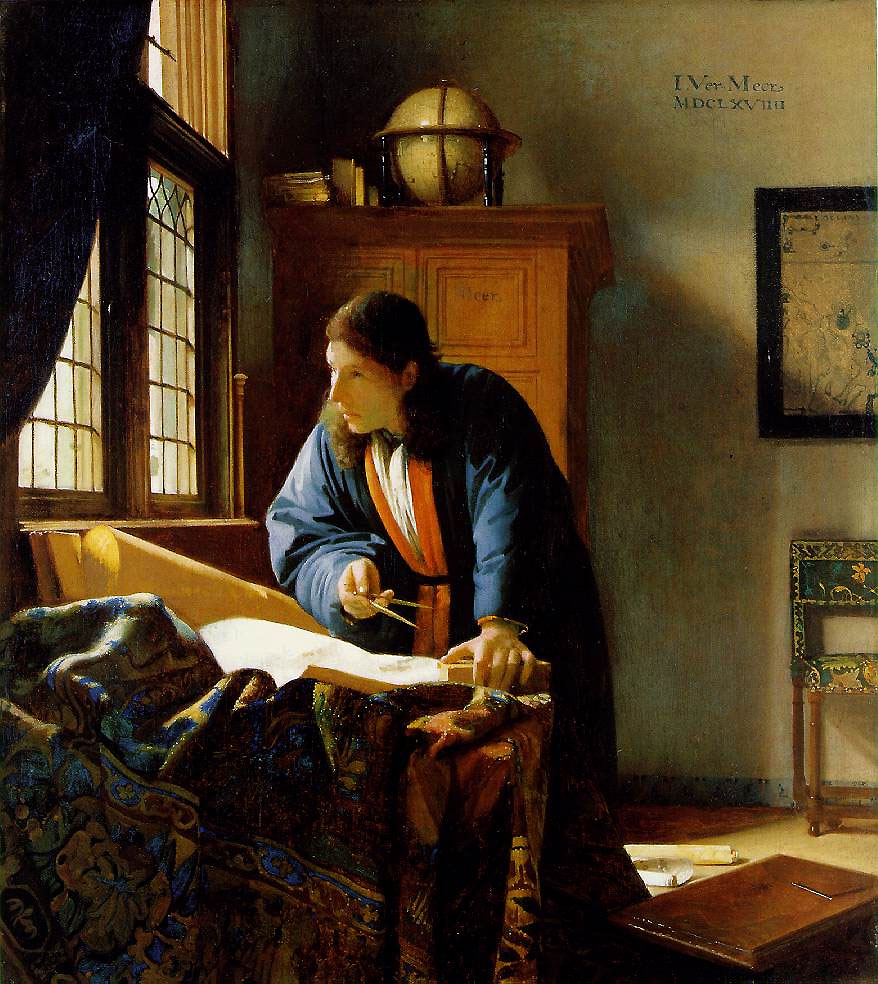
The paintings by Johannes Vermeer titled The Geographer and The Astronomer are both thought to represent the growing influence and rise in prominence of scientific enquiry in Europe at the time of their painting in 1668–69.
Areas of study in geography
Subdividing geography is challenging, as the discipline is broad, interdisciplinary, ancient, and has been approached differently by different cultures. Attempts have gone back centuries, and include the "Four traditions of geography" and applied "branches."
Four traditions of geography
Main article: Four traditions of geography
The four traditions of geography were proposed in 1964 by William D. Pattison in a paper titled "The Four Traditions of Geography" appearing in the Journal of Geography. These traditions are:
- spatial or locational tradition
- area studies or regional tradition
- Human–Environment interaction tradition (originally referred to as the "man-land tradition")
- Earth science tradition
Branches of geography
Main article: Category:Branches of geography
The UNESCO Encyclopedia of Life Support Systems subdivides geography into three major fields of study, which are then further subdivided. These are:
- Human geography: including urban geography, cultural geography, economic geography, political geography, historical geography, marketing geography, health geography, and social geography.
- Physical geography: including geomorphology, hydrology, glaciology, biogeography, climatology, meteorology, pedology, oceanography, geodesy, and environmental geography.
- Technical geography: including geoinformatics, geographic information science, geovisualization, and spatial analysis.
Five themes of geography
Main article: Five themes of geography
The National Geographic Society identifies five broad key themes for geographers:
- human-environment interaction
- Location
- Movement
- Place
- Regions
Notable geographers==
Main article: List of geographers, List of Graeco-Roman geographers

- Alexander von Humboldt (1769–1859) – published Cosmos and founder of the sub-field biogeography.
- Arnold Henry Guyot (1807–1884) – noted the structure of glaciers and advanced understanding in glacier motion, especially in fast ice flow.
- Carl O. Sauer (1889–1975) – cultural geographer.
- Carl Ritter (1779–1859) – occupied the first chair of geography at Berlin University.
- David Harvey (born 1935) – Marxist geographer and author of theories on spatial and urban geography, winner of the Vautrin Lud Prize.
- Doreen Massey (1944–2016) – scholar in the space and places of globalization and its pluralities; winner of the Vautrin Lud Prize.
- Edward Soja (1940–2015) – worked on regional development, planning and governance and coined the terms synekism and postmetropolis; winner of the Vautrin Lud Prize.
- Ellen Churchill Semple (1863–1932) – first female president of the American Association of Geographers.
- Jovan Cvijić (1865–1927) – Serbian geographer, geologist, sociologist and human geographer; father of the karst geomorphology
- Eratosthenes () – calculated the size of the Earth.
- Ernest Burgess (1886–1966) – creator of the concentric zone model.
- Gerardus Mercator (1512–1594) – cartographer who produced the Mercator projection
- John Francon Williams (1854–1911) – author of The Geography of the Oceans.
- Karen Bakker (1971-2023), who contributed significantly to the study of intersections between digital technology and the natural environment
- Karl Butzer (1934–2016) – German-American geographer, cultural ecologist and environmental archaeologist.
- Michael Frank Goodchild (born 1944) – GIS scholar and winner of the RGS founder's medal in 2003.
- Milton Santos (1926–2001) – became known for his pioneering works in several branches of geography, notably urban development in developing countries.
- Muhammad al-Idrisi (; Latin: Dreses) (1100–1165) – author of Nuzhatul Mushtaq.
- Nigel Thrift (born 1949) – originator of non-representational theory.
- Paul Vidal de La Blache (1845–1918) – founder of the French school of geopolitics, wrote the principles of human geography.
- Ptolemy () – compiled Greek and Roman knowledge into the book Geographia.
- Radhanath Sikdar (1813–1870) – calculated the height of Mount Everest.
- Roger Tomlinson (1933 – 2014) – the primary originator of modern geographic information systems.
- Halford Mackinder (1861–1947) – co-founder of the London School of Economics, Geographical Association.
- Strabo (64/63 BC – ) – wrote Geographica, one of the first books outlining the study of geography.
- Waldo Tobler (1930–2018) – coined the first law of geography.
- Walter Christaller (1893–1969) – human geographer and inventor of central place theory.
- William Morris Davis (1850–1934) – father of American geography and developer of the cycle of erosion.
- Yi-Fu Tuan (1930–2022) – Chinese-American scholar credited with starting humanistic geography as a discipline.
Institutions and societies
- American Association of Geographers
- American Geographical Society
- North American Cartographic Information Society
- Anton Melik Geographical Institute (Slovenia)
- Gamma Theta Upsilon (international)
- Institute of Geographical Information Systems (Pakistan)
- International Geographical Union
- Karachi Geographical Society (Pakistan)
- National Geographic Society (US)
- Royal Canadian Geographical Society
- Royal Danish Geographical Society
- Royal Geographical Society (UK)
- Russian Geographical Society
References
References
- Arrowsmith, Aaron. (1832). "A Grammar of Modern Geography". [[King's College School]].
- (n.d.). "geography (n.)". Douglas Harper.
- (2020). "The History of Cartography, Volume 4: Cartography in the European Enlightenment". [[University of Chicago Press]].
- "Geographers : Occupational Outlook Handbook : U.S. Bureau of Labor Statistics".
- (1964). "The Four Traditions of Geography". Journal of Geography.
- (2009). "Geography Volume I". [[Encyclopedia of Life Support Systems.
- (2009). "Geography – Vol. I: Geography". [[Encyclopedia of Life Support Systems.
- (27 June 2014). "Geography's Crosscutting Themes: Golden Anniversary Reflections on "The Four Traditions of Geography"". Journal of Geography.
- Nel, Etienne. (2010-11-23). "The dictionary of human geography, 5th edition - Edited by Derek Gregory, Ron Johnston, Geraldine Pratt, Michael J. Watts and Sarah Whatmore". New Zealand Geographer.
- Marsh, William M.. (2013). "Physical geography : great systems and global environments". Cambridge University Press.
- (24 October 2008). "Geography Education @".
- (July 1980). "The Association of American Geographers: The First Seventy-Five Years 1904-1979". The Geographical Journal.
- (2009-02-26). "AGS History".
- "National Geographic Society".
- "Royal Geographical Society - Royal Geographical Society (with IBG)".
This article was imported from Wikipedia and is available under the Creative Commons Attribution-ShareAlike 4.0 License. Content has been adapted to SurfDoc format. Original contributors can be found on the article history page.
Ask Mako anything about Geographer — get instant answers, deeper analysis, and related topics.
Research with MakoFree with your Surf account
Create a free account to save articles, ask Mako questions, and organize your research.
Sign up freeThis content may have been generated or modified by AI. CloudSurf Software LLC is not responsible for the accuracy, completeness, or reliability of AI-generated content. Always verify important information from primary sources.
Report