From Surf Wiki (app.surf) — the open knowledge base
Geoduck
Species of bivalve

Species of bivalve
The Pacific geoduck ( ; Panopea generosa) is a species of very large saltwater clam in the family Hiatellidae. The common name is derived from the Lushootseed name, .
The geoduck is native to the coastal waters of the eastern North Pacific Ocean from Alaska to Baja California. It is also one of the longest-living animals of any type, with a typical lifespan of 140 years; the oldest has been recorded at 179 years old. The precise longevity of geoducks can be determined from annual rings deposited in the shell which can be assigned to calendar years of formation through crossdating. These annual rings also serve as an archive of past marine variability.
Etymology
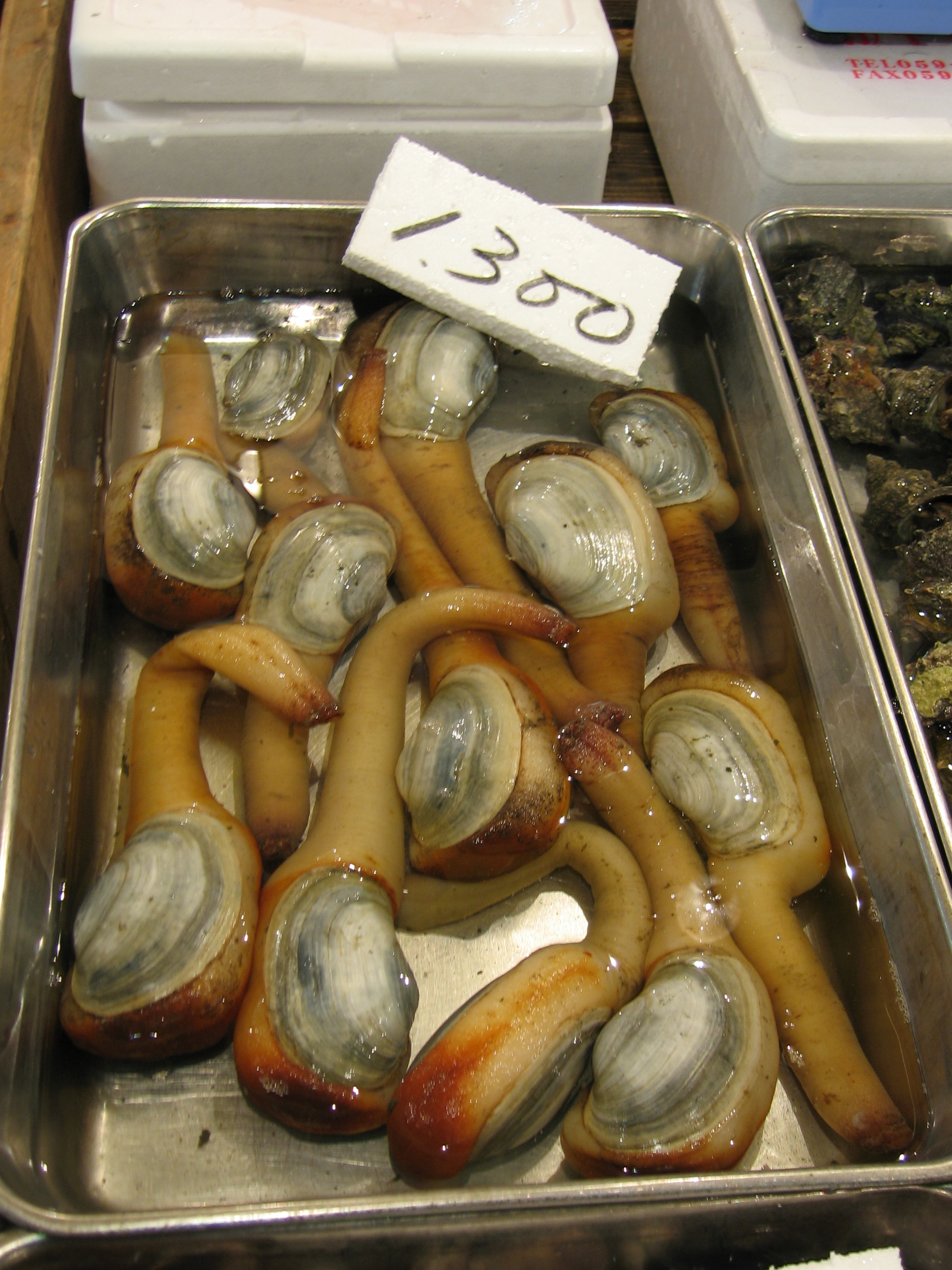
The name Geoduck is derived from the Lushootseed name for the animal, . The etymology of is disputed. According to a published dictionary of Lushotseed, the lexical suffix means "many." The Oxford English Dictionary says it is composed of a root word of unknown meaning and assigns to the meaning "genitals" (referring to the shape of the clam), while other researchers say it is a phrase meaning "dig deep".
It is sometimes known as a mud duck, king clam or, when translated literally from Chinese, an elephant-trunk clam ().
Between 1983 and 2010, the scientific name of this clam was confused with that of an extinct clam, Panopea abrupta (Conrad, 1849), in scientific literature.
Biology
Native to the west coast of Canada and the northwest coast of the United States (primarily Washington and British Columbia), these marine bivalve mollusks are the largest burrowing clams in the world, weighing in at an average of 1+1/2 lb at maturity. The largest ever weighed and verified by Washington Department of Fish and Wildlife biologists was an 8.16 lb specimen dug near Adelma Beach in Discovery Bay.
A related species, Panopea zelandica, is found in New Zealand and has been harvested commercially since 1989. The largest quantities have come from Golden Bay in the South Island where 100 tonne were harvested in one year. There is a growing concern over the increase of parasites in the Puget Sound population of geoduck. Whether these microsporidium-like parasitic species were introduced by commercial farming is being studied by Sea Grant. Research to date does indicate their presence.
The oldest recorded specimen was 179 years old, but individuals usually live up to 140 years. A geoduck sucks water containing plankton down through its long siphon, filters this for food and ejects its refuse out through a separate hole in the siphon. Adult geoducks have few natural predators, which may also contribute to their longevity. In Alaska, sea otters and dogfish have proved capable of dislodging geoducks; starfish also attack and feed on the exposed geoduck siphon.
Geoducks are broadcast spawners. A female geoduck produces about 5 billion eggs in her century-long lifespan. However, due to a low rate of recruitment and a high rate of mortality for geoduck eggs, larvae, and post-settled juveniles, populations are slow to rebound. In the Puget Sound, studies indicate that the recovery time for a harvested tract is 39 years.
Biomass densities in Southeast Alaska are estimated by divers, then inflated by twenty percent to account for geoducks not visible at the time of survey. This estimate is used to predict the two percent allowed for commercial harvesting.
Industry
Main article: Geoduck aquaculture
The world's first geoduck fishery was created in 1970, but demand was low at first due to its texture. , these clams sell in China for over US15 $/lb.
The geoduck's high market value has created an $80-million industry, with harvesting occurring in the US states of Alaska, Washington, and Oregon and the Canadian province of British Columbia. It is one of the most closely regulated fisheries in both countries. In Washington, Department of Natural Resources staff are on the water continually monitoring harvests to ensure revenues are received, and the same is true in Canada where the Underwater Harvesters' Association manages the Canadian Fishery in conjunction with Canada's Department of Fisheries and Oceans. The Washington State Department of Health tests water and flesh to assure clams are not filtering and holding pollutants, an ongoing problem. With the rise in price has come the inevitable problem with poaching, and with it the possibility some could be harvested from unsafe areas.
, advances in the testing system for contaminated clams have allowed geoduck harvesters to deliver live clams more consistently. The new testing system determines the viability of clams from tested beds before the harvesters fish the area. Previous methods tested clams after harvest. This advance has meant that 90 percent of clams were delivered live to market in 2007. In 2001, only 10 percent were live. Because geoduck have a much higher market value live, an additional 2 to, this development has helped to stimulate the burgeoning industry.
The COVID-19 pandemic disrupted the geoduck industry. Given the near-shutdown of restaurants and seafood markets across the country, demand for live geoducks plummeted. Divers in Southeast Alaska who typically see prices of 5 to for live geoducks reported prices as low as 1 $/lb, leading many to stop fishing temporarily.
File:2009 Mollusca in Hong Kong.JPG|Seafood geoduck display in a Chinese restaurant in Hong Kong File:Seattle - Curiosity Shop geoduck 01A.jpg|An ostensibly record-setting geoduck, Ye Olde Curiosity Shop, Seattle, Washington.
Environmental impact
Geoduck farming grow-out and harvest practices are controversial, and have created conflicts with shoreline property owners, and concerns from nongovernmental organizations. However, the Environmental Defense Fund has found that bivalves (oysters, mussels, and clams) are beneficial to the marine environment. The water must be certifiably clean to plant geoducks commercially. Regulation was mandated in 2007. Studies have been funded to determine short- and long-term environmental and genetic impacts. In southern Puget Sound, the effect of geoduck farming on large mobile animals is ambiguous. A 2004 draft biological assessment, commissioned by three of the largest commercial shellfish companies in the Puget Sound region, identified no long-term effects of geoduck farming on threatened or endangered species.
Culinary uses
The large, meaty siphon is prized for its savory flavor and crunchy texture. Geoduck is regarded by some as an aphrodisiac because of its phallic shape. It is very popular in China, where it is considered a delicacy, mostly eaten cooked in a fondue-style Chinese hot pot. In Korean cuisine, geoducks are eaten raw with spicy chili sauce, sautéed, or in soups and stews. In Japan, geoduck is prepared as raw sashimi, dipped in soy sauce and wasabi. On Japanese menus in cheaper sushi restaurants, geoduck is sometimes substituted for Tresus keenae, a species of horse clam, and labeled ja or ja. It is considered to have a texture similar to an ark shell (known in Japanese as ja). ja is sometimes translated into English as "giant clam", and it is distinguished from ja, which is made from Tridacna gigas.
File:Geoduck before cooking at a Chinese restaurant in Sunnyvale.jpg|Geoduck before cooking at a Chinese restaurant in Sunnyvale, California File:Cooked geoduck (right) at a Chinese restaurant in Sunnyvale.jpg|Cooked geoduck (right) at a Chinese restaurant in Sunnyvale, California
In popular culture
The Evergreen State College in Olympia, Washington, has a geoduck as its mascot named Speedy.
Geoducks have also earned cultural interest due to their phallic appearance, status as a delicacy, and appearances in popular media.
References
References
- {{WRMS species. 545994. ''Panopea generosa'' Gould, 1850. 28 December 2010
- (19 July 2015). "The 'phallic' clam America sells to China". BBC.
- (2004). "Precaution in the harvest of Methuselahs clams-the difficulty of getting timely feedback from slow-paced dynamics". Can. J. Fish. Aquat. Sci..
- (2021). "Multicentennial Proxy Record of Northeast Pacific Sea Surface Temperatures From the Annual Growth Increments of Panopea generosa". Paleoceanography and Paleoclimatology.
- (15 October 2011). "Bomb-produced radiocarbon validation of growth-increment crossdating allows marine paleoclimate reconstruction". Palaeogeography, Palaeoclimatology, Palaeoecology.
- (December 2008). "Establishing highly accurate production-age data using the tree-ring technique of crossdating: a case study for Pacific geoduck (Panopea abrupta)". Canadian Journal of Fisheries and Aquatic Sciences.
- (15 July 2009). "Multi-proxy reconstructions of northeastern Pacific sea surface temperature data from trees and Pacific geoduck". Palaeogeography, Palaeoclimatology, Palaeoecology.
- (March 2004). "North Pacific climate recorded in growth rings of geoduck clams: A new tool for paleoenvironmental reconstruction: NORTH PACIFIC CLIMATE FROM GEODUCK CLAMS". Geophysical Research Letters.
- (1994). "Lushootseed Dictionary". University of Washington Press.
- {{Cite OED. geoduck
- {{Dictionary.com. geoduck
- (1998). "Harvesting and distribution of Pacific Geoduck Clams". Proceedings of the North Pacific Symposium on Invertebrate Stock Assessment and Management.
- Chappell, Hilary M.. (2015). "Diversity in Sinitic Languages". Oxford University Press.
- Vadopalas, B.. (2010). "The proper name for the geoduck: resurrection of ''Panopea generosa'' Gould, 1850, from the synonymy of ''Panopea abrupta'' (Conrad, 1849) (Bivalvia: Myoida: Hiatellidae)". Malacologia.
- "Geoduck clam (Panopea generosa)".
- "Geoduck Aquaculture Research Program". Geoduck Aquaculture Research Program, Washington Sea Grant.
- Willner, Georgina B.. (June 2006). "The Potential Impacts of the Commercial Geoduck (''Panope generosa'') Hydraulic Harvest Method on Organisms in the Sediment and at the Water-Sediment Interface in Puget Sound". The Evergreen State College.
- (23 May 2001). "Final Supplemental Environmental Impact Statement: State of Washington Commercial Geoduck Fishery". State of Washington Department of Natural Resources: Department of Fish and Wildlife.
- (2012). "Estimating Geoduck Harvest Rate and Show Factors in Southeast Alaska". In: Steller D, Lobel L, Eds. Diving for Science 2012. Proceedings of the American Academy of Underwater Sciences 31st Symposium..
- Vedder, Tracy. (3 March 2011). "Chinese mafia rakes in millions from 'Puget Sound gold'". KOMOnews.com.
- Welch, Craig, 2012. NW geoducks fetch top dollar in China, and as prices soar, so do concerns about illegal harvesting in Puget Sound, ''The Seattle Times'', 22 April 2012, pp 1 & 10.
- Dunagan, Christopher. "Poaching hurts geoduck population growth". Kitsap Sun.
- Ess, Charlie. "Toxin test gives live market a boost; quota also gets a significant bump". National Fisherman.
- (2020-02-18). "Coronavirus shutters Southeast Alaska geoduck clam fishery".
- "Geoduck aquaculture in South Puget Sound".
- (12 July 2000). "Protect Our Shoreline". Protect Our Shoreline.
- "APHETI-Association to Protect Hammersley, Eld and Totten Inlets". Apheti.com.
- "Responsible Shellfish Farming BC". Responsibleshellfishfarming.ca.
- "Henderson Bay Shoreline Association".
- "About the Partnership". Puget Sound Partnership.
- Goldburg, Rebecca. (2001). "Marine Aquaculture in the United States". Environmental Defense for Pew Oceans Commission.
- "Commercial Shellfish Licensing & Certification Program". Washington State Department of Health Office of Shellfish and Water Protection.
- "Shellfish Aquaculture Regulatory Committee". Washington State Department of Ecology.
- (December 2007). "Interim Progress Report: House Bill 2220 Shellfish Aquaculture Regulatory Committee". House Committee on Ecology and Parks House Committee on Agriculture and Natural Resources Senate Committee on Natural Resources, Ocean & Recreation.
- "Current Geoduck Research". Washington Sea Grant.
- (2011). "Biodiversity of mobile benthic fauna in geoduck (''Panopea generosa'') aquaculture beds in southern Puget Sound, Washington". Journal of Shellfish Research.
- "Programmatic Biological Evaluation".
- "Speedy, Evergreen's Geoduck Mascot". evergreen.edu.
- (2011-11-11). "10 Weird And Hilarious College Mascots". buzzfeed.com.
- Tran, Lina. (2016-07-17). "Everything You Need to Know About Geoducks".
This article was imported from Wikipedia and is available under the Creative Commons Attribution-ShareAlike 4.0 License. Content has been adapted to SurfDoc format. Original contributors can be found on the article history page.
Ask Mako anything about Geoduck — get instant answers, deeper analysis, and related topics.
Research with MakoFree with your Surf account
Create a free account to save articles, ask Mako questions, and organize your research.
Sign up freeThis content may have been generated or modified by AI. CloudSurf Software LLC is not responsible for the accuracy, completeness, or reliability of AI-generated content. Always verify important information from primary sources.
Report