From Surf Wiki (app.surf) — the open knowledge base
Geminids
Meteor shower

Meteor shower
| Field | Value | ||
|---|---|---|---|
| name | Geminids (GEM) | ||
| image | Geminids.jpg | ||
| caption | The Geminids meteor shower as seen from the Northern Hemisphere, in December 2013 | ||
| pronounce | |||
| date | 1862 | ||
| parent | 3200 Phaethon | ||
| constellation | Gemini (near Castor) | ||
| ra | |||
| dec | |||
| month | 4 December – 17 December | ||
| peak | 14 December | ||
| velocity | 35 | ||
| zhr | 120 | ||
| alternate pronunciation | alternate pronounce=ge•mini | alternate= |
The Geminids are a prolific meteor shower, the parent body of which is 3200 Phaethon (which is thought to be an Apollo asteroid with a "rock comet" orbit). Because of this, it would make this shower, along with the Quadrantids, the only major meteor showers not originating from a comet. The meteors from this shower are slow; they can be seen in December and usually peak around December 4–16, with the date of highest intensity being the morning of December 14. Current showers produce up to 120–160 meteors per hour under optimal conditions, peaking at around 2:00 or 3:00. Geminids were first observed in 1862, much later than other showers such as the Perseids (36 AD) and Leonids (902 AD).
Based on data from the Parker Solar Probe, a 2023 study suggested that the Geminids may have been formed by the catastrophic breakup of a comet that formed asteroids 2005 UD and 1999 YC in addition to Phaethon.
Background
The Geminid meteor shower is unique among celestial events as it originates not from a comet but from the asteroid 3200 Phaethon, discovered on Oct. 11, 1983, by the Infrared Astronomical Satellite (IRAS). Phaethon's 1.4-year orbit around the Sun and its comet-like elliptical trajectory have led scientists to speculate if it is a "dead comet" or a distinct celestial entity known as a "rock comet". Despite its comet-like orbit, Phaethon lacks a cometary tail and exhibits spectra resembling a rocky asteroid. The Geminid meteoroids formed from Phaethon are denser (2–3 g/cm3) than typical cometary dust flakes (0.3 g/cm3). Named after the Greek mythological figure who drove the Sun-god Helios' chariot, Phaethon's discovery was attributed to astronomer Fred Whipple.
Radiant

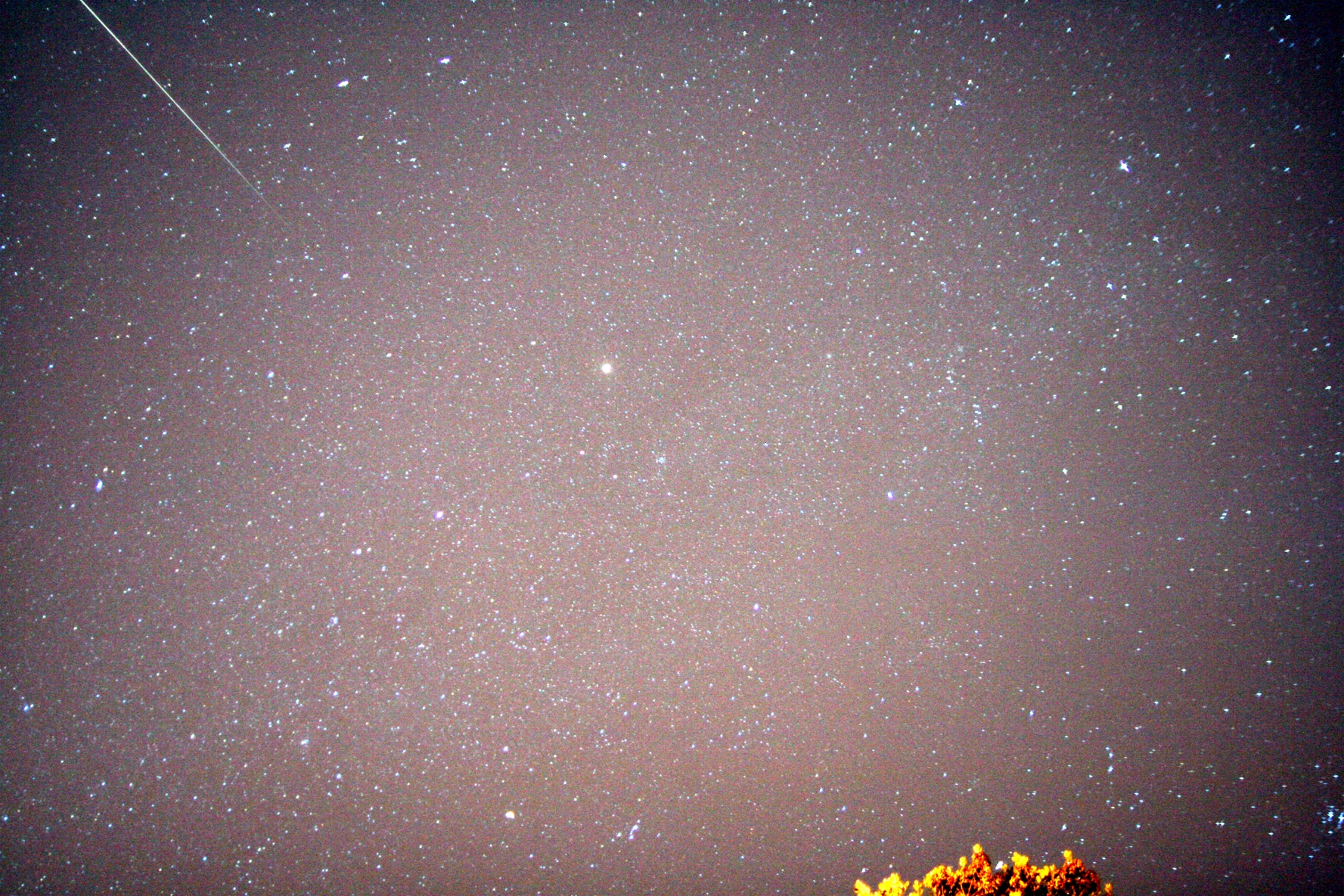

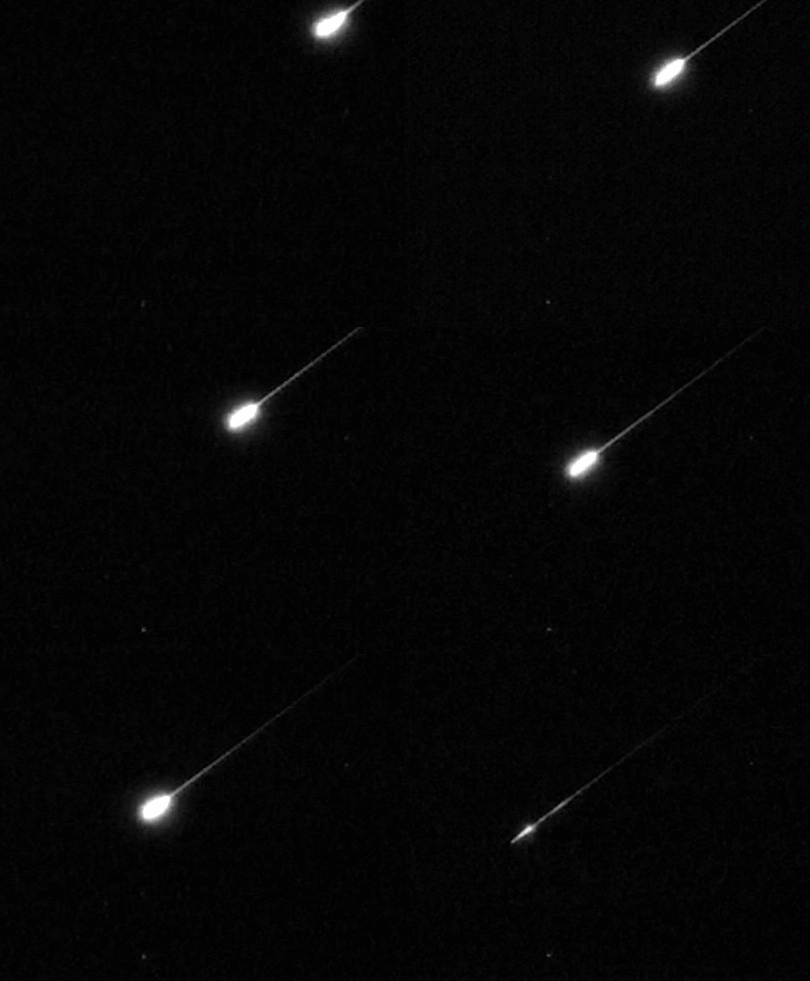
The meteors in this shower appear to come from the radiant in the constellation Gemini (hence the shower's name). However, they can appear almost anywhere in the night sky, and often appear yellowish in hue. Well north of the equator, the radiant rises about sunset, reaching a usable elevation from the local evening hours onwards. In the southern hemisphere, the radiant appears only around local midnight or so. Observers in the northern hemisphere will see higher Geminid rates as the radiant is higher in the sky. The meteors travel at medium speed in relation to other showers, at about 22 mi/s, making them fairly easy to spot. They usually fall apart while at heights above 24 mi.
Timeline
| Year | Peak of shower | ZHRmax | Lunar phase |
|---|---|---|---|
| 2006 | December 14 | 132 | 33% waning crescent |
| 2007 | December 14 | 170 | 30% waxing crescent |
| 2008 | December 13 | 114 | 95% full moon |
| 2009 | December 14 | 140 | 9% new moon |
| 2010 | December 14 | 126 | 59% first quarter |
| 2011 | December 14 | 193 | 86% waning gibbous |
| 2012 | December 13 | 134 | 2% new moon |
| 2013 | December 14 | 172 | 92% full moon |
| 2014 | December 13 | 168 | 50% last quarter |
| 2015 | December 14 | 203 | 10% waxing crescent |
| 2016 | December 14 | 157 | 100% full moon |
| 2017 | December 14 | 145 | 13% waning crescent |
| 2018 | December 14 | 41% waxing crescent | |
| 2019 | December 14 | 111 | 94% waning gibbous |
| 2020 | December 14 | 133 | 2% waning crescent |
| 2021 | December 14 | 128 | 73% waxing gibbous |
| 2022 | December 14 | 113 | 72% waning gibbous |
| 2023 | December 14 | 92 | 0% waxing crescent |
| 2024 | December 13-14 | 112 | 99% waxing gibbous |
| 2025 | December 14 | 150 | 26% waning crescent |
References
|access-date = 2010-10-18 |archive-url = https://web.archive.org/web/20121213022734/http://newswatch.nationalgeographic.com/2010/10/12/geminids_meteor_shower_driven_by_exploding_clays/ |archive-date = 2012-12-13 |url-status = dead
| access-date = 2012-12-11}}
| access-date = 2012-12-14}}
References
- "IMO Meteor Shower Calendar 2012: Geminids (GEM)". International Meteor Organization.
- "Small-Body Database Lookup".
- Marsden, Brian G.. (25 October 1983). "IAUC 3881: 1983 TB and the Geminid Meteors; 1983 SA; KR Aur (Circular No. 3881)". [[Central Bureau for Astronomical Telegrams]].
- (1 June 2023). "Formation, Structure, and Detectability of the Geminids Meteoroid Stream". The Planetary Science Journal.
- Rayne, Elizabeth. (27 June 2023). "We finally know how the mysterious Geminid meteor shower originated".
- "Geminids – NASA Science".
- "Moongiant".
- (20 December 2006). "Geminids 2006 ZHR".
- (20 December 2007). "Geminids 2007 ZHR".
- (20 December 2008). "Geminids 2008 ZHR".
- (20 December 2009). "Geminids 2009 ZHR".
- (20 December 2010). "Geminids 2010 ZHR".
- (20 December 2011). "Geminids 2011 ZHR".
- (20 December 2012). "Geminids 2012 ZHR".
- (20 December 2013). "Geminids 2013 ZHR".
- (20 December 2014). "Geminids 2014 ZHR".
- (20 December 2015). "Geminids 2015 ZHR".
- (20 December 2016). "Geminids 2016 ZHR".
- Antier, Karl. "Impressive 2017 Geminids!".
- Miskotte, Koen. "The Geminids of 2018: an analysis of visual observations".
- (20 December 2018). "Geminids 2018 ZHR".
- (20 December 2019). "Geminids 2019 ZHR".
- (20 December 2020). "Geminids 2020 ZHR".
- (20 December 2021). "Geminids 2021 ZHR".
- (20 December 2022). "Geminids 2022 ZHR".
- (20 December 2023). "Geminids 2023 ZHR".
- (2024-12-14). "Viewing the 2024 Geminid Meteor Shower {{!}} IMO".
- (20 December 2024). "Geminids 2024 ZHR".
- "Meteor Shower Calendar {{!}} IMO {{!}} Page 2025".
- Kronk, Gary W.. "Observing the Geminids". Meteor Showers Online.
This article was imported from Wikipedia and is available under the Creative Commons Attribution-ShareAlike 4.0 License. Content has been adapted to SurfDoc format. Original contributors can be found on the article history page.
Ask Mako anything about Geminids — get instant answers, deeper analysis, and related topics.
Research with MakoFree with your Surf account
Create a free account to save articles, ask Mako questions, and organize your research.
Sign up freeThis content may have been generated or modified by AI. CloudSurf Software LLC is not responsible for the accuracy, completeness, or reliability of AI-generated content. Always verify important information from primary sources.
Report