From Surf Wiki (app.surf) — the open knowledge base
Gemini 10
1966 crewed spaceflight within NASA's Gemini program

1966 crewed spaceflight within NASA's Gemini program
| Field | Value |
|---|---|
| name | Gemini X |
| image | Agena Firing - GPN-2000-001355.jpg |
| image_caption | Gemini 10 is boosted into a higher orbit by its Agena Target Vehicle |
| insignia | File:Gemini 10 Insignia.svg |
| mission_type | {{Unbulleted list |
| operator | NASA |
| COSPAR_ID | 1966-066A |
| SATCAT | 2349 |
| mission_duration | 2 days, 22 hours, 46 minutes, 39 seconds |
| orbits_completed | 43 |
| spacecraft | Gemini SC10 |
| manufacturer | McDonnell |
| launch_mass | 3763 kg |
| landing_mass | 4254 lb |
| launch_date | UTC |
| launch_rocket | Titan II GLV, s/n #62-12565 |
| launch_site | Cape Kennedy LC-19 |
| landing_date | UTC |
| landing_site | |
| recovery_by | |
| orbit_epoch | July 19, 1966 |
| orbit_reference | Geocentric |
| orbit_regime | Low Earth orbit |
| orbit_periapsis | 299 km |
| orbit_apoapsis | 756 km |
| orbit_inclination | 28.8 degrees |
| orbit_period | 95.19 minutes |
| apsis | gee |
| docking_target | GATV-5005 |
| docking_type | dock |
| docking_date | July 19, 1966, 04:15:00 UTC |
| undocking_date | July 20, 1966, 19:00:00 UTC |
| time_docked | 1 day, 14 hours, 45 minutes |
| crew_size | 2 |
| crew_members | |
| crew_EVAs | 2 |
| crew_EVA_duration | 1 hour, 28 minutes |
| crew_photo | Gemini10crew.jpg |
| crew_photo_caption | (L-R) Young, Collins |
| previous_mission | Gemini 9A |
| next_mission | Gemini 11 |
| programme | Project Gemini |
| Space rendezvous | Spacecraft docking | Extravehicular activity}}
Gemini 10 (officially Gemini X){{cite book | chapter-url = http://www.hq.nasa.gov/office/pao/History/SP-4203/ch11-1.htm | access-date = 2013-09-26 | archive-date = 2010-01-13 | archive-url = https://web.archive.org/web/20100113132344/http://www.hq.nasa.gov/office/pao/History/SP-4203/toc.htm | url-status = dead
Crew
Backup crew
Support crew
- Edwin E. "Buzz" Aldrin (Houston CAPCOM)
- L. Gordon Cooper Jr. (Cape and Houston CAPCOM)
Jim Lovell and Buzz Aldrin had originally been named the backup crew, but after Charles Bassett and Elliot See died in a T-38 crash, they were moved to the backup crew for Gemini 9A and Alan Bean and Clifton Williams were moved to the Gemini 10 flight.
Mission parameters
- Mass: 3,762.6 kg
- Perigee: 159.9 km
- Apogee: 268.9 km
- Inclination: 28.87°
- Period: 88.79 min
Docking
- Docked: July 19, 1966 - 04:15:00 UTC
- Undocked: July 20, 1966 - 19:00:00 UTC
Space walk
- Collins - EVA 1 (stand up)
- Start: July 19, 1966, 21:44:00 UTC
- End: July 19, 1966, 22:33:00 UTC
- Duration: 0 hours, 49 minutes
- Collins - EVA 2
- Start: July 20, 1966, 23:01:00 UTC
- End: July 20, 1966, 23:40:00 UTC
- Duration: 0 hours, 39 minutes
Objectives
Gemini 10 was designed to achieve rendezvous and docking with an Agena Target Vehicle (ATV), and EVA. It was also planned to dock with the ATV from the Gemini 8 mission. This Agena's battery power had failed months earlier, and an approach and docking would demonstrate the ability to rendezvous with a passive object. It would also be the first mission to fire the Agena's own rocket, allowing them to reach higher orbits.
Gemini 10 established that radiation at high altitude was not a problem. After docking with their Agena booster in low orbit, Young and Collins used it to climb temporarily to 763.8 km. After leaving the first Agena, they then rendezvoused with the derelict Agena left over from the aborted Gemini 8 flight—thus executing the program's first double rendezvous. With no electricity on board the second Agena, the rendezvous was accomplished with eyes only—no radar.

After the rendezvous, Collins spacewalked over to the dormant Agena at the end of a 50 ft tether, making him the first person to meet another spacecraft in orbit. Collins then retrieved a cosmic dust-collecting panel from the side of the Agena. As he was concentrating on keeping his tether clear of the Gemini and Agena, Collins' Hasselblad camera worked itself free and drifted away, so he was unable to take photographs during the spacewalk.
Flight
The Agena launched perfectly for the second time, after problems had occurred with the targets for Gemini 6 and 9. Gemini 10 followed 100 minutes later and entered a 159.9 by orbit. They were 1800 km behind the Agena. Two anomalous events occurred during the launch. At liftoff, a propellant fill umbilical became snared with its release lanyard. It ripped out of the LC-19 service tower and remained attached to the second stage during ascent. Tracking camera footage also showed that the first stage oxidizer tank dome ruptured after staging and released a cloud of nitrogen tetroxide. The telemetry package on the first stage had been disabled at staging, so visual evidence was the only data available. Film review of the Titan II ICBM launches found at least seven other instances of post-staging tank ruptures, most likely caused by flying debris, second stage engine exhaust, or structural bending. NASA finally decided that this phenomenon did not pose any safety risk to the astronauts and took no corrective action.
| Gemini 10 | Agena Info | Agena | NSSDC ID: | Mass | Launch site | Launch date | Launch time | 1st perigee | 1st apogee | Period | Inclination | Reentered |
|---|---|---|---|---|---|---|---|---|---|---|---|---|
| GATV-5005 | ||||||||||||
| 1966-065A | ||||||||||||
| 3,175 kg | ||||||||||||
| LC-14 | ||||||||||||
| July 18, 1966 | ||||||||||||
| 20:39:46 UTC | ||||||||||||
| 294.7 km | ||||||||||||
| 302.8 km | ||||||||||||
| 90.46 m | ||||||||||||
| 28.85 | ||||||||||||
| December 29, 1966 |
First rendezvous
Collins was unable to use the sextant for navigation as it did not seem to work as expected. At first he mistook airglow as the real horizon when trying to make some fixes on stars. When the image didn't seem right he tried another instrument, but this was not practical to use as it had a very small field of view.
They had a backup in the form of the computers on the ground. They made their first burn to put them into a 265 by orbit. However Young didn't realize that during the next burn, he had the spacecraft turned slightly, which meant that they introduced an out-of-plane error. This meant two extra burns were necessary, and by the time they had docked with the Agena, 60% of their fuel had been consumed. It was decided to keep the Gemini docked to the Agena as long as possible, as this would mean that they could use the fuel on board the Agena for attitude control.
The first burn of the Agena engine lasted 80 seconds and put them in a 294 by orbit. This was the highest a person had ever been, although the record was soon surpassed by Gemini 11, which went to over 1000 km. This burn was quite a ride for the crew. Because the Gemini and Agena docked nose-to-nose, the forces experienced were "eyeballs out" as opposed to "eyeballs in" for a launch from Earth. The crew took a couple of pictures when they reached apogee but were more interested in what was going on in the spacecraft — checking the systems and watching the radiation dosage meter.
After this they had their sleep period which lasted for eight hours and then they were ready for another busy day. The crew's first order of business was to make a second burn with the Agena engine to put them into the same orbit as the Gemini 8 Agena. This was at 20:58 UTC on July 19 and lasted 78 seconds and took 105 m/s off their speed, putting them into a 294 by orbit. They made one more burn of the Agena to circularize their orbit to 377.6 km.
EVA 1
The first of two EVAs on Gemini 10 was a standup EVA, where Collins would stand in the open hatch and take photographs of stars as part of experiment S-13. They used a 70 mm general purpose camera to image the southern Milky Way in ultraviolet. After orbital sunrise Collins photographed a color plate on the side of the spacecraft (MSC-8) to see whether film reproduced colors accurately in space. He reentered the spacecraft six minutes early when both astronauts found that their eyes were irritated, which was caused by a minor leak of lithium hydroxide in the astronauts' oxygen supply. After repressurizing the cabin, they ran the oxygen at high rates and flushed the environment system.
After the exercise of the EVA Young and Collins slept in their second 'night' in space. The next 'morning' they started preparing for the second rendezvous and another EVA.
Second rendezvous
After undocking from their Agena, the crew thought they sighted the Gemini 8 Agena. It however turned out to be their own Agena 5.5 km away, while their target was 176 km away. It was not until just over 30 km away that they saw it as a faint star. After a few more correction burns, they were station-keeping 10 ft away from the Gemini 8 Agena. They found the Agena to be very stable and in good condition.
EVA 2
At 48 hours and 41 minutes into the mission, the second EVA began. Collins' first task was to retrieve a Micrometeorite Collector (S-12) from the side of the spacecraft. This he accomplished with some difficulty (similar to that encountered by Eugene Cernan on Gemini 9A). The collector floated out of the cabin at some time during the EVA, and was lost.
Collins next traveled over to the Agena and tried to grab onto the docking cone but found this impossible as it was smooth and had no grip. He used a nitrogen-propelled Hand-Held Maneuvering Unit (HHMU) to move himself towards the Gemini and then back to the Agena. This time he was able to grab hold of some wire bundles and retrieved the Micrometeorite Collector (S-10) from the Agena. He decided against replacing it as a piece of shroud had come loose on the Agena which could have snared the umbilical, and returning to the Gemini was deemed the safest course of action.
The last tasks remaining on this EVA were to test out the HHMU, test orbital mechanics using a tether between the Gemini and Agena, and for Young in the spacecraft to translate over to a passive Collins. However, due to low propellant quantity remaining, combined with intermittent telemetry to monitor it, these fuel costly manoeuvres were abandoned and the EVA was finished after only 39 minutes. During this time, it took the crew eight minutes to close the hatch as they had some difficulty with the 50 ft umbilical. It was jettisoned along with the chestpack used by Collins an hour later when they opened the hatch for the third and final time.
Experiments
There were ten other experiments that the crew performed during the mission. Three were interested in radiation: MSC-3 was the Tri-Axis Magnetometer which measured levels in the South Atlantic Anomaly. There was also MSC-6, a beta spectrometer, which measured potential radiation doses for Apollo missions, and MSC-7, a bremsstrahlung spectrometer which detected radiation flux as a function of energy when the spacecraft passed through the South Atlantic Anomaly.
S-26 investigated the ion and electron wake of the spacecraft. This provided limited results due to the lack of fuel for attitude control, but found that electron and ion temperatures were higher than expected and it registered shock effects during docking and undocking.
The S-5 and S-6 experiments were performed, which were previously carried on Gemini 9A; these were Synoptic Terrain and Synoptic Weather photography respectively. There was also S-1 which was intended to image the Zodiacal light. All of these experiments were of little use as the film used was only half as sensitive as Gemini 9A and the dirty windows lowered the transmission of light by a factor of six.
The crew also tried to perform D-5, a navigation experiment. They were only able to track five stars, with six needed for accurate measurements. The last experiment, D-10, was to investigate an ion-sensing attitude control system. This experiment measured the attitude of the spacecraft from the flow of ions and electrons around the spacecraft in orbit. The results from this experiment showed the system to be accurate and responsive.
Re-entry
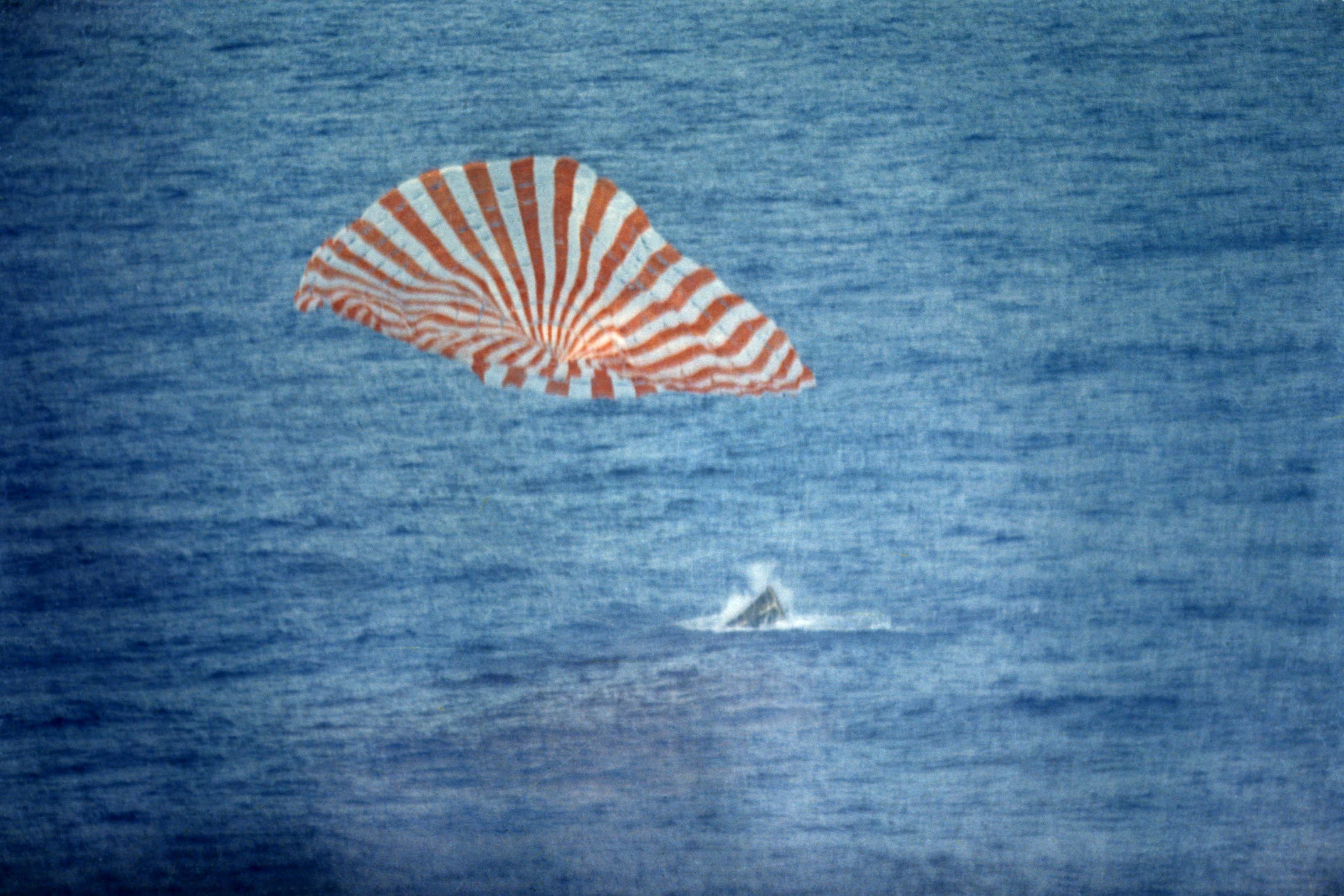
The last day of the mission was short and retrofire came at 70 hours and 10 minutes into the mission. They landed only 5.6 km away from the intended landing site and were recovered by .
The Gemini 10 mission was supported by the following U.S. Department of Defense resources: 9,067 personnel, 78 aircraft and 13 ships.
Insignia

The patch is simple in design but highly symbolic. The main feature is a large X with a Gemini and Agena orbiting around it. The two stars have a variety of meanings: the two rendezvous attempts, Castor and Pollux in Gemini or the two crew members. This is one of the few crew patches without the crew's name. It is able to be displayed "upside down" but is correctly shown with the spacecraft to the right. It was designed by Young's first wife, Barbara.
Spacecraft location

For many years the spacecraft was the centerpiece of a space exhibition at Norsk Teknisk Museum, Oslo, Norway. It was returned on request in 2002.
The spacecraft is currently on display at the Cosmosphere in Hutchinson, Kansas.
References
References
- McDowell, Jonathan. "SATCAT". Jonathan's Space Pages.
- (April 2013). "Astronaut Fact Book". NASA.
- (2016). "Project Gemini". Schiffer Publishing.
- "Gemini 10". NASA Space Science Data Coordinated Archive.
- Collins, Michael. (1974). "Carrying the Fire: An Astronaut's Journeys". Cooper Square Press.
- "Gemini X Composite Air-to-Ground and Onboard Voice Tape Transcription, 338 pages".
- "Gemini X PAO Mission Commentary Transcript, 524 pages".
- "Gemini X PAO Mission Commentary Transcript, 524 pages".
This article was imported from Wikipedia and is available under the Creative Commons Attribution-ShareAlike 4.0 License. Content has been adapted to SurfDoc format. Original contributors can be found on the article history page.
Ask Mako anything about Gemini 10 — get instant answers, deeper analysis, and related topics.
Research with MakoFree with your Surf account
Create a free account to save articles, ask Mako questions, and organize your research.
Sign up freeThis content may have been generated or modified by AI. CloudSurf Software LLC is not responsible for the accuracy, completeness, or reliability of AI-generated content. Always verify important information from primary sources.
Report