From Surf Wiki (app.surf) — the open knowledge base
Garudasana
Standing balancing posture in modern yoga
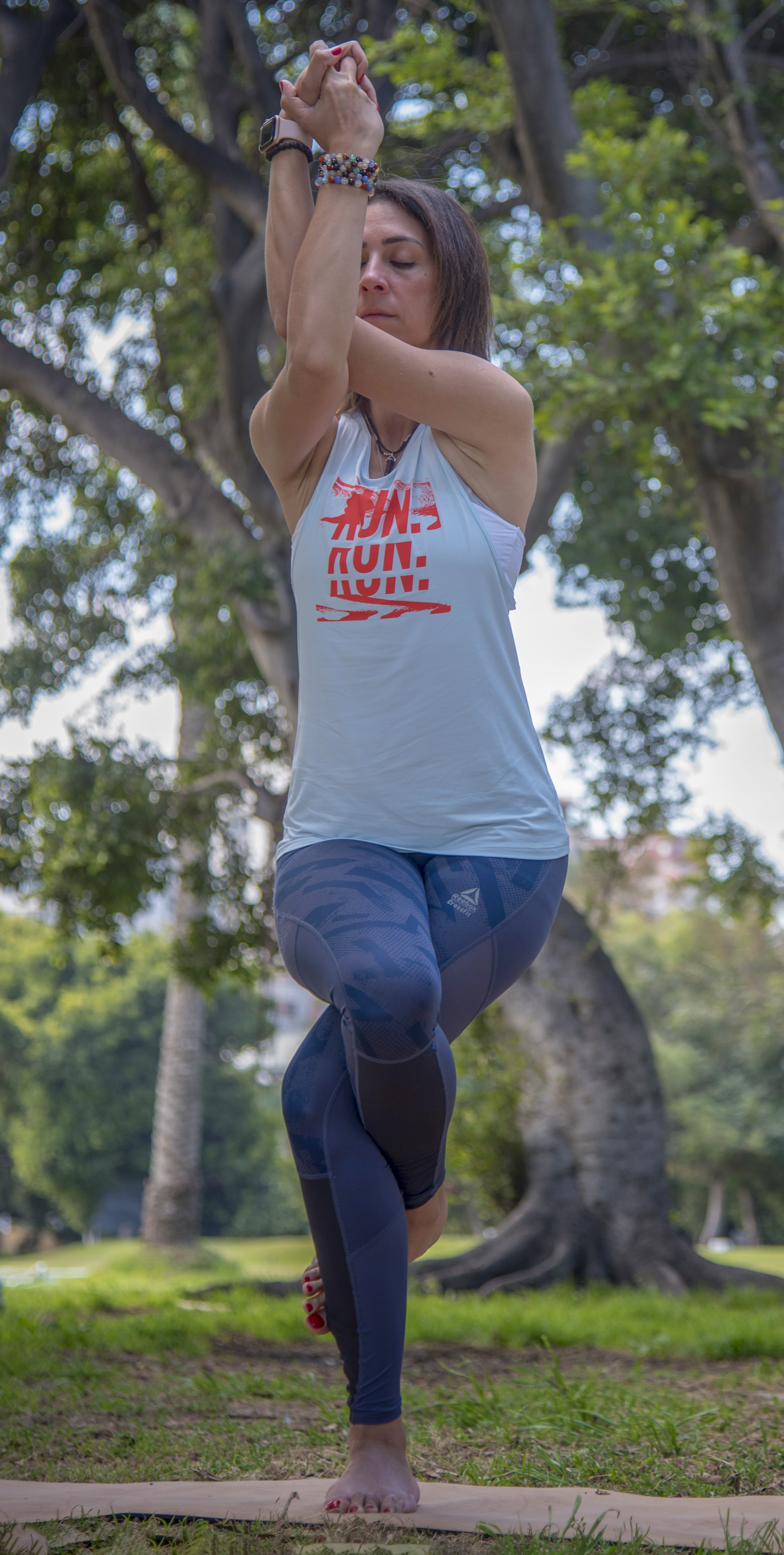
Standing balancing posture in modern yoga
Garudasana (; ) or Eagle Pose is a standing balancing asana in modern yoga as exercise. The name was used in medieval hatha yoga for a different pose.
Etymology and origins

The name comes from the Sanskrit words garuda (गरुड) meaning "eagle", and asana (आसन) meaning "posture" or "seat".
In Hindu mythology, Garuda is known as the king of birds. He is the vahana (mount) of the God Vishnu and is eager to help humanity fight against demons. The word is usually rendered into English as "eagle", though the name literally means "devourer", because Garuda was originally identified with the "all-consuming fire of the sun's rays".
The name is used for a different pose in the late 17th-century Gheranda Samhita, verse 2.37, which has the legs and thighs on the ground, and the hands on the knees.
A one-legged balancing pose named Garudasana but closer to Vrikshasana is described and illustrated in the 19th century Sritattvanidhi. The modern pose is described in Light on Yoga.
Description
Garudasana is an asymmetric position in which one leg, say the right, is crossed over the left, while the arm on the opposite side, say the left, is crossed over the right, and the palms are pressed together. Like all poses on one leg, it demands, and may help to build, balance and concentration. According to Satyananda Saraswati, the two palms pressed together resemble the eagle's beak. The gaze is directed at a fixed point in front.
Variations
A kneeling variant of the pose is Vātāyanāsana, Horse Pose.
In literature
The actress Mariel Hemingway's 2002 autobiography Finding My Balance: A Memoir with Yoga describes how she used yoga to recover balance in her life after a dysfunctional upbringing. Each chapter is titled after an asana, the last being "Eagle Pose, or Garudasana", in each case with some life lesson related to the pose. She describes it as "a balancing posture with the arms and legs intricately intertwined [that] requires some flexibility, a lot of trust, and most of all, balance". The chapter recounts how she, her husband and her daughters all came close to drowning in canoes off Kauai, Hawaii. Doing the asana now "reminds me of the unconscious balance I achieved when I began successfully working my way through the surf without fighting. I spread my toes and pull up on the calf muscle."
References
Sources
References
- "Eagle Pose". [[Yoga Journal]].
- Sinha, S. C.. (1 June 1996). "Dictionary of Philosophy". Anmol Publications.
- Dalal, Roshen. (2010). "Hinduism: An Alphabetical Guide". Penguin Books.
- Jordan, Michael. (August 2004). "Dictionary of gods and goddesses". Infobase Publishing.
- Rai Bahadur Srisa Chandra Vasu (translator) [https://web.archive.org/web/20140124005530/http://brihaspati.net/downloads/Gheranda_Samhita_S_C_Vasu.pdf Gheranda Samhita]
- Sjoman, Norman E.. (1999). "The Yoga Tradition of the Mysore Palace". Abhinav Publications.
- VanEs, Howard Allan. (12 November 2002). "Beginning Yoga: A Practice Manual". Letsdoyoga.com.
- "Vatayanasana". [[Ashtanga (vinyasa) yoga.
- (2004). "Finding My Balance: A Memoir with Yoga". Simon & Schuster.
This article was imported from Wikipedia and is available under the Creative Commons Attribution-ShareAlike 4.0 License. Content has been adapted to SurfDoc format. Original contributors can be found on the article history page.
Ask Mako anything about Garudasana — get instant answers, deeper analysis, and related topics.
Research with MakoFree with your Surf account
Create a free account to save articles, ask Mako questions, and organize your research.
Sign up freeThis content may have been generated or modified by AI. CloudSurf Software LLC is not responsible for the accuracy, completeness, or reliability of AI-generated content. Always verify important information from primary sources.
Report