From Surf Wiki (app.surf) — the open knowledge base
Garter snake
Common name for snakes of the genus Thamnophis

Common name for snakes of the genus Thamnophis
The article is about North American garter snakes. For the unrelated venomous snakes of Africa also called garter snakes, see Elapsoidea.
(Thamnophis sirtalis sirtalis)
- Atomarchus
- Chilopoma
- Eutaenia
- Eutainia
- Phamnovis
- Prymnomiodon
- Stypocemus
- Tropidonote
- Tropidonotus
Garter snake is the common name for small to medium-sized snakes belonging to the genus Thamnophis in the family Colubridae. They are native to North and Central America, ranging from central Canada in the north to Costa Rica in the south.
With about 37 recognized species and 52 subspecies, garter snakes are highly variable in appearance; generally, they have large round eyes with rounded pupils, a slender build, keeled scales (appearing 'raised'), and a pattern of longitudinal stripes that may or may not include spots (although some have no stripes at all). Certain subspecies have stripes of blue, yellow, or red, mixed with black tops and beige-tan underbelly markings. They also vary significantly in total length, from 18 to.
With no real consensus on the classification of the species of Thamnophis, disagreements between taxonomists and disputed sources (such as field guides) are common. One area of debate, for example, is whether or not two specific types of snake are separate species, or subspecies of the same. Garter snakes are closely related to the genus Nerodia (water snakes), with some species having been moved back and forth between genera.
As garter snakes may retain toxins from their amphibian prey in their liver, they are one of the few species of snakes in the world that can be both venomous and poisonous.
Taxonomy
The first garter snake to be scientifically described was the eastern garter snake (now Thamnophis sirtalis sirtalis), by zoologist and taxonomist Carl Linnaeus in 1758. The genus Thamnophis was described by Leopold Fitzinger in 1843 as the genus for the garter snakes and ribbon snakes. Many snakes previously identified as their own genera or species have been reclassified as species or subspecies in Thamnophis. The Reptile Database currently recognised 37 species in the genus, some with several subspecies.
Distribution and habitat
Native to North and Central America, species in the genus Thamnophis can be found in all of the lower 48 United States, and all of the Canadian provinces. They are found from the subarctic plains of west-central Canada east through Ontario and Quebec; from Atlantic Canada and south to Florida, across the southern and central U.S. into the arid regions of the southwest and Mexico, Guatemala and south to the neotropics and Costa Rica.
Garter snakes are not originally native to the eastern Canadian island of Newfoundland, but have been breeding there in the wild and gradually spreading since at least 2010. It is unknown how they reached the island, probably accidentally via hay shipments or as escaped pets.
Their wide distribution is due to their varied diets and adaptability to different habitats, with varying proximity to water. However, in the western part of North America these snakes are more aquatic than in the eastern portion. Garter snakes live in a variety of habitats, including forests, woodlands, fields, grasslands and lawns, but never far from water, often an adjacent wetland, stream or pond. This reflects the fact that amphibians are a large part of their diet. Garter snakes are often found near small ponds with tall weeds.
Behavior
Garter snakes have complex pheromonal communication systems. They can find other snakes by following their pheromone-scented trails. Male and female skin pheromones are so different as to be immediately distinguishable. However, male garter snakes sometimes produce both male and female pheromones. During the mating season, this ability fools other males into attempting to mate with them. This causes the transfer of heat to them in kleptothermy, which is an advantage immediately after hibernation, allowing them to become more active. Male snakes giving off both male and female pheromones have been shown to garner more copulations than normal males in the mating balls that form at the den when females enter the mating melee. A snake hatch can include as many as 57 young.
Garter snakes use the vomeronasal organ to communicate via pheromones through tongue flicking, which gathers chemical cues in the environment. Upon entering the lumen of the organ, the chemical molecules will come into contact with the sensory cells, which are attached to the neurosensory epithelium of the vomeronasal organ.
If disturbed, a garter snake may coil and strike, but it typically hides its head and flails its tail. These snakes will also discharge a malodorous, musky-scented secretion from a gland near the cloaca. This secretion from North American garter snakes contains seven highly odoriferous volatile components: acetic, propanoic, 2-methylpropanoic, butanoic, and 3-methylbutanoic acids; and trimethylamine, and 2-piperidone. They often use these techniques to escape when ensnared by a predator. They will also slither into the water to escape a predator on land. Hawks, crows, egrets, herons, cranes, raccoons, otters and other snake species (such as coral snakes and kingsnakes) will eat garter snakes, with even shrews and frogs eating the juveniles.
Being heterothermic, like all reptiles, garter snakes bask in the sun to regulate their body temperature. During brumation (the reptile equivalent of hibernation), garter snakes typically occupy large communal sites called hibernacula. These snakes will migrate large distances to brumate.
Social behavior
A long-term study by the Ontario Ministry of Transportation has shed light on the social behavior of Butler's garter snakes. The study, conducted in a 250-hectare area near Windsor, Canada, tracked over 3,000 individual snakes over a 12-year period. The findings challenge previous assumptions about solitary snake behavior and suggest that these snakes form social groups and communities. The study revealed that Butler's garter snakes do not wander randomly but instead tend to associate with specific groups of snakes. These groups typically consist of three to four individuals, with some larger groups reaching up to 46 snakes.
Diet

Garter snakes, like all snakes, are carnivorous. Their diet consists of almost any creature they are capable of overpowering: slugs, earthworms (nightcrawlers, as redworms are toxic to garter snakes), leeches, lizards, amphibians (including frog eggs), minnows, and rodents. When living near water, they eat other aquatic animals. The ribbon snake (Thamnophis saurita) in particular favors frogs (including tadpoles), readily eating them despite their strong chemical defenses. Food is swallowed whole. Garter snakes often adapt to eating whatever they can find and whenever they can find it because food can be either scarce or abundant. Although they feed mostly on live animals they will sometimes eat eggs.
Venom
Garter snakes were long thought to be non-venomous, but discoveries in the early 2000s revealed that they produce a neurotoxic venom. Despite this, garter snakes cannot seriously injure or kill humans with the small amounts of comparatively mild venom they produce and they also lack an effective means of delivering it. In a few cases, some swelling and bruising has been reported. but their gums are significantly larger and the secretions of their Duvernoy's gland are only mildly toxic.
Evidence suggests that garter snake and newt populations share an evolutionary link in their tetrodotoxin resistance levels, implying co-evolution between predator and prey. Garter snakes feeding on toxic newts can also retain those toxins in their liver for weeks, making those snakes poisonous as well as venomous.
Conservation status
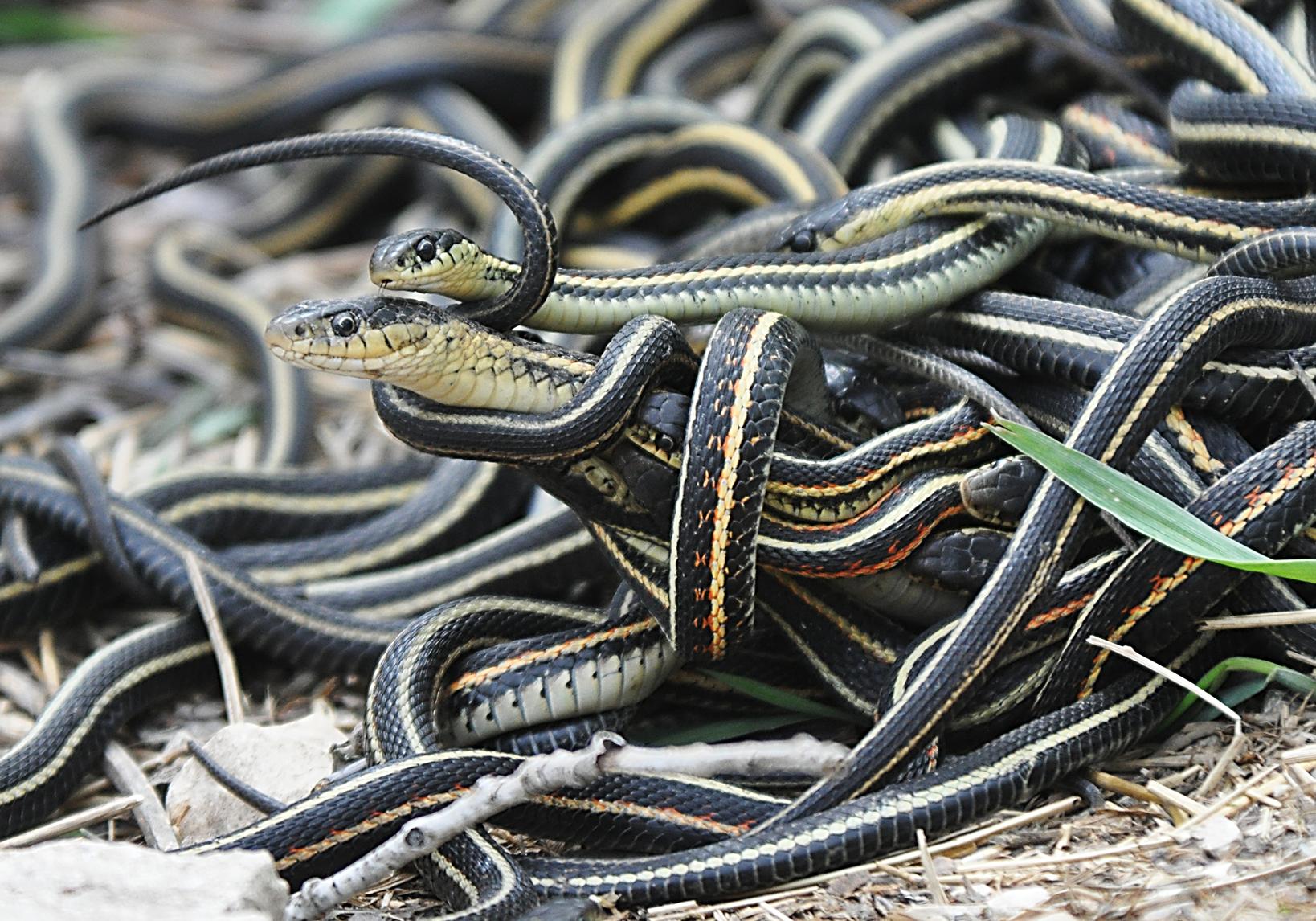
Despite the decline in their population from collection as pets (especially in the more northerly regions, in which large groups are collected at hibernation), pollution of aquatic areas, and the introduction of American bullfrogs as potential predators, garter snakes are still some of the most commonly found reptiles in much of their ranges. The San Francisco garter snake (Thamnophis sirtalis tetrataenia), however, has been on the endangered list since 1969. Predation by crayfish has also been responsible for the decline of the narrow-headed garter snake (Thamnophis rufipunctatus). Many breeders have bred all species of garter snakes, making it a popular breed.
Species and subspecies
Arranged alphabetically by scientific name:
| Image | Subspecies | Common name | Subspecies | Distribution | ||
|---|---|---|---|---|---|---|
| Thamnophis ahumadai | Jalisco Mountain, Mexico | |||||
| [[File:Thamnophis atratus (1).jpg | 120px]] | Thamnophis atratus | Aquatic garter snake | coast of Oregon and California. | ||
| Thamnophis bogerti | Bogert's garter snake | Oaxaca, Mexico | ||||
| Thamnophis brachystoma | Shorthead garter snake | northwestern Pennsylvania and southwestern New York. | ||||
| [[File:Thamnophis butleri.jpg | 120px]] | Thamnophis butleri | Butler's garter snake | northwestern Ohio, northeastern Indiana, the eastern portion of the Lower Peninsula of Michigan, and the adjacent extreme southern tip of Ontario, Canada. | ||
| Thamnophis chrysocephalus | Golden head garter snake | Mexico. | ||||
| Thamnophis conanti | Conant's garter snake | Puebla and Veracruz, Mexico. | ||||
| Thamnophis copei | Cope's mountain meadow garter snake | Mexico. | ||||
| [[File:Sierra garter snake handled.jpg | 120px]] | Thamnophis couchii | Sierra garter snake | California and Oregon in the United States | ||
| [[File:Thamnophis cyrtopsis ocellatus.jpg | 120px]] | Thamnophis cyrtopsis | Blackneck garter snake | southwestern United States, Mexico and Guatemala | ||
| [[File:Coast Garter Snake.jpg | 120px]] | Thamnophis elegans | Western terrestrial garter snake | central British Columbia, central Alberta, and southwestern Manitoba in Canada, central United States | ||
| [[File:Thamnophis eques1.jpg | 120px]] | Thamnophis eques | Mexican garter snake | Mexico and in the United States (Arizona and New Mexico). | ||
| [[File:Thamnophis errans.jpg | 120px]] | Thamnophis errans | Mexican wandering garter snake | Chihuahua, Durango, Jalisco, Nayarit, and Zacatecas States of Mexico. | ||
| Thamnophis exsul | Montane garter snake | Mexico. | ||||
| Thamnophis foxi | Fox's mountain meadow snake | Mexico. | ||||
| Thamnophis fulvus | Highland garter snake | Mexico, Guatemala, Honduras and El Salvador. | ||||
| [[File:Giant Garter Snake 1.jpg | 120px]] | Thamnophis gigas | Giant garter snake | central California. | ||
| Thamnophis godmani | Godman's garter snake | southern Mexico | ||||
| [[File:Thamnophis hammondii 02.jpg | 120px]] | Thamnophis hammondii | Two-striped garter snake | central California to Baja California, Mexico | ||
| Rossman & Burbrink, 2005 }} | Liner's garter snake | Mexico. | ||||
| [[File:Thamnophis marcianus.jpg | 120px]] | Thamnophis marcianus | Checkered garter snake | southwestern United States, Mexico, and Central America. | ||
| [[File:Blackbelly Garter Snake imported from iNaturalist photo 162669277 on 15 November 2021.jpg | 120px]] | Thamnophis melanogaster | Blackbelly garter snake | Mexico. | ||
| Thamnophis mendax | Tamaulipan montane garter snake | Mexico. | ||||
| Thamnophis nigronuchalis | Southern Durango spotted garter snake | Durango, Mexico. | ||||
| [[File:Thamnophis ordinoides 071616 A.jpg | 120px]] | Thamnophis ordinoides | Northwestern garter snake | California, Oregon, and Washington; in Canada, it is found in British Columbia | ||
| Thamnophis postremus | Tepalcatepec Valley garter snake | Mexico. | ||||
| [[File:Thamnophis proximus rubrilineatus.jpg | 120px]] | Thamnophis proximus | Western ribbon snake | western United States, Mexico, and Central America | ||
| [[File:Thamnophis pulchrilatus4.jpg | 120px]] | Thamnophis pulchrilatus | Yellow-throated garter snake | Mexico. | ||
| [[File:Thamnophis-radix.JPG | 120px]] | Thamnophis radix | Plains garter snake | central United States as far north as Canada and as far south as Texas. | ||
| Thamnophis rossmani | Rossman's garter snake | Mexico. | ||||
| Thamnophis rufipunctatus | Narrow-headed garter snake | Arizona and New Mexico, and in the Mexican states of Sonora, Chihuahua and Durango | ||||
| [[File:EasternRibbonSnake.jpg | 120px]] | Thamnophis saurita | Ribbon snake | Eastern North America | ||
| [[File:Thamnophis scalaris.jpg | 120px]] | Thamnophis scalaris | Longtail alpine garter snake | Mexico. | ||
| Thamnophis scaliger | Short-tail alpine garter snake | Mexico. | ||||
| [[File:Thamnophis sirtalis annectens.jpg | 120px]] | Thamnophis sirtalis | Common garter snake | North America | ||
| Thamnophis sumichrasti | Sumichrast's garter snake | Mexico. | ||||
| Thamnophis unilabialis | Madrean narrow-headed garter snake | Mexico. | ||||
| Thamnophis validus | West Coast garter snake | Mexico. |
In the above list, a binomial authority or a trinomial authority in parentheses indicates that the species or subspecies was originally described in a genus other than Thamnophis.
References
References
- [[Albert Hazen Wright. Wright AH]], Wright AA (1957). ''Handbook of Snakes of the United States and Canada''. Ithaca and London: Comstock Publishing Associates, a division of Cornell University Press. 1,105 pp. (in 2 volumes). (''Thamnophis'', p. 755).
- "Thamnophis {{!}} COL".
- "ITIS Standard Report Page: Thamnophis".
- "Species in genus ''Thamnophis''".
- "Genus Thamnophis - taxonomy & distribution / RepFocus".
- CBC News, "[https://www.cbc.ca/news/canada/newfoundland-labrador/snakes-newfoundland-research-invasive-species-1.7242649 Think there aren't any snakes in Newfoundland? Think again]", June 25, 2024. Accessed on June 27, 2024.
- Nature Conservancy Canada, "[https://www.natureconservancy.ca/en/where-we-work/newfoundland-and-labrador/stories/snakes-saints-and-sightings.html#:~:text=The%20first%20confirmed%20report%20of,John's. Snakes, saints and sightings: What you can do to help uncover the mystery of gartersnakes in Newfoundland]". Accessed on June 27, 2024.
- "Thamnophis Fitzinger, 1843".
- Rossman, Douglas Athon. (1996). "The Garter Snakes: Evolution and Ecology". University of Oklahoma Press.
- (2001). "Benefits of female mimicry to snakes". Nature.
- "Garter Snakes: A Gardener's Best Friend | Northern Virginia Soil and Water Conservation District".
- (1995). "Volatile Components in Scent Gland Secretions of Garter Snakes (Thamnophis sp.)". J. Chemical Ecology.
- Howlett, Joseph. (2023-12-15). "Garter snakes make friends, organize their society around females". [[Science (journal).
- (2020-04-15). "Aggregation and social interaction in garter snakes (Thamnophis sirtalis sirtalis)". Behavioral Ecology and Sociobiology.
- "Garter Snake Care Sheet". Thamnophis.com.
- Zimmer, Carl. (April 5, 2005). "Open Wide: Decoding the Secrets of Venom". The New York Times.
- (1979). "The Functional Anatomy of the Teeth of the Western Terrestrial Garter Snake, ''Thamnophis elegans''.". Herpetologica.
- Smith, Michael. (September 2001). "Duverney's Glands and "Warm" Herping". Dallas-Fort Worth Herpetological Society.
- de Queiroz, Alan. (September 27, 2010). "Garter Snakes". Nevada Humanities.
- (2003). "Coevolution of Deadly Toxins and Predator Resistance: Self-Assessment of Resistance by Garter Snakes Leads to Behavioral Rejection of Toxic Newt Prey". Herpetologica.
- (2004). "A resistant predator and its toxic prey: persistence of newt toxin leads to poisonous (not venomous) snakes". Journal of Chemical Ecology.
- Zimmerman R. (2013). "''Thamnophis sirtalis ''". Animal Diversity Web.
- Hammerson GA. (2007). "''Thamnophis rufipunctatus ''".
- (2024-06-26). "A new species of Thamnophis (Serpentes, Colubridae) from Jalisco, Mexico, with a discussion on the phylogeny, taxonomy, and distribution of snakes related to Thamnophis scalaris". Herpetozoa.
- Beolens, Bo; Watkins, Michael; Grayson, Michael (2011). ''The Eponym Dictionary of Reptiles''. Baltimore: Johns Hopkins University Press. xiii + 296 pp. {{ISBN. 978-1-4214-0135-5. (''Thamnophis godmani'', p. 102).
- [http://reptile-database.reptarium.cz/species?genus=Thamnophis&species=lineri&search_param=%28%28genus%3D%27Thamnophis%27%29%29 ''Thamnophis lineri'']. The Reptile Database. http://www.reptile-database.org.
This article was imported from Wikipedia and is available under the Creative Commons Attribution-ShareAlike 4.0 License. Content has been adapted to SurfDoc format. Original contributors can be found on the article history page.
Ask Mako anything about Garter snake — get instant answers, deeper analysis, and related topics.
Research with MakoFree with your Surf account
Create a free account to save articles, ask Mako questions, and organize your research.
Sign up freeThis content may have been generated or modified by AI. CloudSurf Software LLC is not responsible for the accuracy, completeness, or reliability of AI-generated content. Always verify important information from primary sources.
Report