From Surf Wiki (app.surf) — the open knowledge base
Ganzhou

| Field | Value |
|---|---|
| name | Ganzhou |
| native_name | 赣州市 |
| native_name_lang | zh-Hans |
| other_name | Kanchow |
| settlement_type | Prefecture-level city |
| image_skyline | Yugutai.JPG |
| image_caption | Yugu Pavilion |
| image_map | Location map of Ganzhou, Jiangxi.png |
| map_caption | Location of Ganzhou City jurisdiction in Jiangxi |
| map_caption1 | |
| pushpin_map | Jiangxi |
| pushpin_map_caption | Location of the city centre in Jiangxi |
| pushpin_label_position | left |
| coor_pinpoint | Ganzhou municipal government |
| coordinates | |
| subdivision_type | Country |
| subdivision_name | People's Republic of China |
| subdivision_type1 | Province |
| subdivision_name1 | Jiangxi |
| established_title | Settled |
| established_date | 236 AD |
| seat_type | Municipal seat |
| seat | Zhanggong District |
| leader_title | Mayor (deputy) |
| leader_name | Zeng Wenming |
| leader_title1 | Secretary |
| leader_name1 | Li Bingjun |
| area_total_km2 | 39379.64 |
| area_metro_km2 | 5316.8 |
| elevation_m | 107 |
| population_total | 8970014 |
| population_as_of | 2020 census |
| population_footnotes | |
| population_density_km2 | auto |
| area_urban_km2 | 5316.8 |
| population_urban | 2588060 |
| population_density_urban_km2 | auto |
| population_metro | 2588060 |
| population_density_metro_km2 | auto |
| demographics_type2 | GDP |
| demographics2_title1 | Prefecture-level city |
| demographics2_info1 | CN¥ 347.4 billion |
| US$ 53.5 billion | |
| demographics2_title2 | Per capita |
| demographics2_info2 | CN¥ 35,342 |
| US$ 5,440 | |
| postal_code_type | Postal code |
| postal_code | 341000 |
| area_code | 0797 |
| website | |
| timezone | China Standard |
| utc_offset | +8 |
| blank4_name | Vehicle registration plate prefixes |
| blank4_info | 赣B |
| blank5_name | Administrative division code |
| blank5_info | 360700 |
| iso_code | CN-JX-07 |
| pushpin_map | China |
-- US$ 53.5 billion US$ 5,440
Ganzhou (), alternately romanized as Kanchow, is a prefecture-level city in the south of Jiangxi province, China, bordering Fujian to the east, Guangdong to the south, and Hunan to the west. Its administrative seat is at Zhanggong District.
History
Early settlement and administration
In 201 CE, Emperor Gaozu of Han established a county in the territory of modern Ganzhou. In 236 CE, during the Three Kingdoms period, the was established in the area. In the early years, Han Chinese settlement and authority in the area was minimal and largely restricted to the Gan River basin. The river, a tributary of the Yangtze via Poyang Lake, provided a route of communication from the north as well as irrigation for rice farming.
Sui dynasty
In 589 CE, during the Sui dynasty, the was abolished, and the area was reorganized as Qianzhou. During the Song, immigration from the north bolstered the local population and drove local aboriginal tribes into admixing with the northerners. After the fall of the capital to the Jin in 1126 in the Jingkang Incident, immigration increased dramatically.
Song dynasty
In 1153, under the Southern Song, Qianzhou was abolished, and re-organized as Ganzhou, the same name as the present-day city.
Yuan dynasty
In 1277, under the Yuan dynasty, the area was reorganized as . Near the end of the Yuan dynasty, in 1365, Ganzhou Circuit was reorganized again as , which it remained until 1912.
Qing dynasty
During the late 1800s Ganzhou was opened as one of the southern treaty ports and became a minor base for foreign companies.
Republic of China
In 1912, the Republic of China abolished the area's dynasty-era subdivisions, replacing them all with counties administered by the provincial government of Jiangxi. In 1914, the province of Jiangxi was divided into four circuits (), one of which being , which ruled the area of present-day Ganzhou. In 1926, Gannan Circuit was abolished, and its counties were again directly administered by the Jiangxi provincial government. In 1932, the province established , and the area of present-day Ganzhou was split between the 9th, 11th, 12th, and 13th Administrative Inspectorates. In subsequent years, the area would be reorganized to be divided between various Administrative Inspectorates.
Chinese Soviet Republic
Beginning in 1928, the Chinese Communist Party began operating in the area, and by June 1930, a local soviet had formed and began governing a number of counties in the region. In November 1931, the Chinese Soviet Republic was proclaimed in , in the then-county of Ruijin. During the subsequent years, Ganzhou was governed by the Jiangxi–Fujian Soviet. Beginning in February 1934, Communist Party forces in the area began to lose territory to Kuomintang forces (Fifth encirclement). From then until March 1935, the Soviet gradually lost territory with only five northeastern counties left in Ganzhou as of early October 1934 until it collapsed.
Gannan New Deal
People's Republic of China
On August 14, 1949, the People's Liberation Army established control of Gan County. In June 1951, Ganzhou Prefecture () was established.
In February 1999, Ganzhou was changed from a prefecture to a prefecture-level city.
Administration

Ganzhou has jurisdiction over 3 districts, 2 county-level cities, 13 counties:
;District:
- Zhanggong District (章贡区)
- Nankang District (南康区)
- Ganxian District (赣县区)
;County-level cities:
- Ruijin (瑞金市)
- Longnan (龙南市)
;Counties:
- Yudu County (于都县)
- Xingguo County (兴国县)
- Ningdu County (宁都县)
- Shicheng County (石城县)
- Huichang County (会昌县)
- Xunwu County (寻乌县)
- Anyuan County (安远县)
- Dingnan County (定南县)
- Quannan County (全南县)
- Xinfeng County (信丰县)
- Dayu County (大余县)
- Chongyi County (崇义县)
- Shangyou County (上犹县)
| Map |
|---|
Geography
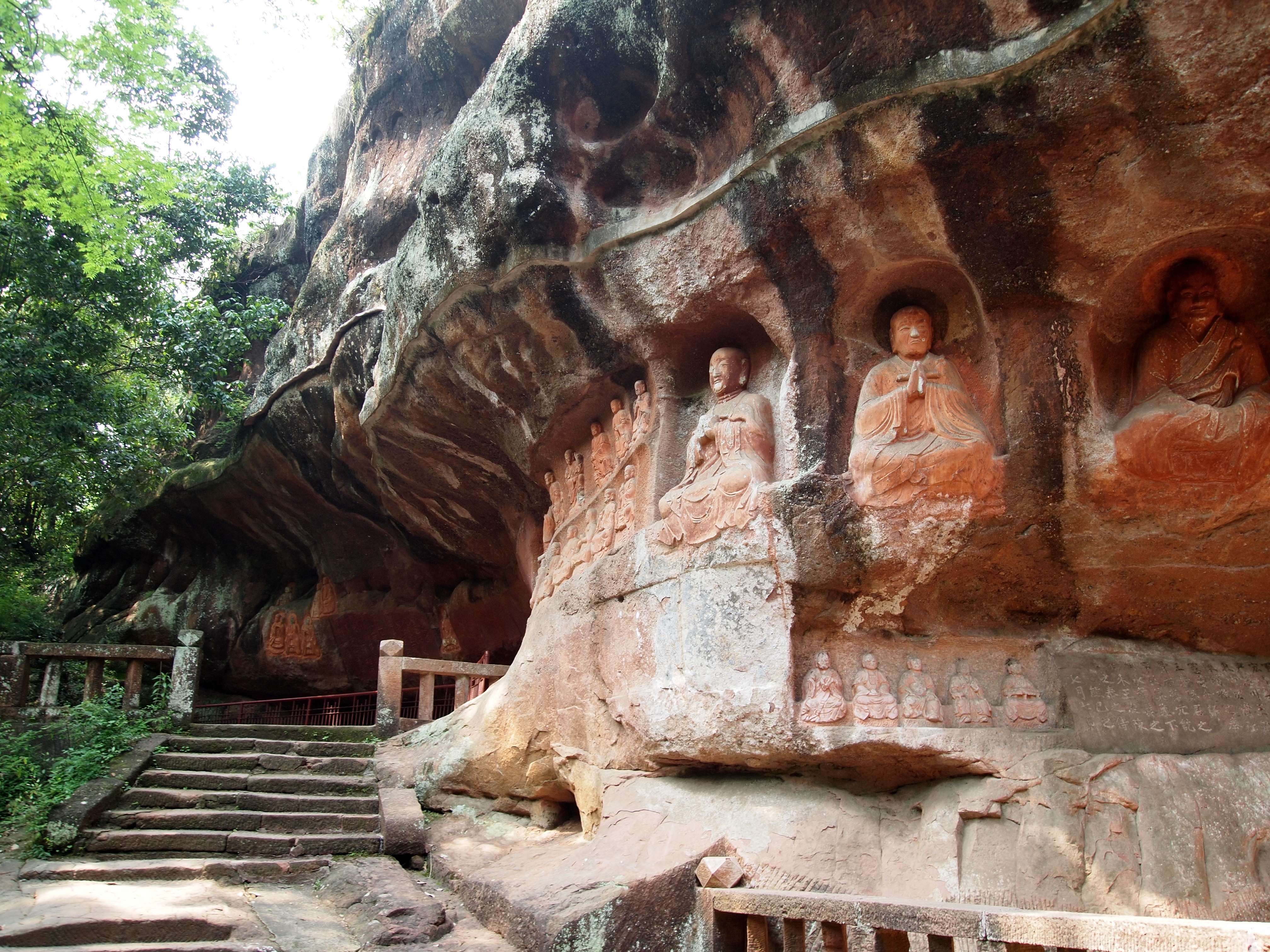
Ganzhou is located in the upper reaches of Ganjiang River, in the south of Jiangxi Province, referred to as Gannan. The geographical coordinates of Ganzhou City are 114.93° east longitude and 25.83° north latitude. Ganzhou is a large city covering the southern third of Jiangxi, with an area of 39400 km2. More than 70% of its administrative area is forested, and over 83% is also mountainous. Several of the major tributaries of the Gan River, Ganzhou's namesake, join at a confluence in the center of the city. Bordering prefecture-level cities are:
Fujian:
- Sanmingeast
- Longyaneast
Guangdong:
- Meizhousouth
- Heyuansouth
- Shaoguansouth
Hunan:
- Chenzhouwest
Jiangxi:
- Ji'annorth
- Fuzhounorth
Climate
Ganzhou has a humid subtropical climate (Köppen Cfa) affected by the East Asian monsoon, with long, humid, very hot summers and cool and drier winters with occasional cold snaps. The monthly 24-hour average temperature ranges from 8.2 °C in January to 29.5 °C in July, with an annual average of 19.57 °C. The average annual precipitation is around 1450 mm. With monthly percent possible sunshine ranging from 20% in March to 62% in July, the city receives 1,778 hours of bright sunshine annually. Winter begins somewhat sunny and dry but becomes progressively wetter and cloudier; spring begins especially gloomy, and from March to June each of the months averages more than 170 mm of rainfall. After the heavy rains subside in June, summer is especially sunny. Autumn is warm and relatively dry.
| Jan record high C = 27.7 | Feb record high C = 31.4 | Mar record high C = 33.2 | Apr record high C = 35.1 | May record high C = 37.9 | Jun record high C = 38.4 | Jul record high C = 40.0 | Aug record high C = 41.2 | Sep record high C = 38.8 | Oct record high C = 39.6 | Nov record high C = 32.8 | Dec record high C = 29.1 | Jan record low C = -6.0 | Feb record low C = −4.4 | Mar record low C = −0.3 | Apr record low C = 4.2 | May record low C = 11.1 | Jun record low C = 15.6 | Jul record low C = 19.1 | Aug record low C = 19.7 | Sep record low C = 13.1 | Oct record low C = 5.2 | Nov record low C = −0.4 | Dec record low C = −3.8 extremes{{cite web |access-date= 7 October 2025
Demographics
Ganzhou has a total population of 7.94 million, mainly composed of Han, She, Hui, Manchu, Mongolian, Zhuang and other ethnic groups.
Its population was 8,970,014 at the 2020 Chinese census whom 2,588,060 in the built-up (or metro) area made of Zhanggong, Nankang, and Ganxian Districts.
As of 2019, Ganzhou's birth rate is 12.96 per 1,000.
Economy
As of 2021, Ganzhou's gross domestic product (GDP) totaled ¥416.9 billion, an 9.5% increase from the previous year. Of this, ¥37.632 billion (10.83%) came from the city's primary sector, ¥136.819 billion (39.38%) came from the city's secondary sector, and ¥172.983 billion came (49.79%) from the city's tertiary sector. The city's GDP per capita totaled ¥35,341.74.
As of 2019, the per capita disposable income of the Ganzhou's urban residents totaled ¥34,826, and the per capita disposable income of the Ganzhou's rural residents totaled ¥11,941.
In 2011, Ganzhou's gross domestic product totaled ¥133.598 billion.
Tourism

Ganzhou is known as the "Orange Capital of the World"{{cite web |url=http://www.ganzhou.gov.cn/english/news/201001/t20100129_164781.htm |title=Contest Entry Notice for the Design of the Logo of "Ganzhou-World Capital of the Navel Orange" |publisher=Ganzhou Daily |date=2010-01-13 |access-date=2011-01-23 |url-status=dead |archive-url=https://web.archive.org/web/20100926171857/http://www.ganzhou.gov.cn/english/news/201001/t20100129_164781.htm |archive-date=2010-09-26
- Mount Jiulian (九连山), Longnan County
- Mei Pass, Dayu County
- Cuiwei Peak (翠微峰), Ningdu County
- Hakka architecture: Some of the most representative Hakka houses include Guanxi Xinwei (关西新围) of Longnan; Yanji Wei (燕翼围), of Yangcun (杨村); Longguang Wei (龙光围) of Taojiang (桃江); and Dongsheng Wei (东生围) of Anyuan, etc.
- Yugu Pavilion, Zhanggong District
- Bajing Pavilion, Zhanggong District
- Dongjin Bridge: Pontoon bridges have been constructed over the Zhang and Gong rivers since the Song dynasty. The Dongjin Bridge is one that can still be seen. It is 400 metres long, made up of wooden planks placed on around 100 wooden boats linked together with iron chains.
- (灶儿巷), Zhanggong District: An alley dating to at least the Song dynasty, with a length of 227.3 m.
Zhanggong has a city wall dating to the Song dynasty, as well as a number of pavilions and Buddhist and Taoist temples from the Ming and Qing. Altogether there are some 17 National Cultural Relic Protection Units in Ganzhou and 48 Provincial-level Cultural Relic Protection Units.
Media
Ganzhou Daily covers news about Ganzhou.
Transportation
Roads and highways
- China National Highways: G 105, G 206, G 319, G 323.
- Expressways of China: G45 Daqing–Guangzhou Expressway and G76 Xiamen–Chengdu Expressway.
Railway

The Beijing-Jiulong Railway goes through Ganzhou from north to south, and it meets the Ganzhou–Longyan Railway (Ganlong line) at East Ganzhou Railway Station in Zhanggong District.Nanchang–Shenzhen high-speed railway is under construction. The Ganzhou–Shenzhen high-speed railway opened on 10 December 2021 and connects Ganzhou with Shenzhen.
Major railway stations in Ganzhou are:
- Ganzhou, Xingguo, Nankang, Xinfeng, Longnan and Dingnan (Beijing-Jiulong Railway)
- Ganxian, Yudu, Huichang, Ruijin (Ganzhou-Longyan Railway)
Air

The new Ganzhou Huangjin Airport, located in Nankang, was opened on March 26, 2008. Its name inherited from the old Huangjin Airport in Huangjin Town, Zhanggong District, which was closed since it was too close to the expanding Ganzhou urban area. It has domestic routes to Shenzhen, Guangzhou, Nanchang, Xiamen, Nanjing, Shanghai, Nanning, Chongqing and Beijing.
Notable people
- Nobel Laureate Gao Xingjian (Nobel Prize for literature in 2000) was born in Ganzhou.
- Artist Hu Zhiying was born November 12, 1959, in Ganzhou.
- Actress Zhu Xijuan was born in Ganzhou.
- Professor Li Peng was born in Ganzhou.
Sister cities
- US McAllen, Texas, United States, since 1994.
- France Roissy-en-France, Val-d'Oise, France, since 2008.
- Sierra Leone Freetown, Sierra Leone, since 2008.
- US Brunswick, Georgia, United States, since 2008.
- Greece Phocis, Greece, since 2011.
- Brazil Limeira, São Paulo, Brazil, since 2013.
Notes
References
- "China: Jiāngxī (Prefectures, Cities, Districts and Counties) - Population Statistics, Charts and Map".
- link. Ganzhou Municipal People's Government
- "国家地理".
- (2020-11-16). link. Ganzhou Municipal People's Government
- "上犹招商引资—上犹招商网-产业扶持优惠政策{{!}}工业园区{{!}}产业园".
- "Ganzhou Travel Guide - Jiangxi Tourism Cities - Zhangjiajie Holiday China Tour & Travel".
- "Diocese of Ganzhou".
- "Chiang Ching-kuo and the Regional Planning of Gannan under the Influence of Soviet Experience (1941-1945)".
- "赣州拾取坐标、地址坐标、坐标查位置、经纬度定位位置--查错网".
- link. [[China Meteorological Administration]]
- link. [[China Meteorological Administration]]
- "中国知识".
- "2025年赣州市人口总人数口有多少和第七次人口普查结果 年龄金字塔结构 民族组成情况-红黑人口库".
- (2020-11-16). link. Ganzhou Municipal People's Government
- (2020-09-16). link. Ganzhou Municipal People's Government
- (2020-09-16). link. Ganzhou Municipal People's Government
- (2012-02-02). link. Ganzhou Municipal People's Government
- link. Jiangxi Times. (2010-05-25)
- (2007-12-21). "Ganzhou the world's largest tungsten supplier". China Daily.
- (2010-07-14). "Ganzhou World's Largest Mechanical Clock". Ganzhou Daily.
- "太有用了!赶紧收藏!江西发布最新攻略".
- link
- "京九铁路_升华天下{{!}}辛亥革命网{{!}}辛亥革命114周年,辛亥网".
- link. (2012-02-16 "Ganzhou and Roissy become sister cities", Association Amitié Euro-Chinoise (Chinese))
- link
This article was imported from Wikipedia and is available under the Creative Commons Attribution-ShareAlike 4.0 License. Content has been adapted to SurfDoc format. Original contributors can be found on the article history page.
Ask Mako anything about Ganzhou — get instant answers, deeper analysis, and related topics.
Research with MakoFree with your Surf account
Create a free account to save articles, ask Mako questions, and organize your research.
Sign up freeThis content may have been generated or modified by AI. CloudSurf Software LLC is not responsible for the accuracy, completeness, or reliability of AI-generated content. Always verify important information from primary sources.
Report