From Surf Wiki (app.surf) — the open knowledge base
Gamilaraay language
Australian Aboriginal language
Australian Aboriginal language
| Field | Value |
|---|---|
| name | Gamilaraay |
| nativename | Gamilaraay |
| altname | Darling tributaries |
| Kamilaroi | |
| states | Australia |
| region | Central northern New South Wales |
| ethnicity | Gamilaraay, Ualarai, Kawambarai |
| ref | |
| familycolor | Australian |
| fam1 | Pama–Nyungan |
| fam2 | Wiradhuric |
| dia1 | Gamilaraay (Kamilaroi) |
| dia2 | Yuwaalaraay (Euahlayi) |
| dia3 | Yuwaalayaay (Yuwaaliyaay) |
| dia4 | Guyinbaraay (Gunjbaraay) |
| dia5 | Gawambaraay (Kawambarai) |
| dia6 | Wirray Wirray (Wiriwiri) |
| dia7 | Waalaraay (Walaraay) |
| iso3 | kld |
| aiatsis | D23 |
| glotto | gami1243 |
| glottorefname | Yuwaalaraay-Gamilaraay |
| ELP2 | 5987 |
| ELPname2 | Yuwaalaraay |
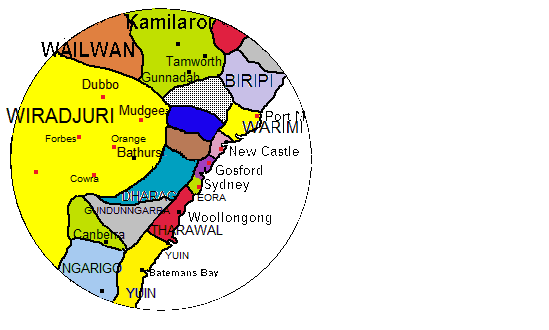
| map | Map of New South Wales as occupied by the native tribes.jpg |
| mapcaption | A map of the tribes of New South Wales, published in 1892. is marked I. |
| notice | IPA |
| map2 | Lang Status 20-CR.svg |
| mapcaption2 | |
| pronunciation | |
| speakers | 1,065 |
| date | 2021 census |
| image | Ngummi.png |
| imagecaption | gurre kamilaroi, a 19th-century Gamilaraay text |
Kamilaroi
The Gamilaraay or Kamilaroi language () is a Pama–Nyungan language of the Wiradhuric subgroup found mostly in south-eastern Australia. It is the traditional language of the Gamilaraay (Kamilaroi), an Aboriginal Australian people. It has been noted as endangered, but the number of speakers grew from 87 in the 2011 Australian Census to 105 in the 2016 Australian Census. Thousands of Australians identify as Gamilaraay, and the language is taught in some schools.
Wirray Wirray, Guyinbaraay, Yuwaalayaay, Waalaraay and Gawambaraay are dialects; Yuwaalaraay/Euahlayi is a closely related language.
Name
The name Gamilaraay means 'gamil-having', with gamil being the word for 'no'. Other dialects and languages are similarly named after their respective words for 'no'. (Compare the division between langues d'oïl and langues d'oc in France, distinguished by their respective words for 'yes'.)
Spellings of the name, pronounced in the language itself, include Goomeroi; Kamilaroi; Gamilaraay and Gamilaroi.
Dialects
While AUSTLANG cites Euahlayi, Ualarai, Euhahlayi, and Juwalarai as synonyms for Gamilaraay in earlier sources, it has updated its codes to reflect more recent sources suggest different distinctions. AIATSIS groups the Yuwaalaraay/Euahlayi/Yuwaaliyaay language and people in its resource collection, and gives it a separate code (D23). AUSTLANG assigns separate codes to the following dialects, all related and part of the Gamilaraay group:
- Yuwaalaraay (Yuwaaliyaay, Euahlayi) (D27), spoken by the Yuwaalaraay people;
- Wirray Wirray (Wiriwiri) (D28);
- Guyinbaraay (Gunjbaraay) (D15);
- Yuwaalayaay (D54);
- Waalaraay (Walaraay) (D55);
- Gawambaraay (Kawambarai) (D39), spoken by the Gawambaraay people.
According to Robert Fuller of the Department of Indigenous Studies at Macquarie University and his colleagues, the Gamilaraay and Euahlayi peoples are a cultural grouping of north and northwest New South Wales (NSW), and the Gamilaraay dialect groups are known as Gamilaraay and Yuwaalaraay, while the Euahlayi (Euayelai) have a similar but distinct language.
History
Southern Aboriginal guides led the surveyor John Howe to the upper Hunter River above present-day Singleton in 1819. They told him that the country there was "Coomery Roy [=Gamilaraay] and more further a great way", meaning to the north-west, over the Liverpool Ranges. This is probably the first record of the name.
A basic wordlist collected by Thomas Mitchell in 1832 is the earliest written record of Gamilaraay.
Presbyterian missionary William Ridley studied the language from 1852 to 1856.
Status
In 2013 Gamilaraay was noted as endangered by Ethnologue, with only 35 speakers left in 2006 (AUSTLANG says 37 at that date), all mixing Gamilaraay and English. At the 2011 census there were 87 speakers recorded and in 2016, 105. There are no known fluent speakers of the language.
Phonology
Vowels
| Front | Back | High | Low |
|---|---|---|---|
| , | , | ||
| , |
is realised as .
Consonants
| Peripheral | Laminal | Apical | Bilabial | Velar | Palatal | Dental | Alveolar | Post- |
|---|---|---|---|---|---|---|---|---|
| alveolar | Stop | Nasal | Lateral | Rhotic | Semivowel |
Initially, and may be simplified to and .
Stress
All long vowels in a word get equal stress. If no long vowels are present, stress falls on the first syllable. Secondary stress falls on short vowels, which are two syllables to the right or to the left of a stressed syllable.
Grammar
Pronouns
Gawambaraay Dialect
| Singular | Dual | Plural | 1st person | 2nd person | 3rd person |
|---|---|---|---|---|---|
| ngaya | ngali | ngiyaani | |||
| ngindu | ngindaali | ngindaay | |||
| nguru | (nguru)gali | ganu |
Influence in English
Several loanwords have entered Australian English from Gamilaraay, including:
| Common nouns | Anglicised form | Gamilaraay | Meaning | Proper nouns | Anglicised form | Gamilaraay | Meaning | Place names | Anglicised form | Gamilaraay | Meaning | ||||||
|---|---|---|---|---|---|---|---|---|---|---|---|---|---|---|---|---|---|
| bindi-eye, bindii, bindies | bindayaa | The burrs of several plant species (Emex australis, Tribulus terrestris, and Soliva sessilis) that stick in one's feet | |||||||||||||||
| brolga | burralga | A bird species, Grus rubicunda | |||||||||||||||
| possibly budgerigar | gidjirrigaa | A bird species, Melopsittacus undulatus | |||||||||||||||
| galah | gilaa | A bird species, Eolophus roseicapilla | |||||||||||||||
| yarran | yarraan | A species of acacia tree, Acacia homalophylla | |||||||||||||||
| Kamilaroi | gamilaraay | The Gamilaraay people or language | |||||||||||||||
| Boggabri | bagaaybaraay | having creeks | |||||||||||||||
| Boggabilla | bagaaybila | full of creeks | |||||||||||||||
| Collarenebri | galariinbaraay | having acacia blossoms |
Footnotes
References
Bibliography
- (On Google Books)
References
- Australian Bureau of Statistics. (2021). "Cultural diversity: Census".
- kld
- (26 July 2019). "D23: Gamilaraay / Gamilaroi / Kamilaroi".
- "Yuwaalaraay, Euahlayi, Yuwaaliyaay".
- AIATSIS. (Feb 2017). "Selected bibliography of material on the Yuwaalaraay / Euahlayi / Yuwaaliyaay language and people held in the AIATSIS Library".
- (26 July 2019). "D27: Yuwaalaraay".
- (26 July 2019). "D28: Wiriyaraay".
- (26 July 2019). "D66: Wirraay-Wirraay".
- (26 July 2019). "D15: Guyinbaraay".
- (26 July 2019). "D54: Yuwaalayaay".
- (26 July 2019). "D55: Waalaraay".
- (26 July 2019). "D39: Gawambaraay".
- Behrendt, Larissa. (1995). "Aboriginal Urban Identity: Preserving the Spirit, Protecting the Traditional in Non-Traditional Settings". Australian Feminist Law Journal.
- (2014). "The Emu Sky Knowledge of the Kamilaroi and Euahlayi Peoples". Journal of Astronomical History and Heritage.
- O'Rourke, Michael.. (1997). "The Kamilaroi Lands: North-central New South Wales in the Early 19th Century". Self-published.
- Austin, P. (1993) ''A Reference Grammar of Gamilaraay, Northern New South Wales''.
- ''[[Oxford Dictionary of English]]'', p 2,056
This article was imported from Wikipedia and is available under the Creative Commons Attribution-ShareAlike 4.0 License. Content has been adapted to SurfDoc format. Original contributors can be found on the article history page.
Ask Mako anything about Gamilaraay language — get instant answers, deeper analysis, and related topics.
Research with MakoFree with your Surf account
Create a free account to save articles, ask Mako questions, and organize your research.
Sign up freeThis content may have been generated or modified by AI. CloudSurf Software LLC is not responsible for the accuracy, completeness, or reliability of AI-generated content. Always verify important information from primary sources.
Report