From Surf Wiki (app.surf) — the open knowledge base
GameCube controller
Primary game controller for the GameCube

Primary game controller for the GameCube
| Field | Value | |||
|---|---|---|---|---|
| name | GameCube controller | |||
| image | GameCube controller.png | |||
| caption | Indigo GameCube controller | |||
| manufacturer | Nintendo | |||
| family | GameCube | |||
| type | Gamepad | |||
| generation | Sixth | |||
| release_date | {{collapsible list | titlestyle=font-weight:normal;background:transparent;text-align:left; | title=September 14, 2001 | |
| lifespan | 2001–present | |||
| input | {{ubl | |||
| connectivity | GameCube controller port | |||
| dimensions | {{ubl | |||
| {{convert | 65 | mm | abbr | on}} × 140 mm × 100 mm; 2 m cable |
| predecessor | Nintendo 64 controller | |||
| successor | {{ubl |
| GameCube (original release) | | Wii U re-release | | Nintendo Switch re-release and redesign | | Nintendo Switch 2 re-release and redesign | | 2 × analog sticks | 2 × hybrid analog triggers/digital buttons | 6 × digital buttons (A, B, X, Y, Z, Start) | Digital D-pad | Macro & turbo buttons (third-party GameCube controllers only) | 65 mm × 140 mm × 100 mm; 2 m cable | Wii Remote and Nunchuk | Classic Controller
The GameCube controller is the standard game controller for the GameCube video game console, manufactured by Nintendo and launched in 2001. As the successor to the Nintendo 64 controller, it is the progression of Nintendo's controller design in numerous ways. The M-shaped design of its predecessor was replaced with a more conventional handlebar style controller shape; a second analog stick was added, replacing the C buttons with a C stick and the X and Y face buttons, last seen on the Super Nintendo controller, were reintroduced; the shoulder buttons were changed to hybrid analog triggers. A wireless variant of the GameCube controller known as the WaveBird was released in 2002.
Though many elements of the GameCube controller's unique design were not embraced by many future twin-stick gamepads (such as the pressure-sensitive shoulder buttons and a face button layout that emphasizes one button over three others), some controllers adopted its staggered analog stick layout. The GameCube controller continued to endure even beyond its system's launch cycle, gaining varying levels of support from its subsequent successor consoles. GameCube controllers are natively forward-compatible on most models of the Wii console, which feature dedicated ports for connecting said gamepads for use in either GameCube or supported Wii games.
Years after the GameCube's discontinuation, the controller was first re-released in Japan in 2008 for the Wii title Super Smash Bros. Brawl. Nintendo officially re-issued the controller and produced dedicated adapters, coinciding with the releases of Super Smash Bros. for Wii U in 2014 and Super Smash Bros. Ultimate for Nintendo Switch in 2018*,* honoring the enduring popularity of the GameCube controller in the Super Smash Bros. community after the release of the critically acclaimed Super Smash Bros. Melee in 2001, which made the controller desirable for competitive play. A redesigned iteration of the controller for use with the Nintendo Classics service on Nintendo Switch 2 released with the console in June 2025.
Overview
Released alongside the GameCube console, the standard GameCube controller has a wing grip design. This controller was bundled with all new GameCube systems throughout the console's life cycle and was also available separately. It connects to the console's controller ports via a 2 m cable.
The standard GameCube controller provides haptic feedback by way of a built-in rumble motor rather than using an external Rumble Pak add-on like the Nintendo 64 controller. Also unlike its predecessor, it does not feature any expansion capabilities.
The controller features a total of six digital buttons, two staggered analog sticks, a directional pad and two hybrid analog and digital triggers. The primary analog stick is on the left, with the D-pad below it. The four face buttons are on the right side of the controller with a large green button in the center, flanked by a smaller red button to its bottom left and two kidney-shaped buttons to its right () and top (); below the face buttons is a yellow stick. A Start/Pause button is located in the middle of the controller. On the "shoulders" of the controller are two pressure-sensitive analog triggers marked and , as well as one digital button marked which sits in front of the trigger. The and triggers feature both analog and digital capabilities: each behaves as a typical analog trigger until fully depressed, at which point the button "clicks" to register an additional digital signal. This method effectively serves to provide two functions per button without actually adding two separate physical buttons.

Versions
Colors and designs
Standard editions
The GameCube controller was sold in several different colors over the console's lifespan. Standard colors included "Indigo" (dark royal purple), "Jet Black", and "Platinum" (Silver), which were bundled with their respective colored GameCube consoles and sold separately in many countries. Other standard colors sold separately included "Spice" (Orange), "Indigo/Clear" (Indigo top with a clear translucent bottom), "Emerald Blue" (Turquoise), and White; the latter two colors are available exclusively in Nintendo's home country, Japan.
Limited editions
Nintendo released a number of limited edition controllers in their home country, Japan, through Club Nintendo, which featured a unique color scheme and/or logo in the center. Club Nintendo controllers could be purchased for 500 points each and designs included "Mario" (red top and blue bottom), "Luigi" (green top and blue bottom), "Wario" (yellow top and purple bottom) and a "Club Nintendo" controller (white top and light blue bottom). The "Mario" design was also made available in limited quantities through the European Stars Catalogue for 5000 points.
A number of limited edition GameCube consoles have been released which included matching controllers. Colors released by Nintendo in their home country, Japan, include "Starlight Gold", "Crystal White", "Symphonic Green" (mint green), "Hanshin Tigers" (black with Hanshin Tigers logo), "Gundam Copper" (two-tone red with Gundam logo), and "Transparent" which is in the "Enjoy Plus Pack +" bundle. The "Symphonic Green" color was also released in France. "Pearl White" was released in Europe, bundled with Mario Smash Football. A Resident Evil 4 controller (silver top and black bottom with logo) was available in Europe as part of a limited edition Resident Evil 4 console bundle. The Panasonic Q, a GameCube/DVD player hybrid exclusive to Nintendo and Panasonic's home country, Japan, came bundled with a grey Panasonic branded version of the controller. The controller has the Panasonic logo on it instead of the Nintendo GameCube text.
WaveBird Wireless Controller
Main article: WaveBird Wireless Controller

The WaveBird Wireless Controller, released in 2002, is a radio frequency-based wireless controller based on the same design as the standard controller. It communicates with the GameCube console wirelessly through a receiver dongle connected to one of its controller ports. It is powered by two AA batteries. As a power-conservation measure, the WaveBird lacks the rumble function of the standard controller. The WaveBird came in two colors, gray and silver (Platinum).
LodgeNet controller

A specially designed variant of the GameCube controller was created for the LodgeNet in some North American hotels. The controller can be used for pay-per-play access to select GameCube games. In addition to the standard GameCube controller inputs, the LodgeNet controller also includes six additional buttons which are used to control the on-screen game selection interface. The controller cannot be used on regular GameCube hardware.
Development
The Nintendo 64 controller, released in 1996, received mixed impressions, being lauded for standardizing the controls for 3D movement with its analog stick and for its comfortable design, but derided for its bulkiness Shigeru Miyamoto designed the GameCube controller in a span of at least three years—the longest he had spent on any controller at that time—with the goal being to accommodate as many people as possible, regardless of their age, the size of their hands, and whether they have any experience in playing video games with a gamepad. The controller had seen at least four or five versions during its development cycle, and each build would be radically different on a monthly basis, containing new ideas and discarding old ones.
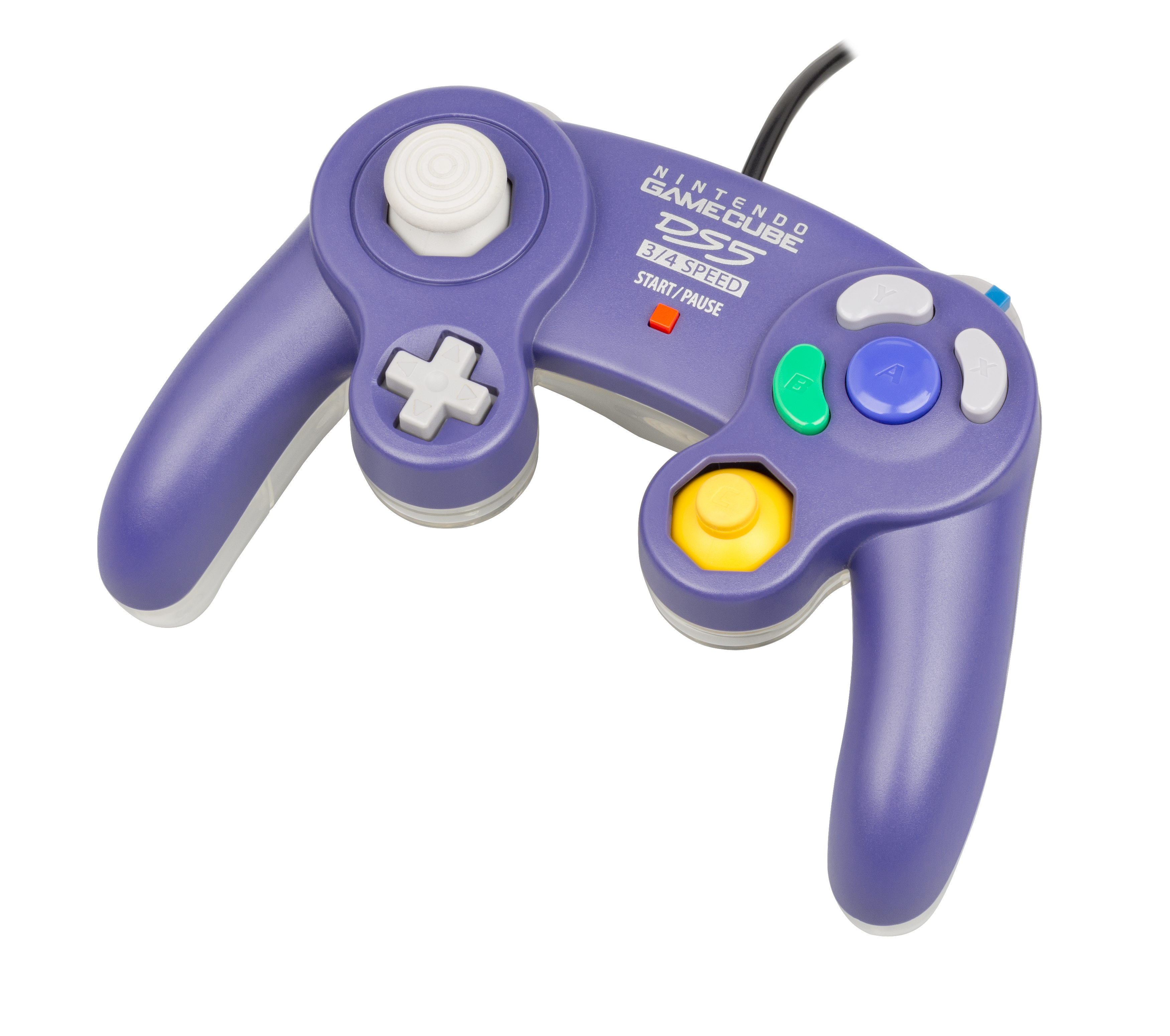
Miyamoto's first idea was to redesign the controller's four rhombus-positioned face buttons, a standard he had set when he designed the SNES controller. The green button was made the largest to give the holder the idea that it performs the primary function.
In a video published on its YouTube channel in December 2023, Masahiro Sakurai stated that while developing Super Smash Bros. Melee, he had suggested for a scroll wheel or jog dial to be implemented into the design of the controller. Sakurai supposed that a lack of space on the controller may explain why his idea wasn't implemented.
The GameCube controller was released to Japan on September 14, 2001; to North America on November 18; to Europe on May 3, 2002; and to Australia on May 17. It was made available in numerous colors to boost its sales, following the same course as the Nintendo 64 due to the latter's improved performance.
Availability
While unlicensed third-party GameCube controllers have been on the market, they have been criticized for generally being made of lower quality components than Nintendo's official GameCube controllers. The official controllers have become scarce at retailers, as an increased demand of the controller started due to the Wii's backward compatibility with GameCube games and the fact that several Wii games support the controller as a primary method of control. In response to the regained popularity, Nintendo re-launched the GameCube controller. These relaunched models of the controller have a 3 m cable, longer than the original models 2 m cable. These relaunched models also lack the metal braces inserted inside the controller's triggers to help push the triggers down, something that most of the original 2001-2007 manufactured GameCube controllers do have. They also have a plastic stickbox for the two control sticks, something that Nintendo did in 2003 when they switched from metal to plastic stickboxes after resuming production of the GameCube at that time.
White controller
In April 2008, Nintendo released a white GameCube controller exclusively in their home country, Japan. It differs from previous editions in that it features a white cable which is 3 m long, rather than the 2 m black cable used on standard controllers. This model also lacks the metal braces inserted inside the L and R triggers (see above). This controller has not been released outside Japan, but online retailers such as Amazon and Play-Asia do import and sell the controller internationally.
In 2014, the manufacturing production of the white controller was resumed under the Super Smash Bros. branding, again exclusively in Nintendo's home country.
Continued production of platinum controller
Nintendo of America continued to sell wired platinum controllers up until early 2012 in North America, but have since ceased production.
''Super Smash Bros. for Wii U Edition'' controller
The Super Smash Bros. edition controller was released in 2014, in conjunction with the release of Super Smash Bros. for Wii U. The controller features a metallic silver Super Smash Bros. logo surrounded by flames instead of the GameCube logo. It came in black worldwide, although a white version was released in Japan. The controller has the same length cable as the 2008 re-release and also lacks the metal braces inserted inside the triggers (see above).
Along with the release of the controller, Nintendo released a GameCube controller adapter for the Wii U. The adapter supports four GameCube controllers, and all original pads are supported. A second adapter can be hooked up to a console, allowing up to eight players to use a GameCube controller. The adapter is only officially compatible with Super Smash Bros. for Wii U and does not support any other Wii U software. Wii software running on the Wii U also does not support the adapter either.
''Super Smash Bros. Ultimate Edition'' controller
During E3 2018, Nintendo confirmed it would re-issue the black GameCube controller for use with Super Smash Bros. Ultimate for the Nintendo Switch, as, like its Wii and Wii U predecessors, the game officially supports the GameCube controller. This controller has the same length cable as the 2008 and 2014 re-releases and also lacks the metal braces inserted inside the triggers (see above). The re-issued controller was released on November 2, 2018, and features a simplified variant Super Smash Bros. emblem design.
On the same day, Nintendo also re-released the official USB GameCube controller adapter, with a generic Nintendo embossed branding (unlike the first edition that featured the Wii U logo). It is identical to the one released for Wii U, and both adapters will work on either console. The Switch itself and its games are capable of supporting the GameCube controller in both docked and handheld mode after a system update issued in October 2017. Most Switch games recognize GameCube controllers as Pro Controllers. However, due to the lack of a minus button, the ZL button, clickable analogue sticks and motion sensors, players may have trouble playing games that use these features using a GameCube controller. The adapter is also compatible with GameCube games re-released via the Nintendo Classics service on Nintendo Switch 2.
Though the controller and the adapter were discontinued in North America shortly after release, a second wave continued to be made for Japan.
Use on subsequent consoles

Due to the Wii's ability to use GameCube controller input, all official GameCube controllers can be used on the Wii. GameCube software played on the Wii requires the use of a GameCube controller. Wii software can be programmed to make full use of GameCube controllers. Nearly all Virtual Console games and certain Wii and WiiWare games have been designed to support GameCube controllers as input. However, some later Wii models, such as the Wii Family Edition and Wii Mini, lack support for GameCube software and accessories.
Although the subsequent console, the Wii U, omits compatibility with GameCube software and hardware, Nintendo announced that an official adapter would be released that allows the use of up to four GameCube controllers on the Wii U via USB. Though its initial product listing stated it would be compatible with any Wii U game that supports the Wii U Pro Controller, Nintendo since corrected the listing, stating the adapter can only be used with Super Smash Bros. for Wii U and would not be compatible with other Wii U or Wii software. The adapter launched alongside the game in November 2014, both separately and as part of a bundle with the game.
Support for the adapter on Nintendo Switch was introduced via its 4.0 firmware update. Though the Switch itself only supports it in docked mode, there are third-party accessories that allow it to connect in tabletop mode. Unlike the Wii U, it is supported by any game, although the Switch recognizes it as a Pro Controller and functionality may be affected if a game utilizes buttons not found on the GameCube controller. Super Smash Bros. Ultimate, Super Mario Sunshine (via Super Mario 3D All-Stars), and Grid Autosport are among the Switch games that recognizes them as a GameCube controller in-game. Additionally, the adapter is compatible with the Nintendo Switch 2 for use with the Nintendo Classics GameCube app, which gives customers access to a catalog of GameCube games. Similarly to the aforementioned Switch games, Kirby Air Riders recognizes the controller as a GameCube controller in-game.
Replications

Accessory maker Performance Designed Products (PDP) began releasing a line of officially licensed "Wired Fight Pad" controllers for the Wii and Wii U in 2014, with color schemes based on various Nintendo characters. They are based on the design and layout of the GameCube controller, but are connected via the Wii Remote's expansion port and act identically to a Classic Controller Pro (thus supporting any Wii and Wii U game that supports the Classic Controller Pro, but not GameCube games). To provide parity with the Classic Controller Pro, these controllers feature dual shoulder buttons, as well as the "+", "−", and "Home" buttons standard on Wii controllers. The smaller C-stick is also replaced with a more standard analog stick. Hori released a similar product line known as the "Battle Pad". Unlike PDP, Hori's controllers look identical to real GameCube controllers while also including the same features of the PDP controllers. Both the PDP "Wired Fight Pad" and the Hori "Battle Pad" will work on the NES Classic and the SNES Classic.
In anticipation of Super Smash Bros. Ultimate, both Hori and PDP unveiled similar replications as USB gamepads for Nintendo Switch, both officially licensed. As with their Wii U counterparts, they maintain similar designs and appearance to the standard GameCube controllers, but updated to include dual shoulder buttons and Switch system buttons.
PowerA released a Nintendo Switch Pro Controller with the GameCube controller layout but with additional inputs standard on Switch controllers, allowing it to be used in all Switch games. This controller was officially licensed by Nintendo and is available wireless and wired.
Nintendo Switch 2 version
A wireless version of the controller for the Nintendo Switch 2 launched simultaneously with the console on June 5, 2025. It is designed for use with the Nintendo GameCube - Nintendo Classics app for Nintendo Switch Online subscribers. It is also compatible with Nintendo Switch games running via backwards compatibility that supported the original GameCube controller via the USB adapter. The Switch 2 GameCube controller features additional buttons to allow players access to the ZL, home and capture buttons that correspond with Switch functionality that was not available on GameCube; along with the console's new "C" button which launches GameChat to communicate with other players. The controller is only available in the indigo color and does not work on the Nintendo Switch or the GameCube.
Legal issues
Anascape Ltd, a Texas-based firm, filed a lawsuit against Nintendo for patent infringements regarding many of Nintendo's controllers. A July 2008 verdict found that a ban would be issued preventing Nintendo from selling the regular GameCube and WaveBird controllers in the United States. Nintendo was free to continue selling the controllers pending an appeal to the United States Court of Appeals for the Federal Circuit. On April 13, 2010, Nintendo successfully appealed and the previous court decision was reversed.
References
References
- Satterfield, Shane. (November 16, 2001). "What's inside the GameCube?". [[ZDNet]].
- link. [[Nintendo]]
- IGN Staff. (July 7, 2004). "Nintendo's Mario Controller". IGN.
- Niizumi, Hirohiko. (August 9, 2004). "Luigi GameCube controller coming to Japan". [[GameSpot]].
- (October 6, 2007). "Hardware Gallery - Club Nintendo Wario Controller".
- (October 6, 2007). "Hardware Gallery - Club Nintendo GameCube Controller".
- "Mario Controller Limited Edition".
- "Samurai Nintendo : GameCube models & special editions". samurainintendo.com.
- IGN Staff. (July 20, 2004). "New GameCube Color: Starlight Gold". IGN.
- Jones, Ashley. (June 23, 2003). "News: Japanese White GameCube". N-Europe.
- "Samurai Nintendo : GameCube bundles & packs". samurainintendo.com.
- (May 31, 2006). "Hanshin Tigers GameCube". japan-games.com.
- link. [[Nintendo]]
- Hirohiko Niizumi. (June 28, 2004). "Limited-edition GameCube bundle hitting Japan". [[GameSpot]].
- Tim. (August 17, 2005). "News: Mario Smash Football Bundle". N-Europe.
- Bramwell, Tom. (February 3, 2005). "Resident Evil 4 Cube bundle on 18th March". [[Eurogamer]].
- "DVD/ゲームプレーヤー SL-GC10 商品概要 {{!}} BD/DVD {{!}} Panasonic". [[Panasonic]].
- Baglole, Joel. (June 19, 2002). "Videogame Accessory Companies Tout New Wireless Controllers". [[The Wall Street Journal]].
- Rogers, Emily. (September 29, 2013). "The Pressure To Create The Perfect Controller". Dromble.
- (June 22, 2001). "FAQS: GameCube FAQ - Controller". Nintendo World News.
- Plunkett, Luke. (February 11, 2013). "Let's Rank Nintendo's Controllers, Best To Worst". [[Kotaku]].
- Life, Nintendo. (2023-12-01). "Random: Sakurai Wanted The GameCube Controller To Include A Scroll Wheel".
- Wolf, Mark J. P.. (November 21, 2018). "The Routledge Companion to Media Technology and Obsolescence". [[Routledge]].
- (April 9, 2008). "Nintendo to Re-launch GameCube Controller". IGN.
- "Amazon.com: Official Nintendo Classic Gamecube / Wii Controller: Video Games".
- "Buy Game Cube Controller (White) (Gamecube & Nintendo Wii) at Play-Asia.com". [[Play-Asia]].
- "Nintendo: Online Store - Product Detail - Gamecube Controller - Platinum (GCN)". [[Nintendo]].
- Collette (SilverShadowFly). (October 7, 2014). "Japan Will Get A Gorgeous White Smash Bros Limited Edition GameCube Controller".
- "GameCube Controller Vs. Smash Bros. Wii U GameCube Controller - cord length comparison {{pipe}} GoNintendo - What are YOU waiting for?".
- Gartenberg, Chaim. (June 12, 2018). "Super Smash Bros. Ultimate will support GameCube controllers". [[The Verge]].
- Byford, Sam. (October 24, 2017). "The Nintendo Switch now supports GameCube controllers". [[The Verge]].
- "Nintendo Support: How to Use the GameCube Controller with Nintendo Switch".
- Doolan, Liam. (April 4, 2025). "Nintendo Confirms Switch Controllers Are Compatible With "Switch 2 Exclusive Games"".
- Makuch, Eddie. (May 29, 2014). "Super Smash Bros. Wii U Works with GameCube Controllers -- Here's How". GameSpot.
- Grubb, Jeff. (October 7, 2014). "Wii U's GameCube controller will support more than just Smash Bros. [updated]". [[VentureBeat]].
- (October 8, 2014). "Wii U GameCube controller adapter compatible with more than just Smash Bros.". Gamer Network.
- (October 7, 2014). "Super Smash Bros. for Wii U Release Dates Confirmed". Nintendo Life.
- Veloria, Lorenzo. (May 29, 2014). "Will the Wii U's GameCube controller adapter only ever support one game?". Gamesradar.
- "GameCube controller support comes to Nintendo Switch". Polygon.
- Cryer, Hirun. (17 November 2020). "Super Mario 3D All-Stars update includes GameCube controller support for Sunshine". GamesRadar+.
- "Feral Support {{!}} GRID Autosport FAQs {{!}} Does GRID Autosport work with a GameCube controller?".
- Doolan, Liam. (April 4, 2025). "Nintendo Confirms Switch Controllers Are Compatible With "Switch 2 Exclusive Games"".
- "Kirby Air Riders Direct #2 October 23, 2025: Information and Reactions". Source Gaming.
- (June 10, 2014). "The New Wii U GameCube Controllers Are Super Hot".
- (December 13, 2014). "You can now pre-order these cool Nintendo GameCube-style controllers".
- Otero, Jose. (2015-04-17). "Hori Battle Pad for Wii U Review".
- (September 29, 2017). "SNES Classic controllers work with NES Classic, and vice versa".
- "Nintendo Switch is getting a GameCube-styled Smash Bros. controller". Polygon.
- "Hori's Switch-enhanced GameCube controllers are coming just in time for Super Smash Bros. Ultimate". The Verge.
- "PowerA Wireless GameCube Controller Review: The Wavebird Flies Again". ReviewGeek.
- ChaseYama. (2025-06-10). "Does the Switch 2 GameCube Controller work with Smash Ultimate? 🤔".
- Robinson, Andy. (April 2, 2025). "GameCube is officially coming to Switch Online, exclusively for Switch 2".
- INQUIRER staff. (August 3, 2006). "Microsoft, Nintendo sued over games controller". The Inquirer.
- (July 22, 2008). "Nintendo Faces Ban on Some Wii, GameCube Controllers (Update2)". Bloomberg.
- (April 13, 2010). "Federal Circuit Court Vindicates Nintendo in Patent Lawsuit".
This article was imported from Wikipedia and is available under the Creative Commons Attribution-ShareAlike 4.0 License. Content has been adapted to SurfDoc format. Original contributors can be found on the article history page.
Ask Mako anything about GameCube controller — get instant answers, deeper analysis, and related topics.
Research with MakoFree with your Surf account
Create a free account to save articles, ask Mako questions, and organize your research.
Sign up freeThis content may have been generated or modified by AI. CloudSurf Software LLC is not responsible for the accuracy, completeness, or reliability of AI-generated content. Always verify important information from primary sources.
Report