From Surf Wiki (app.surf) — the open knowledge base
Galaxy morphological classification
System for categorizing galaxies based on appearance
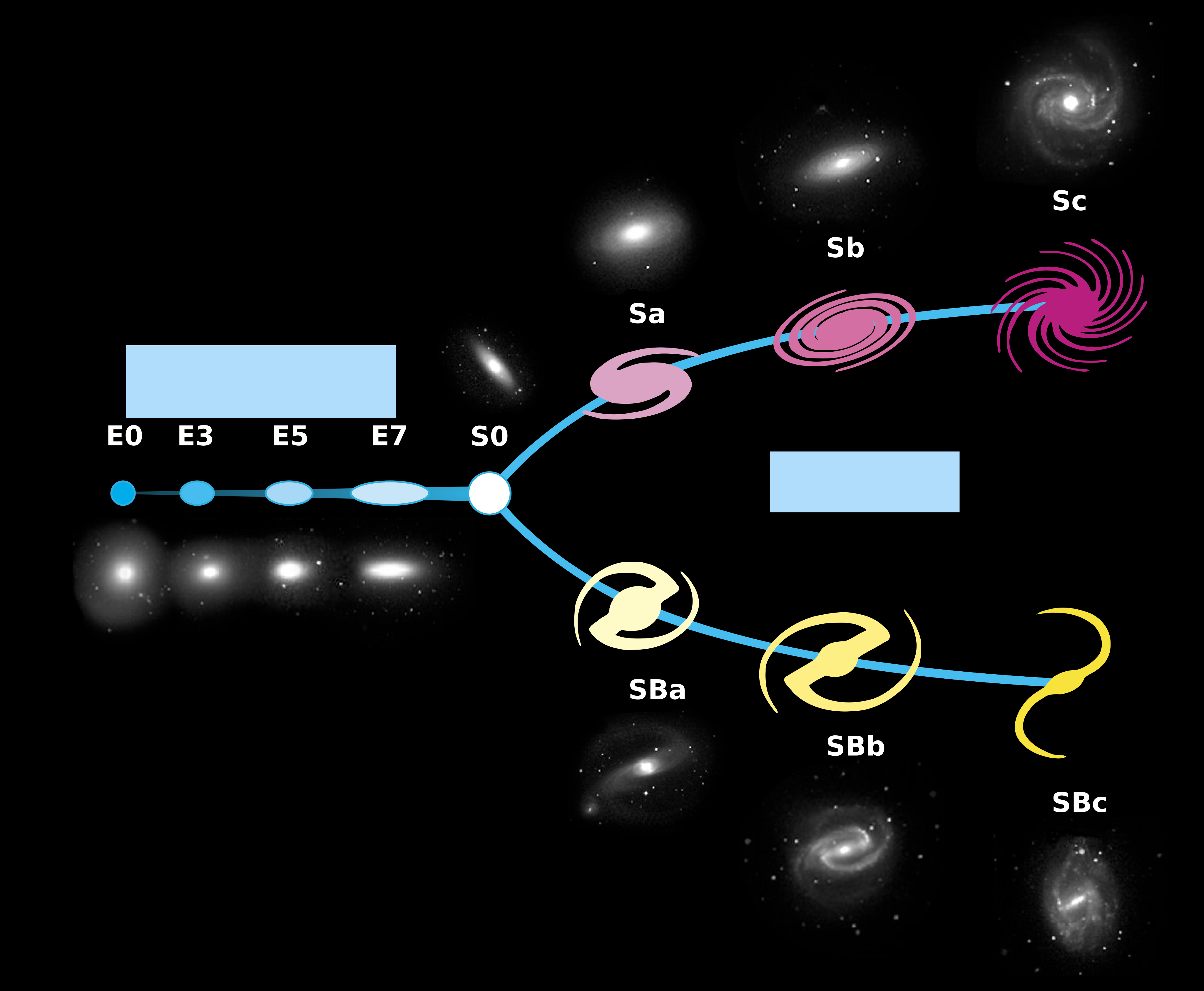
System for categorizing galaxies based on appearance
Galaxy morphological classification is a system used by astronomers to divide galaxies into groups based on their visual appearance. There are several schemes in use by which galaxies can be classified according to their morphologies, the most famous being the Hubble sequence, devised by Edwin Hubble and later expanded by Gérard de Vaucouleurs and Allan Sandage. However, galaxy classification and morphology are now largely done using computational methods and physical morphology.
Hubble sequence
Main article: Hubble sequence

The Hubble sequence is a morphological classification scheme for galaxies invented by Edwin Hubble in 1926. It is often known colloquially as the “Hubble tuning-fork” because of the shape in which it is traditionally represented. Hubble's scheme divides galaxies into three broad classes based on their visual appearance (originally on photographic plates):
- Elliptical galaxies have smooth, featureless light distributions and appear as ellipses in images. They are denoted by the letter "E", followed by an integer n representing their degree of ellipticity on the sky. The specific ellipticity rating depends on ratio of the major (a) to minor axes (b), thus:{{cite web | access-date=2020-09-19 }} :: E = 10 \times \left( 1-\frac{b}{a} \right)
- Spiral galaxies consist of a flattened disk, with stars forming a (usually two-armed) spiral structure, and a central concentration of stars known as the bulge, which is similar in appearance to an elliptical galaxy. They are given the symbol "S". Roughly half of all spirals are also observed to have a bar-like structure, extending from the central bulge. These barred spirals are given the symbol "SB".
- Lenticular galaxies (designated S0) also consist of a bright central bulge surrounded by an extended, disk-like structure but, unlike spiral galaxies, the disks of lenticular galaxies have no visible spiral structure and are not actively forming stars in any significant quantity.

These broad classes can be extended to enable finer distinctions of appearance and to encompass other types of galaxies, such as irregular galaxies, which have no obvious regular structure (either disk-like or ellipsoidal).
The Hubble sequence is often represented in the form of a two-pronged fork, with the ellipticals on the left (with the degree of ellipticity increasing from left to right) and the barred and unbarred spirals forming the two parallel prongs of the fork on the right. Lenticular galaxies are placed between the ellipticals and the spirals, at the point where the two prongs meet the “handle”.
To this day, the Hubble sequence is the most commonly used system for classifying galaxies, both in professional astronomical research and in amateur astronomy.
| Galaxy Type | Mass (Solar Masses) | Luminosity (Solar Luminosity) | Diameter (kpc) | Stellar Populations | Percentage of Observed Galaxies |
|---|---|---|---|---|---|
| Spiral / | |||||
| Barred Spiral | 109 to 1011 | 108 to 1010 | 5–250 | disk: Population Ihalo:Population II | 77% |
| Elliptical | 105 to 1013 | 105 to 1011 | 1–205 | Population II | 20% |
| Irregular | 108 to 1010 | 107 to 109 | 1–10 | Population I | 3% |
-- More modern observations of galaxies have given us the following information about these types:
- Elliptical galaxies are generally fairly low in gas and dust, and are composed mostly of older stars.
- Spiral galaxies generally have plentiful supplies of gas and dust, and have a broad mix of older and younger stars.
- Irregular galaxies are fairly rich in gas, dust, and young stars.
From this, astronomers have constructed a theory of galaxy evolution which suggests that ellipticals are, in fact, the result of collisions between spiral and/or irregular galaxies, which strip out much of the gas and dust and randomize the orbits of the stars. See galaxy formation and evolution.
| Name | Right Ascension | Declination | Hubble Type |
|---|---|---|---|
| M49 (NGC 4472) | 12h 29.8m | 8° 00′ | E4 |
| M59 (NGC 4621) | 12h 42.0m | 11° 39′ | E3 |
| M60 (NGC 4649) | 12h 43.7m | 11° 33' | E1 |
| M84 (NGC 4374) | 12h 25.1m | 12° 53′ | E1 |
| M86 (NGC 4406) | 12h 26.2m | 12° 57′ | E3 |
| M89 (NGC 4552) | 12h 35.7m | 12° 33′ | E0 |
| M110 (NGC 205) | 00h 40.4m | 41° 41′ | E6 |
-- Nonetheless, in June 2019, citizen scientists through Galaxy Zoo reported that the usual Hubble classification, particularly concerning the relationship between spiral arms and galactic nucleus in spiral galaxies, may need reassessment.
De Vaucouleurs system ==


The de Vaucouleurs system for classifying galaxies is a widely used extension to the Hubble sequence, first described by Gérard de Vaucouleurs in 1959. De Vaucouleurs argued that Hubble's two-dimensional classification of spiral galaxies—based on the tightness of the spiral arms and the presence or absence of a bar—did not adequately describe the full range of observed galaxy morphologies. In particular, he argued that rings and lenses are important structural components of spiral galaxies.
The de Vaucouleurs system retains Hubble's basic division of galaxies into ellipticals, lenticulars, spirals and irregulars. To complement Hubble's scheme, de Vaucouleurs introduced a more elaborate classification system for spiral galaxies, based on three morphological characteristics:
Most galaxies in these three classes were classified as Irr I in Hubble’s original scheme. In addition, the Sd class contains some galaxies from Hubble’s Sc class. Galaxies in the classes Sm and Im are termed the “Magellanic” spirals and irregulars, respectively, after the Magellanic Clouds. The Large Magellanic Cloud is of type SBm, while the Small Magellanic Cloud is an irregular (Im).
The different elements of the classification scheme are combined — in the order in which they are listed — to give the complete classification of a galaxy. For example, a weakly barred spiral galaxy with loosely wound arms and a ring is denoted SAB(r)c.
Visually, the de Vaucouleurs system can be represented as a three-dimensional version of Hubble's tuning fork, with stage (spiralness) on the x-axis, family (barredness) on the y-axis, and variety (ringedness) on the z-axis.
Numerical Hubble stage
De Vaucouleurs also assigned numerical values to each class of galaxy in his scheme. Values of the numerical Hubble stage T run from −6 to +10, with negative numbers corresponding to early-type galaxies (ellipticals and lenticulars) and positive numbers to late types (spirals and irregulars). Thus, as a rough rule, lower values of T correspond to a larger fraction of the stellar mass contained in a spheroid/bulge relative to the disk. The approximate mapping between the spheroid-to-total stellar mass ratio (MB/MT) and the Hubble stage is MB/MT=(10−T)2/256 based on local galaxies.
Elliptical galaxies are divided into three 'stages': compact ellipticals (cE), normal ellipticals (E) and late types (E+). Lenticulars are similarly subdivided into early (S−), intermediate (S0) and late (S+) types. Irregular galaxies can be of type magellanic irregulars (T = 10) or 'compact' (T = 11).
| Hubble stage T | de Vaucouleurs class | approximate Hubble class |
|---|---|---|
| −6 | −5 | −4 |
| cE | E | E+ |
| E | S0 | S0/a |
The use of numerical stages allows for more quantitative studies of galaxy morphology.
Yerkes (or Morgan) scheme
The Yerkes scheme was created by American astronomer William Wilson Morgan. Together with Philip Keenan, Morgan also developed the MK system for the classification of stars through their spectra. The Yerkes scheme uses the spectra of stars in the galaxy; the shape, real and apparent; and the degree of the central concentration to classify galaxies.
| Spectral Type | Explanation |
|---|---|
| a | Prominent A stars |
| af | Prominent A–F stars |
| f | Prominent F stars |
| fg | Prominent F–G stars |
| g | Prominent G stars |
| gk | Prominent G–K stars |
| k | Prominent K stars |
| Galactic Shape | Explanation |
|---|---|
| B | Barred spiral |
| D | Rotational symmetry without pronounced spiral or elliptical structure |
| E | Elliptical |
| Ep | Elliptical with dust absorption |
| I | Irregular |
| L | Low surface brightness |
| N | Small bright nucleus |
| S | Spiral |
| Inclination | Explanation |
|---|---|
| 1 | Galaxy is "face-on" |
| 2 | |
| 3 | |
| 4 | |
| 5 | |
| 6 | |
| 7 | Galaxy is "edge-on" |
Thus, for example, the Andromeda Galaxy is classified as kS5.
References
References
- "A remarkable galactic hybrid".
- Hubble, E. P.. (1926). "Extra-galactic nebulae". Contributions from the Mount Wilson Observatory / Carnegie Institution of Washington.
- Hubble, E. P.. (1936). "The Realm of the Nebulae". [[Yale University Press]].
- "The Hubble tuning fork – classification of galaxies".
- Binney, James. (1998). "Galactic Astronomy". Princeton University Press.
- "Lenticular Galaxies".
- "Hubble explores the origins of modern galaxies". ESA/Hubble Press Release.
- "Galaxies".
- Iafrate, G.. "THE HUBBLE SEQUENCE".
- Royal Astronomical Society. (11 June 2019). "Citizen scientists re-tune Hubble's galaxy classification". [[EurekAlert!]].
- Masters, Karen L.. (30 April 2019). "Galaxy Zoo: unwinding the winding problem – observations of spiral bulge prominence and arm pitch angles suggest local spiral galaxies are winding". [[Monthly Notices of the Royal Astronomical Society]].
- De Vaucouleurs, G.. (1959). "Astrophysik IV: Sternsysteme / Astrophysics IV: Stellar Systems".
- Binney, J.. (1998). "Galactic Astronomy". [[Princeton University Press]].
- "Galaxy – Types of galaxies".
- de Vaucouleurs, Gérard. (April 1963). "Revised Classification of 1500 Bright Galaxies". Astrophysical Journal Supplement.
- De Vaucouleurs, G.. (1994). "Global Physical Parameters of Galaxies". Proceedings of "Quantifying Galaxy Morphology at High Redshift", A Workshop Held at the Space Telescope Science Institute, Baltimore MD, April 27-29 1994.
- "Qualitative and Quantitative Classifications of Galaxies".
- (2009). "Simulation of the Cosmic Evolution of Atomic and Molecular Hydrogen in Galaxies". The Astrophysical Journal.
- Binney, J.. (1998). "Galactic Astronomy". Princeton University Press.
- "The Yerkes Classification".
- Darling, David. "galaxy classification".
This article was imported from Wikipedia and is available under the Creative Commons Attribution-ShareAlike 4.0 License. Content has been adapted to SurfDoc format. Original contributors can be found on the article history page.
Ask Mako anything about Galaxy morphological classification — get instant answers, deeper analysis, and related topics.
Research with MakoFree with your Surf account
Create a free account to save articles, ask Mako questions, and organize your research.
Sign up freeThis content may have been generated or modified by AI. CloudSurf Software LLC is not responsible for the accuracy, completeness, or reliability of AI-generated content. Always verify important information from primary sources.
Report