From Surf Wiki (app.surf) — the open knowledge base
Gaganendranath Tagore
Indian painter and cartoonist of the Bengal school (1867–1938)
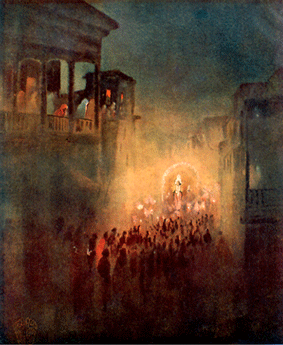
Indian painter and cartoonist of the Bengal school (1867–1938)
| Field | Value |
|---|---|
| name | Gaganendranath Tagore |
| image | Gaganendranath Tagore.png |
| birth_date | |
| birth_place | Calcutta, Bengal Presidency, British India |
| death_date | |
| death_place | Calcutta, Bengal Presidency, British India |
| nationality | Indian |
| movement | Bengal School of Art |
| known_for |
Gaganendranath Tagore (18 September 1867 – 14 February 1938) was an Indian painter and cartoonist of the Bengal school. Along with his brother Abanindranath Tagore, he was counted as one of the earliest modern artists in India.
Life and career
Gaganendranath Tagore was born at Jorasanko into a family whose creativity defined Bengal's cultural life. Gaganendranath was the eldest son of Gunendranath Tagore, grandson of Girindranath Tagore and a great-grandson of Prince Dwarkanath Tagore. His brother Abanindranath was a pioneer and leading exponent of the Bengal School of Art. He was a nephew of the poet Rabindranath Tagore and the paternal great-grandfather of actress Sharmila Tagore.
Gaganendranath received no formal education but trained under the watercolourist Harinarayan Bandopadhyay. In 1907, along with his brother Abanindranath, he founded the Indian Society of Oriental Art which later published the influential journal Rupam. Between 1906 and 1910, the artist studied and assimilated Japanese brush techniques and the influence of Far Eastern art into his own work, as demonstrated by his illustrations for Rabindranath Tagore's autobiography Jeevansmriti (1912). He went on to develop his own approach in his Chaitanya and Pilgrim series. Gaganendranath eventually abandoned the revivalism of the Bengal School and took up caricature. The Modern Review published many of his cartoons in 1917. From 1917 onwards, his satirical lithographs appeared in a series of books, including Play of Opposites, Realm of the Absurd and Reform Screams.
Between 1920 and 1925, Gaganendranath pioneered experiments in modernist painting. Partha Mitter describes him as "the only Indian painter before the 1940s who made use of the language and syntax of Cubism in his painting". From 1925 onwards, the artist developed a complex post-cubist style.
Gaganendranath also took a keen interest in theatre, and wrote a children's book in the manner of Lewis Carroll, Bhodor Bahadur ('Otter the Great').
Works
- Adbhut Lok: realm of the absurd, 1917, Calcutta: Vichitra Press, a portfolio of thirteen satirical pictures.
- Naba Hullod: Reform screams; a pictorial review at the close of the year 1921, 1921, Calcutta: Thacker, Spink & Co.
- Birupa bajra (Play of Opposites), 1930, Calcutta: Preonath Das Gupta for the Indian Publishing House.
- Bhondor bahadur, Kolkata: Shishu Sahitya Samsad, 1998, classic children's book
Family tree
Main article: Tagore_family#Family_tree
Gallery
File:জীবন-স্মৃতি - রবীন্দ্রনাথ ঠাকুর (page 97 crop).jpg|"In this patch of light the maids have gathered,... rolling cotton waste into lamp-wicks, and chatting in undertones of their village homes", illustration in Rabindranath Tagore's Jivan Smriti (জীবন-স্মৃতি, My Reminiscences), 1912 Gaganendranath Tagore - Sat-Bhai Champa.jpg|Sat-Bhai Champa. Watercolour, 34 × 25 cm, Victoria Memorial, Kolkata Gaganendranath Tagore - Meeting at the Staircase - Google Art Project.jpg|Meeting at the Staircase, c. 1920–1925 Rising son in law in Bengal, painting by Gaganendranath Tagore - Indian Museum, Kolkata.jpg|Rising Sun-in-law of Bengal, a criticism to bride burning. Indian Museum, Kolkata
.jpg&oldid=753878888)
References
References
- {{cite encyclopedia. (1988). link. Sahitya Samsad
- Terracciano, Emilia. "Bengal School Painting from the Collection of L.T.P Manjusri (1902-82)". Oliver Forge Brendan Lynch.
- Kasturbhai Lalbhai Museum, [[Ahmenabad]]
- Mitter, Partha. (2007). "The Triumph of Modernism: India's Artists and the Avant-Garde, 1922-1947". Reaktion Books.
This article was imported from Wikipedia and is available under the Creative Commons Attribution-ShareAlike 4.0 License. Content has been adapted to SurfDoc format. Original contributors can be found on the article history page.
Ask Mako anything about Gaganendranath Tagore — get instant answers, deeper analysis, and related topics.
Research with MakoFree with your Surf account
Create a free account to save articles, ask Mako questions, and organize your research.
Sign up freeThis content may have been generated or modified by AI. CloudSurf Software LLC is not responsible for the accuracy, completeness, or reliability of AI-generated content. Always verify important information from primary sources.
Report