From Surf Wiki (app.surf) — the open knowledge base
Gafsa
City in Tunisia

City in Tunisia
| Field | Value | |
|---|---|---|
| <!-- Basic info ----------------> | official_name | Gafsa |
| native_name | قفصة - ڨفصة | |
| settlement_type | ||
| motto | ||
| image_skyline | Gafsa.jpg | |
| imagesize | 250px | |
| pushpin_map | Tunisia | |
| pushpin_label_position | bottom | |
| pushpin_map_caption | Location in Tunisia | |
| <!-- Location ------------------> | subdivision_type | Country |
| subdivision_name | ||
| subdivision_type1 | Governorate | |
| subdivision_name1 | Gafsa Governorate | |
| subdivision_type2 | Delegation(s) | |
| subdivision_name2 | Gafsa North, Gafsa South | |
| subdivision_name4 | ||
| leader_party | Nidaa Tounes | |
| leader_title | Mayor | |
| leader_name | Helmi Belhani | |
| established_title | ||
| established_title2 | ||
| established_title3 | ||
| established_date3 | ||
| unit_pref | Imperial | |
| area_total_km2 | ||
| area_land_km2 | ||
| area_blank1_sq_mi | ||
| population_as_of | 2022 | |
| population_total | 120,739 | |
| population_blank1_title | Ethnicities | |
| population_blank2_title | Religions | |
| population_density_blank1_sq_mi | ||
| timezone | CET | |
| utc_offset | 1 | |
| coordinates | ||
| elevation_footnotes | ||
| elevation_ft | ||
| postal_code_type |
Gafsa (; ; **) is the capital of Gafsa Governorate in Tunisia. With a population of 120,739, Gafsa is the ninth-largest Tunisian city and is 335 km from the country's capital, Tunis.
Overview
Gafsa is the capital of Gafsa Governorate, in southwestern Tunisia and is both a historical oasis and the home to the mining industry of Tunisia. The city had 111,170 inhabitants at the 2014 census, under the rule of the mayor, Helmi Belhani. Lying 369 km by road southwest of the country's capital, Tunis, Gafsa has its geographical coordinates .
History
Ancient history
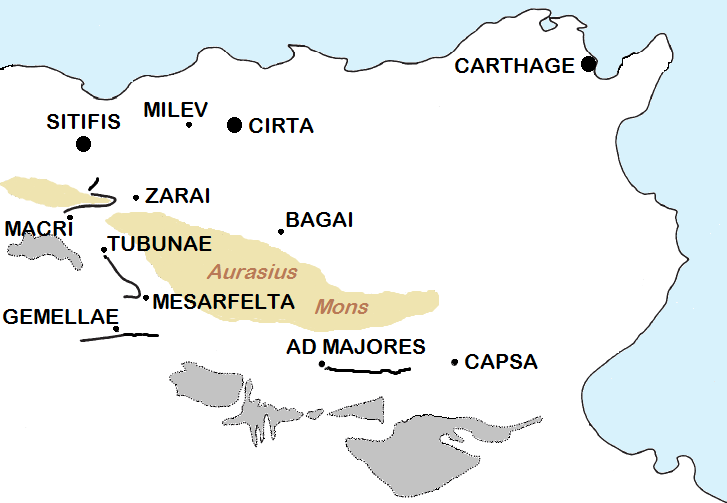
Excavations at prehistoric sites in the Gafsa area have yielded artefacts and skeletal remains associated with the Capsian culture. This Mesolithic civilisation has been radiocarbon dated to between 10,000 and 6,000 BCE. The associated ancient population, known as the Snail eaters, are known for their extensive middens of snail shells. They are believed to be the ancestors of the modern Berbers.
The city was originally called Capsa in Latin. Gafsa lends its Latin name of Capsa to the Mesolithic Capsian culture. It belonged to King Jugurtha, who deposited his treasures there. It was captured by Gaius Marius in 106 BC and destroyed, later becoming reestablished under the Punic-style magistracy of sufetes before being granted the status of a Roman colonia. Capsa was an important city of Roman Africa near the Fossatum Africae. Roman cisterns are still evident in the city ruins.
The Vandals conquered the Roman city and ruled it until the death of Genseric (477). The Berbers then occupied it, making it the capital of a Romano-Berber kingdom until subjected to Byzantium under Justinian I (527–565) and the era of Byzantine North Africa. He made Capsa the capital of the province of Byzacena. The Duke of Byzacena resided there. In 540, the Byzantine governor general Solomon built a new city wall, naming the city Justiniana Capsa.
Arab conquest
The Arab army of Uqba ibn Nafi conquered Gafsa in 688, in spite of resistance from the Berbers. After the Arab conquest, Capsa started to lose importance, replaced by Muslim-founded Kairouan.
Historians such as Camps and Laverde consider Gafsa the place in North Africa where African Romance last survived, until the 13th century, as a spoken language. Al Yacoubi reports that this time its inhabitants were considered Romanized Berber and Al-Idrissi says they continued to speak an African Latin and part of them remained faithful to the Christian religion.
Al-Idrisi described the city in the 12th century:The city of Gafsa is a fine city, surrounded by a wall, with a flowing river whose water is purer than that of Castile. At its center lies the spring known as al-Tarmīdh. It has bustling markets, abundant trade, and thriving industries. The city is encircled by numerous date palms, bearing remarkable varieties of dates. Gafsa is also adorned with beautiful gardens, orchards, and well-maintained palaces. Various crops are cultivated there, including henna and cotton. Its inhabitants are largely Berbers, and most of them speak the Latin-African tongue.
Recent history
Phosphate mines were discovered in 1886, and Gafsa today is home to one of the largest mines of phosphate in the world.
The travel-book ‘Fountains in the Sand’ (1912) by British author Norman Douglas gives an in-depth account of life and work in Gafsa.
In the Second World War, Gafsa suffered heavy bombardment from both the German and Italian side and the Allies. Part of its Kasbah was destroyed.
On 27 January 1980, a group of dissidents armed and trained by Libya occupied the city to contest the régime of Habib Bourguiba. 48 people were killed in the battles.
The Gafsa region has had an active political voice throughout its history, and various events there have shaped its political developments in the various phases of modern Tunisia.
In 2008, Gafsa was the center of riots directed against the government of President Zine El Abidine Ben Ali. The government was swift and brutal in its suppression of the uprising, but this movement has since been credited with sowing the first seeds of the Jasmine Revolution that removed Zine El Abidine Ben Ali from power three years later, igniting the Arab Spring across much of North Africa and the Middle East.
In 2014, a lake suddenly appeared around 25 kilometers from the town. The cause of the lake's formation is currently unknown.
Bishopric

Extant documents give the names of a few of the bishops of Capsa.
In the 3rd century, Donatulus took part in the council that Saint Cyprian convoked in Carthage in 256 to discuss the problem of the lapsi.
In the 4th century, at the Council of Carthage (349), Fortunatianus of Capsa was present, mentioned as the first among the bishops of Byzacena. A Donatist bishop of Capsa called Quintasius was at the council held at Cabarsussi in 393 by a breakaway group of Donatists led by Maximianus.
In the 5th century, at the joint Council of Carthage (411) attended by Catholics and Donatists, Gams and Morcelli say Capsa was represented by the Donatist Donatianus, and that it had no Catholic bishop.
Capsa still had resident bishops at the end of the 9th century, being mentioned in a Notitia Episcopatuum of Leo VI the Wise (886–912).
No longer a residential bishopric, Capsa is today listed by the Catholic Church as a titular see.
Climate
Gafsa has a hot desert climate (Köppen climate classification BWh). |Jan record high C = 26.8 |Feb record high C = 32.0 |Mar record high C = 36.9 |Apr record high C = 38.0 |May record high C = 42.8 |Jun record high C = 46.1 |Jul record high C = 46.5 |Aug record high C = 45.7 |Sep record high C = 43.5 |Oct record high C = 39.5 |Nov record high C = 35.5 |Dec record high C = 29.0 |year record high C = 46.5 |Jan record low C = -5.5 |Feb record low C = -4.3 |Mar record low C = -2.1 |Apr record low C = 1.8 |May record low C = 6.0 |Jun record low C = 9.1 |Jul record low C = 13.8 |Aug record low C = 15.1 |Sep record low C = 10.3 |Oct record low C = 2.6 |Nov record low C = -1.2 |Dec record low C = -4.9 |year record low C = -5.5 | archive-url = https://web.archive.org/web/20191219211209/http://data.transport.tn/dataset/9e1ed3a1-69f5-4ef9-a05e-daa8126fdb7c/resource/acf0d32e-92b3-4247-9281-1b3a1587d23f/download/normales_1981_2010.txt | archive-date = 19 December 2019 | access-date = 3 February 2020}}{{cite web | archive-url = https://web.archive.org/web/20191221032155/http://data.transport.tn/dataset/c8d4b465-056c-41e2-a666-05160d19784e/resource/3d38ac83-8a3c-4207-b327-9684131292b3/download/normales_1961_1990.txt | archive-date = 21 December 2019 | access-date = 3 February 2020}}{{cite web | archive-url = https://web.archive.org/web/20191221032448/http://data.transport.tn/dataset/b19bf5d3-5f47-43a3-befc-80a4f4f1d267/resource/0f4ff280-9f86-4e4f-bc18-29df886c2a30/download/extremes.txt | archive-date = 21 December 2019 | access-date = 3 February 2020}} | access-date = 24 January 2015}} | access-date = 18 September 2018}}
Economy

Gafsa is developing thanks to the mining of phosphates, the deposit of which discovered in 1886 is one of the largest in the world. Tunisia extracted nearly five million tonnes of phosphates in 2011. Production fell after the revolution to reach 3,500,000 tonnes in 2016. Tunisia has thus fallen from seventh in the world to tenth. The Compagnie des phosphates de Gafsa had its own private railway line until 1966, on the basis of an agreement signed on 25 August 1896. Paradoxically, the city is quite poor and does not benefit from income from phosphate.
Transport
Gafsa – Ksar International Airport is located in the city.
Sport

El Kawafel Sportives de Gafsa (EGSG) is the main football club of Gafsa.
Media
Radio stations:
- Radio Gafsa (governmental) | Frequencies : 87.8 FM, 93.5 FM and 91.8 FM,
- Mines FM or Sawt Elmanajem (private) | Frequencies : 90.9 FM
and other government and private Tunisian radios broadcast in Gafsa as Shems FM, RTCI, Youth Radio, Culture Radio, Zitouna, and the National Radio.
International relations
Twin towns – Sister cities
Gafsa is twinned with:
- ITA Naples, Italy
- ESP Palma de Mallorca, Spain
References
Notes
References
- "Recensement de 2004 (Institut National de la Statistique – Tunisie)". ins.nat.tn.
- Paul Lachlan MacKendrick, The North African Stones Speak (UNC Press Books, 1 December 2000).
- [http://www.newadvent.org/cathen/03314b.htm Siméon Vailhé, "Capsa"] in ''[[Catholic Encyclopedia]]'' (New York 1908)
- (June 1974). "The Impact of the Carthaginians and the Romans on the Administrative System of the Maghreb Part I". Journal of the Historical Society of Nigeria.
- Trudy Ring, Robert M. Salkin, Sharon La Boda ''International Dictionary of Historic Places: Middle East and Africa'', Volume 4 (Taylor & Francis, 1994) p312.
- [http://www.asmgafsa.org.tn/historique.htm History of Gafsa (in French)] {{webarchive. link. (15 May 2014)
- [https://ar.wikisource.org/wiki/نزهة_المشتاق_في_اختراق_الآفاق/الإقليم_الثالث/الجزء_الثاني نزهة المشتاق في اختراق الآفاق - الإقليم الثالث، الجزء الثاني] [[Muhammad al-Idrisi]]
- "Gafsa Beach: Mysterious Lake Discovered in Drought-Stricken Tunisia Could be 'Radioactive'". uk.news.yahoo.com.
- [http://gallica.bnf.fr/ark:/12148/bpt6k1096329/f84.image J. Mesnage, ''L'Afrique chrétienne''], Paris 1912, pp. 69–70
- Pius Bonifacius Gams, [http://www.wbc.poznan.pl/dlibra/doccontent?id=65154&dirids=1 ''Series episcoporum Ecclesiae Catholicae''], Leipzig 1931, p. 464
- Stefano Antonio Morcelli, [https://books.google.com/books?id=dO4-AAAAcAAJ&pg=PA118 ''Africa christiana''], Volume I, Brescia 1816, pp. 118–119
- summoned to Carthage in 484]] and then exiled. However, the latest editions of the [[Roman Martyrology]], which commemorates Vindemialis on 2 May, call him bishop of Capsus in Numidia.''Martyrologium Romanum'' (Libreria Editrice Vaticana 2001 {{ISBN. 978-1274930071)
- "The Last Christians Of North-West Africa: Some Lessons For Orthodox Today". orthodoxengland.org.uk.
- ''[[Annuario Pontificio]] 2013'' (Libreria Editrice Vaticana 2013 {{ISBN. 978-88-209-9070-1), p. 838
- "Période ensoleillée 1981-2010 climatiques en Tunisie". Ministère du Transport.
- "Réseau des stations météorologiques synoptiques de la Tunisie". Ministère du Transport.
- . (1 July 2022). ["60745: Gafsa (Tunisia)"](https://www.ogimet.com/cgi-bin/gsynres?ind=60745&ano=2022&mes=7&day=2&hora=18&min=0&ndays=30). *OGIMET*.
- [http://minerals.usgs.gov/minerals/pubs/commodity/phosphate_rock/mcs-2017-phosp.pdf : Phosphate Rock]
- Vacca, Maria Luisa. "Comune di Napoli -Gemellaggi". Comune di Napoli.
This article was imported from Wikipedia and is available under the Creative Commons Attribution-ShareAlike 4.0 License. Content has been adapted to SurfDoc format. Original contributors can be found on the article history page.
Ask Mako anything about Gafsa — get instant answers, deeper analysis, and related topics.
Research with MakoFree with your Surf account
Create a free account to save articles, ask Mako questions, and organize your research.
Sign up freeThis content may have been generated or modified by AI. CloudSurf Software LLC is not responsible for the accuracy, completeness, or reliability of AI-generated content. Always verify important information from primary sources.
Report