From Surf Wiki (app.surf) — the open knowledge base
Gabrovo

| Field | Value |
|---|---|
| name | Gabrovo |
| native_name | Габрово |
| settlement_type | city |
| image_skyline | {{multiple image |
| border | infobox |
| perrow | 1/2/2/2/2 |
| total_width | 250 |
| image1 | TownHall Gabrovo.jpg |
| image2 | Gabrovo-building-ifb.jpg |
| image3 | Gabrovo humor Iz3.jpg |
| footer | From the top, Town Hall, Orlovets Hall, House of Humour and Satire |
| subdivision_type | Country |
| subdivision_name | Bulgaria |
| subdivision_type1 | Province |
| (Oblast) | |
| subdivision_name1 | Gabrovo |
| timezone | EET |
| utc_offset | +2 |
| timezone_DST | EEST |
| utc_offset_DST | +3 |
| map_caption | Location of Gabrovo |
| pushpin_map | Bulgaria#Balkans |
| pushpin_map_caption | Location of Gabrovo |
| leader_title | Mayor |
| area_total_km2 | 233.817 |
| population_density_km2 | auto |
| website | Official website |
| postal_code_type | Postal Code |
| image_flag | BG Gabrovo flag.svg |
| image_shield | gerb Gabrovo.svg |
| population_total | 48133 |
| population_urban | 54608 |
| population_footnotes | |
| population_as_of | Census 2021 |
| elevation_m | 392 |
| postal_code | 5300 |
| area_code | 066 |
| coordinates | |
| leader_name | Tanya Hristova |
(Oblast)
Gabrovo ( ) is a city in central northern Bulgaria, the administrative centre of Gabrovo Province.It is situated at the foot of the central Balkan Mountains, in the valley of the Yantra River, and is known as an international capital of humour and satire (see Gabrovo humour), as well as noted for its Bulgarian National Revival architecture. Gabrovo is also known as the longest town in Bulgaria, stretching over 25 km along the Yantra, yet reaching only 1 km in width at places. The geographic center of Bulgaria - Uzana - is located near the town.
Name

According to the most widespread legend, Gabrovo was founded by a blacksmith named Racho, close to whose fireplace a hornbeam rose, so the settlement acquired its name, from the Slavic word gabar ("hornbeam") + the Slavic suffix -ovo.
History
The area around Gabrovo, inhabited since the Neolithic, gained economic importance after Veliko Tarnovo became capital of the Second Bulgarian Empire in the 12th century. Craftsmanship and trade prospered due to the proximity to both the capital and the Balkan passes. Medieval Gabrovo was a small pass village of about 100 houses.
After the Ottoman invasion of the Balkans in the 14th century, the demographic position of Gabrovo changed significantly, as it was the only settlement in a considerably large geographic area and an attractive place for Bulgarians fleeing from the conquered capital and neighbouring fortresses. It turned from a village into a small town (palanka) and began to develop as an economic, cultural and spiritual centre.

During Ottoman rule, the rich tradesmen spent plenty of resources for the small town's public planning. The first Bulgarian secular school, the Aprilov National High School, was founded in Gabrovo in 1835 with the aid of Vasil Aprilov and Nikolay Palauzov. Gabrovo was officially proclaimed a town by the Ottoman authority in May 1860. In the 1870s Felix Kanitz said that Gabrovo is "a big workshop" and that it is a "city that lives from the water," referring to widely used water power. The glory of the goods of Gabrovo became known throughout the Ottoman Empire, and beyond that, in Bucharest even nowadays there is a street named "Gabroveni".
Shortly before and after the Liberation of Bulgaria in 1878, Gabrovo developed as a centre of industry on the basis of its economic traditions. Joint-stock companies emerged, factories were constructed and connections to the large stock exchanges were created, prompting some to label the town "The Bulgarian Manchester".
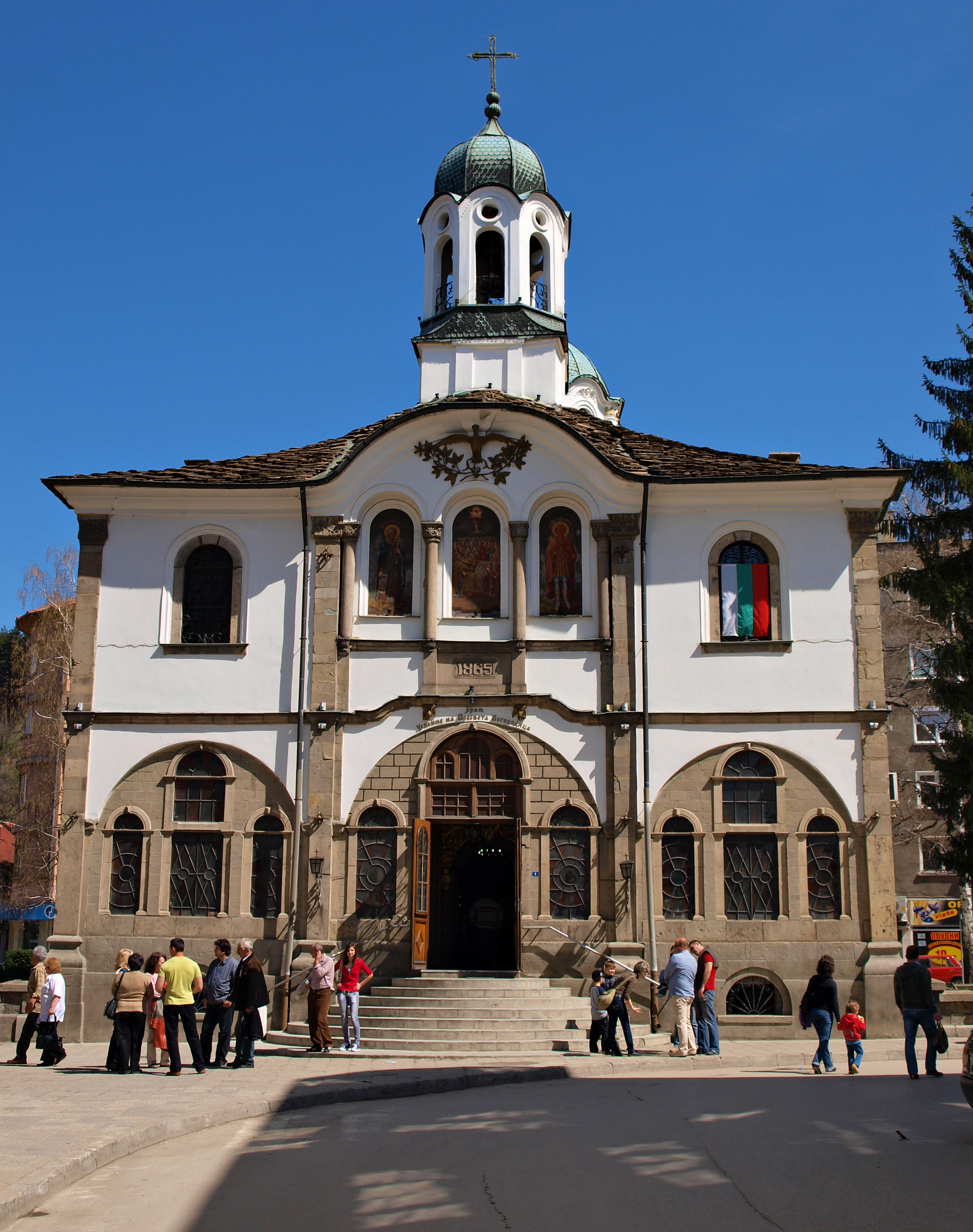
Population
Gabrovo saw its most rapid growth in the post-World War II years, when its population doubled. Following general population trends in Bulgaria, the number of citizens started declining after the fall of Communism in the country. People started emigrating abroad or to the capital, Sofia. Currently, Gabrovo is more than 30,000 people short of its peak, achieved in the period 1985-1991 when the number of the residents exceeded 80,000. According to Census 2011, , the population of the town was 58,950 inhabitants.
Ethnic, linguistic and religious composition
According to the latest 2011 census data, the individuals declared their ethnic identity were distributed as follows:
- Bulgarians: 54,227 (97.9%)
- Turks: 473 (0.9%)
- Roma: 343 (0.6%)
- Others: 193 (0.3%)
- Indefinable: 151 (0.3%)
- Undeclared: 3,563 (6.0%) Total: 58,950
The ethnic composition of Gabrovo Municipality is 60,207 Bulgarians, 504 Turks and 367 Roma among others.
Culture
Internationally known as a centre of humour and satire, Gabrovo has two theatres, the Racho Stoyanov Drama Theatre and the puppet theatre, a House of Humour and Satire that serves as a cultural institute, a centre, museum and gallery to popularise comic art. There is a cinema, Aleko Cinema, and museums and memorial houses in the town and around it, most notably the Etar Architectural-Ethnographic Complex and the National Museum of Education at the Aprilov National High School.
On a Saturday around the week of May 21, Gabrovo hosts an annual Carnival of Humor and Satire with the slogan in Bulgarian “Da izkukurigame ot smyah” (translating to "Let`s go nuts from laughter"). On the day of the carnival, the streets of Gabrovo town are overflowing with fun characters like masked musketeers, bullfighters, shamans, gypsies, and much more. The carnival is also popular for its use of traditional Balkan songs, folklore choreography, and a rich display of Gabrovo humour and culture.
A planetarium is in operation.
Tourism
Places of interest in Gabrovo include the House of Humour and Satire and Aprilov National High School. In Gabrovo Province sites include architectural reserve Bozhentsi. Hiking is widely available in the Central Balkan National Park and in the Bulgarka Nature Park, itself home to Ethnographic Complex Etara, Dryanovo Monastery, Sokolski Monastery, Shipka Pass, and the Uzana area. For admirers of historical tourism Shipka Memorial is a must-see. Gabrovo is member of the Creative Tourism Network ®.
Sports
- The town's most successful sports club is FC Yantra Gabrovo, which was founded in 1919.
- The town also has long handball traditions.
- About 25 km from the town in Central Balkan Mountains is located the renowned winter resort Uzana.
Honors
A minor planet 2206 Gabrova discovered on April 1, 1976, by Soviet astronomer Nikolai Stepanovich Chernykh is named in honor of the town.
Gabrovo Knoll on Livingston Island in the South Shetland Islands, Antarctica is named after Gabrovo.
Notable people
- Vasil Aprilov (1789–1847) - revivalist and educator; founder of the first secular school in Bulgaria
- Ivan Hadji Berov (1858–1934) - industrialist- lit the first light bulb in Bulgaria - erected the first hydro electric power plant in Gabrovo
- Tsanko Dyustabanov (1844–1876) - revolutionary
- Teodor Kabakchiev (born 1998), professional motorcycle racer
- Ivan Kolchev Kalpazanov (1835–1889) - industrialist, ancestor of the modern industry in Gabrovo and Kingdom of Bulgaria (1882)
- Vasil Nikolov Karagiosov (1856–1938) - teacher, industrialist, politician, German vicecouncul, monk in the Zograf monastery, Mount Athos, Greece
- Nikolay Palauzov (1821–1899) - merchant, donated money for the Gabrovian school
- Petar Rúsеv - father of former Brazilian president Dilma Rousseff
- Tota Venkova (1855 – 1921), first native-born Bulgarian woman physician. The regional hospital in Gabrovo is named after her.
- Christo Yavashev (1935–2020) - installation artist
Education
University
Gabrovo has one of the biggest technical universities in Bulgaria, the Technical University of Gabrovo, which opened in 1964. The idea for the university came from the 1840s. Today the university has about 5400 students; around 60 of them are from other countries.
Twin towns – sister cities
Gabrovo is twinned with:
- BEL Aalst, Belgium
- UKR Chernihiv, Ukraine
- MKD Kumanovo, North Macedonia
- GER Mittweida, Germany
- BLR Mogilev, Belarus
- RUS Mytischi, Russia
- POL Nowy Sącz, Poland
- LTU Panevėžys, Lithuania
- ISR Petah Tikva, Israel
- SVK Prešov, Slovakia
- AZE Shaki, Azerbaijan
- CRO Sisak, Croatia
- SUI Thun, Switzerland
References
References
- (2008-12-31). "Население по области, общини, местоживеене и пол | Национален статистически институт". Nsi.bg.
- "Archived copy".
- (2024-04-03). "Cities of Bulgaria".
- (2012). "Bulgaria (Other Places Travel Guide)". Other Places Publishing.
- Kay, Annie. (2008). "Bulgaria". Bradt Travel Guides.
- [http://www.britannica.com/EBchecked/topic/223244/Gabrovo Gabrovo] in Encyclopædia Britannica
- {{in lang. (January 2017)
- {{in lang. link. (2011-04-08)
- {{in lang. bg [http://www.nsi.bg/ORPDOCS/Census2011_1.pop_by_age.xls Population on 01.02.2011 by provinces, municipalities, settlements and age; National Statistical Institute] {{webarchive. link. (September 8, 2013)
- [http://www.nsi.bg/ORPDOCS/Census2011_4.pop_by_ethnos.xls Population by province, municipality, settlement and ethnic identification, by 01.02.2011; Bulgarian National Statistical Institute] {{webarchive. link. (2013-05-21 {{in lang). bg
- "Regulation | Gabrovo carnival".
- Schmadel, Lutz D.. (2003). "Dictionary of Minor Planet Names". Springer Verlag.
- Crampton, R. J.. (November 24, 2005). "A Concise History of Bulgaria". Cambridge University Press.
- Anamnesis article by Hristo Berov
- (May 15, 2011). "Conflicting Loyalties in the Balkans". I.B.Tauris.
- Palairet, Michael R.. (November 13, 2003). "The Balkan Economies c. 1800-1914". Cambridge University Press.
- (June 13, 2013). "Entangled Histories of the Balkans". BRILL.
- (15 December 2021). "Д-р Тота Венкова: Учител, не обичащ децата, е лош учител, лекар, не обичащ болните, е лекар занаятчия". Elovitsa Gabrovo News.
- Baal-Teshuva, Jacob. (2001). "Christo and Jeanne-Claude". [[Taschen]].
- "Technical University of Gabrovo". [[Technical University of Gabrovo]].
- "Побратимени градове". Gabrovo.
This article was imported from Wikipedia and is available under the Creative Commons Attribution-ShareAlike 4.0 License. Content has been adapted to SurfDoc format. Original contributors can be found on the article history page.
Ask Mako anything about Gabrovo — get instant answers, deeper analysis, and related topics.
Research with MakoFree with your Surf account
Create a free account to save articles, ask Mako questions, and organize your research.
Sign up freeThis content may have been generated or modified by AI. CloudSurf Software LLC is not responsible for the accuracy, completeness, or reliability of AI-generated content. Always verify important information from primary sources.
Report