From Surf Wiki (app.surf) — the open knowledge base
Gaborone
Capital and largest city of Botswana

Capital and largest city of Botswana
| Field | Value |
|---|---|
| official_name | Gaborone |
| nicknames | Gabs, GC, Gabz, G-City, Mageba, Moshate |
| named_for | Kgosi Gaborone |
| settlement_type | Capital city |
| image_skyline | {{multiple image |
| border | infobox |
| perrow | 1/2/2 |
| total_width | 290 |
| caption_align | center |
| image1 | Botswana, Gaborone Central Business District.jpg |
| caption1 | Gaborone Central Business District |
| image2 | BotswanaParliament.jpg |
| caption2 | Botswana Parliament |
| image3 | Aeropuerto Internacional Sir Seretse Khama de Gaborone, Botswana.jpg |
| caption3 | Sir Seretse Khama International Airport |
| image4 | Gaborone_National_Museum_20200211.jpg |
| caption4 | Gaborone National Museum |
| image5 | Gaborone Dam 2.jpg |
| caption5 | Gaborone Dam |
| image_flag | File:Flag of Gaborone.svg |
| pushpin_map | Botswana#Africa |
| pushpin_relief | 1 |
| map_caption | Location of Gaborone in Botswana##Location of Gaborone in Africa |
| pushpin_label_position | left |
| subdivision_type | Country |
| subdivision_name | Botswana |
| subdivision_type1 | District |
| subdivision_name1 | South East |
| subdivision_type2 | Sub-district |
| subdivision_name2 | Gaborone |
| government_type | City commission government |
| governing_body | Gaborone City Council |
| leader_title | Mayor |
| leader_name | Oarabile Motlaleng (UDC) |
| leader_title1 | Deputy Mayor |
| leader_name1 | Mankie Sekete (UDC) |
| established_title | Founded |
| established_date | 1964 |
| unit_pref | |
| area_footnotes | |
| area_total_km2 | 169 |
| area_land_km2 | |
| area_total_sq_mi | 65.25 |
| population_as_of | 2022 |
| population_footnotes | |
| population_total | 246325 |
| population_density_km2 | auto |
| population_density_sq_mi | auto |
| population_metro | 534,842 |
| timezone | CAT |
| utc_offset | +02:00 |
| coordinates | |
| elevation_footnotes | |
| elevation_m | 1014 |
| elevation_ft | 3326 |
| area_code_type | Geographical area code |
| area_code | 3XX |
| iso_code | BW-SE |
| blank_name_sec1 | HDI (2019) |
| blank_info_sec1 | 0.820 |
| blank_name | Climate |
| blank_info | BSh |
| website | Gaborone City Council Website |
Gaborone ( , , ) is the capital and largest city of Botswana. It was formerly spelled as Gaberones during the colonial era, a name still occasionally used in older English texts and maps. With a population of 246,325 based on the 2022 census, about 10% of the total population of Botswana.
Gaborone is situated between Kgale Hill and Oodi Hill, near the confluence of the Notwane River and Segoditshane River in the southeastern corner of Botswana, within 15 km from the South African border. The city is served by the Sir Seretse Khama International Airport. It is an administrative district in its own right, but is the capital of the surrounding South-East District. Locals often refer to the city as GC or Motse-Mshate.
The city of Gaborone is named after Chief Gaborone of the Tlokwa people, who once controlled land nearby. Because it was not affiliated with any specific indigenous group and was close to fresh water, the city was planned to be the capital in the mid-1960s when the Bechuanaland Protectorate became an independent nation. The centre of the city comprises a long strip of commercial businesses, called "Main Mall", with a semi-circular area of government offices to its east. Gaborone was once one of the fastest-growing cities in the world, and this has created problems with housing and illegal settlements. The city has also dealt with conflicts spilling into the country from Zimbabwe and South Africa during the 1980s.
Gaborone is the political and economic capital of Botswana, home to its largest companies and the Botswana Stock Exchange. It is also serves as the headquarters of the Southern African Development Community (SADC). The main spoken languages in the city include Setswana (Tswana), English, Kalanga, and Kgalagadi.
History
Main article: History of Gaborone, Timeline of Gaborone

Evidence shows that there have been inhabitants along the Notwane River for centuries. In more recent history, the Tlokwa left the Magaliesberg ranges to settle in the area around 1880, and called the settlement Moshaweng. The word "Gaborone" literally means "it does not fit badly" or "it is not unbecoming". The city was then called "Gaberones" by early European colonizers. Gaberones, a shortening of "Gaborone's Village", was named after Chief Gaborone of the Tlokwa, The fort was where Rhodes planned the Jameson Raid.Britannica, Gaborone Gaborone, britannica.com, USA, accessed on July 7, 2019
The modern town was only founded in 1964, after a decision was taken to establish a capital for Botswana, which became a self governing territory in 1965, before becoming a fully independent republic on 30 September 1966.
In 1965, the capital of the Bechuanaland Protectorate moved from Mafeking to Gaberones. When Botswana gained its independence, Lobatse was the first choice as the nation's capital. However, Lobatse was deemed too limited, and instead, a new capital city would be created next to Gaberones. The city was chosen because of its proximity to a fresh water source, its proximity to the railway to Pretoria, its central location among the central tribes, and its lack of association with those surrounding tribes.
The city was planned under Garden city principles with numerous pedestrian walkways and open spaces. Building of Gaborone started in mid-1964. During the city's construction, the chairman of Gaberones Township Authority, Geoffrey Cornish, likened the layout of the city to a "brandy glass" with the government offices in the base of the glass and businesses in the "mall", a strip of land extending from the base.
Most of the early town was built within three years, as a small town designed to accommodate 20,000 people – only to later develop after independence into a modern city. Buildings in early Gaborone include assembly buildings, government offices, a power station, a hospital, schools, a radio station, a telephone exchange, police stations, a post office, and more than 1,000 houses. Because the town was built so quickly, there was a massive influx of labourers who had built illegal settlements on the new city's southern industrial development zone. These settlements were named Naledi. The latter term literally means "the star", but could also mean "under the open sky" or "a community that stands out from all others". In 1971, because of the growth of illegal settlements, the Gaborone Town Council and the Ministry of Local Government and Lands surveyed an area called Bontleng, which would contain low-income housing. However, Naledi still grew, and the demand for housing was greater than ever. In 1973, the Botswana Housing Corporation (BHC) built a "New Naledi" across the road from the "Old Naledi". Residents from Old Naledi would be moved to New Naledi. However, the demand for housing increased yet again; moreover, the residents who relocated to New Naledi disliked the houses. The problem was solved in 1975 when Sir Seretse Khama, the president of Botswana, rezoned Naledi from an industrial zone to a low-income housing area.
On 30 September 1966, Bechuanaland became the eleventh British dependency in Africa to become independent. The first mayor of Gaborone was Reverend Derek Jones. The old Gaberones became a suburb of the new Gaborone, and is now known as "the Village".
In the mid-1980s, South Africa attacked Botswana and conducted raids on Gaborone and other border towns. The Raid on Gaborone resulted in twelve deaths.
After the 1994 General Elections, riots started in Gaborone because of high unemployment and other issues.
Today, Gaborone is growing very rapidly. In 1964, Gaborone only had 3,855 citizens; seven years later, the city had almost 18,000 residents. The city originally planned on 20,000 citizens, but by 1992, the city had 138,000 people. This has led to many squatter settlements on undeveloped land. Former mayor Veronica Lesole has stated that Gaborone's development problems were caused by the original city planners.
Geography


Gaborone is situated at between Kgale and Oodi Hills, on the Notwane River in the south-eastern corner of Botswana, and 15 km from the South African border.
In the centre of the city lies the Main Mall which houses many diplomatic missions. At the eastern end of the Mall, one can find the Civic Centre along with the Pula Arch that commemorates Botswana's independence. The Botswana Stock Exchange, National Museum and Art Gallery, and the main campus of the University of Botswana also lie near the Main Mall. To the west of the Main Mall is the Government Enclave. This area contains the governmental buildings such as the National Assembly of Botswana and Ntlo ya Dikgosi buildings. The National Archives building is also found here.
Climate
Gaborone has a hot semi-arid climate (Köppen climate classification BSh). Most of the year, Gaborone is very sunny. The summers are usually hot. The nights are cool. Usually, the summers with little rainfall are warmer than summers with regular rainfall. If there is a drought, the hottest temperatures of the year are usually in January or February. If there is normal rainfall, the hottest temperatures are usually in October, right before the rain starts. During the winter, days are still warm, and the nights are cold.
There are on average seventy-four days per year with temperatures above 32 °C. There are on average 196 days per year with temperatures above 26 °C. There are on average fifty-one days per year with temperatures below 7 °C. There is on average one day per year with temperatures below 0 °C. The lowest temperature registered in Gaborone was -6.5 °C.
Precipitation in Gaborone is scanty and erratic. Most of the rainfall in Gaborone falls during the summer months, between October and April. Gaborone has been affected by three floods based on records going back to 1995, one in 2000, one in 2001 that caused an estimated 5,000,000 Botswana pula worth of damage, and one in 2006.
The highest relative humidity occurs in June at 90% while the lowest is in September at 28%.
Solar irradiance ranges from 4.1 kWh m−2 d−1 in June to 7.3 kWh m−2 d−1 in December.
It is windier from September to November at 14 km/h, and it is calmer from May to August at 8 km/h. The average wind speed in a given year is 12 km/h. |Jan record high F = 103 |Feb record high C = 40.6 |Mar record high F = 102 |Apr record high F = 98 |May record high F = 91 |Jun record high F = 84 |Jul record high F = 83 |Aug record high F = 91 |Sep record high F = 103 |Oct record high F = 100 |Nov record high F = 104 |Dec record high F = 103 |year record high F = 104 |Jan record low F = 57 |Feb record low F = 55 |Mar record low F = 52 |Apr record low F = 32 |May record low F = 30 |Jun record low F = 30 |Jul record low F = 28 |Aug record low F = 32 |Sep record low F = 41 |Oct record low F = 45 |Nov record low F = 46 |Dec record low F = 52 |year record low F = 28 |access-date = January 19, 2016 |url-status = live |archive-url = https://web.archive.org/web/20160314035305/http://acmad.net/rcc/African-RCC/rcc_country_selection.php |archive-date = 14 March 2016
Demographics
|1964|3855 |1971|17718 |1981|59657 |1991|133468 |2001|186007 |2006|191776 |2011|231626 |2022|246325
The population, based on the 2022 census, is 246,325. There are 118,727 males and 127,598 females in the city. There are 58,476 households in Gaborone. In 2001, the average household size was 3.11 people. The city of Gaborone is home to over 10% of the population of Botswana.
The population growth rate of Gaborone is 3.4%, the highest in the country. This is most likely because the city has a more developed infrastructure, making it more livable. Gaborone is one of the fastest-growing cities in the world. Much of the growth is based on net in migration from the rest of Botswana.
The sex ratio of Gaborone is 96.3, meaning that there are 963 men for every 1,000 women. On average, there are 3.3 persons per household in Gaborone. This is a low number compared to the rest of Botswana.
Places of worship

Among places of worship, Christian churches and temples predominate. These include houses of worship affiliated with the Evangelical Lutheran Church in Botswana (Lutheran World Federation), Assemblies of God, The Church of Jesus Christ of Latter-day Saints, International Pentecostal Holiness Church, Christ Embassy, Roman Catholic Diocese of Gaborone (Catholic Church). Accompanying a significant community of ethnic Serbs in the city, there are also two Serbian Orthodox churches within Gaborone; the St. Nicholas Church and the St. Sava Church.
Culture
The National Museum and Art Gallery is located just northwest of the Mall along Independence Road. The museum opened in 1968. It holds many things from traditional crafts to works of art by local artists. The museum houses original paintings by Thomas Baines and Lucas Sithole. Exhibits include Artists in Botswana, Children's Art Competition and Thapong International. Outside the museum, there are various forms of transportation such as wagons, sledges, and bakkies (pickup trucks). There is also an exhibit on the San, the earliest inhabitants of southern Africa. The museum opened a 3.6 ha botanical garden called the National Botanical Garden on 2 November 2007. The garden was built to protect Botswana's indigenous plant life, and 90% of its total plant species are native plants from Botswana.
The Maitisong Festival was started in 1987 and is held every year for seven days on either the last week of March or the first week of April. The festival holds outdoor concerts, plays, and films in various venues around the city.
"My African Dream" was a performing-arts competition during the 2000s that was held every year at the Gaborone International Convention Center. The show featured many kwaito dancers and musicians.
The book series The No. 1 Ladies' Detective Agency, written by Scottish author Alexander McCall Smith, is set in Gaborone. The books follow Precious Ramotswe, the first female private detective in Botswana, and the mysteries that she solves. The Detective Kubu series, by Michael Stanley (South African co-writers Michael Sears and Stanley Trollip), features Assistant Superintendent David 'Kubu' Bengu of the Botswana Police Service Criminal Investigation Department.
Economy

Gaborone is the center of the national economy. The headquarters of important financial institutions such as the Bank of Botswana, Bank Gaborone, BancABC, and the Botswana Stock Exchange are centrally located, as well as the headquarters for Air Botswana, Consumer Watchdog, Botswana Telecommunications Corporation, and Debswana, the joint diamond mining venture between De Beers and the Botswana government. The Southern African Development Community (SADC) has its headquarters in Gaborone; the organization was formed in 1980 to increase economic cooperation among its members and reduce dependence on South Africa.
Several international companies have invested in the city: Hyundai, SABMiller, Daewoo, Volvo, and Siemens.
.jpg)
A Diamond Technology Park was recently opened, this is as part of Botswana Government's vision for establishment of downstream diamond industry. Companies dealing in diamonds have established their local operations in the park.
The Botswana Resource Conference is held annually at the Gaborone International Conference Centre.
The unemployment rate in Gaborone is 11.7% . 19.7% of the population in Gaborone is employed in the financial sector.
According to Mercer's 2011 Worldwide Cost of Living Survey, Gaborone has the 195th highest cost of living for expatriates in the world, up from 203rd in 2010. Gaborone comes between Chennai, India and Quito, Ecuador. Gaborone is the fourth least expensive city for expatriates in Africa, coming in above Addis Ababa, Ethiopia at 211th, Kampala, Uganda at 202nd and Windhoek, Namibia at 198th.
Sport
There are several football stadiums located in and around Gaborone. These include SSKB Stadium, Mochudi Stadium, and Botswana National Stadium. There are also several football teams representing Gaborone, which include, amongst others, Botswana Defence Force XI, Gaborone United, Police XI, Township Rollers and Uniao Flamengo Santos FC, which is based in nearby Gabane; all of them have played in the Botswana Premier League. The Botswana national football team plays in the National Stadium, but has never qualified for the FIFA World Cup, even though they recently qualified for the Africa Cup of Nations, held in Gabon in January 2012.
The Botswana Cricket Association, the governing body of cricket in Botswana, is headquartered in Gaborone. There are two Ovals where cricket is played in the city.
The Steinmetz Gaborone Marathon, the second marathon in Botswana, was held for the first time on 18 April 2010. The route started at the Phakalane Golf Estate in Phakalane, north of the city, and went through Gaborone, passing the National Assembly Building. The marathon, which was cancelled in 2011, has been held annually starting from 2012.
| University of Botswana Stadium | Football | 5,000 | Uniao Flamengo Santos F.C. |
|---|
Parks and recreation
The Gaborone Dam is located south of Gaborone along the Gaborone-Lobatse road, and provides water for both Gaborone and Lobatse. The dam is the second biggest in Botswana, able to hold 141400000 m3. It is also starting to be marketed as a recreational area. The northern end of the reservoir is planned to become an entertainment venue called The Waterfront. There is a yacht club, called Gaborone Yacht Club, also on the northern side of the lake. The southern end houses the Kalahari Fishing Club and a new public facility called City Scapes. City Scapes contains parks, playgrounds, and boating facilities. The dam is popular with birdwatchers, windsurfers, and anglers. However, there is no swimming due to the presence of crocodiles and parasitic bilharzias.
Wildlife

The Gaborone Game Reserve is a 600 ha park east of the city on Limpopo Drive. The reserve was built in 1988 and is now the third-busiest in Botswana. Examples of animals in the park are impala, kudu, ostriches, wildebeest, zebras, gemsbok, bushbuck, springbok, duiker, common eland, and common warthogs. The park is a destination for birdwatching. Birds in the marshy section of the park include snake eagles, boubou, gallinule, kingfishers, and hornbills.

Kgale Hill is located a few hundred metres from the city. The hill is nicknamed the Sleeping Giant and is 1287 m. There are three different paths to reach the top, usually taking two hours.
The Mokolodi Nature Reserve is a 30 km2 reserve that was created in 1994.
Somarelang Tikologo (Environment Watch Botswana) is a member-based environmental NGO housed inside an ecological park at the heart of Gaborone. The aim of the organization is to promote sustainable environmental protection by educating, demonstrating and encouraging best practices in environmental planning, resource conservation and waste management in Botswana. The park was officially opened by the Botswana Minister of Environment, Wildlife and Tourism, Onkokame kitso Mokaila on 27 February 2009. The park contains a playground for children to play on throughout the day, a community organic garden, a recycling drop-off center, and a shop where visitors can purchase products made of recycled material.
Government
Main article: Parliament of Botswana

Local government
Main article: Gaborone City Council
Gaborone is controlled by the Gaborone City Council, the wealthiest council in Botswana. It is composed of 35 councillors representing the wards of Gaborone. The Townships Act mandates the structure of local governments in Botswana. Because Botswana is a unitary state, the power of the local councils are delegated from the national level. The Ministry of Local Government, Land and Housing has a major influence in terms of personnel hiring and training, budgeting, and development planning.
The city commission-style council is run by the city clerk and the deputy city clerk. The city is governed by the mayor, deputy mayor, and several committees run by councillors: the financial and general purposes committee; the public health, social welfare and housing committee; the Self-Help Housing Agency (SHAA) management committee; the town planning committee; the trade licensing committee; and the education committee. The councillors elect the mayor in a first-past-the-post system and place each other in the committees yearly. The council has 2,515 employees.
An income tax called the Local Government Tax used to be the main source of income of the city council, but it was abolished. Today, the city council derives most of its revenue from property rates. City councillors feel that because of recurrent obligations, they have little room to institute new solutions.
The city council has been criticised by the Botswana Association of Local Authorities for its closed elections and minimal authority. This has led to a buildup of uncollected garbage. Haskins Nkaigwa, mayor of Gaborone from 2011, has stressed the importance of more local autonomy. He advocates for a stronger city council with the power to determine budgets and hire and fire clerks and officers.
National government

Gaborone is the political centre of Botswana. Most government buildings are located west of the Main Mall in an area called the Government Enclave. Another monument pays tribute to the Botswana Defence Force soldiers who died in the Rhodesian Bush War.
Before 1982, Gaborone held one parliamentary constituency, in the Parliament of Botswana. From 1982 to 1993, Gaborone was divided into two constituencies, Gaborone North and Gaborone South. A third seat in Parliament was given to a member elected for the whole city of Gaborone. In January 1993, two new constituencies were created: Gaborone West and Gaborone Central. For local government elections, the four constituencies were divided into wards. Gaborone North had seven, Gaborone West had seven. Gaborone Central had six, and Gaborone South had five.
An International Law Enforcement Academy (ILEA) was established on 24 July 2000 in Gaborone. The academy would provide training for middle managers for the countries in the Southern African Development Community (SADC).
There are 21 diplomatic missions in Gaborone.
Education

Main article: List of schools in Botswana
There are more people who have earned a degree or postgraduate qualifications in Gaborone than anywhere else in Botswana. 70.9% of the population of Gaborone have earned at least a secondary-level education
Gaborone has many primary and secondary schools, both public and private. These include Westwood International School, Maru-a-Pula School, St. Joseph's College, Kgale, Legae Academy, Northside Primary School, Thornhill Primary School and Hillcrest International School. Seventeen of the sixty private schools in Botswana are located in Gaborone.
The main campus of the University of Botswana (which was established in 1982) is on the eastern extent of the city.
In addition there are other universities or institutions of higher education that cater to specialized study and instruction.
- Limkokwing University Of Creative Technology (which also has a campus in Gaborone)
- Botswana Accountancy College (which caters to both accounting and IT students)
- Botswana Institute of Administration and Commerce
- Botswana Open University (offering long-distance learning)
- Gaborone Technical College
- Boitekanelo College
- Botho University (which offers courses ranging from computing, accounting and finance, business, engineering and health information management)
- Botswana University of Agriculture and Natural Resources, situated approximately 15 km from the city centre
Further, in year 2006, the Gaborone Universal College of Law, opened its main campus in Gaborone, with its first group of students graduating in 2010.
Media
Newspapers published in Gaborone include Mmegi, The Botswana Gazette, The Monitor, Midweek Sun, The Patriot on Sunday, Sunday Standard, and The Voice. Magazines published are Lapologa, Peolwane, Kutwlano among others.
Radio station Yarona FM broadcasts from Gaborone; its frequency in Gaborone is 106.6 FM. Another small, local radio station in Gaborone is Gabz FM, Duma FM & Yarona FM.{{Cite book|last1=Denbow|first1=James Raymond|last2=Thebe|first2=Phenyo C. | title =Culture and customs of Botswana|chapter=Literature and Media|pages=72–73|chapter-url=https://books.google.com/books?id=8ycoVZ-DfrYC&q=gabz+FM&pg=PA55
Before 2000, residents of Gaborone received television programming from BOP TV in Mahikeng via a repeating transmitter on the summit of Kgale Hill. Today, the Gaborone Broadcasting Company and Botswana TV provide television programming for Gaborone. 78.7% of the households in Gaborone have a working television. Other local channels based in Gaborone are Now TV, Khuduga HD, Access TV & Maru TV.
93.7% of the households in Gaborone have a cell phone.
Infrastructure
Gaborone is one of the fastest-growing cities in Africa. The growth of Gaborone, especially suburban growth, has caused much of the farmland surrounding the city to be absorbed into the city. Much of the food for Gaborone comes from north of the city with some smaller-scale farms on the southern end. The city centre was planned to be functionalist, The Main Mall, a car-free shopping and commercial area, runs in an east–west direction with the Government Enclave and National Assembly on the west end and the Gaborone City Town Council complex on the east.
Gaborone's CBD is home to the new Square Mall, The Tower, the new SADC headquarters, the Industrial Court, a court specifically for settling trade disputes, and the Three Dikgosi Monument, a landmark featuring the statues of Khama III, Sebele I, and Bathoen I, three dikgosi, or chiefs, who traveled to Great Britain to establish the Bechuanaland Protectorate separate from Southern Rhodesia (present-day Zimbabwe) or the Cape Colony (present-day South Africa). The monument was inaugurated on 29 September 2005. While the statues represent famous historical figures, there has been some controversy over the cost of the construction, P12,000,000 (approx. US$1.7M, €1.4M, or £1.1M as of June 2010), and over the construction company, North Korean Mansudae Overseas Projects, putting the wrong inscription date. Other buildings under construction in the CBD include the Holiday Inn Gaborone, retail space, and office space.
Utilities
The city gets most of its water from the reservoir formed from the Gaborone Dam on the southeast side of the city, which has facilitated growth. The city of Gaborone was originally constructed as a small town, so the Gaborone Dam needed to be built to provide water for all its citizens.
From 2007 to 2008, 23963000 m3 of water was sold in Gaborone. The government sector bought the most water, 11359000 m3. 8564000 m3 of water was bought for domestic use, and 4040000 m3 of water was bought by the commercial and industrial sectors. In 2008, the city of Gaborone consumed 25657363 kl of water, and the water consumption per capita was 0.184 m3 per person per year, the lowest rate since 1999.
Gaborone has some of the highest water tariffs in the country because of high transportation costs and high water consumption. The high tariffs may also be due to the fact that some of Gaborone's water supply is imported from the Letsibogo Dam.
The average pH of the water in the Gaborone Dam is 7.95 as of February 2006. The concentration of calcium in the reservoir was 14.87milligrams per litre from April 2001 to August 2006. During the same period, the concentration of calcium carbonate (CaCO3) was 57.73 milligrams per litre, slightly over Botswana's ideal concentration which means the water is hard. Also during the same period, the chloride concentration was 6.44 mg/l, the fluoride concentration was 0.54 mg/l, the potassium concentration was 6.72 mg/l, and the sodium concentration was 10.76 mg/l.
Healthcare
Main article: List of hospitals in Botswana
The Botswana Red Cross Society, established in 1968, is headquartered in Gaborone. The Princess Marina Hospital is the main referral hospital in Gaborone and houses 500 beds.{{Cite web | archive-url= https://web.archive.org/web/20101229125740/http://www.velavke.co.za/projects.htm?action=view-item&id=860 | archive-date= 29 December 2010 |access-date=2023-02-06 | url-status= usurped }} There is also Gaborone Private Hospital and Sidilega Private Hospital all operating in the city of Gaborone. The Cancer Association of Botswana is a voluntary non-governmental organization established as a trust in 1998.
HIV/AIDS
AIDS is a very serious problem in Gaborone. 17,773 Gaborone citizens, 17.1% of the total population of Gaborone, have tested positive for HIV. There is a higher prevalence of HIV among women; 20.5% of women have tested positive compared to 13.6% of men. The population between 45 and 49 years of age are most likely to have AIDS with 35.4% of the residents in that age group testing positive.
HIV/AIDS education is extensive in Gaborone. However, a 2008 study shows that 14.5% of Gaborone residents between 10 and 64 who have heard of HIV/AIDS believe that HIV can be spread through witchcraft, and 31.3% of the residents believe HIV can be spread through mosquito bites.
Transportation
Railways
Main article: Rail transport in Botswana
The railway that served the founding purpose of the city remains important, bisecting the city in a north–south direction. The line stops at the following cities in and near Botswana: Ramatlabama on the South African border, Lobatse, Gaborone, Palapye, Serule, Francistown, Ramokgwebana, and Plumtree, Zimbabwe. The line became a cargo-only line on 1 April 2009 but passenger services resumed in early 2016.
Airports
Main article: List of airports in Botswana

Sir Seretse Khama International Airport (ICAO code: FBSK IATA code: GBE north of the city It is the headquarters of Air Botswana, the national airline of Botswana.
In 2008, Sir Seretse Khama International Airport handled 15,844 aircraft movements, second only to Maun Airport (ICAO code: FMBN IATA code: MUB) Air traffic in Gaborone has decreased since 2006. However, Gaborone has the most air passenger traffic, accounting for 51.6% of all passenger movement in Botswana. International passengers total 244,073 passengers while domestic air passenger movement comes up to 333,390 passengers. Gaborone International Airport terminal was rebuilt into a modern terminal in 2010.
Roads
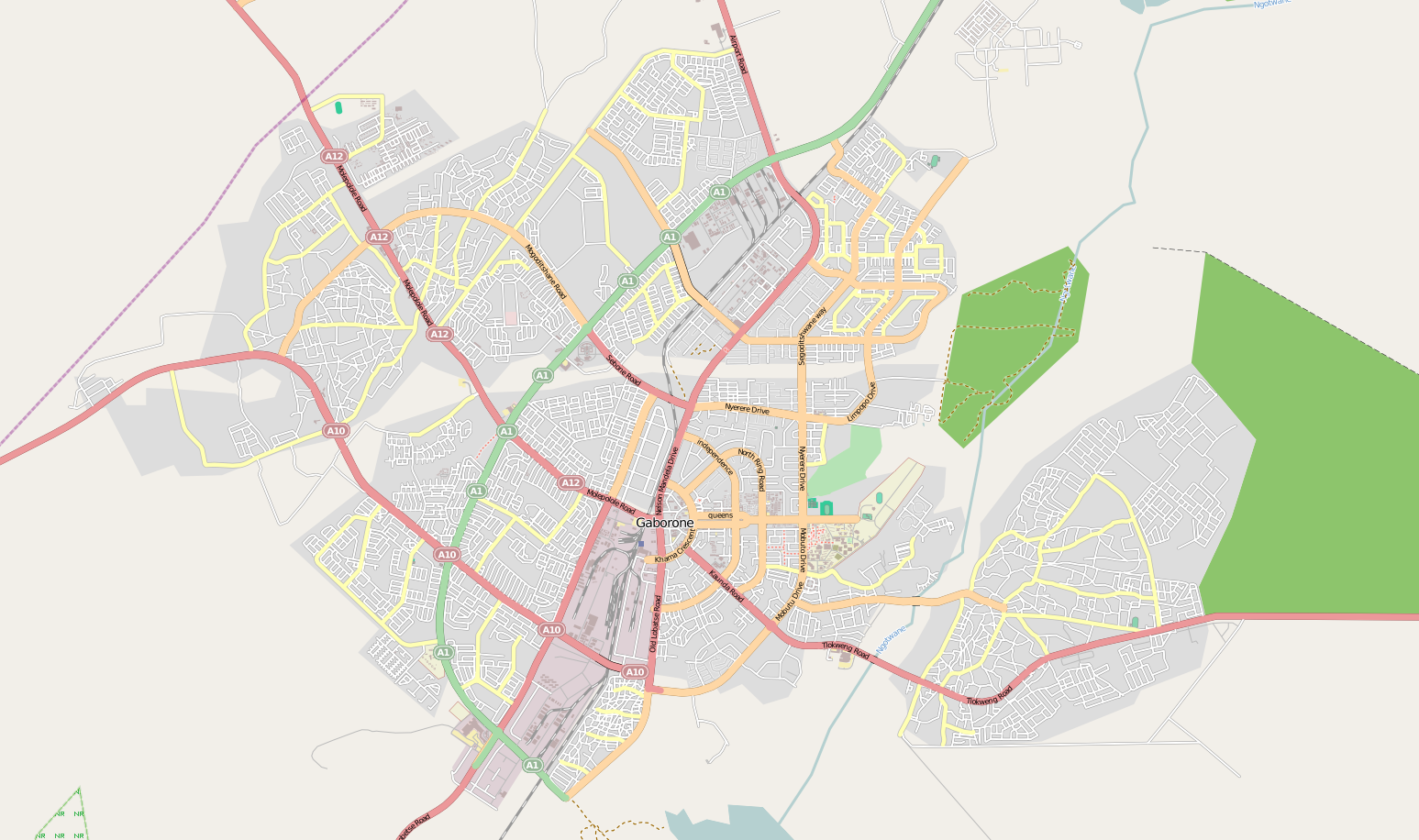
Highways in and around Gaborone include the Trans-Kalahari Highway, A1 Highway, A10 Highway and the Cairo-Cape Town Highway. There are five major roads in Gaborone that go to Lobatse, Kanye, Molepolole, Francistown via Mochudi, and Tlokweng.
Public transport
;Kombi

Public transport in the city is generally reliable, when compared with major African cities. Kombis (small vans) and taxis ply the routes within the city, while buses serve surrounding villages and other towns in Botswana.
Private traffic
Gaborone has several vehicle licensing stations. 15,538 new private motor vehicles, accounting for 46.5% of Botswana's total new vehicle registrations, were registered in Gaborone in 2008, of which 8,440 were passenger cars, 440 were minibuses, 204 were motorcycles, and 181 were tractors. The total has increased from 12,690 new vehicle registrations in 2007. Gaborone also has the highest number of vehicle registration renewals at 73,206 in 2008.
Including the district of Gaborone West, Gaborone had 9,415 vehicle accidents with 74 human fatalities in 2008. Most of the traffic collisions in that year, 3,146 collisions, were side collisions. 263 accidents involved animals. The city has also seen 679 pedestrian casualties in 2008; 24 pedestrians were killed. The majority of vehicle accident casualties involved pedestrians, and most traffic accidents occur between 16:00 and 18:00.
Notable people
-
Letsile Tebogo (b. 2003) Motswana Athlete, Sprinter, won He won the silver medal at the 2023 World Championships in the 100 m
-
Kgosi Gaborone ( 1825–1931), Motswana chief, after whom the city is named
-
Alec Campbell (1932–2012), archaeologist and museum curator
-
Thamsanga Mnyele (1948–1985), member of the African National Congress and artist
-
Vernon Nkadimeng (1958–1985), member of the African National Congress, killed in Gaborone by the apartheid police
-
Boniface Tshosa Setlalekgosi (b. 1927), Roman Catholic bishop of the Diocese of Gaborone, Botswana from 1981 to 2009
-
Wally Serote (b. 1944), poet and anti-apartheid activist
-
Dipsy Selolwane (b. 1978), football player
-
Mpule Kwelagobe (b. 1979), Miss World Botswana 1997, Miss Universe Botswana 1999 and Miss Universe 1999
-
Alister Walker (b. 1982), squash player
-
Abednico Powell (b. 1983), football player
-
Joel Mogorosi (b. 1984), football player
-
Dirang Moloi (b. 1985), member of the Botswana national football team
-
Donald Molosi (b. 1985), actor, writer and playwright attended Maru a Pula School in his teens, and the National Arts Festival in South Africa
-
Sumaiyah Marope ( 1987), Miss Botswana 2009
-
Emma Wareus (b. 1990), Miss World Botswana 2010, first runner-up to Miss World 2010
-
Matsieng, a Setswana traditional music group, formed in Gaborone in 2005
International relations
Gaborone has been twinned with:
- USA Burbank, United States
Gallery
File:Flag map of Gaborone.svg|alt=A flag map of Gaborone|Flag map of Gaborone File:GaboroneStreetScene.jpg|alt=A road with a Bank Gaborone building to the left and a taller building with curved truss structures on the windows to the right|Street scene near the Main Mall File:RhodesiaRailcar.jpg|alt=A brown train, viewed from the side, is at rest under a small open station. "1035 Rhodesia Railways" is written in gold letters over the train's windows. There is a white fence and a brick walkway in front of the train.|Rhodesia Railways car at the national museum File:Kgale Hill 2.jpg|View from Kgale Hill (Oodi Hill on horizon) File:Gaborone Dam 1.jpg|Gaborone Dam File:Gaborone Dam 2.jpg|Gaborone Dam File:Botswana Gaborone I Towers.jpg|Botswana Gaborone I Towers File:Gaborone, Botswana Hindu Temple.jpg|Gaborone Hindu Temple File:Gaborone, Botswana Mosque.jpg|Gaborone Mosque File:Botswana, Gaborone Central Business District.jpg|CBD File:Gaborone, Botswana New Development CBD.jpg|CBD Developments File:Gaborone, Botswana - 51207616203.jpg|New Construction Developments File:Gaborone, Botswana Room 52 Rooftop Restaurant.jpg|Room 52 Roof Top Restaurant File:Gaborone, Botswana - 51208479090.jpg|New CBD File:Gaborone, Botswana Christ The King Cathedral.jpg|Christ The King Cathedral File:Gaborone, Botswana - 51206700752.jpg|CBD Mall File:Gaborone, Botswana - Sir Seretse Khama International Airport.jpg|SSKI Airport
References
References
- Parsons, Neil. (19 August 1999). "Botswana History Page 7: Geography". University of Botswana History Department.
- "Gaborone, Botswana Page". Falling Rain Genomics, Inc..
- "Current Local Time in Gaborone, Botswana".
- Botswana Telecommunications Authority. (11 September 2009). "Botswana (country code +267)". International Telecommunication Union.
- "Sub-national HDI – Area Database – Global Data Lab".
- "Gaborone". [[HarperCollins]].
- "Gaborone". [[Oxford University Press]].
- {{Cite American Heritage Dictionary. Gaborone
- [https://www.britannica.com/place/Gaborone Britannica – Gaborone]
- "Statistics Botswana - Census 2022 - Population of cities, towns and villages".
- "Botswana: Districts, Cities, Towns, Urban Villages & Agglomerations - Population Statistics, Maps, Charts, Weather and Web Information".
- (2008). "Botswana and Its People". Godfrey Mwakikagile.
- [http://www.laws.gov.bw/ Laws of Botswana] {{webarchive. link. (23 July 2011 , [http://www.mlg.gov.bw/ Ministry of Local Government] {{webarchive). link. (18 July 2009)
- "Map - Gaborone - MAP[N]ALL.COM".
- "Southern African Development Community :: About SADC".
- "Travel Companion – Southern Botswana". Botswana Tourism Board.
- (2007). "Botswana & Namibia". Lonely Planet.
- "African cities- Gaborone History". AfricanCities.net.
- (22 December 1969). "Regions Given New Spelling". Spokane Daily Chronicle.
- Roman Adrian Cybriwsky, ''Capital Cities around the World: An Encyclopedia of Geography, History, and Culture'', ABC-CLIO, USA, 2013, p. 113
- Books, L. L. C.. (June 2010). "Settlements in Botswan: Cities, Towns and Villages in Botswana, Gaborone, Palapye, Moshupa, Serowe, Francistown, Maun, Ghanzi, Hukuntsi". General Books.
- Njeru, Purity. (2009). "History of Gaborone". [[The African Executive]].
- (2008). "Botswana and Its People". New Africa Press.
- (2004). "From understanding to action: sustainable urban development in medium-sized cities in Africa and Latin America". Springer.
- Paine, David J.. (15 April 1966). "Capital City Being Built On Virgin Soil". Eugene Register-Guard.
- killion. (29 June 2009). "The Unsustainable urban growth of Gaborone City, Botswana". Boidus: Blogs.
- Van Nostrand, John Cornelius. (1982). "Old Naledi, the village becomes a town: an outline of the Old Naledi Squatter Upgrading Project, Gaborone, Botswana". James Lorimer & Company.
- Grant, Sandy. (18 June 2009). "Our Heritage.". [[Mmegi.
- Maundeni, Zibani. (June 2004). "Mapping Local Democracy in Gaborone City". Botswana Association of Local Authorities.
- Central Statistics Office. "Table 1.6: Distribution of Population in Urban Settlements: 1971–2001 Censuses".
- (1997). "New patterns: process and change in human geography". Nelson Thornes.
- (15 July 2011). "Garden City Concept is a thing of the past, says Richard Rogers". Boidus.co.bw.
- "Botswana's Climate". Meteorological Services Botswana.
- "Weatherbase: Historical Weather for Gaborone, Botswana". Weatherbase.
- Central Statistics Office. (August 2009). "NATURAL DISASTERS DIGEST 2008".
- Bauer, Carl. (2005). "Climate". Bauer Consult.
- (December 2011). "BOTSWANA STATISTICAL YEAR BOOK 2010". Central Statistics Office.
- (June 2012). "The Population of Towns, Villages and Associated Localities". Statistics Botswana.
- Central Statistics Office. (7 February 2008). "Table 1.1: Population by sex and census districts (1991 And 2001)".
- Central Statistics Office. (February 2005). "2001 POPULATION CENSUS ATLAS: BOTSWANA".
- A. N. Majelantle. (May 2010). "MARRIAGE STATISTICS 2007". Central Statistics Office.
- Central Statistics Office. (January 2009). "Botswana Demographic Survey 2006".
- J. Gordon Melton, Martin Baumann, ''Religions of the World: A Comprehensive Encyclopedia of Beliefs and Practices'', ABC-CLIO, USA, 2010, p. 380
- (24 May 2006). "Gaborone Holidays – a Visit to the Vibrant Cosmopolitan Capital".
- "National Botanical Garden". Botanic Gardens Conservation International.
- Palapye. (25 October 2007). "National Museum to Launch Botanical Garden".
- "African cities- Gaborone Culture". AfricanCities.net.
- (12 July 2011). "Worldwide Cost of Living survey 2011 – city ranking". Mercer.
- "Gaborone City Marathon".
- (2010). "Stadiums in Gaborone". worldstadia.com.
- (2010). "Stadiums in Botswana". World Stadiums.
- Majelantle, A.. (October 2009). "Botswana water statistics". Central Statistics Office.
- Gabscity.com. "City – Gabscity.com all about Gaborone".
- Mokolodi Nature Reserve. "Introduction". Mokolodi Nature Reserve.
- Somarelang Tikologo. "What is ST?". Somarelang Tikologo.
- Nengwekhulu, Ranwedzi. (1 April 1996). "An evaluation of the nature and role of local government in post colonial Botswana". University of Pretoria School of Public Management and Administration.
- Wunsch, James S.. (1998). "Decentralization, Local Governance and the Democratic Transition in Southern Africa: A Comparative Analysis". [[University of Florida]] Center for African Studies.
- Lekorwe, Mogopodi. (1998). "The politics of urban governance and management in Gaborone". Pula: Botswana Journal of African Studies.
- Mooketsi, Lekopanye. (3 March 2010). "Frenic Company sues Gaborone City Council". Mmegi.
- Ngwanaamotho, Maranyane. (9 April 2010). "Gaborone City Council fails to collect garbage". Mmegi.
- Keoreng, Ephraim. (5 October 2011). "New Gaborone Mayor seeks power to hire and fire".
- (2010). "Botswana Review 29th Edition". B&T Directories (Pty) LTD.
- Odubeng, Maureen. (18 October 2019). "How Parties Fared in 2019 Parliamentary Election".
- (29 June 2009). "History". ILEA Gaborone-Botswana.
- "Westwood International School".
- "Home - Maru-a-Pula School".
- "ST JOSEPH'S COLLEGE".
- "Home".
- (December 2011). "Education Statistics 2011". Central Statistics Office.
- "General Information".
- (12 November 2013). "BCA becomes university". Daily News.
- "About Us". Gaborone Universal College of Law.
- Mokgoabone, Kabo. (6 September 2010). "Gaborone University College of Law holds 2010 graduation". Sunday Standard.
- (July 2001). "Incorporating Urban Agriculture In Gaborone City Planning".
- (25 February 2008). "Gaborone: a capital city w/ a strange design".
- Gabscity.com. "Home – Gabscity.com all about Gaborone".
- Mosinyi, Wanetsha. (8 May 2009). "New CBD threatens office space market". [[Mmegi.
- "The Industrial Court of Botswana".
- (8 September 2005). "Historians support dikgosi statues". Gabscity.com.
- (19 December 2005). "The Highlights Of An Eventful Year". [[Mmegi]].
- Keto Segwai. (28 July 2006). "Three dikgosi in waiting". [[Mmegi]].
- Benza, Brian. (11 August 2008). "Masa Towers To Cost P275 Million – Giachetti". [[Mmegi.
- "Botswana Railway Network". Botswana Tourism Board.
- Malikongwa, Lewis. (27 February 2009). "Termination of Botswana Railways' Passenger Service". Ministry of Works and Transport.
- Mouwane, Tumelo. (2016-03-23). "New, improved passenger train sets off".
- {{GCM. FBSK. Sir Seretse Khama International Airport
- (2007). "Botswana". Marshall Cavendish.
- {{GCM. FMBN. Maun Airport
- "Road network map". Botswana Tourism Board.
- A. N. Majelantle. (December 2009). "Botswana transport statistics – 2008". Central Statistics Office.
- [http://www.mmegi.bw/2004/June/Thursday24/2835465531965.html A piecing together of fragments] {{Webarchive. link. (16 September 2017 ''Mmegi Online''. Retrieved September 15, 2017.)
- Setlalekgosi, Onneile. (2016-07-15). "The immortal story teller". [[The Voice (Botswana).
- "Burbank's Sister Cities". Burbank Sister City Organization.


This article was imported from Wikipedia and is available under the Creative Commons Attribution-ShareAlike 4.0 License. Content has been adapted to SurfDoc format. Original contributors can be found on the article history page.
Ask Mako anything about Gaborone — get instant answers, deeper analysis, and related topics.
Research with MakoFree with your Surf account
Create a free account to save articles, ask Mako questions, and organize your research.
Sign up freeThis content may have been generated or modified by AI. CloudSurf Software LLC is not responsible for the accuracy, completeness, or reliability of AI-generated content. Always verify important information from primary sources.
Report