From Surf Wiki (app.surf) — the open knowledge base
G (New York City Subway service)
Rapid transit service

Rapid transit service
| Field | Value |
|---|---|
| service | G |
| name | Brooklyn-Queens Crosstown |
| image1 | R211 G train at Court Square September 2025.jpg |
| alt1 | A "G" train of R211A subway cars at Court Square |
| caption1 | A G train of R211As at Court Square |
| north term | Court Square |
| south term | Church Avenue |
| stations | 21 |
| depot | Coney Island Yard |
| started | |
| map | |
| map_state | collapsed |
The G Brooklyn-Queens Crosstown is an 11.4 mi rapid transit service in the B Division of the New York City Subway. Its route emblem, or "bullet", is colored since it uses the IND Crosstown Line.
The G operates 24 hours daily between Court Square in Long Island City, Queens, and Church Avenue in Kensington, Brooklyn and makes all stops along the full route. It is the only non-shuttle service in the system that does not serve the borough of Manhattan. The G serves two stations in Queens—Court Square and 21st Street, both in Long Island City. Prior to 2010, it served the IND Queens Boulevard Line between Court Square and 71st Avenue in Forest Hills. In 1939 and 1940, the then-designated GG also used the now-demolished IND World's Fair Line to access the 1939 New York World's Fair. The GG, which became the G in 1985, had its southern terminal at Smith–Ninth Streets from 1976 to 2009.
In the 21st century, the G suffered from a wide range of issues that has resulted in complaints by people living along the route. These issues included an inadequacy of transfers to other services; the lack of direct service to Manhattan; short train lengths; and low frequencies. Since the 2000s, several improvements have been made to the G, including a route extension in Brooklyn and a full-route audit in 2013 that identified solutions for issues on the G service. , additional improvements are planned for the G route, including the automation of the entire route. The G has a weekday ridership of 166,000.
History
Early service
The original Brooklyn–Queens Crosstown Local service began on August 19, 1933, as a shuttle between Queens Plaza on the IND Queens Boulevard Line and Nassau Avenue. This service was designated GG because the IND used double letters to indicate local service. Starting on April 24, 1937, GG trains were extended to Forest Hills–71st Avenue during rush hours, serving as the Queens Boulevard local while trains ran express west of 71st Avenue. The entire IND Crosstown Line was completed on July 1, 1937, including the connection to the IND Culver Line (then the South Brooklyn Line) at Bergen Street. Although some retrospective accounts have intimated that GG service initially ran at all times between Forest Hills–71st Avenue and Church Avenue before being truncated,
From April 30 to November 1, 1939, and from May 11 to October 28, 1940, GG trains were extended via the temporary IND World's Fair Line to World's Fair Station at Horace Harding Boulevard at all times during the 1939–1940 World's Fair. Trains were marked as S Special. The fair closed on October 28, 1940, with the station and line being demolished later that year. As a result, GG service was truncated to Forest Hills–71st Avenue. Additional GG service was provided for the 1964 New York World's Fair, running nonstop between Hoyt–Schermerhorn Streets station and Roosevelt Avenue every 30 minutes between 10 a.m. and 3:30 pm. It took 23 minutes for trains to travel between the two stations.
1960s to 1990s
| The bullet used from 1967 to 1979 |
|---|
| The bullet used from 1979 to 1985 |
|---|
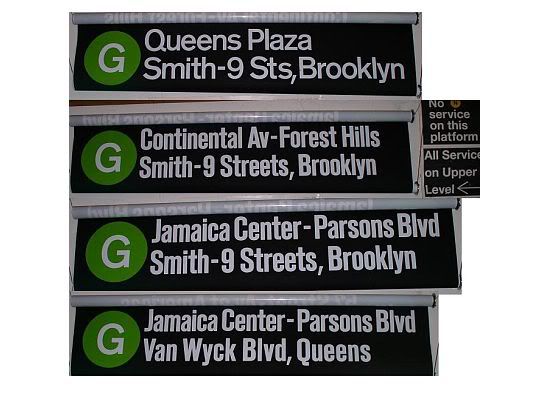
On August 19, 1968, service was extended to Church Avenue during rush hours to allow for the introduction of express service on the IND Culver Line. Since riders at local stations complained about the loss of direct service to Manhattan, F trains to and from Kings Highway began making local stops. All peak-direction F trains began running local on January 19, 1976. On August 30, 1976, due to budget cuts, remaining F express service north of Church Avenue was eliminated and GG service was cut back to Smith–Ninth Streets. On January 24, 1977, as part of a series of NYCTA service cuts to save $13 million, many subway lines began running shorter trains again during middays. As part of the change, GG trains began running with four cars between 9:30 a.m. and 1:30 pm. On August 27, 1977, GG service was cut back to Queens Plaza during late nights, and local service along Queens Boulevard was provided by the . Effective May 6, 1985, use of double letters to indicate local service was discontinued, so the GG was relabeled G.
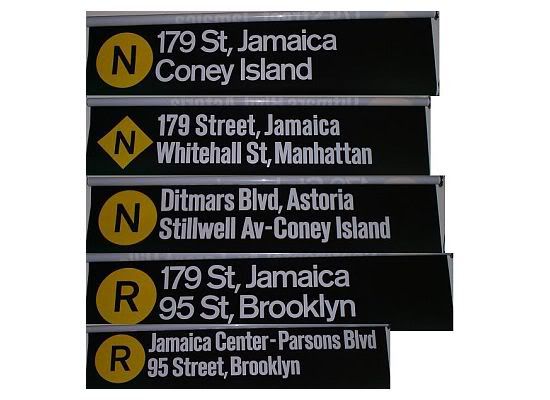
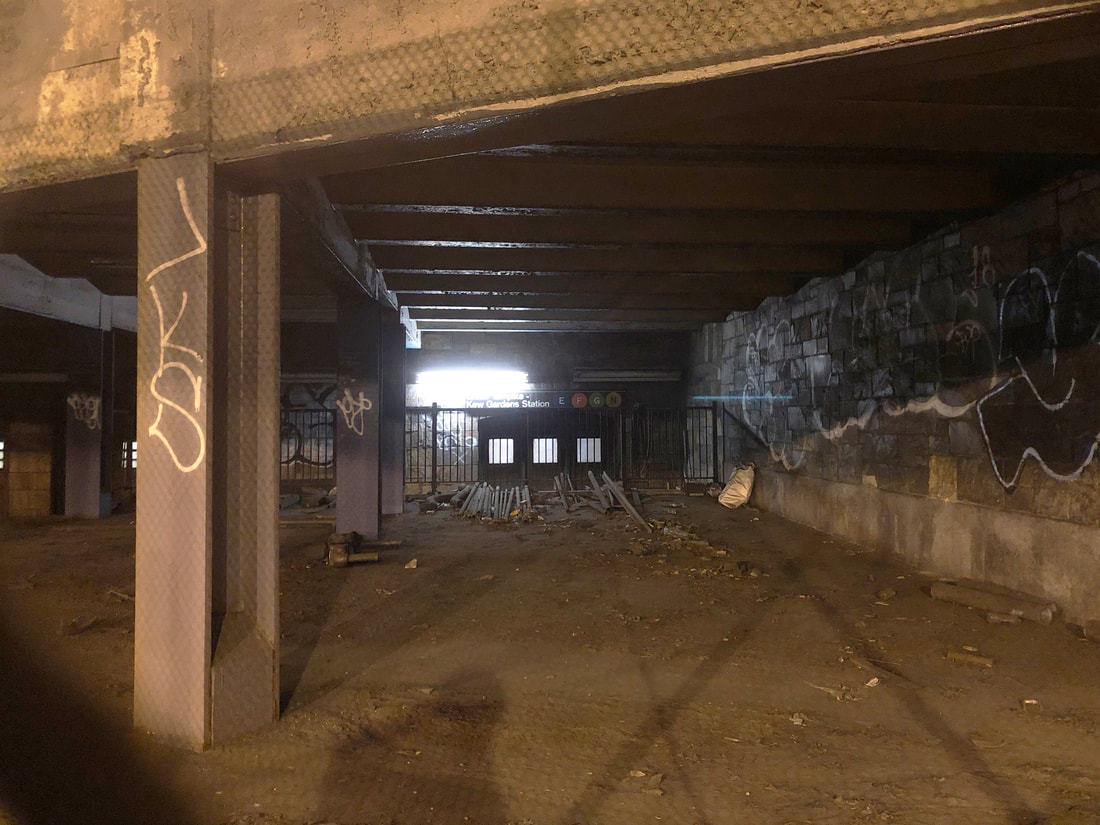
Afterwards, as part of the New York City Transit Authority's proposed service plan to serve the new Archer Avenue Line upper level, the G would have been extended to Jamaica Center during weekends and evenings when N trains terminated at 71st Avenue or 57th Street–Seventh Avenue. During late nights, a G train shuttle would have run between Jamaica Center and Van Wyck Boulevard. On weekdays, the extension would have been served by N trains. This service plan would have allowed E and F trains to remain on the Queens Boulevard mainline toward 179th Street. The final service plan, which took effect on December 11, 1988, had the extension served by E trains, with R trains extended to 179th Street.
On May 24, 1987, the and services switched terminals in Queens. As part of the reroute plan, Queens Plaza became the northern terminal for the G train on evenings, weekends, and late nights. Three years later, on September 30, 1990, G service was extended to 179th Street during late nights to replace the , which terminated at 36th Street and Fourth Avenue. On April 14, 1991, weekend service was extended from Queens Plaza to 71st Avenue. Weekend G service was cut back to Queens Plaza on July 26, 1992.
In January 1991, F express service was proposed to speed service during the height of rush hours which would have reduced travel time by up to five minutes. Alternate F trains would operate express in both directions between Jay Street and Church Avenue, stopping at Seventh Avenue; as a result of this service change, G trains would be cut back from its southern terminal at Smith–Ninth Streets and originate and terminate at Bergen Street to prevent delays in express service. This service change would have been implemented in October 1991, pending approval from the MTA board. An alternate version was implemented in September 2019 when limited rush hour F trains (designated as a diamond ) began running express between Jay Street and Church Avenue, stopping at Seventh Avenue.
Late 1990s to present
On March 23, 1997, G trains started terminating at Court Square on weekends. On August 30, overnight service was permanently cut back from 179th Street to Court Square, with F trains making all stops east of Queens Plaza to replace the G, meaning that the G only ran along the Queens Boulevard Line on weekdays. Evening service between 9 p.m. and 11 p.m. was cut back from Queens Plaza to Court Square.
On December 16, 2001, the 63rd Street Connector opened and the G was removed from Queens Boulevard during weekday rush hours and middays; Court Square became the northern terminal for the G train during this time. Service was extended beyond Court Square to and from 71st Avenue at all other times, which represented the reverse of the previous pattern. Service along the IND Queens Boulevard Line was replaced by the new train on weekdays during the day. This service change was supposed to go in effect on November 11, but was delayed due to the September 11 attacks. The G was to be truncated to Court Square 24 hours to make room for the V, but due to rider opposition, it was cut back only on weekdays until 8:30 pm. To determine if existing G service along Queens Boulevard could be maintained along with V trains simultaneously, weekday rush hour service was simulated on Saturday, April 14, 2001 from 9:45 to 11:30 AM. G trains operated on a ten-minute frequency, terminated at 179th Street in the northbound direction and originated at 71st Avenue in the southbound direction. V trains operated on a six-minute frequency between 71st Avenue and 57th Street–Seventh Avenue via 63rd Street and made all stops. Another weekday simulation took place during the daytime hours on Saturday, September 8, adapting the service pattern that would be implemented when the V would debut, but without the G operating along Queens Boulevard during weekday rush hours and middays. Some trips were extended beyond Smith–Ninth Streets and originated and terminated at Church Avenue. Frequencies for weekday evening service decreased from every 12 minutes to every 15 minutes, while frequencies for weekday rush hour and Saturday morning and afternoon service increased from every 10 minutes to every 8 minutes.
On April 27, 2003, Saturday morning and afternoon G service was decreased, with service running every 12 minutes instead of every 8 minutes, and Sunday afternoon service was decreased to run every 12 minutes instead of every 10 minutes. In addition, Saturday morning and afternoon G trains turned out of service at Fourth Avenue instead of Church Avenue.
On July 5, 2009, the G was once again extended south at all times to Church Avenue. This was required for overhaul of the Culver Viaduct, which caused the express tracks at Smith–Ninth Streets and Fourth Avenue/Ninth Street—used to switch G trains between tracks after they terminated at Smith–Ninth Streets—to be temporarily taken out of service. This reduced the need for riders from Park Slope and Kensington to make multiple train transfers to get to northern Brooklyn and Long Island City.
Due to the MTA's financial crisis in the late 2000s, as well as continued capacity issues on the IND Queens Boulevard Line, the G was to be cut back from Forest Hills–71st Avenue to Court Square permanently beginning June 27, 2010. However, due to planned track repairs during the times the G normally ran on the Queens Boulevard Line, service along the line last ran on April 19.
Flood waters from Hurricane Sandy caused significant damage to the Greenpoint Tubes under the Newtown Creek. Although the G was back in service days after the hurricane, the tube needed permanent repairs. To allow for these repairs, G service ran only between Nassau Avenue and Church Avenue for twelve weekends between July and December 2013. This schedule was also in effect daily between July 25 and September 2, 2014. Service was also suspended on parts of the G route from June 28 to September 3, 2024, as part of a project to automate the Crosstown and Culver lines.
Issues
In the 21st century, the G suffered from a wide range of issues that has resulted in complaints by people living along the route. Historically, it has connected only Brooklyn and Queens, resulting in many people thinking of the G as the subway system's "outcast" and the "unwanted drunk uncle everyone has." One reporter wrote of the G, "[Riders] need it because it goes where no other train does, but they hate that they need it." Compounding to the G "outcast" reputation, some of the G stations along the Crosstown Line are in bad shape. Since 2001, a series of service cuts and missing connections to other lines has worsened public opinion of the G.
On December 16, 2001, the G northern terminus was cut back from Forest Hills to Court Square during weekdays, and since April 2010, this service pattern has applied at all times. This service pattern not only puts more ridership pressure on the E route—already one of the system's busiest before 2001—but also resulted in G trains' lengths being shortened by one third, from 450 ft or 6 cars to 300 ft or 4. In addition, between 2001 and 2010, weekend service along the G to Forest Hills had been intermittent, with frequent service changes due to "track work".
63rd Street Connector service reductions
When the connector to the IND 63rd Street Line from the IND Queens Boulevard Line was put into regular passenger service in December 2001, it not only introduced the new V service, but also allowed up to nine additional trains to and from Manhattan on the Queens Boulevard Line during peak hours. However, to make room for the V train on Queens Boulevard, the G had to terminate at Court Square on weekdays. The reroute of the G was part of the original plans of the 63rd Street tunnel and connector, going back to the late 1960s. The service plan was designed to redistribute Queens-bound passenger loads on the crowded IND Queens Boulevard Line, which ran under 53rd Street while in Manhattan. In turn, this plan was intended to bring better service and transfer opportunities, as the V train allowed direct access to 53rd Street and the IND Sixth Avenue Line for Queens Boulevard Local passengers who previously had to transfer to an express train at Queens Plaza. The New York Times prematurely described the service plan as "complex and heavily criticized" because it put more crowding on the E train.
In response to complaints from G riders at public hearings about losing a major transfer point to Manhattan-bound trains at Queens Plaza, the MTA agreed to a number of compromises, including installing a moving sidewalk in the passageway between Court Square and 23rd Street–Ely Avenue (now served by the ) on the Queens Boulevard Line.
The MTA also agreed to extend the G to Forest Hills–71st Avenue during evenings and weekends (when the V was not running), and run more trains on that route. There was a four-hour period where the G, , and V, as well as the Queens Boulevard line's express services, the E and the F, were all running at once since the V stopped running at midnight and the G was extended to 71st Avenue at 8:00 pm. The authority "had spent several hundred thousand dollars on tests, trying to figure out a way to keep the G train running past Court Square and farther into Queens on weekdays, but because of the addition of the V train, which shared space along the Queens Boulevard Line with the trains already there (the E, F and R trains), G trains could not fit during the daytime, when service is heaviest."
However, due to construction on the Queens Boulevard Line, the G train frequently terminated at Court Square even when the published timetable said it ran to 71st Avenue. Some riders were suspicious that the service disruptions were "simply a de facto way to implement the original plan of halving G train service." The original plans called for the G terminate at Court Square at all times; that plan was shelved in 2001 in the face of community opposition, but due to budget cuts, the MTA decided to implement it in 2010. An MTA spokesman said, "It's not personal.... If you want to keep the system up to date, you need to make sure the track and switching are all in good repair."
Community groups such as Save the G! and the Riders Alliance have been frequent activists for improvements of G service. Save the G! regularly lobbied the MTA for more G train service since the original cutbacks when the V was introduced in 2001. They made the restoration of service to the Queens Boulevard Line at all times an issue in the 2002 New York gubernatorial race, but the transit authority said, "Unfortunately, putting the G back to full service is just not an option, given our track capacity—and that's not likely to change."
Changes to train length
To increase service and reduce waiting time due to the 63rd Street Connector cutbacks, the G would need more trains, but there were not enough cars available in the system. The solution was to reduce the length of trains to increase service frequency.
This meant that riders would be packed into smaller trains, and led some passengers to miss trains because they were standing at the wrong part of the platform. In the past, there have been signs indicating where the train stops at some stations, in addition to the "4" and "6" markers next to the tracks used by train operators as stop points. Still, the overall lack of visual identifiers of train stop points on the platforms, the differing stop points during different times of day, and the location of staircases, transfer passageways and platform benches have been cited as a cause of passengers missing trains or being bunched into single cars. Beginning in 2013, additional signs were installed along G train platforms. In 2014, several improvements were implemented due to an infusion of extra funding, with G trains to be lengthened in 2019 (see below).
Non-free transfers
Save the G!, the Riders Alliance, and other organizations have also lobbied for the creation of new free out-of-system transfers to nearby stations. The most prominent is between Broadway on the Crosstown Line and either Hewes Street or Lorimer Street on the BMT Jamaica Line, which are both about three blocks away; this transfer has been previously proposed. This sentiment was repeated in 2013, with the MTA citing the loss of around $770,000 in revenue if the transfer were to become free.
Temporary free transfers have been provided in the past, including one to Lorimer Street in 1999 due to suspended service over the Williamsburg Bridge on the , and again during the Summer 2014 G service suspension north of Nassau Avenue. A second transfer, from Fulton Street to the busy Atlantic Avenue–Barclays Center complex in Downtown Brooklyn, was rejected by the MTA due to the long walking distance between the two stations, as well as the fact that there is a transfer to Manhattan-bound trains at Hoyt–Schermerhorn Streets.
A temporary transfer between Broadway and Hewes Street or Lorimer Street (along the BMT Jamaica Line) was reinstated in April 2019 due to L train service changes associated with the 14th Street Tunnel shutdown. The transfer was in effect until May 31, 2020. A temporary, MetroCard-only transfer between 21st Street and Hunters Point Avenue (along the IRT Flushing Line) was proposed, but not implemented.
21st-century upgrades

Station entrance reopenings
Most stations along the IND Crosstown Line were built with multiple exits to the street. Over the years, many lower-use exits were closed (as they were in other parts of the subway), as the city was concerned that they were a magnet for criminals; this resulted in G trains along the Crosstown Line needing to stop at the locations closest to the exits. However, in July 2005, in response to community pressure, the MTA agreed to re-open an exit to the southwestern corner of South Portland Avenue to the southbound platform of the Fulton Street station. The New York Times described it as a "minor victory" for "a maligned line." Additionally, exits to the intersection of Powers Street, Hope Street, and Union Avenue at Metropolitan Avenue were reopened on February 28, 2019, to address possible capacity constraints due to the L train shutdown. In 2019, the Court Square station received several new stairways to accommodate increased ridership from L train riders during the reconstruction of the BMT Canarsie Line tunnels under the East River, which started in late April 2019.
Review of the G route
In 2013, at the request of State Senators Daniel Squadron and Martin Malave Dilan, the MTA conducted a review of the entire G route. The route had been maligned by riders because of its unreliability, and the review recommended a few service changes for the G. On June 9, 2014, a budget surplus in the MTA allowed these improvements to be implemented. These improvements included an increase in the number of trains per hour, from six to trains per hour during evening rush hour; uniform stopping locations for trains, whereas previously, trains stopped at different places along the platform at different times of the day; public service announcement systems on platforms along the IND Crosstown Line; relocated benches; and new CCTV systems installed for OPTO. Such improvements eliminated the infamous "G train sprint," wherein riders ran for G trains that stopped at the other end of the platforms.
From 2010 to 2015, ridership on the G rose 17%, with approximately 150,000 riders per weekday in 2015. At the time, it was the route with the fastest growing ridership base in the entire system. These improvements also had the additional benefit of being able to accommodate the growing ridership base in gentrified neighborhoods along the line, like Park Slope, Carroll Gardens, Bedford–Stuyvesant, Williamsburg, Greenpoint, and Long Island City. This was due in part to the G weekday frequencies having become more dependable as a result of the 2013 review. Even so, the G continued to have long headways during weekends until July 2023. , the G has a weekday ridership of 166,000.
L train shutdown
Despite the influx of ridership, train lengths did not change. In 2016, it was announced that the G was expected to receive longer trains to accommodate displaced L train riders in 2019, when the 14th Street Tunnel shutdown was supposed to limit direct L train access to Manhattan. As a result, riders in Williamsburg, Greenpoint, and Bushwick would need to use the G to transfer to other subway routes that travel to Manhattan. The delivery of new R179 subway cars to other routes would make it possible for older fleets from these other routes to be passed onto the G. In addition, three extra G trains per hour would run during peak periods, for a total of 11 trains per hour during the shutdown. A full-length G train would run every five to six minutes, more than doubling the route's total capacity. Since the G train's schedule is designed around that of the F train, train frequencies on both routes would have to be modified.
In July 2018, the MTA published a report stating that the G route would have 15 full-length trains per hour between Court Square and Bedford–Nostrand Avenues, or a rate of one train every four minutes. South of Bedford–Nostrand Avenues, the G would have a headway of 12 trains per hour. Other temporary improvements during the L train shutdown would include free-out-of-system transfers between the G at Broadway and the at Lorimer Street and Hewes Street, as well as between the G at 21st Street and the at Hunters Point Avenue. In addition, closed entrances would be reopened at Metropolitan Avenue, and the Nassau Avenue and Metropolitan Avenue stations' fare control areas would be reconfigured to accommodate increased ridership.
The L train shutdown was curtailed in January 2019. Instead of being a full-time closure, it would only be a partial closure on nights and weekends. However, the station enhancements along the route were still implemented. The following month, the MTA decided that the G would not receive full-length trains, though it would still see an increase in train frequencies during nights and weekends. A spokesperson for the MTA said in 2023 that there was not enough rolling stock available to allow G trains to be lengthened without decreasing frequencies. Weekend frequencies on the G route were increased in July 2023.
CBTC signaling
In December 2022, the MTA announced that it would award a $368 million design–build contract to Crosstown Partners, a joint venture between Thales Group and TC Electric LLC, to install communications-based train control (CBTC) along the length of the G route. The contract includes not only the Crosstown Line between Court Square and Bergen Street, but also the Culver Line between Bergen Street and Church Avenue. The project also included adding Wi-Fi in the tunnels. Upon the completion of the contract, the G would be one of three routes in the system to be entirely equipped with CBTC, besides the L and 7 trains.
To accommodate the CBTC upgrades, the Crosstown Line was partially closed in three phases starting on June 28, 2024, and G service was partially suspended. Initially, the northern half of the line was closed, followed by the southern half. Local politicians asked the MTA to operate full-length G trains and extend the route to Forest Hills following the partial closures. However, MTA chairman Janno Lieber said that longer G trains would not be restored until ridership levels increase, though the CBTC signaling would be capable of handling lengthened G trains. Full service resumed on September 3, 2024. As part of the project, the Crosstown Line tunnels used by the G train between the Court Square and Hoyt–Schermerhorn Streets stations were retrofitted with 5G cellular service, which was activated north of Bedford–Nostrand Avenues in November 2025. The MTA indicated in July 2025 that the Crosstown CBTC upgrade would be delayed due to the need to add new 5G transmitters to the R211s used on the G route.
Fleet
The G operates 300 ft trains, half the length of normal B Division standards. It also operates One Person Train Operation (OPTO) service during late nights and weekends. Since the G's stations can still accommodate full-length 600 ft trains, trains serve only certain parts of the platform at each station (see ). , the G's fleet entirely consists of R211A and R211T cars, the latter of which began running on the G in 2025. The G route typically operates with 13 train sets, four of which are R211Ts and the rest R211As.
Route
Service pattern
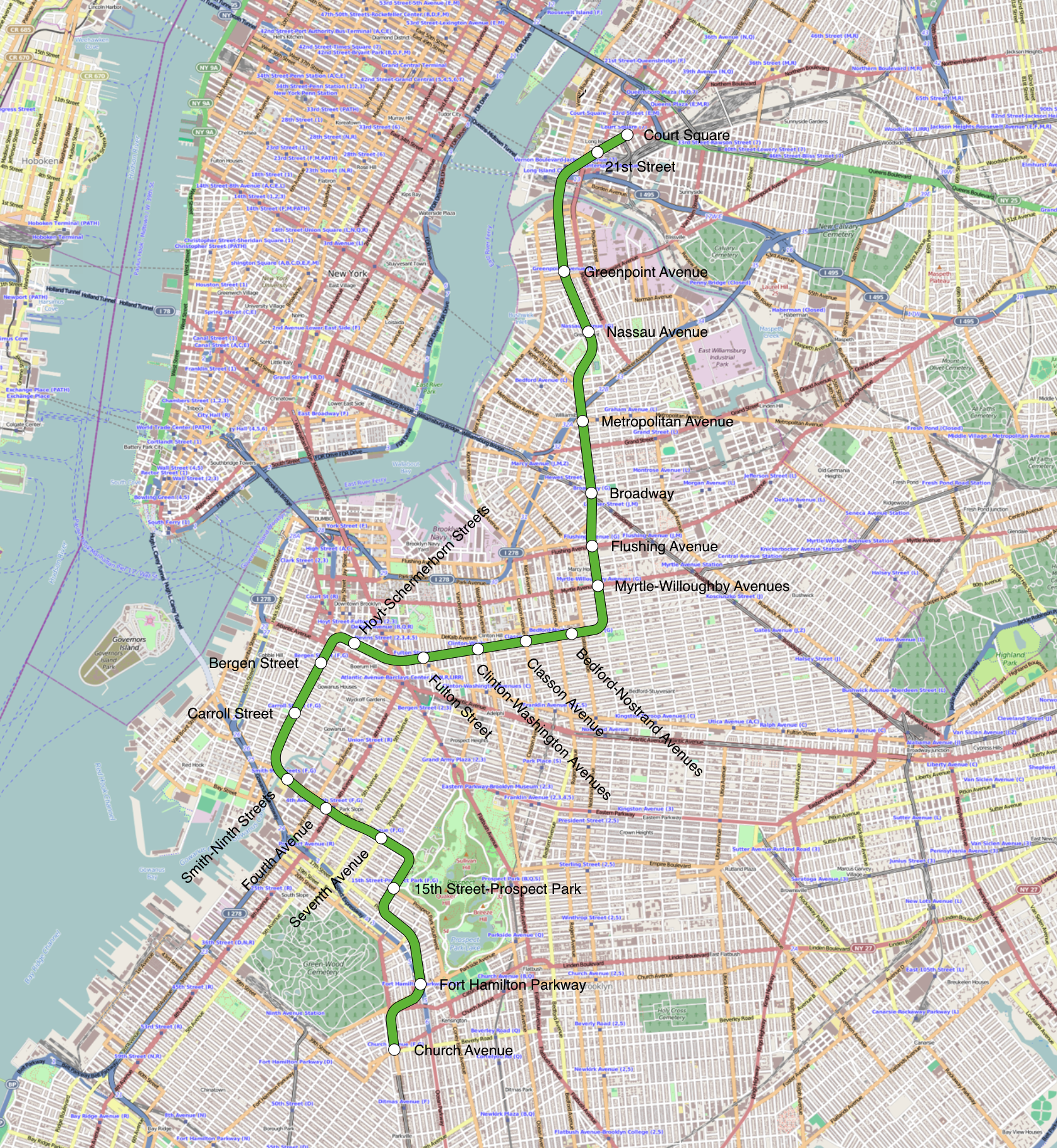
The G uses the following lines with the same service pattern at all times.
| Line | From | To | Tracks |
|---|---|---|---|
| IND Crosstown Line | Court Square | Hoyt–Schermerhorn Streets | all |
| IND Culver Line | Bergen Street | Church Avenue | local |
Stations
For a more detailed station listing, see the articles on the lines listed above.
| [[File:NYCS-bull-trans-G-Std.svg | 20px | G service]] | Stations | Subway transfers | Connections |
|---|---|---|---|---|---|
| Queens | |||||
| Crosstown Line | |||||
| (IRT Flushing Line) | |||||
| (IND Queens Boulevard Line at ) | |||||
| Brooklyn | |||||
| (BMT Canarsie Line at ) | |||||
| [[File:Aiga elevator.svg | 20px | alt=Elevator access to mezzanine only]] | (IND Fulton Street Line) | ||
| Culver Line | |||||
| (BMT Fourth Avenue Line at ) |
In popular culture
The G train is shown in the TV series Girls, as the show's main character, Hannah, lives in Greenpoint (near a stop along the G) and sometimes uses the route. The G train is also the subject of the song "G Train" by Thirdstory, featuring Pusha T.
Notes
References
References
- {{NYCS const. timetable. G
- "Mta.info – Line Colors". mta.info.
- (August 21, 2013). "Independent Subway Services Beginning in 1932".
- (July 1, 1937). "New Crosstown Subway Line Is Opened". [[Brooklyn Daily Eagle]].
- (27 June 1937). "CITY SUBWAY LINK IN KINGS IS TESTED: Crosstown Line, to Be Opened Thursday, Will Connect Queens and Brooklyn IT IS 41/2 MILES IN LENGTH Cost $35,000,000 and Ends Transit Program Except for the 6th Ave Route EXERCISES FOR OPENING Mayor, City Officials and Civic Leaders to Ride Trains and Attend Luncheon". The New York Times.
- Linder, Bernard. (July 2009). "GG/G Train Service". Electric Railroaders' Association.
- (November 26, 1940). "End of Subway Spur To Fair Now Urged: Transportation Board Asks the Right to Demolish It". The New York Times.
- (April 30, 1939). "How To Get To The Fair Grounds; By Subway". The New York Times.
- (February 18, 1939). "CITY SUBWAY RIDE TO FAIR TO COST 10¢ Board Holds Dime Charge Is Necessary to Pay for Branch Line to the Grounds".
- (April 17, 1939). "NEW SUBWAY SPUR IS READY TO OPEN: First Train to Start Four Minutes Before the Fair Officially Begins". [[The New York Times]].
- (August 18, 1968). "5 Fast Lines to Coney". New York Daily News.
- Linder, Bernard. (June 2009). "Houston Street and Smith Street Subways". Electric Railroaders' Association.
- (October 7, 2009). "Review of F Line Operations, Ridership, And Infrastructure". [[Metropolitan Transportation Authority.
- (August 1976). "Service Adjustment on BMT and IND Lines Effective 1 A.M. Monday, Aug. 30". New York City Transit Authority.
- Cosgrove, Vincent. (January 28, 1977). "Straphangers: Mini-Train Idea Comes Up Short". New York Daily News.
- "Service Adjustments on the BMT and IND Lines Effective Midnight, Saturday, August 27 New York City Transit Authority (1977)".
- Korman, Joe. "What's a K Train?".
- "Hey, What's a "K" Train? 1985 Brochure".
- "R46 Subway Car Rollsign". Metropolitan Transportation Authority.
- "R46 Subway Car Rollsign". Metropolitan Transportation Authority.
- (March 8, 2020). "A View of the Western Car Dropoff/Pickup Area. A Sign Outlining the Proposed Services Following the Opening of the Archer Avenue Subway Can Be Seen – N Trains, Which Served the Queens Boulevard Line Until 1987, Would Have Run to Jamaica Center, Along with the G, Which Served the Queens Boulevard Line Until 2010. In Addition, A Sealed Passage to the Northwestern of Union Turnpike Upper Level and Queens Boulevard Can Be Made out by the Arched Ceiling to the Right of the Subway Sign.".
- Polsky, Carol. (December 11, 1988). "New Subway Line Finally Rolling Through Queens". Newsday.
- Cox, Jeremiah. "Announcing Service Changes on the N and R Routes".
- (September 30, 1990). "Service Changes September 30, 1990". New York City Transit Authority.
- (January 4, 1991). "1991 Service Capacity Plan". New York City Transit Authority.
- Barone, Vincent. (July 9, 2019). "Limited F Express Service Coming to Brooklyn for Rush Hour".
- (March 23, 1997). "March 1997 New York City Transit Subway Map". New York City Transit.
- (September 2, 1997). "Starting August 30, There Will Be Changes in Late-Night Service Along Queens Boulevard.". New York Daily News.
- (September 1997). "September 1997 New York City Transit Subway Map". New York City Transit.
- (July 10, 2013). "Review of the G Line". [[Metropolitan Transportation Authority]].
- Chan, Joseph. (December 2001). "On Queens Boulevard, V Is For Velocity: Planning & Rehearsing 63rd Street Connector Service -- Rehearsing the Service Plan". Electric Railroaders' Association, Incorporated.
- Donohue, Pete. (June 1, 2001). "V Train Approved to Cut Crush on E, F & R". New York Daily News.
- Kershaw, Sarah. (December 17, 2001). "V Train Begins Service Today, Giving Queens Commuters Another Option". The New York Times.
- (May 2001). "Around New York's Transit System -- E/F/G/R/V Service Tested on Queens Boulevard". Electric Railroaders' Association, Incorporated.
- (June 2001). "Around New York's Transit System -- E/F/G/R/V Service Tested on Queens Queens Boulevard—Additional Information". Electric Railroaders' Association, Incorporated.
- Chan, Joseph. (December 2001). "On Queens Boulevard, V Is For Velocity: Planning & Rehearsing 63rd Street Connector Service -- Rehearsing the Service Plan". Electric Railroaders' Association, Incorporated.
- Donohue, Pete. (June 1, 2001). "V Train Approved to Cut Crush on E, F & R". New York Daily News.
- (January 2002). "63rd Street Connector In Service – New Schedules in Effect". Electric Railroaders' Association.
- (July 2003). "New BMT-IND Schedules". Electric Railroaders' Association.
- (July 2009). "MTA NYC Transit – Service Advisory". Metropolitan Transportation Authority.
- (March 18, 2008). "Service Change Details". [[Metropolitan Transportation Authority]].
- "2010 NYC Transit Service Reductions". [[Metropolitan Transportation Authority]].
- (April 13, 2010). "G Train Taking a Hit Before Service Cuts Roll Out". [[Newsday]].
- "G Line Review".
- (January 27, 2013). "Lawmakers: G Train Riders Deserve Better Service « CBS New York". Newyork.cbslocal.com.
- Fitzsimmons, Emma G.. (August 1, 2016). "Once Mocked, The G Train Is Now Cool. Kind Of.". The New York Times.
- (January 10, 2008). "The G Train From Smith-9th Streets to Long Island City". [[The New York Times]].
- Kershaw, Sarah. (December 17, 2001). "V Train Begins Service Today, Giving Queens Commuters Another Option". The New York Times.
- (December 31, 2012). "G Train Riders to Renew Push for Improved Service With New Year". [[DNAinfo.com]].
- Kershaw, Sarah. (December 2, 2000). "Proposed Line Would Lighten Subway Crush". [[The New York Times]].
- (1969). "Regional Transportation Program". [[Metropolitan Transportation Authority]].
- (May 1984). "Queens Subway Options Study, New York: Environmental Impact Statement". [[United States Department of Transportation]], [[Metropolitan Transportation Authority]], [[Urban Mass Transit Administration]].
- (June 1992). "Final Environmental Impact Statement for the 63rd Street Line Connection to the Queens Boulevard Line". [[Metropolitan Transportation Authority]], [[United States Department of Transportation]], [[Federal Transit Administration]].
- (October 28, 2015). "MTA Capital Program 2015–2019: Renew. Enhance. Expand.". [[Metropolitan Transportation Authority]].
- Kennedy, Randy. (May 25, 2001). "Panel Approves New V Train but Shortens G Line to Make Room". [[The New York Times]].
- Kadushin, Peter. (January 15, 2008). "G Train May Give Brooklyn Riders Faster Service, Queens Riders More Legwork". [[Daily News (New York).
- Ilel, Neille. (2005-07-21). "‘G’ Is For Gone—G Train Loses Nearly Half Its Weekend Stops".
- Hays, Elizabeth. (October 24, 2002). "Riders Rail at G Switch". [[Daily News (New York).
- Flegenheimer, Matt. (July 15, 2013). "M.T.A. Will End Mystery of Where on the Platform the G Train Stops". The New York Times.
- (July 10, 2013). "Review of the G Line: Appendices". [[Metropolitan Transportation Authority]].
- (January 13, 2014). "MTA's New Signs Do Little to Curb the 'G Train Sprint,' Locals Say". [[DNAinfo.com]].
- Rivoli, Dan. (June 8, 2014). "G Train Service to Become More Frequent". AM NY.
- (August 1, 2013). "MTA to Increase G Train Service – Greenpoint – DNAinfo.com New York". DNA Info.
- (May 6, 2016). "G Train To Get Full-Length Train Cars During L Shutdown, MTA Says". DNAinfo New York.
- (August 28, 2014). "Free Transfer Set to Expire Between G Train and J/M Lines in Brooklyn". New York's PIX11 / WPIX-TV.
- "Service During the L Project".
- Guse, Clayton. (June 1, 2020). "MTA ends free transfer between overlapping Brooklyn subway stations".
- [[New York City Transit Authority]]. (July 2018). "MTA New York City Transit Canarsie Tunnel Project Supplemental Environmental Assessment and Section 4(f) Review: Final Report". [[Metropolitan Transportation Authority]].
- Mooney, Jake. (July 3, 2005). "For a Maligned Line, A Minor Victory". [[The New York Times]].
- Kabak, Benjamin. (December 13, 2017). "First Look: DOT, MTA Present Initial Plans for L Train Shutdown". Second Ave. Sagas.
- (July 15, 2013). "M.T.A. Will End Mystery of Where on the Platform the G Train Stops". The New York Times.
- "'G Train Workout' Shows the 'Hike' and 'Sprint' Required of Riders".
- Pasquarelli, Adrianne. (May 12, 2013). "Trendy Greenpoint Has Grown, But G Train Service Hasn't". Crain's New York Business.
- Lavin, Talia. (May 10, 2018). "How Screwed Will Your Subway Line Be by the L Train Shutdown? F/G Edition".
- (October 22, 2018). "Transit & Bus Committee Meeting October 2018". Metropolitan Transportation Authority.
- (January 15, 2019). "Forget everything you knew about the L train shutdown".
- (January 18, 2019). "For 250,000 Daily Riders on the L Train, Transportation Purgatory".
- (February 14, 2019). "'L' Train Service May Still Be Reduced on Nights and Weekends for Repairs".
- Siff, Andrew. (February 13, 2019). "MTA Unveils Proposed Alternative Service Plan for L Train".
- Metro, amNewYork. (May 28, 2023). "Ask the MTA".
- Izzo, Christina. (May 8, 2023). "Changes are coming to the G, J and M trains this summer".
- Simko-Bednarski, Evan. (May 2, 2023). "NYC Transit boosting subway service on a dozen lines this summer".
- Brachfeld, Ben. (December 20, 2022). "MTA Set to Award $368 Million Contract to Modernize G Line Signals".
- (December 19, 2022). "Capital Program Oversight Committee Meeting December 2022". Metropolitan Transportation Authority.
- Burkett, N.J.. (August 7, 2024). "Exclusive look at MTA's G train modernization and what it means for riders in New York City".
- (June 28, 2024). "NYC commuter alert: G train service partially suspended starting Friday night in Brooklyn for MTA signal modernization project".
- Zanger, Jesse. (May 30, 2024). "G train service will be partially shut down throughout the summer. Here's what to expect.".
- Schwach, Ryan. (January 29, 2024). "Local pols want G train restored to former Queens glory".
- Heyward, Giulia. (January 24, 2024). "Politicians demand bigger G train upgrades during summer shutdown of line".
- (June 12, 2024). "MTA says full-length G trains could be possible someday thanks to line's summer shutdown".
- Medgie, Raegan. (September 3, 2024). "NYC Subway: G train back to full service after summer repairs and modernization project".
- Simko-Bednarski, Evan. (September 3, 2024). "G train reopens as MTA crews wrap up subway signaling work".
- Khalifeh, Ramsey. (May 28, 2025). "Cell service coming to G train subway tunnels, MTA says".
- Jack, Dominique. (November 12, 2025). "More underground cell service coming to MTA subway tunnels in NYC".
- Laterman, Kaya. (November 14, 2025). "G Train Riders Get a 5G Cellular Upgrade".
- Simko-Bednarski, Evan. (July 28, 2025). "G train signal upgrades will take longer amid equipment upgrades: MTA".
- Simko-Bednarski, Evan. (July 22, 2025). "G train upgraded to all new subway cars after months of running old ones".
- Khalifeh, Ramsey. (March 4, 2025). "'Open gangway' subway trains debut on Brooklyn's G line: 'It's refreshing'".
- Rahhal, Emily. (March 4, 2025). "The G train is getting new open gangway subway cars".
- {{NYCS const. serviceguide
- "New York City Subway Severe Winter Weather". MTA.
- Detrick, Ben. (January 8, 2014). "Lena Dunham Attends the HBO 'Girls' Season Premiere in Manhattan". The New York Times.
- Phull, Hardeep. (September 25, 2016). "This Band Has Hit It Big with a Funny Song About the G Train".

This article was imported from Wikipedia and is available under the Creative Commons Attribution-ShareAlike 4.0 License. Content has been adapted to SurfDoc format. Original contributors can be found on the article history page.
Ask Mako anything about G (New York City Subway service) — get instant answers, deeper analysis, and related topics.
Research with MakoFree with your Surf account
Create a free account to save articles, ask Mako questions, and organize your research.
Sign up freeThis content may have been generated or modified by AI. CloudSurf Software LLC is not responsible for the accuracy, completeness, or reliability of AI-generated content. Always verify important information from primary sources.
Report