From Surf Wiki (app.surf) — the open knowledge base
Fusiliers marins
Protection forces of the French Navy

Protection forces of the French Navy
| Field | Value |
|---|---|
| unit_name | Sailor Riflemen |
| native_name | Fusiliers marins |
| image | Insigne des Fusiliers marins.svg |
| image_size | 200px |
| caption | Insignia of Fusiliers marins |
| dates | 1856 – present |
| country | France |
| branch | |
| type | Naval Security Forces |
| role | Force protection |
| Maritime interdiction | |
| Master-at-arms | |
| Naval boarding | |
| size | ~ 1,800 |
| current_commander | Counter admiral Christophe Lucas |
| garrison | BFM "Amyot d'Inville" – Brest |
| BFM "De Morsier" – Île Longue | |
| BFM "Détroyat" – Toulon | |
| CFM "Le Goffic" – Cherbourg | |
| CFM "Bernier" – Lanvéoc | |
| CFM "Brière" – Lann-Bihoué | |
| CFM "Colmay" – France Sud | |
| CFM "Morel" – Sainte-Assise | |
| CFM "Le Sant" – Rosnay | |
| motto | On ne se rendra jamais ("We shall never surrender") |
| mascot | Neptune (mythology) |
| battles | Franco-Prussian War |
| World War I | |
| World War II | |
| First Indochina War | |
| Algerian War | |
| notable_commanders | CDR. Philippe Kieffer |
| Admiral Pierre Alexis Ronarc'h |
Maritime interdiction Master-at-arms Naval boarding BFM "De Morsier" – Île Longue BFM "Détroyat" – Toulon CFM "Le Goffic" – Cherbourg CFM "Bernier" – Lanvéoc CFM "Brière" – Lann-Bihoué CFM "Colmay" – France Sud CFM "Morel" – Sainte-Assise CFM "Le Sant" – Rosnay World War I World War II First Indochina War Algerian War Admiral Pierre Alexis Ronarc'h
The Fusiliers marins (lit. "Sailor Riflemen") are specialized sailors of the Marine nationale (French Navy). The Fusiliers marins serve primarily as the Navy’s security forces, providing protection for naval vessels and naval installations on land. Created in 1856 and with a modern strength of about 1,800 personnel, the Fusiliers marins should not be confused with the larger Troupes de Marine of the Armée de terre (French Army) who are often referred to as the French ‘marines.’
Missions
The Fusiliers marins are tasked with:
- the protection of sensitive sites of the Navy (Naval bases, French Naval Aviation, transmission stations etc.);
- reinforcement of protection duties provided by Naval forces (maintaining order on board ship and the protection of naval vessels against attack).
History of the French ''Fusiliers marins''
Creation of a specialized corps in 1856
These companies lacked specialized personnel trained for combat on land.
An Imperial decree dated 5 June 1856, created the Fusiliers marins, whose formation and training were undertaken by a battalion stationed at Lorient, Brittany. This specialized corps was put under the command of the captains and sergeants-at-arms of the various naval vessels of the French fleet, and was the direct ancestor of the modern Fusiliers.
Since that date, the Fusiliers have participated the following conflicts:
- The military colonial campaigns of the end of the 19th century,
- The expeditions in China, Cochinchina, Tonkin and Madagascar,
- The European conflicts in 1870, 1914–1918 and 1939–1945.
During the Franco-Prussian War of 1870, following the disaster of Sedan, several brigades of Fusiliers marins and naval artillerymen were engaged in combat at Bapaume and subsequently participated in the defense of Paris, notably at the Bourget and at L'Haÿ-les-Roses. This force formed part of the Government Armée versaillaise () employed in the suppression of the Paris Commune in 1871.
A detachment of Fusiliers marins defended the French Legation (diplomatic mission) in Peking during the Boxer Rebellion of 1900. Amongst their officers was enseigne de vaisseau Paul Henry and Pierre Alexis Ronarc'h, who, in 1914, would serve as Counter-Admiral and Commandant of the Brigade de Fusiliers Marins BFM attached to the 32nd Army Corps.
The Brigade de Fusiliers marins distinguished themselves at Dixmude, on the Yser, at Longewaede, Hailles and Laffaux during the early stages of World War I. Three French ships have been named after Dixmude.
The Fusiliers marins participated in the campaigns of Free France. They initially formed a battalion then the 1er Régiment de Fusiliers Marins 1e RFM at the corps of the 1st Free French Division (1er DFL) and the 1er Bataillon de Fusiliers Marins Commandos (1er BFMC) who served in 10 (Inter-Allied) Commando. The 177 Commandos Kieffer who disembarked on 6 June in Normandy, were Fusiliers Marins forming part of the Free France Forces. Other Fusiliers Marins, drawn from the former Armée de Vichy, formed the Régiment Blindé de Fusiliers-Marins (RBFM) which served efficiently as part of the 2nd Armored Division. On 30 April 1945 the Fusiliers marins played a role in the liberation of the Île d'Oléron. Disembarked at 0620 at Gatseau, an FM detachment advanced slowly through forested terrain facing stern resistance.

In 1945, the Far Eastern Marine Brigade (BMEO) was created with personnel from the RBFM and the 1er RFM, and was part of the French Far East Expeditionary Corps. The Marine Brigade formed riverine brigades (flottilles fluviales) in 1945–1946. They became the Dinassaut, which were created by General Leclerc in 1947 in order to replace the flottilles fluviales created by Jaubert, and operated in Tonkin and Cochinchina from 1947 to 1954. In 1956, with operational cadres serving in Algeria, the Demi-Brigade of Fusiliers Marins (DBFM) was created to play a leading role in securing the borders between Algeria and Morocco until 1962. This demi-brigade was under the command of Vessel Commander (CV) Ponchardier.
File:LPDF 61 10 les fusillers marins de Dixmude.jpg|Fusiliers marins decorated after the Battle of the Yser Image:Commandant Ducuing 061030-N-5555T-019.jpg|Inspections at sea are often carried out by Fusilliers marins.
Uniforms
During the 19th and early 20th centuries the Fusiliers marins wore the standard dark blue or white uniforms of the French navy. When serving on land during the Franco-Prussian War and World War I the capotes (greatcoats) of the regular French infantry were adopted, together with leggings and leather campaign equipment. The Fusiliers marins retained their naval caps as distinctions, although the conspicuous red pompon was not worn in the field in 1914.
The modern Sailor Riflemen wear a dark blue beret with their combat uniforms, pulled right with their own distinctive badge worn over the left eye or temple. Along with the Naval Commandos, they are unique among French forces in wearing the beret this way. When wearing regular dress uniforms, the sailor cap is worn by junior ratings and the peaked cap by senior petty officers and officers. File:GFM Toulon Bastille Day 2008 n2.jpeg|Parade uniform File:Groupement de fusiliers marins de Toulon-IMG 8636.jpg|Summer parade uniform File:Fusilier marin remise des fourragère le 06 juin 2009. Recadré.jpg|Standard combat clothing File:Insigne de béret des Fusilliers Marins..jpg|The Fusiliers marins beret badge File:Fusiliers marins-IMG 9129.JPG|Fusiliers marins combat uniform insigna File:Fusiliers marins-IMG 9196.JPG|Fusiliers marins parading with the sailor hat worn with camouflage uniform
Equipment
Weapons used
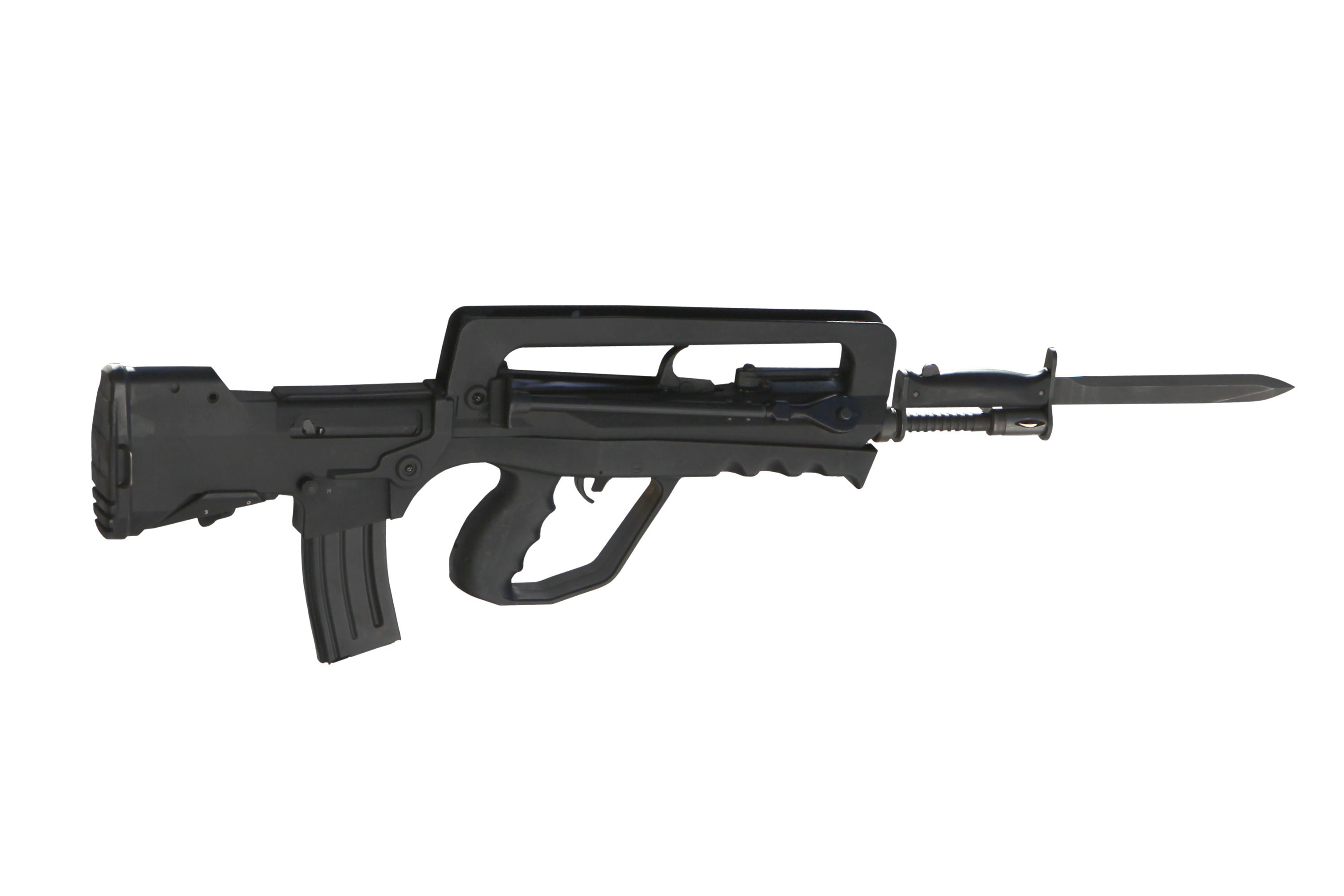
Assault rifles
- Famas G2 assault rifle
- HK416 assault rifle
Sniper rifles
- HK G3-SG1
- FR F2 sniper rifle
Shotguns
- Valtro PM5 M2 shotgun
Pistols
- HK Marine semi-automatic pistol
Non-lethal
- Alsetex "Cougar" 56mm grenade launcher (used for riot control and other such purposes)
- X26 Taser weapon
Machine guns
- Browning machine gun Cal.50 M-2HB
- NF-1 machine gun
Rocket launchers
- AT4CS Anti-tank weapon
Inflatable boats
- Zodiac Hurricane 630 IO EDOP
- Zodiac Futura Mark II
- Zodiac Futura Mark III
Ground vehicles
- Light tactical vehicle Land Rover Defender 90 Td5
- ACMAT VT 4
Notable ''Fusiliers marins''

- Admiral Philippe de Gaulle, son of General Charles de Gaulle
- Lieutenant Commander Henri de Pimodan, famous resistant, died in deportation
- Lieutenant Commander Robert Detroyat, first commandant of the legendary 1st battalion of Fusilier marins, died during operation Exporter in Syria (1941)
- Quarter-master Theo "Dudu" Dumas, a popular figure who appears in the film Taxi for Tobruk played by Lino Ventura
- Quarter-master Constant Duclos, the first French soldier to execute a parachute jump on 17 November 1915
- Lieutenant Georges Hébert, a pioneering French physical educator, theorist, and instructor
- Sub-Lieutenant Paul Henry, Fusilier marin officer, died defending the legation quarter of Peking (1900)
- Lieutenant Pierre Guillaume, a famous Fusilier officer of the French Indochina war, inspired the character of "Drummer Crab", the hero of the French film Le Crabe-tambour.
- Actor Jean Gabin made his military service in the Fusiliers marins in 1924.
- Mercenary Bob Denard served as a fusilier marin during the First Indochina War
- Actor Alain Delon served as a fusilier marin during the First Indochina War.
Notes
References
- M. Alexander, France and the Algerian War, 1954–1962: Strategy, Operations and Diplomacy, Routledge, 2002, or .
- René Bail., DBFM, demi-brigade des fusiliers marins, Rennes : Marines, 2007, or .
- Edward L Bimberg, Tricolor over the Sahara the desert battles of the Free French, 1940–1942, Westport, Conn.: Greenwood Press, 2002, or .
- Fleury Georges, Les fusiliers marins de la France libre, Grasset, 1980, or 978-2-246-09659-7.
- Major General USMC Paul J. Kennedy, Dinassaut Operations in Indochina: 1946–1954, 2001.
- Contre-Amiral Robert Kilian, Les Fusiliers marins en Indochine : La Brigade marine du corps expéditionnaire d'Extrême-Orient, septembre 1945 – mars 1947, Berger-Levrault, 1948.
- Charles W. Koburger, The French Navy in Indochina: Riverine and Coastal Forces, 1945–54, Praeger, 1991, or .
- Amiral La Roncière-Le Noury, La marine au siège de Paris, Plon, 1872.
- Georges Le Bail, La Brigade des Jean le Gouin; Histoire documentaire et anecdotique des Fusiliers marins, Paris, 1917.
- Adolphe Auguste Marie Lepotier, Les fusiliers marins, Editions France, 1962.
- L’évolution des opérations amphibies, La Revue maritime, n° 198, avril 1963, p. 424.
- Raymond Maggiar, Les fusiliers marins dans la division Leclerc, du débarquement en Normandie, en passant par Paris et Strasbourg jusqu'à Berchtesgaden, Paris : Albin Michel, 1947.
- Raymond Maggiar, Les fusiliers marins de Leclerc: une route difficile vers de Gaulle, Editions France-Empire, 1984, or .
- Jean Pinguet, Trois Etapes de la Brigade des Fusiliers Marins – La Marne, Gand, Dixmude, 1918.
- Marcel Vigneras, Rearming the French, Office of the Chief of Military History, Dept. of the Army, US, 1957.
References
- Jouineau, Andre. "Officers and Soldiers of the French Army 1914".
- "Les fusiliers marins de Cherbourg ont reçu leur nouveau fanion".
This article was imported from Wikipedia and is available under the Creative Commons Attribution-ShareAlike 4.0 License. Content has been adapted to SurfDoc format. Original contributors can be found on the article history page.
Ask Mako anything about Fusiliers marins — get instant answers, deeper analysis, and related topics.
Research with MakoFree with your Surf account
Create a free account to save articles, ask Mako questions, and organize your research.
Sign up freeThis content may have been generated or modified by AI. CloudSurf Software LLC is not responsible for the accuracy, completeness, or reliability of AI-generated content. Always verify important information from primary sources.
Report