From Surf Wiki (app.surf) — the open knowledge base
Funen
Island in Denmark

Island in Denmark
| Field | Value |
|---|---|
| name | Funen |
| image_name | Funen, Denmark by Sentinel-2.jpg |
| image_caption | A Sentinel-2 satellite image of the island |
| map_image | Location map Funen.svg |
| image_coat | File:Coat of Wends.png |
| native_name | Fyn |
| location | Kattegat |
| coordinates | |
| area_km2 | 2984.56 |
| country | Denmark |
| country_admin_divisions_title | Region |
| country_admin_divisions | South Denmark Region |
| country_admin_divisions_title_1 | Municipality |
| country_admin_divisions_1 | Several |
| country_largest_city | Odense |
| country_largest_city_population | 180,302 |
| population | 469,947 |
| population_as_of | 2020 |
| density_km2 | 150 |
Funen (, ) is the third-largest island of Denmark, after Zealand and Vendsyssel-Thy, with an area of 3099.7 km2. It is the 165th-largest island in the world. It is located in the central part of the country and has a population of 469,947 as of 2020. Funen's main city is Odense, which is connected to the sea by a rarely-used canal. The city's shipyard, Odense Steel Shipyard, has been relocated outside Odense proper.
Funen belongs administratively to the Region of Southern Denmark. From 1970 to 2006, the island formed the largest part of Funen County, which also included the islands of Langeland, Ærø, Tåsinge, and a number of smaller islands.
Funen is linked to Zealand, Denmark's largest island, by the Great Belt Bridge, which carries both trains and cars. The bridge is in reality three bridges; low road and rail bridges connect Funen to the small island of Sprogø in the middle of the Great Belt, and a long road suspension bridge (the second longest in the world at the time of opening) connects Funen the rest of the way to Zealand, paralleled by a rail tunnel.
Two bridges connect Funen to the Danish mainland, Jutland. The Old Little Belt Bridge was constructed in the 1930s, shortly before World War II, for both cars and trains. The New Little Belt Bridge, a suspension bridge, was constructed in the 1970s and is used for cars only.
The populations of the major cities and towns on the island are, as of 1 January 2024:
- Odense: 183,783
- Svendborg: 27,521
- Nyborg: 17,902
- Middelfart: 16,528
- Faaborg: 6,867
- Ringe: 6,729
- Kerteminde: 6,044
- Assens: 6,001
- Otterup: 5,270
- Bogense: 4,060
Funen was the birthplace of Hans Christian Andersen, the composer Carl Nielsen, American War of Independence combatant Christian Febiger, pop singer MØ and international footballer Christian Eriksen.
The highest natural point on Funen is Frøbjerg Bavnehøj.
Politics
Fynsk dialects
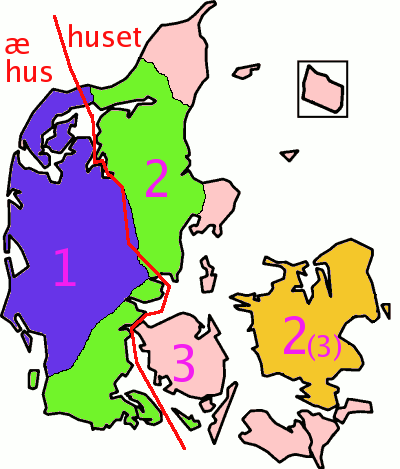
Fynsk, colloquially known as Funish by local English speakers, but in English most commonly known as the Funen dialects, refers to the variations of Danish spoken on Funen and adjacent islands.
Locally, there can be significant variations, even within short distances, for example between neighboring towns. On the island of Funen, at least four main dialects are typically distinguished: East, North, South, and West Funen dialects, as well as sub-dialects such as the Tåsinge, Ærø, and Langeland dialects. West Funen dialects may further be divided into Northwest and Southwest Funen dialects.
The Funen dialects belong to what is referred to as Insular Danish, where the dialects have retained three grammatical genders: masculine, feminine and neuter. This is in contrast to Zealand, where, like in Swedish, a reduction to two genders has taken place, and large parts of Jutland, where, like in English, no such distinction is made.
For instance in masculine, the indefinite article is "ei" and the ending in the definite form is "-i": ei mar, mar'i, ei post, posti, ei vogn, vogni, ei ovn, ovni, ei kat, katti (a man, the man, a post, the post, a wagon, the wagon, an oven, the oven, a cat, the cat). These articles and endings are usually unstressed.
Viking Age
In 2018, at Munkebo Bakke in northeastern Funen, archaeologists found an exceedingly large Viking hall that dates back to c. 825 – 1,000 CE. According to the Funen museum experts, this Viking hall is larger than any found on Funen before.
Galgedil is a Viking Age cemetery located in northern Funen. Excavations at the site revealed 54 graves containing 59 inhumations and 2 cremation burials.
References
References
- "Kommuner på landkortet - Danmarks Statistik".
- "Statistikbanken".
- (3 July 2018). "Danish Archaeologists Stunned After Discovering a New Viking Hall".
- (November 2014). "Galgedil: Isotopic studies of a Viking cemetery on the Danish island of Funen, AD 800–1050". Danish Journal of Archaeology.
This article was imported from Wikipedia and is available under the Creative Commons Attribution-ShareAlike 4.0 License. Content has been adapted to SurfDoc format. Original contributors can be found on the article history page.
Ask Mako anything about Funen — get instant answers, deeper analysis, and related topics.
Research with MakoFree with your Surf account
Create a free account to save articles, ask Mako questions, and organize your research.
Sign up freeThis content may have been generated or modified by AI. CloudSurf Software LLC is not responsible for the accuracy, completeness, or reliability of AI-generated content. Always verify important information from primary sources.
Report