From Surf Wiki (app.surf) — the open knowledge base
Fundamental pair of periods
Way of defining a lattice in the complex plane
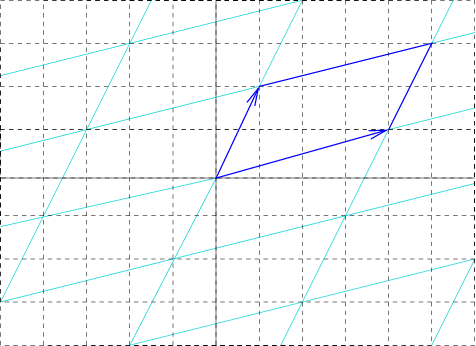
Way of defining a lattice in the complex plane
Definition
A fundamental pair of periods is a pair of complex numbers \omega_1,\omega_2 \in \Complex such that their ratio \omega_2 / \omega_1 is not real. If considered as vectors in \R^2, the two are linearly independent. The lattice generated by \omega_1 and \omega_2 is
:\Lambda = \left{ m\omega_1 + n\omega_2 \mid m,n\in\Z \right}.
This lattice is also sometimes denoted as \Lambda(\omega_1, \omega_2) to make clear that it depends on \omega_1 and \omega_2. It is also sometimes denoted by \Omega\vphantom{(} or \Omega(\omega_1, \omega_2), or simply by (\omega_1, \omega_2). The two generators \omega_1 and \omega_2 are called the lattice basis. The parallelogram with vertices (0, \omega_1, \omega_1+\omega_2, \omega_2) is called the fundamental parallelogram.
While a fundamental pair generates a lattice, a lattice does not have any unique fundamental pair; in fact, an infinite number of fundamental pairs correspond to the same lattice.
Algebraic properties
A number of properties, listed below, can be seen.
Equivalence

Two pairs of complex numbers (\omega_1, \omega_2) and (\alpha_1, \alpha_2) are called equivalent if they generate the same lattice: that is, if \Lambda(\omega_1, \omega_2) = \Lambda(\alpha_1, \alpha_2).
No interior points
The fundamental parallelogram contains no further lattice points in its interior or boundary. Conversely, any pair of lattice points with this property constitute a fundamental pair, and furthermore, they generate the same lattice.
Modular symmetry
Two pairs (\omega_1,\omega_2) and (\alpha_1,\alpha_2) are equivalent if and only if there exists a 2 × 2 matrix \begin{pmatrix} a & b \ c & d \end{pmatrix} with integer entries a, b, c, and d and determinant ad - bc = \pm 1 such that
:\begin{pmatrix} \alpha_1 \ \alpha_2 \end{pmatrix} = \begin{pmatrix} a & b \ c & d \end{pmatrix} \begin{pmatrix} \omega_1 \ \omega_2 \end{pmatrix},
that is, so that
:\begin{align} \alpha_1 = a\omega_1+b\omega_2, \[5mu] \alpha_2 = c\omega_1+d\omega_2. \end{align}
This matrix belongs to the modular group \mathrm{SL}(2,\Z). This equivalence of lattices can be thought of as underlying many of the properties of elliptic functions (especially the Weierstrass elliptic function) and modular forms.
Topological properties
The abelian group \Z^2 maps the complex plane into the fundamental parallelogram. That is, every point z \in \Complex can be written as z = p+m\omega_1+n\omega_2 for integers m,n with a point p in the fundamental parallelogram.
Since this mapping identifies opposite sides of the parallelogram as being the same, the fundamental parallelogram has the topology of a torus. Equivalently, one says that the quotient manifold \C/\Lambda is a torus.
Fundamental region

Define \tau = \omega_2/\omega_1 to be the half-period ratio. Then the lattice basis can always be chosen so that \tau lies in a special region, called the fundamental domain. Alternately, there always exists an element of the projective special linear group \operatorname{PSL}(2,\Z) that maps a lattice basis to another basis so that \tau lies in the fundamental domain.
The fundamental domain is given by the set D, which is composed of a set U plus a part of the boundary of
:U = \left{ z \in H: \left| z \right| 1, , \left| \operatorname{Re}(z) \right|
where H is the upper half-plane.
The fundamental domain D is then built by adding the boundary on the left plus half the arc on the bottom:
:D = U \cup \left{ z \in H: \left| z \right| \geq 1,, \operatorname{Re}(z) = -\tfrac{1}{2} \right} \cup \left{ z \in H: \left| z \right| = 1,, \operatorname{Re}(z) \le 0 \right}.
Three cases pertain:
- If \tau \ne i and \tau \ne e^{i\pi/3}, then there are exactly two lattice bases with the same \tau in the fundamental region: (\omega_1,\omega_2) and (-\omega_1,-\omega_2).
- If \tau=i, then four lattice bases have the same the above two (\omega_1,\omega_2), (-\omega_1,-\omega_2) and (i\omega_1,i\omega_2), (-i\omega_1,-i\omega_2).
- If \tau=e^{i\pi/3}, then there are six lattice bases with the same (\omega_1,\omega_2), (\tau \omega_1, \tau \omega_2), (\tau^2 \omega_1, \tau^2 \omega_2) and their negatives.
In the closure of the fundamental domain: \tau=i and \tau=e^{i\pi/3}.
References
- Tom M. Apostol, Modular functions and Dirichlet Series in Number Theory (1990), Springer-Verlag, New York. (See chapters 1 and 2.)
- Jurgen Jost, Compact Riemann Surfaces (2002), Springer-Verlag, New York. (See chapter 2.)
This article was imported from Wikipedia and is available under the Creative Commons Attribution-ShareAlike 4.0 License. Content has been adapted to SurfDoc format. Original contributors can be found on the article history page.
Ask Mako anything about Fundamental pair of periods — get instant answers, deeper analysis, and related topics.
Research with MakoFree with your Surf account
Create a free account to save articles, ask Mako questions, and organize your research.
Sign up freeThis content may have been generated or modified by AI. CloudSurf Software LLC is not responsible for the accuracy, completeness, or reliability of AI-generated content. Always verify important information from primary sources.
Report