From Surf Wiki (app.surf) — the open knowledge base
Fuller (groove)
Groove swaged into a knife blade
.jpg)
Groove swaged into a knife blade
A fuller is a rounded or beveled longitudinal groove or slot along the flat side of a blade (e.g., a sword, knife, or bayonet) that serves to both lighten and stiffen the blade, when considering its reduced weight.
Cutting or grinding a fuller into an existing blade will decrease its absolute stiffness due to the removal of material, but much of the strength remains due to the geometry of its shape. When the groove is forged into the blade, it achieves a similar reduction in weight with a relatively small reduction in strength without the wasted material produced by grinding. When impressed during forging, it may be made using a blacksmithing tool that is also called a fuller, a form of spring swage.
When combined with optimal distal tapers, heat treatment and blade tempering, a fullered blade can be 20% to 35% lighter than a non-fullered blade. The ridges and groove created by the fuller are comparable to an I-beam's flanges and web; this shape aims to optimize the strength and stiffness for a given quantity of material, particularly in the cutting direction.
A fuller is often used to widen a blade during smithing or forging. Fullers are sometimes inaccurately called blood grooves or blood gutters. Channelling blood is not the purpose of a fuller.
Etymology
The term "fuller" is from the Middle English fuliere, meaning 'one that fulls [pleats] cloth'. It is derived from the Latin word fullo. The first recorded use of the term in relation to metal working is 1587. The first recorded use of the term to describe a groove or channel in a blade is 1967.
Tool
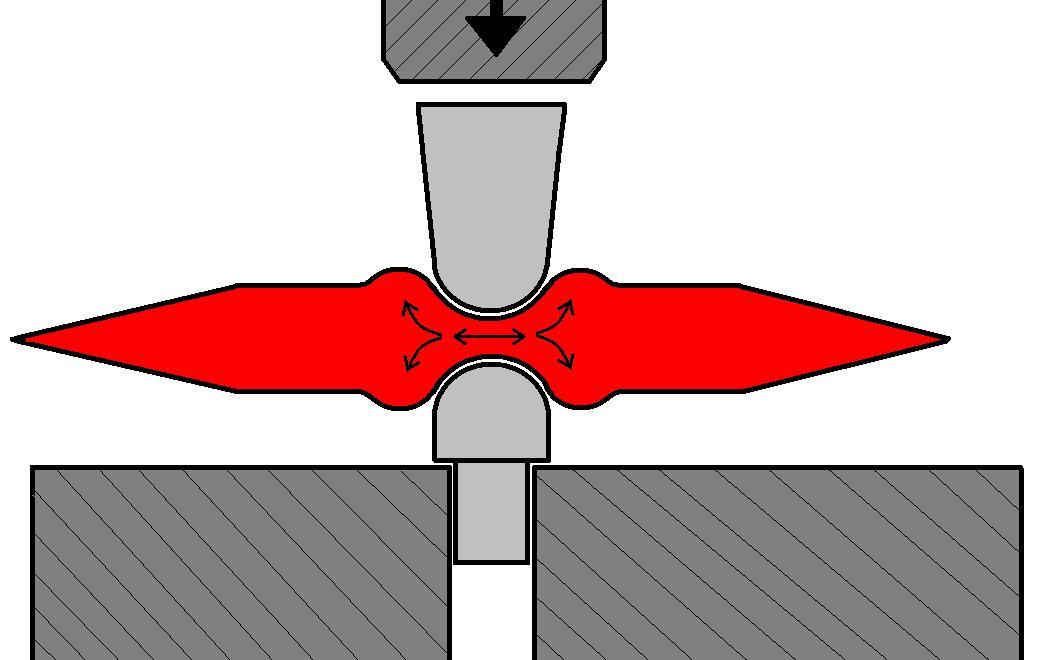
As a blacksmithing tool, a fuller is a type of swage, a tool with a cylindrical or beveled face used to imprint grooves into metal.
Fullers are typically three to six inches long. If a groove is to be applied to both sides of the steel, two fullers may be used at the same time, sandwiching the workpiece in the middle. Often, one fuller will have a peg that holds it securely in the anvil, while the other fuller will have a handle and a flat head, for striking with a hammer. A blade being fullered will generally be slowly pulled through the fullers as it is being hammered, displacing material to the side (rather than removing it) and thereby creating ridges on either side of a groove. These ridges may be hammered flat, widening the blade, or they are often shaped with other swages, increasing the strength of the blade both by creating thicker areas in its cross section and lateral ridges that resist lengthwise deflection.
In addition to being used to "draw out" steel, hammering a short block into a long bar, fullers are also used in the production of items such as hinges and latches, plow parts, and horseshoes.
Japanese blades
In Japanese swordsmithing, fullers have a rich tradition and terminology, enough that there are separate terminologies for the top (hi, usually pronounced as bi when used as the second member of a compound) and bottom (tome) ends of the feature.
- Bo-hi (棒樋, ぼうひ): A continuous straight groove of notable width, known as katana-bi on tantō. With soe-bi (添樋, そえび), a secondary narrow groove follows the inner straight length of the main one. With tsure-bi (連樋, つれひ), the secondary is similar but continues beyond the straight length. :*Futasuji-hi (二筋樋, ふたすじひ): Two parallel grooves. :*Shobu-hi (菖蒲樋, しょうぶひ): A groove shaped like the leaf of an iris plant. :*Naginata-hi (薙刀樋, なぎなたひ): A miniature bo-hi whose top is oriented opposite from the blade's, and usually accompanied by a soe-bi. Seen primarily on naginatas. :*Kuichigai-hi (喰違樋, くいちがいひ): Two thin grooves that run the top half of the blade; the bottom half is denoted by the outer groove stopping halfway while the inner one expands to fill the width. :*Koshi-bi (腰樋, こしび): A short rounded-top groove found near the bottom of a blade, near to the tang.
- Tome :*Kaki-toshi (掻通し, かきとおし): The groove runs all the way down to the end of the tang. :*Kaki-nagashi (掻流し, かきながし): The groove tapers to a pointed end halfway down the tang. :*Kaku-dome (角止め, かくどめ): The groove stops as a square end within 3 cm of the tang's upper end. :*Maru-dome (丸止め, まるどめ): Similar to the kaku, except with a rounded-end.
The kukri
_with_Sheath_MET_36.25.831a_b_001_Apr2017.jpg)
The Nepali kukri has a terminology of its own, including the "aunlo bal" (finger of strength/force/energy), a relatively deep and narrow fuller near the spine of the blade, which runs (at most) between the handle and the corner of the blade, and the "chirra", which may refer either to shallow fullers in the belly of the blade or a hollow grind of the edge, and of which two or three may be used on each side of the blade.
Gallery
File:Bayonet,knife-sword(and_scabbard)(AM_697056-1).jpg|Pattern 1907 bayonet from World War One File:Bayonet,knife-sword(and_scabbard)(AM_697055-4).jpg|Close-up view of a Pattern 1907 bayonet with hooked quillion Prussian bayonet clean.jpg|Fully fullered Imperial German S98/05 "Butcher Blade" bayonet Royal_Navy_Bayonet.jpg|Bayonet attached to the barrel of a British L85A2 rifle. Note the barrel to the left and slot in the blade to attach the wire-cutter scabbard Jungle carbine bayonet.jpg|Bayonet for the Lee–Enfield rifle No. 5 Mk I "jungle carbine" World-War-II-US-Military-Bayonets.jpg|US military bayonets; from the top down, they are the M1905, the M1, M1905E1 Bowie point bayonet (a cut down version of the M1905), and the M4 Bayonet for the M1 carbine. The top 3 blades each have fullers.
References
References
- [https://www.tastesofhistory.co.uk/post/dispelling-some-myths-blood-grooves] Taste of History, "Dispelling Some Myths: 'Blood Grooves'"
- (30 October 2013). "Distal Taper: Why Knives Have It".
- "Knife Encyclopedia; Blood Groove".
- (13 May 2017). "Fuller".
- "Fuller". Merriam-Webster.com Dictionary.
- Neumann, George. (1967). "The History of Weapons of the American Revolution". Harper.
- (1892). "English Mechanic and World of Science: With which are Incorporated "the Mechanic", "Scientific Opinion," and the "British and Foreign Mechanic."". E. J. Kibblewhite.
- "Khukuri Construction and Technology".
This article was imported from Wikipedia and is available under the Creative Commons Attribution-ShareAlike 4.0 License. Content has been adapted to SurfDoc format. Original contributors can be found on the article history page.
Ask Mako anything about Fuller (groove) — get instant answers, deeper analysis, and related topics.
Research with MakoFree with your Surf account
Create a free account to save articles, ask Mako questions, and organize your research.
Sign up freeThis content may have been generated or modified by AI. CloudSurf Software LLC is not responsible for the accuracy, completeness, or reliability of AI-generated content. Always verify important information from primary sources.
Report