From Surf Wiki (app.surf) — the open knowledge base
Full breakfast
Breakfast served in Great Britain and Ireland
.jpg)
Breakfast served in Great Britain and Ireland
A full breakfast or fry-up is a substantial cooked breakfast meal often served in Britain and Ireland. Depending on the region, it may also be referred to as a full English, full Scottish, full Welsh, full Irish or Ulster fry.
The typical ingredients are bacon, sausages, eggs, black pudding, tomatoes, mushrooms, and fried bread or toast and the meal is often served with tea. Baked beans, hash browns, and coffee (in place of tea) are common contemporary but non-traditional inclusions.
The fried breakfast became popular in Great Britain and Ireland during the Victorian era; while the term "full breakfast" does not appear, a breakfast of "fried ham and eggs" is in Isabella Beeton's Book of Household Management (1861).
History
Many of the ingredients of a full breakfast have long histories, but "large cooked breakfasts do not figure in English life and letters until the 19th century, when they appeared with dramatic suddenness".O’Connor, K. (2009). Cuisine, nationality and the making of a national meal: The English breakfast. In Nations and their histories: Constructions and representations (pp. 157-171). London: Palgrave Macmillan UK. Across the British Isles, early modern breakfasts were often breads served with jams or marmalades, or else forms of oatmeal, porridge or pottage. Eggs and bacon started to appear in breakfasts in the seventeenth century, but they were not the only meats consumed in breakfasts at that time. The rising popularity of breakfast was closely tied to the rise of tea as a popular morning drink. Of note were the lavish breakfasts of the aristocracy, which would centre on local meats and fish from their country estates.
The fried breakfast became popular in Great Britain and Ireland during the Victorian era. Cookbooks were important in the fixing of the ingredients of a full breakfast during this time, and the full breakfast appeared in the best-selling Isabella Beeton's Book of Household Management (1861). This new full breakfast was a pared-down version of the country breakfasts of the upper class, affordable to the emergent middle classes and able to be prepared and consumed in a shorter time before a day's work. The full breakfast reached its peak of popularity in Edwardian Britain, and despite a decline following the food shortages of World War II, new technologies of food storage and preparation allowed it to become a staple of the working class in the 1950s. Since then the full breakfast has declined in popularity as a daily meal, due to perceived concerns about health and its lengthy preparation compared to convenience-food breakfasts. However, the meal remains popular as an occasional, celebratory or traditional breakfast.
It is so popular in Great Britain and Ireland that many cafés and pubs offer the meal at any time of day as an "all-day breakfast". It is also popular in many Commonwealth nations. The full breakfast is among the most internationally recognised British dishes along with bangers and mash, toad in the hole, shepherd's pie, fish and chips, roast beef, Sunday roast, cream tea and the Christmas dinner.
Variants
England

_-_Café_Belchers.jpg)
There is no fixed menu or set of ingredients for a full breakfast. A common traditional English breakfast typically includes back bacon, sausages (usually pork), eggs (fried, poached or scrambled), fried or grilled tomatoes, fried mushrooms, black pudding, baked beans, and toast or fried bread. Bubble and squeak is a traditional accompaniment but is now more commonly replaced by hash browns.
A poll by YouGov in 2017 found the following to be on more than 50% of 'ideal' Full English breakfasts: bacon; sausage; beans; bread (either toast or fried); eggs (fried, scrambled or poached); hash browns; mushrooms (fried or grilled); and tomatoes (fried, grilled or tinned). Black pudding was the least popular of the traditional ingredients, chosen 35% of the time, and 26% of people included either chips or sautéed potatoes.
Buttered toast, and jam or marmalade, are often served at the end of the meal, although toast is generally available throughout the meal.
As nearly everything is fried in this meal, it is commonly known as a "fry-up". In the UK it is sometimes referred to as a "Full Monty". One theory for the origin of this term is that British Army general Bernard Montgomery, nicknamed 'Monty', was said to have started every day with a "Full English" breakfast while on campaign in North Africa during the Second World War.
Vegetarian or vegan alternatives can be made or are available in cafes and restaurants. Meat alternative sausages and bacon may often be used, with either scrambled tofu or egg substitutes. The role of the mushroom and tomatoes is generally larger in these versions.
Scotland

In Scotland there are some distinctively Scottish elements of the full breakfast which include Scottish style or Stornoway black pudding, Lorne sausage (sometimes called "square sausage" for its traditional shape), Ayrshire middle bacon and tattie scones. Occasionally haggis, white pudding, fruit pudding or oatcakes are included.
Early editions of Brewer's Dictionary of Phrase and Fable referred to a Scotch breakfast as "a substantial breakfast of sundry sorts of good things to eat and drink".
Wales
Two key ingredients that distinguish the Welsh breakfast from the other "full" variations are cockles () and laverbread ( or bara lawr) (an edible seaweed purée often mixed with oatmeal and fried). Fried laver with cockles and bacon was the traditional breakfast for mine workers in the South Wales Coalfield, but a breakfast may have also included Welsh sausages, mushrooms and eggs. Smoked fish may be served as a modern alternative to the traditional full breakfast.
Ireland
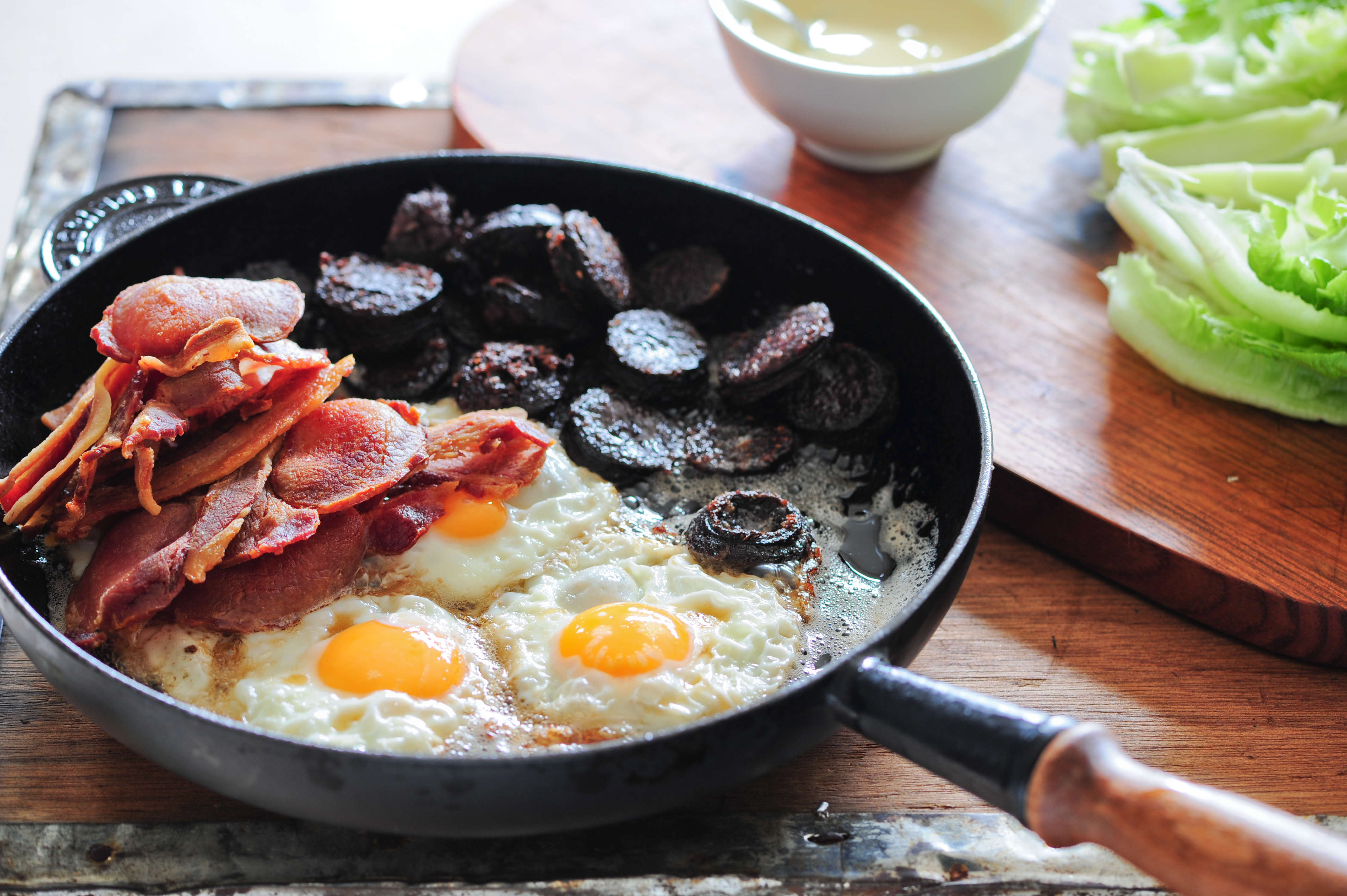
In most of Ireland, brown soda bread, fried potato farls, white pudding and boxty are often included.
The "breakfast roll", consisting of elements of the full breakfast served in a French roll, has become popular in Ireland due to the fact it can be easily eaten on the way to school or work. The breakfast roll is available from many petrol stations and corner shops throughout Ireland.
Ulster
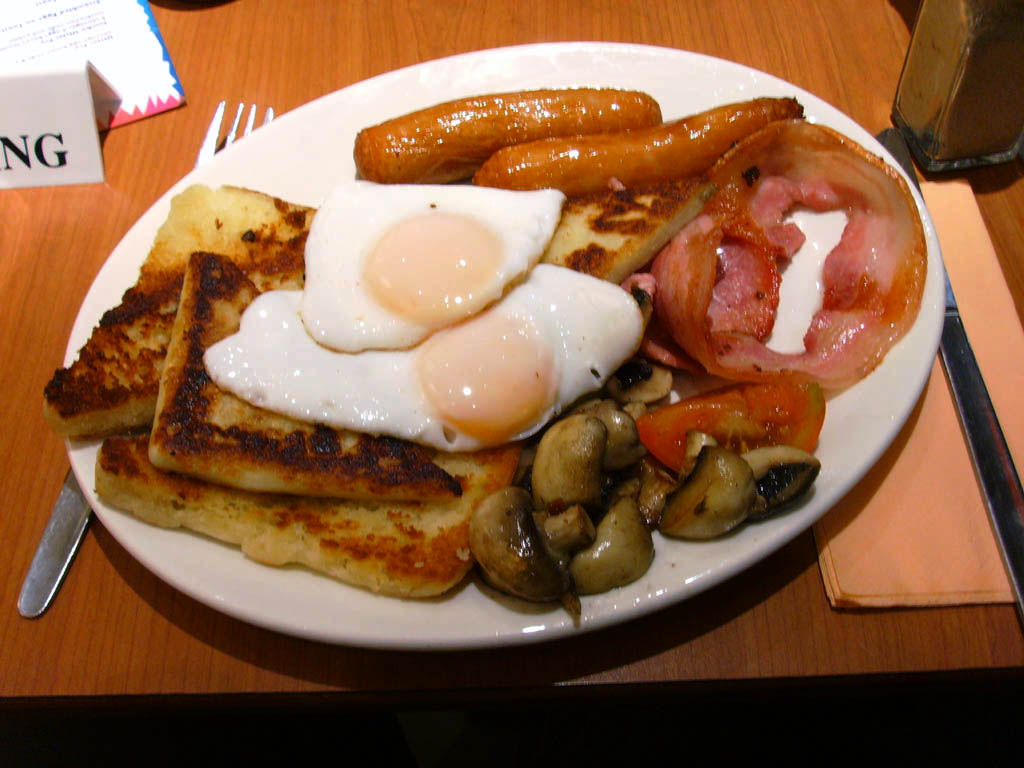
In Ulster, the northern province in Ireland, the "Ulster fry" variant is popular throughout most of the province, where it is eaten not only at breakfast time but throughout the day. Typically it will include soda bread farls and potato bread.
References
Reference bibliography
References
- "The full English". Jamieoliver.com.
- "Traditional Scottish Food". Visit Scotland.
- (25 October 2005). "So what is a 'full Welsh breakfast'?". Wales Online.
- Bell, James. (29 January 2014). "How to... Cook the perfect Ulster Fry". Belfast Telegraph.
- Anderson, H. A. (2013). Breakfast: a history. AltaMira Press.
- "The Gastronomic World of Sir Walter Scott". Electric Scotland.
- "History Of The Traditional English Breakfast".
- Spencer, Colin. (2003). "British Food: An Extraordinary Thousand Years of History". [[Columbia University Press]].
- "Full English Breakfast Recipe". BBC.
- (29 March 2018). "The Full English".
- (12 April 2024). "EXCLUSIVE: Expert declares key ingredient doesn't belong in Full English for savage reason". [[Daily Mirror]].
- (3 April 2023). "Bubble and shriek! Why war has been declared on the humble hash brown". The Guardian.
- "Breakfast". YouGov.
- (25 June 2015). "How to make the perfect full English breakfast".
- Parkinson, Judy (2011). ''Spilling the Beans on the Cats Pyjamas: Popular Expressions – What They Mean and Where We Got Them''. Michael O'Mara Books
- (2009). "What Made The Crocodile Cry?: 101 questions about the English language". Oxford University Press.
- (5 October 2018). "Wetherspoons launches full English breakfast for vegans". Vegan Food and Living.
- "Vegan fry-up". BBC Good Food.
- (15 October 2019). "Vegan Traditional Full English Breakfast". The Edgy Veg.
- Gerald, Paul. (12 July 2012). "The Full English". Contemporary Media, Inc..
- Foyster, Elizabeth and Whatley, Christopher A.. (2009). "A History of Everyday Life in Scotland, 1600 to 1800". Edinburgh University Press.
- Davidson, Alan and Jaine, Tom. (2006). "The Oxford companion to food". Oxford University Press.
- (18 October 2007). "Maw Broon's Cookbook". Waverley Books.
- Brewer, E. Cobham. "Brewer's Dictionary of Phrase & Fable". Harper & Brothers.
- "This is how to cook the perfect full Welsh breakfast". Wales Online.
- Welsh Government. "Wales.com – Food". [[Government of Wales]].
- (13 July 2021). "Welsh caviar: should we all start eating laver?".
- Gerald, Paul. (12 July 2012). "The Full English". Contemporary Media, Inc..
- McDonald, Brian. (12 May 2008). "Top breakfast baguette rolls into Irish history". Irish Independent.
- [https://www.bbc.co.uk/guides/zgk7mp3 "Is the Ulster fry the best cooked breakfast in the UK?"]. BBC. Retrieved 29 October 2018 {{Webarchive. link. (24 June 2019)
This article was imported from Wikipedia and is available under the Creative Commons Attribution-ShareAlike 4.0 License. Content has been adapted to SurfDoc format. Original contributors can be found on the article history page.
Ask Mako anything about Full breakfast — get instant answers, deeper analysis, and related topics.
Research with MakoFree with your Surf account
Create a free account to save articles, ask Mako questions, and organize your research.
Sign up freeThis content may have been generated or modified by AI. CloudSurf Software LLC is not responsible for the accuracy, completeness, or reliability of AI-generated content. Always verify important information from primary sources.
Report