From Surf Wiki (app.surf) — the open knowledge base
Fugazi
American post-hardcore band
American post-hardcore band
| Field | Value | |
|---|---|---|
| name | Fugazi | |
| background | group_or_band | |
| image | Fugazi.jpg | |
| landscape | yes | |
| caption | Fugazi performing at Emo's in 2002; left to right: Ian MacKaye, Brendan Canty and Guy Picciotto (not pictured: Joe Lally) | |
| origin | Washington, D.C., U.S. | |
| genre | {{flatlist | |
| works | Discography | |
| years_active | 1986–2003 | |
| label | Dischord | |
| spinoffs | {{flatlist | |
| website | ||
| spinoff_of | {{flatlist | |
| past_members | Colin Sears |
- Post-hardcore
- art punk
- alternative rock
- punk rock
- experimental rock
- The Evens
- Coriky
- Deathfix
- The Messthetics
- The Teen Idles
- Minor Threat
- Rites of Spring
- Embrace
- Egg Hunt
- Dag Nasty
- Ian MacKaye
- Joe Lally
- Brendan Canty
- Guy Picciotto
Fugazi (; ) is an American post-hardcore band formed in Washington, D.C., in 1986. The band consists of guitarists and vocalists Ian MacKaye and Guy Picciotto, bassist Joe Lally, and drummer Brendan Canty. They were noted for their style-transcending music, DIY ethical stance, manner of business practice, and contempt for the music industry.
Fugazi performed numerous worldwide tours and produced six studio albums, a film, and a comprehensive live series, gaining the band critical acclaim and success around the world. Highly influential on punk and alternative music, the band has been on an indefinite hiatus since 2003.
History
Formation and early years (1986–1989)
After the hardcore punk group Minor Threat dissolved, MacKaye (vocals and guitar) was active with a few short-lived groups, most notably Embrace. MacKaye realized that he wanted to prioritize making music over being in a band, "because sometimes bands get in the way of music, because you’re so focussed [sic] on making a band that you forget that it should be about music first." MacKaye had gotten to know Joe Lally, who was working as a roadie for the band Beefeater. After learning Lally played bass, MacKaye asked him if he would be interested in playing together. They soon recruited Dag Nasty drummer Colin Sears, and the trio began practicing around August or September of 1986. MacKaye's original concept for Fugazi was akin to "MC5 plus reggae".
In January 1987, Sears returned to Dag Nasty and was replaced by Brendan Canty, formerly of Rites of Spring. One day, Picciotto, Canty's Rites of Spring bandmate, dropped by during a practice session to see how his friend was getting along; he later admitted he secretly harbored the idea of joining the group. Picciotto was disappointed that there seemed to be no place for him.
After some uncertainty from Canty about what he wanted to do with his future, the trio regrouped and booked their first show at the Wilson Center in early September 1987. The group still needed a name, so MacKaye chose the word "fugazi" from Mark Baker's Nam, a compilation of stories of Vietnam War veterans, in there being a slang acronym for "Fucked Up, Got Ambushed, Zipped In [a body bag]".
The band began inviting Picciotto to practices. Inspired by the use of a foil in hip-hop, Picciotto sang backup vocals. After his band Happy Go Licky broke up, he became more involved with Fugazi. MacKaye eventually asked Picciotto to become a full member, and he accepted.
''Fugazi EP'' & ''Margin Walker'' – ''13 Songs'' (1988–1989)
Fugazi embarked on its first tour in January 1988. In June 1988 the band recorded its debut EP Fugazi with producer Ted Niceley and producer/engineer Don Zientara (who became a longtime collaborator), and shortly afterward embarked on an arduous tour of Europe.
At the tour's conclusion in December, the band recorded songs for its intended debut album, but the band was exhausted from touring and found the resulting sessions were unsatisfactory. The track list was cut down to an EP and released as Margin Walker the next year. Both EPs were eventually combined into the 13 Songs, released in late 1989. Upon the band's return from Europe, Picciotto, unsatisfied with singing, began playing guitar too.
''Repeater'' and ''Steady Diet of Nothing'' (1990–1992)
With Picciotto playing guitar full-time, Fugazi made the transition into jamming and writing new material as a band as opposed to performing songs composed solely by MacKaye. In addition to working on new material, songs they had been performing live were refined, such as "Merchandise" and "Turnover", for inclusion on their first official full-length studio album.
Released on April 19, 1990, through Dischord Records, Repeater did not initially reach the Billboard 200 charts or become a commercial success. But the band spent most of 1990 and 1991 touring heavily behind Repeater, performing 250 concerts between March 1990 and June 1991, routinely selling out 1,000-plus capacity venues throughout the world. By summer 1991, the album sold more than 300,000 copies, a large number for a label that relied on minimal promotion. Major labels began to court Fugazi, but the band stayed with Dischord. It was critically well received and featured an alternative rock sound that predated significant releases such as Nirvana's Nevermind and Pearl Jam's Ten, which unexpectedly broke the genre into the mainstream.
For Fugazi's second studio album, Steady Diet of Nothing, released in July 1991, the band again asked Ted Niceley to produce. Niceley had become a chef and had to reluctantly turn down the job, so the band decided to produce the record themselves. After the success of Repeater and its subsequent world tour, Steady Diet was highly anticipated. Six months before its release Dischord had more than 160,000 pre-orders for the album.
''In on the Kill Taker'' and ''Red Medicine'' (1993–1996)
Fugazi recorded its third album, In on the Kill Taker, in the fall of 1992 with Steve Albini in Chicago, but the results were deemed unsatisfactory and the band rerecorded the album with Niceley and Don Zientara. With the breakthrough of alternative rock in the early 1990s, In on the Kill Taker; released on June 30, 1993, became the group's first record to enter the Billboard album charts, receiving critical praise from Spin, Time and Rolling Stone, and becoming the band's breakthrough album.
By the In on the Kill Taker tour, the group began to sell out large auditoriums and arenas and receive more lucrative major label offers. During its sold-out 3-night stint at New York City's Roseland Ballroom in September 1993, music mogul and Atlantic Records president Ahmet Ertegun met with the band backstage in an attempt to sign them. Ertegun offered the band "anything you want", their own subsidiary label and more than $10 million just to sign with Atlantic. Fugazi declined. The organizers of Lollapalooza also attempted to recruit the band for a headlining slot on its 1993 tour, which the band considered but ultimately turned down.
Fugazi began writing the material for Red Medicine in late 1994, after touring in support of In on the Kill Taker. The band worked with Zientara but chose not to work with Niceley again. Fugazi opted to retreat from the in-your-face production values of In on the Kill Taker and instead worked to create an ambient sound that displayed greater range and depth. To achieve this, the band handled production duties itself, and in doing so, became more confident with in-studio experimentation. Red Medicine has been seen as an introduction to the art rock aesthetic that would continue in the band's next two studio albums. The band began an extensive worldwide tour in support of the album, playing 172 shows between March 1995 and November 1996.
''End Hits'' and ''The Argument'' (1997–2002)
After the grueling worldwide tour the band completed in support of Red Medicine, Fugazi took an extended break and also began writing material for a follow-up release. By March 1997 Fugazi had once again returned to Inner Ear Studios with Zientara to begin recording what became End Hits, with the intention of taking a more relaxed approach to recording and a longer amount of time to experiment with different songs and techniques in the studio. The group ultimately spent seven months recording the album. Due to the title, rumors began circulating at the time that it was to be their last release.
Released on April 28, 1998, the album was commercially successful and marked one of the band's highest debuts yet on Billboards charts. Critical reaction to End Hits was mixed. Many critics praised its heavier tracks, while others questioned the inclusion of the group's longer, more experimental songs. Fugazi elected to bring in their former roadie Jerry Busher as a second drummer in order to replicate the drum overdub-heavy sound of the album live.
Fugazi began work on The Argument in 1999. This process saw the group taking more time than usual to write and demo material. Each member brought his own riffs and ideas to the band, jammed on them, and then began piecing the songs together into various configurations before deciding on the final versions. The album's recording sessions took place between January and April 2001 at Inner Ear Studios and Dischord House in Arlington, Virginia. The band once again worked with Zientara. During the recording process a considerable amount of time was spent finalizing each song's production, in particular the album's drum tracks, in an effort to give it a unique feel. Canty told Modern Drummer, "We recorded them all very differently in terms of the drum sounds. We used a lot of different drum kits, cymbals, snares, and ways of miking."
The Argument was released by Dischord Records on October 16, 2001, along with the EP Furniture. Arion Berger of Rolling Stone called the album "bracing" and "intellectual" and Chris True of AllMusic "spine-tingling and ear-shattering all at once", writing, "the band has raised the bar for themselves and others once again." He also wrote that the album had "touched on strange new territory". By this point Fugazi was on tour less, due in large part to other professional and personal commitments. It performed only 32 shows in 2001 and 2002. Even though the number of performances dwindled, during Fugazi's last tour they performed in front of over roughly 70,000 people.
Indefinite hiatus and reunion rumours (2003–present)
Fugazi went on what it has called an "indefinite hiatus" after the conclusion of its 2002 UK tour following three sold-out nights at the London Forum on November 2–4, 2002. The hiatus was brought on by the band members' insistence on spending more time with their families and pursuing other professional projects.
Since Fugazi went on hiatus in 2003, rumors began circulating about a reunion, with some insinuating that the band may get back together to headline the Coachella Festival. While the band has confirmed that it has been offered large sums of money to reunite and headline festivals, such as Coachella, it has so far declined the offers.
In March 2011, MacKaye reiterated that Fugazi has "been offered insane amounts of money to play reunions, but it's not going to be money that brings us back together, we would only play music together if we wanted to play music together and time allowed it".
In November 2011, when asked by The A.V. Club about the possibility of a reunion and a follow up to 2001's The Argument, Lally said, "The Argument was a great record that we should try and top. It'll take some time to come together and everything. To do that, we'd have to, the way the four of us are, we would take quite some time, I think, reassociating ourselves musically, and then just letting it come about naturally, because it would have to be a natural thing. So we'll just see."
In August 2014, Dischord announced the official release of First Demo, an album featuring 11 demo songs recorded in January 1988. The announcement included a preview of the demo for the Fugazi track "Merchandise". The album was released on November 18, 2014.
MacKaye insisted in a 2017 interview that Fugazi is not, in fact, broken up. While he admits any future public performance will have to contend with various confounding factors, the members have occasionally played music together, privately, since their 2003 hiatus. On March 21, 2018, in an interview on Vish Khanna's Kreative Kontrol podcast, Lally confirmed the band's irregular practice of casual get-togethers. He stated: "Yeah, when we're all in D.C., we totally hang out together and talk and spend a lot of time laughing. We have a great time together, go out to dinner, and we'll play some music together." Lally also stated that additional public performances or tours were unlikely: "There's so much to try to look after to allow Fugazi to do anything, that we do not have the time to give it the respect that it deserves. So unfortunately, it is where it is."
On February 13, 2019, Louder Sound asked Lally and Canty about the possibility of Fugazi returning, Lally responded "You never want to say never about anything, because how can you say that about the future? But there does seem to be a lack of time to allow it to happen, because the four of us would have to spend a lot of time together to figure out, 'Should we play old songs?' 'Who are we now?' 'What is it now?' We are not the kind of band to get together and just rehearse two hours of old songs to go out and play it, rake in the dough and come home." Canty added, "If we got back together it would have to be from the spirit of creativity. It would be different if we got back together."
Live performances
Main article: Fugazi Live Series
Between 1987 and 2003, Fugazi played over 1,000 concerts in all 50 US states and all over the world. Over 800 of these shows were recorded by the band's sound engineers. Beginning in 2004 and continuing into 2005, Fugazi launched a 30 CD Live Series that featured concerts from various points in their career, which were made available for sale via Dischord Records. Continuing with the live series concept and after several years of development on December 1, 2011, Fugazi launched a comprehensive Live Series website through Dischord Records that features 750 recordings available for download at the suggested price of $5 each or a "pay what you want" sliding scale option for each download between $1–100 with the goal of eventually making all 800 of the shows that have been recorded available for purchase. For $500 fans can also purchase an "All Access" privilege which will include access to any future concerts and downloads added to the site.
While each concert was professionally mastered, the recordings capture everything that happened onstage and for preservation's sake the band chose not to edit anything out, singer/guitarist Guy Picciotto explained to the New York Times, "We liked this idea of, 'Let's just let it be everything,' ... There doesn't have to be the idea that this is the great, golden document. It's all there, and it's not cleaned up. You get what you get." The sound quality also varies as the earliest recordings were made to cassettes, then eventually digital formats such as Digital Audio Tape, CD-R, and ultimately hard-drives were used. Each concert page also includes flyers, photographs and ticket stubs. As a career-spanning archival project, the Fugazi Live Series has few equals, putting the band in the company of acts like the Grateful Dead, Phish and Pearl Jam, three notable examples of other artists with such a large volume of concerts available for purchase.
For the first time, in May 2025, Fugazi began to release complete live shows on streaming services and Bandcamp. On May 1st, the bands first show (September 3, 1987 at Wilson Center in Washington, DC) and the band's to-date final performance (November 4, 2002 at The Forum in London, UK) were posted, and it was announced that select shows will be released every month for the rest of 2025.
Musical style and influences
Fugazi's style has been described as post-hardcore, art punk, alternative rock, experimental rock, punk rock and hardcore punk. According to Alternative Press, Fugazi is not an emo band, despite being closely "linked to its story." Fugazi's music was an intentional departure from that of the hardcore punk bands the members had played in previously. Fugazi combined punk with funk and reggae beats, irregular stop-start song structures, and heavy riffs inspired by popular rock bands such as Led Zeppelin and Queen, bands that the punk community of the time largely disdained. When questioned by Guitar World in 2002 about the band's influences, singer/guitarist Ian MacKaye responded, "Too many to mention. And not just from the last few years. Some of them predate us by decades, and most of them wouldn't be punk. I would hope any musician would be inspired by a lot of different kinds of music." Fugazi's influences include Bad Brains, the Faith, Void, Minutemen, Black Flag, Sonic Youth, the Ex, the Beatles, and the Obsessed.
Picciotto became the group's second guitarist when he realized MacKaye's typically chunky, low-end riffs and Lally's dub-influenced basslines allowed him to focus on high-pitched parts. In both vocal and guitar roles, Picciotto assumed the role of a foil to MacKaye; employing a Rickenbacker guitar for its scratchy single-coil sound in order to "cut through MacKaye's chunky chording like a laser beam." Their inventive, interlocking guitarwork often defies the traditional notion of "lead" and "rhythm" guitars and features unusual and dissonant chords and progressions filtered through a hardcore punk lens. Later, Fugazi more fully integrated elements of punk rock, hardcore, soul and noise with an inventively syncopated rhythm section.
Picciotto's assumption of guitar duties allowed all four members of the band to jam together and write songs that way, where previously they had played songs largely as MacKaye had arranged them. When writing songs, the band often rearranges them with different structures and different singers. Spin has listed MacKaye and Picciotto together at No. 86 on their list of the 100 Greatest Guitarists of All Time for their unique and interlocking guitar style in Fugazi.
Generally, MacKaye's lyrics and singing are more direct and anthemic (MacKaye admits that he loves audience sing-alongs and writes songs with shout-able slogans), while Picciotto usually favors a more abstract, oblique approach. Lally has contributed vocals to a few songs as well, in which he sings in a more relaxed, quiet style as opposed to MacKaye and Picciotto, whose lyrics and vocals often feature strong emotional intensity.
Each of Fugazi's albums since Repeater have featured an instrumental. By the time of 1995's Red Medicine bassist Joe Lally also began contributing vocals to the band and the group was implementing many of their broader influences into the overall sound. Critics Ian McCaleb and Ira Robbins declared that Fugazi's music combined an "unprecedented dynamic range ... and previously unimagined elements" such as "clattering musique concrète ... pian] and sound effects ... murky dub and lancing clarinet" and "loose-limbed jammy funk ... into an ambitious, experimental format that raises more stylistic questions than it answers."
Ideology and views

Fugazi is well known for their members' refusal to sign to or work with corporate record labels, instead choosing to release their albums through Dischord. Despite receiving offers from major labels like Atlantic Records, the band were adamant about retaining their independence. MacKaye has stated that "no amount of money is worth losing control of our music."
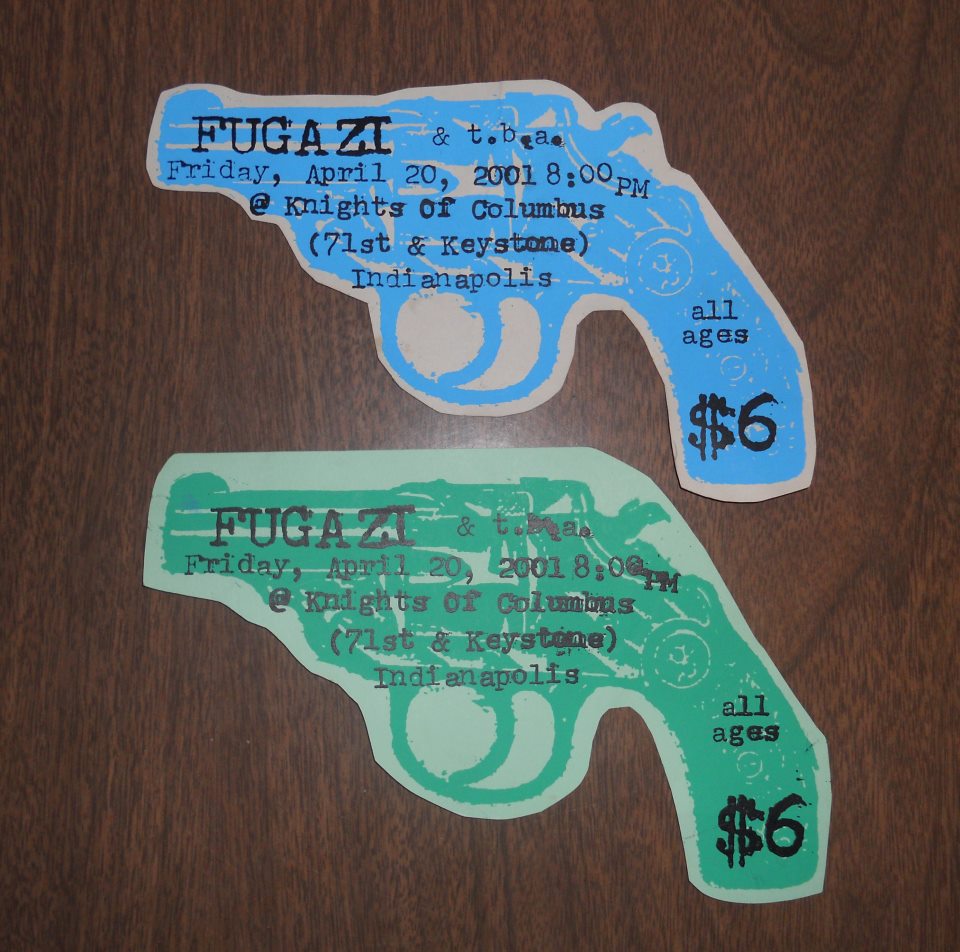
On their first tours, Fugazi worked out its DIY ethic by trial and error. Their decisions were partly motivated by pragmatic considerations that were essentially a punk rock version of simple living: for example, selling merchandise on tour would require a full-time merchandise salesperson who would require lodging, food, and other costs, so Fugazi decided to simplify their touring by not selling merchandise. The band was also motivated by moral or ethical considerations: for example, Fugazi's members regarded pricey admission for rock concerts as tantamount to price gouging a performer's most loyal fans. Fugazi's inexpensive target goal of $5 admission was spawned during a conversation on an early tour when the band's members were debating the lowest profitable admission price. Everett True has said that MacKaye and Fugazi "had a mind-set that believed that any involvement with the system was corrupting and that you should create completely alternative structures outside".
In later years, Fugazi was unable to negotiate ticket prices below about $10–$15 total. However, it never saw the $5 rule as inviolable, instead aiming to charge a price that was both affordable and profitable. Unlike some similar, independent rock contemporaries, Fugazi's performances and tours were always profitable, due to the group's popularity, low business overhead costs, and MacKaye's keen sense of audience response in given regions. Many times the band performed sold-out shows multiple consecutive nights at the same venue.
Fugazi's early tours earned it a strong word of mouth reputation, both for its powerful performances, and also for the band's eagerness to play in unusual venues. The group sought out alternatives to traditional rock clubs partly to relieve the boredom of touring, but also hoping to show fans that there are other options to traditional ways of doing things. As Picciotto said, "You find the Elks Lodge, you find the guy who's got a space in the back of his pizzeria, you find the guy who has a gallery. Kids will do that stuff because they want to make stuff happen."
The group, and MacKaye in particular, also made a point of discouraging violent, unwanted slam dancing and fist fights. This was not only due to them seeing violence as a relic of the early 1980s hardcore punk era, but also due to financial concerns; moshing often denoted the installation of costly barricades to prevent injuries in the crowd. MacKaye recounted in an interview: "We played one show to 4000 people one night and the barricade made more money than we did: the barricade cost more than we made. And that’s not even factoring in the 30 security staff you have to hire to man that barricade."
Michael Azerrad quotes Mackaye, "See, [slam dancers] have one form of communication: violence ... So to disorient them, you don't give them violence. I'd say, 'Excuse me, sir ...'- I mean, it freaks them out – 'Excuse me, sir, would you please cut that crap out?'" Azerrad writes: "[MacKaye's] admonitions seemed preachy to some. And by and large, people would obey – it wasn't cool to disrespect Ian MacKaye." Occasionally, Fugazi would have an unrepentant slam-dancer escorted from the concert, and give them an envelope containing a $5 refund (the group kept a stock of such envelopes in their tour van for these occasions).
During the summer of 1990, MacKaye formed the corporation Lunar Atrocities Ltd. in order to shield his own and his bandmates' personal assets from the threat of lawsuits. As MacKaye's financial advisor, Seth Martin, explained to The Washington Post in a 1993 interview: "protection from liability is the main reason to form a corporation, and for these guys it makes sense. If someone got hurt stage-diving and decided to sue, it would be harder to go after their personal assets."
Influence and legacy
Fugazi's music and ethics have been immensely influential on punk and alternative music throughout the years, and has earned the band praise from many notable musicians as well. Sublime "thanked" the band by namedropping them on their debut album. At the Drive-In called the band an influence on their own music, as did other notable post-hardcore bands such as Refused, Quicksand, Thrice, Thursday, Cursive, Cap'n Jazz, Braid, and Mclusky. Former At the Drive-In guitarist Jim Ward has also noted Fugazi as a major influence of his during the recording process for his band Sparta's first album Wiretap Scars. John Frusciante named them an influence on Red Hot Chili Peppers' Californication and on his solo album, The Will to Death. Nirvana cited the band as an influence, and Kurt Cobain - who was a friend of the members of Fugazi - was even spotted in a popular photo of the band with the word "Fugazi" misspelt on both shoes. Eddie Vedder of Pearl Jam remarked that witnessing the band live "was a life-changing experience" for him. Jimmy Eat World have also named Fugazi as an influence, and frontman Jim Adkins has noted that both MacKaye and Picciotto's playing styles made him "more open to the ideas behind guitar playing, as opposed to the technical difficulty of it.". Reportedly a huge fan, Elliott Smith was "super-obsessed" with the band and later admitted that his former band Heatmiser was "trying to be Fugazi". The Smiths guitarist Johnny Marr offered the band praise, and called MacKaye one of his favorite guitarists.
Towards the end of his life, Joe Strummer, lead vocalist of the Clash, recognized Fugazi as the band that best exemplified "the spirit of punk" in a 2000 Rolling Stone interview, besides offering them accolades on several other occasions. In 1993, Joey Ramone of the Ramones picked the band as a favorite, labeling them a "great social conscience". Graham Coxon of Blur recalls his introduction to bands such as Fugazi (and the Picciotto-led Rites of Spring) in the mid 1990s as being one of the most musically significant moments of his life: "They used the guitar in an incredible way; making quite restrained noisy music, which I'd never heard English bands doing." Daniel Kessler of Interpol has also cited the band as an influence on his guitar-playing, as has Colin Frangicetto of Circa Survive, and Gareth Liddiard of the Drones and Tropical Fuck Storm. Tim Commerford of Rage Against the Machine found the band's music on Repeater revelatory, as did Steve Holmes of American Football. Tom DeLonge of Blink-182 called the band a big influence as they "stood for something and never varied from that path." "Fugazi was probably my biggest influence as far as wanting to start a band", Modest Mouse founding member Jeremiah Green admitted, "It was really great music and just sounded like something I could possibly do." When asked to name some of his favorite records or discographies, Brian Cook of Botch (and later Russian Circles) included the band's entire discography amongst others. Gogol Bordello's Eugene Hutz called the band's debut EP "probably the best I ever heard. It's so together and everything sits in the right place." Jeff Rosenstock not only called the band a big influence on his music, but also on his strict DIY business practices & ethics. Sunny Day Real Estate cited the band as an influence for similar reasons.
The band has been cited as an influence by Tool bassist Justin Chancellor, Jack White,
In addition, the first concert White ever attended was a Fugazi concert, see: Sepultura vocalist Derrick Green, Carrie Brownstein of Sleater-Kinney, Chester Bennington of Linkin Park, Dashboard Confessional, the Kills, Face to Face, the Futureheads, the Get Up Kids, ...And You Will Know Us by the Trail of Dead, Dillinger Escape Plan guitarist Ben Weinman, OK Go frontman Damian Kulash, Rise Against frontman Tim McIlrath, Daniel Johns of Silverchair, Biffy Clyro frontman Simon Neil, Justin Pierre of Motion City Soundtrack, Prong frontman Tommy Victor, Efrim Menuck of Godspeed You! Black Emperor, Dylan Baldi of Cloud Nothings, Arcade Fire lead singer Win Butler, Paul Dempsey of Something for Kate, Travis Morrison of the Dismemberment Plan, Brand New guitarist Jesse Lacey, Converge singer Jacob Bannon, Coalesce, Ben Lee, Patterson Hood of Drive-By Truckers, Pretty Girls Make Graves guitarist J. Clark, Explosions in the Sky, Kele Okereke of Bloc Party, Trevor de Brauw of Pelican, Matty Healy of the 1975, Mary Timony, Hayley Williams of Paramore, Justin Vernon of Bon Iver, and Lorde.
Members
Final lineup
- Ian MacKaye – vocals, guitar, piano (1986–2003)
- Joe Lally – bass (1986–2003), vocals (1995–2003)
- Brendan Canty – drums, piano (1987–2003)
- Guy Picciotto – vocals (1988–2003), guitar (1989–2003)
Former members
- Colin Sears – drums (1986)
Touring musicians
- Jerry Busher – additional drums, percussion, trumpet (1998–2002)
Timeline
ImageSize = width:900 height:auto barincrement:25 PlotArea = left:100 bottom:60 top:10 right:50 Alignbars = justify DateFormat = mm/dd/yyyy Period = from:09/01/1986 till:12/31/2002 TimeAxis = orientation:horizontal format:yyyy
Colors = id:vox value:red legend:Vocals id:guitar value:green legend:Guitar id:bass value:blue legend:Bass id:drums value:orange legend:Drums id:piano value:purple legend:Piano id:album value:black legend:Studio_album id:soundtrack value:gray(0.4) legend:Soundtrack id:ep value:gray(0.7) legend:EP id:bars value:gray(0.95)
BackgroundColors = bars:bars
Legend = orientation:horizontal position:bottom
ScaleMajor = increment:2 start:1987 ScaleMinor = increment:1 start:1987
LineData = at:04/19/1990 color:album layer:back at:07/01/1991 color:album layer:back at:06/30/1993 color:album layer:back at:06/12/1995 color:album layer:back at:04/01/1998 color:album layer:back at:10/16/2001 color:album layer:back at:03/23/1999 color:soundtrack layer:back at:11/01/1988 color:ep layer:back at:07/01/1989 color:ep layer:back at:09/08/2001 color:ep layer:back
BarData = bar:MacKaye text:"Ian MacKaye" bar:Picciotto text:"Guy Picciotto" bar:Lally text:"Joe Lally" bar:Sears text:"Colin Sears" bar:Canty text:"Brendan Canty"
PlotData= width:11 textcolor:black align:left anchor:from shift:(10,-4) bar:MacKaye from:09/01/1986 till:end color:vox bar:MacKaye from:09/01/1986 till:end color:guitar width:3 bar:MacKaye from:07/01/1989 till:10/01/1989 color:piano width:7 bar:MacKaye from:01/01/2001 till:04/01/2001 color:piano width:7 bar:Picciotto from:06/26/1988 till:end color:vox bar:Picciotto from:07/01/1989 till:end color:guitar width:3 bar:Lally from:09/01/1986 till:end color:bass bar:Lally from:01/01/1995 till:end color:vox width:3 bar:Sears from:09/01/1986 till:12/31/1986 color:drums bar:Canty from:12/31/1986 till:end color:drums bar:Canty from:01/01/2001 till:04/01/2001 color:piano width:3
Discography
Main article: Fugazi discography
Note
References
Sources
References
- Azerrad, p. 385.
- Baker, p. 321.
- Azerrad, p. 386.
- Azerrad, p. 396.
- (February 26, 2004). "Brooklyn based Music Blog: Anachronique: Fugazi (War Punk)". Still in Rock.
- Azerrad, p. 398.
- Azerrad, p. 399.
- ^ a b c d Perlah, Jeff. "The Independent". Guitar World. March 2002.
- Azerrad, p. 407.
- (2001). "Dance of Days: Two Decades of Punk in the Nation's Capital". Akashic Books.
- Freidman, p. 52.
- Brace, Eric. (August 1, 1993). "PUNK LIVES! WASHINGTON'S FUGAZI CLAIMS IT'S JUST A BAND. SO WHY DO SO MANY KIDS THINK IT'S GOD?". [[The Washington Post]].
- Law, Sam. (January 12, 2021). "20 classic albums that are 20 years old in 2021".
- "Fugazi: Red Medicine".
- "Guy Picciotto of Fugazi: The Argument (2001): Interview". Morphizm.com.
- Crane, Larry (February 1999). "Fugazi: Brendan Canty & Guy Picciotto on the Recording Process". ''[[Tape Op]]''.
- Horwath, Benjamin. (January 22, 2002). "Fugazi - Interview with Guy Picciotto Part 1".
- Chanko, Chip. (2002). "Interviews:Fugazi". [[Pitchfork Media.
- Perlah, Jeff. (2005). [http://www.moderndrummer.com/site/2004/05/brendan-canty/ "Brendan Canty"]. ''[[Modern Drummer]]''. Retrieved April 28, 2011.
- Berger, Arion. [https://www.rollingstone.com/music/albumreviews/the-argument-20011113 Fugazi The Argument] {{Webarchive. link. (March 11, 2017 Rollingstone.com. Retrieved 4/28/11.)
- True, Chris. "The Argument - Fugazi {{!}} Songs, Reviews, Credits".
- Perlah, Jeff. "The Independent". ''Guitar World''. March 2002.
- "Fugazi Live Series: A to Z".
- Freidman, p. 11.
- Freidman, p. 12.
- (September 17, 2007). "Brendan Canty discusses Fugazi hiatus, "Burn to Shine" and new projects". Punknews.org.
- (March 22, 2011). "Approaching Oblivion: Ian Mackaye Interview (Minor Threat, Fugazi, Dischord Records)". Approachingoblivion.blogspot.com.
- "Fugazi "First Demo" Out November 18th". Dischord.com.
- (October 27, 2014). "Fugazi – "Merchandise" (Demo) - Stereogum". Stereogum.
- "Fugazi - First Demo". Dischord Records.
- (January 19, 2017). "Fugazi's still around--they just went underground". culturecreature.com.
- (February 13, 2019). "The Messthetics are the band every Fugazi fan needs in their life". Loudersound.com.
- (January 9, 2013). "Talkin' Ludwig, Punk Rock, and Family Gone Mad with Amy Farina of The Evens".
- Kellman, Andy. "The DC EP - John Frusciante".
- "Deathfix". [[Dischord Records]].
- Kellman, Andy. "Ataxia Songs, Albums, Reviews, Bio & More".
- Joe Gross. (July 13, 2011). "Wugazi's '13 Chambers': A Track-by-Track Breakdown".
- (November 10, 2011). "Interview: Joe Lally". The A.V. Club Chicago.
- (January 23, 2013). "Fugazi Edits". Cool Hunting.
- (November 30, 2012). "Fugazi Edits is the Ultimate Mash-up Album". Creators Project.
- Thompson, Paul. "Deathfix: Deathfix".
- (March 23, 2018). "Press Release: The Messthetics". Dischord Records.
- (March 31, 2018). "The Messthetics: The Messthetics". [[Pitchfork Media.
- (July 13, 2019). "The Messthetics Announce New Album Anthropocosmic Nest for September 2019 Release".
- "The Messthetics Anthropocosmic Nest".
- (November 12, 2018). "Ian MacKaye, Joe Lally & Amy Farina's band played their first show (pics)". [[Brooklyn Vegan]].
- Grow, Kory. (February 11, 2020). "Coriky — Featuring Fugazi, Evens Members — Tease Album With 'Clean Kill'".
- Sacher, Andrew. (February 11, 2020). "Ian MacKaye's new band Coriky announce debut album, share "Clean Kill"". [[Brooklyn Vegan]].
- Gotrich, Lars. (February 11, 2020). "Coriky, Ian MacKaye's New Band With Joe Lally And Amy Farina, Announces Debut Album". [[NPR]].
- (February 24, 2020). "Ian MacKaye's band Coriky played DC's St. Stephen and the Incarnation Episcopal Church (pics)". [[Brooklyn Vegan]].
- (April 13, 2020). "Coriky release update". [[Dischord Records]].
- "Coriky is the sound of D.C.'s punk past landing squarely in the present".
- "Coriky - Coriky".
- (June 9, 2020). "Album Of The Week: Coriky Coriky".
- "Fugazi Live Series: A to Z". Dischord.com.
- (November 25, 2011). "Fugazi Rises Again, In Online Archive". [[The New York Times]].
- (1 May 2025). "Fugazi to make Live Series recordings available on Bandcamp and streaming services".
- Andy Kellman. "Fugazi | Biography". AllMusic.
- Carlick, Stephen. (July 19, 2010). "Fugazi Nearly Finished Massive Live Archive Project". [[Exclaim!]].
- Little, Michael. (October 17, 2003). "In on the Killjoy". [[Washington City Paper]].
- Farseth, Erik. (2012). "American Rock: Guitar Heroes, Punks, and Metalheads". Twenty-First Century Books ™.
- Toth, James Jackson. (August 23, 2012). "Fugazi Albums From Worst To Best: Red Medicine". [[Stereogum]].
- Hickie, James. "9 bands commonly mistaken as emo who really aren’t".
- Azerrad, p. 391–392.
- Brannigan, Paul. (April 16, 2014). "Ian MacKaye on Minor Threat, Fugazi and the power of Punk Rock".
- Azerrad, p. 399–400.
- (May 3, 2012). "Spin's 100 Greatest Guitarists of All Time". [[Spin (magazine).
- "Fugazi". TrouserPress.com.
- McMahan, Tim. (1998). "Fugazi: It's Not All 'bout the Benjamins".
- Brannigan, Paul. (October 26, 2023). ""It would have been the most stupid and self-destructive thing we could possibly have done": Why the man who signed Led Zeppelin and The Rolling Stones failed in his repeated bids to sign Fugazi, not even for 10 million dollars". LOUDER.
- Gross, Jason. (April 1997). "Fugazi- IAN MACKAYE INTERVIEW".
- (2019). "Serving the Servant: Remembering Kurt Cobain".
- Azerrad, p. 391.
- Brannigan, Paul. (July 2, 2024). ""I imagine there's more unlistened to copies of Killtaker than any other Fugazi album." Nirvana may have brought 'alternative rock' to the masses, but for Fugazi, America's greatest punk band, the fall-out proved to be "a real nightmare"".
- Azerrad, p. 392.
- link. (March 6, 2010)
- "Archived copy".
- (November 3, 2011). "Interview with Fugazi's Guy Piciotto".
- "Sublime: 40oz. to Freedom".
- Grubbs, Eric. (2008). "POST: A Look at the Influence of Post-Hardcore-1985-2007". [[iUniverse.
- (June 30, 2015). "Refused's Dennis Lyxzén Revisits Fugazi's Red Medicine".
- November 2017, Stephen Hill 09. (November 9, 2017). "Quicksand's track by track guide to new album Interiors".
- Ballik, Shawna. (July 16, 2006). "Interview with Thrice bassist Eddie Breckenridge".
- (January 14, 2011). "Thursday".
- Dan Ozzi. (November 24, 2014). "The Oral History of Cursive's Accidental Masterpiece, 'The Ugly Organ'".
- Exposito, Suzy. (November 2, 2016). "American Football: Inside Emo Godfathers' Unlikely Return".
- (July 25, 2013). "BRAID".
- (May 15, 2008). "South Wales: M".
- Sacher, Andrew. (July 21, 2022). "Sparta's 'Wiretap Scars' turns 20; Jim Ward discusses it in new interview with If It Kills You".
- Miller, Eric T.. (October 1, 2004). "John Frusciante: Perfect From Now On". [[Magnet (magazine).
- Luerssen, John D.. (March 1, 2014). "Nirvana FAQ: All That's Left to Know About the Most Important Band of the 1990s". Rowman & Littlefield.
- (October 13, 2009). "Why Did Kurt Cobain Write FUHGAWZ On His Shoe???".
- (September 19, 2013). "Nirvana: The 1993 'In Utero' Cover Story, 'Smashing Their Heads on the Punk Rock'".
- Alex Young. (March 27, 2020). "Pearl Jam Talk Gigaton, Favorite Venues, and Basketball on The Bill Simmons Podcast: Stream".
- Tay, Francesca. (April 5, 2011). "Hear You, Me".
- Stock, Matt. (September 8, 2016). "The 13 best guitarists according to Jimmy Eat World's Jim Adkins".
- Benjamin Nugent. (April 27, 2009). "Elliott Smith and the Big Nothing". Hachette Books.
- Nugent, Benjamin. (April 27, 2009). "Elliott Smith and the Big Nothing". Hachette Books.
- "Johnny Marr - 'It was my destiny'".
- (November 11, 2014). "One of my favourite guitar players Ian MacKaye of Fugazi, Minor Threat and The Evens, and a cup cake.".
- (2003). "Dance of Days: Two Decades of Punk in the Nation's Capital". Akashic Books.
- Mark Andersen. "The Clash and Fugazi: Punk Paths Toward Revolution".
- (January 1993). "Who Do You Love?".
- John Lewis. (February 10, 2017). "Graham Coxon on Blur and pop: 'It's a strange, limiting form... but me and Damon are more receptive these days'".
- Myers, Marc. (October 2, 2014). "Interpol's Daniel Kessler on Five Electrifying Albums". Wall Street Journal.
- Goodman, Lizzy. (August 1, 2017). "Meet Me in the Bathroom: Rebirth and Rock and Roll in New York City 2001–2011". Faber & Faber.
- (May 15, 2018). "Interview: Colin Frangicetto of Circa Survive".
- Txema Mañeru. (October 16, 2016). "The Drones".
- "RATM's Tim Commerford on Fugazi and more - Under the Influence".
- (October 21, 2016). "American Football: 5 Albums That Changed My Life".
- "List: Five Bands That Influenced Blink-182".
- Stephen Bidwell. "Features - Jeremiah Green".
- (November 22, 2013). "Interview #68 /// Brian Cook of Botch / Russian Circles".
- (August 15, 2013). "The Quietus | Features | Baker's Dozen | Soul-Searching Frequencies: Eugene Hütz Of Gogol Bordello's Favourite LPs".
- Morgan, Steven. (October 6, 2018). "In Conversation With Jeff Rosenstock". All Things Loud.
- (March 4, 2015). "Interview: Jeff Rosenstock on being 'Cool', writing depressing lyrics for upbeat songs, and staying relevant past 30".
- Hyden, Steven. (October 7, 2016). "DIY Punk God Jeff Rosenstock On Maturity, Sell Outs, Defending Ska, And His Great New LP 'Worry'".
- Marc Hawthorne. (September 17, 2009). "Sunny Day Real Estate".
- "The Tool Page: Articles".
- (December 5, 2006). "Divine Heavy Metal: Sepultura at Jaxx". [[The Washington Post]].
- (May 8, 2015). "Carrie Brownstein: The Music That Made Me".
- Oswald, Derek. (March 13, 2015). "[AltWire Interview] Chester Bennington - 'We'll Be Playing Some Songs That We Haven't Played Before...'".
- Gordon, Lily. (October 19, 2012). "Carrabba confessional: Early aughts pop star on life after Dashboard".
- (March 15, 2011). "The Kills Talk Fugazi, Tokyo, and Blood Pressures".
- Hodgkinson, Will. (February 4, 2005). "'We're chain-smoking vegans...' The Kills reveal all". The Guardian.
- Ramirez, Carlos. (June 1, 2011). "Five Albums That Changed My Life: Face to Face's Trever Keith".
- Murray, Robin. (May 25, 2010). "The Futureheads On 'The Chaos'".
- Crowther IV, Rob. (July 24, 2019). "Matt Pryor of The Get Up Kids on 'Problems,' Growing Up Musically & Asbury Park".
- Ryan Reed. (September 25, 2012). "Song Premiere: ... And You Will Know Us by the Trail of Dead, 'Catatonic'".
- Weinmann, Benjamin. (October 30, 2013). "Under the Influence: Dillinger Escape Plan's Ben Weinman".
- Jozwik, Catherine. (April 19, 2019). "OK Go is Coming to Milwaukee. We Chatted with Them About What it Takes to Make Those Iconic Videos".
- Heisel, Scott. (February 8, 2003). "Interviews: Rise Against".
- (July 23, 2007). "Young Moderns: Silverchair". [[The Washington Post]].
- Bosso, Joe. (December 12, 2012). "Biffy Clyro's Simon Neil talks guitars, writing riffs and new album, Opposites".
- Heisel, Scott. (January 14, 2016). "Don't Panic: The surprising rebirth of Motion City Soundtrack".
- Shlosman, Rafi. (July 12, 2012). "INTERVIEW – TOMMY VICTOR OF PRONG".
- Andrew Hannah. (January 20, 2014). "Thee Silver Mt. Zion Memorial Orchestra – Fuck Off Get Free We Pour Light On Everything".
- "Cloud Nothings: TAS In Session | WFUV".
- "Arcade Fire interview – See Arcade Fire live in London".
- (August 27, 2007). "Interview with Something For Kate".
- Tom Murphy. (September 18, 2013). "Dismemberment Plan's Travis Morrison on the similarities of making music to programming".
- Fiona McKinlay. (September 17, 2009). ""I like talking to people": Brand New's Jesse Lacey chats to DiS.".
- (October 15, 2009). "Notes From The Underground – Converge Takeover: Jacob Bannon Says Thanks".
- Ryan J. Downey. (September 2007). "History". www.crashandbang.com.
- Jedd Beaudoin. (November 19, 2019). "These Are the Artists That Raised Me: An Interview with Indie Pop's Ben Lee".
- Mark Huddle. (March 16, 2010). "Interview: Patterson Hood of Drive-By Truckers".
- Seling, Megan. (September 30, 2024). "An Abridged Oral History of Seattle's Greatest Rock Band, Pretty Girls Make Graves".
- Jul. "Explosions in the Sky Interview".
- Paul Connolly. (February 26, 2005). "Scared to party?".
- Jonathan Horsley. (May 23, 2019). "Pelican's Trevor de Brauw: the 10 guitar albums that blew my mind".
- (August 24, 2019). "LISTEN! the 1975 new single 'People' great slice of millennial punk rock noise and the live version is even better".
- Daoud Tyler-Ameen. (December 1, 2011). "Full Disclosure: Fugazi's Best Live Moments, Remembered".
- (April 26, 2020). "Hayley shares early Paramore influences playlist".
- Alastair McKay. (May 24, 2013). "Bon Iver: 'Man, you can take yourself too seriously...'".
- Gordon, Jeremy. (August 7, 2014). "Lorde's Fugazi, Mars Volta, and PJ Harvey-Influenced High School Band Recordings Surface".
This article was imported from Wikipedia and is available under the Creative Commons Attribution-ShareAlike 4.0 License. Content has been adapted to SurfDoc format. Original contributors can be found on the article history page.
Ask Mako anything about Fugazi — get instant answers, deeper analysis, and related topics.
Research with MakoFree with your Surf account
Create a free account to save articles, ask Mako questions, and organize your research.
Sign up freeThis content may have been generated or modified by AI. CloudSurf Software LLC is not responsible for the accuracy, completeness, or reliability of AI-generated content. Always verify important information from primary sources.
Report