From Surf Wiki (app.surf) — the open knowledge base
Front-mid-engine, front-wheel-drive layout
Motor vehicle layout

Motor vehicle layout
In automotive design, a front-mid-engine, front-wheel-drive layout (also called more simply "mid-engine, front-wheel-drive layout", and abbreviated MF or FMF) is one in which the front road wheels are driven by an internal-combustion engine placed just behind them, in front of the passenger compartment.{{cite web| url=https://carbiketech.com/mid-engine-layout/
In contrast to the front-engine, front-wheel-drive layout (FF), the center of mass of the engine is behind the front axle. This layout is typically chosen for its better weight distribution (the heaviest component is near the center of the car, lowering its moment of inertia). Many early successful (and mostly French) mass-produced front-wheel drive cars used the MF layout, until the 1959 BMC (Austin / Morris) Mini demonstrated the layout and passenger car packaging benefits of mounting the engine transversely in front of the front axle. At first – when well executed – the packaging, space utilization and user experience of MF layout, even in a subcompact or supermini, like the Renault 16 or Renault 5, made many people consider the differences between the FF and MF layouts to be minor.
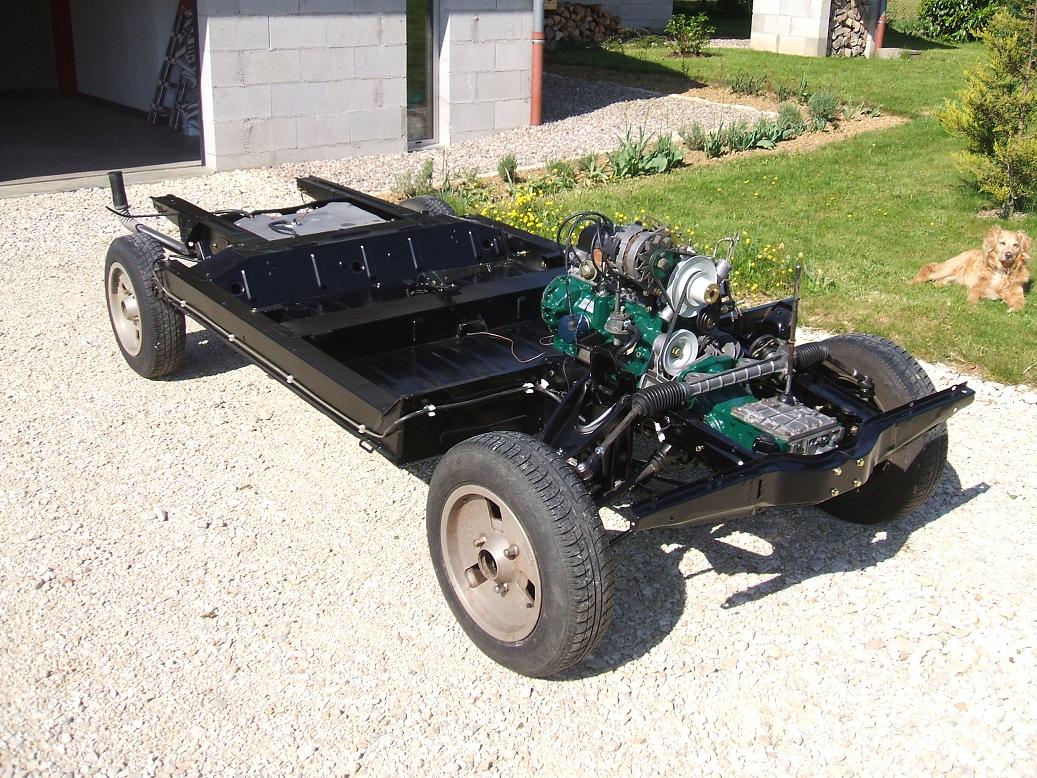
Examples of road cars using the MF layout include the Cord 810, BSA Scout, Citroën Traction Avant, Citroën DS, Renault 4 (and derivatives R5 and R6), Renault 16, Saab 900, Saab Sonett I, the Citroën SM, as well as some commercial vehicles like the Tempo Matador. These vehicles have longitudinal mounted engines; transverse engined vehicles are possible in theory if the issue of passenger footwell location is addressed. The Toyota iQ comes close to this by having its front differential in front of the engine, however despite this, the iQ is still considered to have an FF layout.
Traditionally, the term mid-engine has been reserved for cars that place the engine and transaxle behind the driver and in front of the rear axles , as in the Lamborghini Countach or Ferrari Testarossa, but an engine placed in front of the driver's compartment but fully behind the front axle line also qualifies as mid-engine.
Gallery
Citroën Berline 7A aka Traction (very very early one) 1303cc 1934.JPG|Citroën Traction Avant revolutionized auto design with its low slung unibody design bodywork. 1973 Citroën D Spécial sedan (2011-05-12) 02.jpg|The 1955–1975 Citroën DS successor packed full of innovations, but retained the MF layout Sonett-mk1-red.jpg|Saab Sonett mk1 used the MF layout by turning the engine and running it "backwards". Renault 5 First generation with 5 doors in Spain.jpg|The 1972 Renault 5 was one of the last successful mid-engine, front-wheel-drive cars. Nissan Motorsports - Nissan GT-R LM Nismo -23 (18860958202).jpg|The Nissan GT-R LM Nismo was the only Le Mans Prototype race car with a front-mid-engine, front-wheel-drive layout.
References
References
- (21 July 2012). "Front Wheel Drive (FWD) layouts". Virtual Motoring.
- Veeresh, Sai. (6 June 2021). "Stability of Car Layout". International Journal of Innovative Science and Research Technology ISSN No:-2456-2165.
- Toma, Sebastian. (30 November 2016). "Engine Layouts - Your Guide To What FF, RMR, And All In Between Mean". Autoevolution.
- (22 October 2008). "TOYOTA IQ: SIX DEGREES OF INNOVATION – NO1".
This article was imported from Wikipedia and is available under the Creative Commons Attribution-ShareAlike 4.0 License. Content has been adapted to SurfDoc format. Original contributors can be found on the article history page.
Ask Mako anything about Front-mid-engine, front-wheel-drive layout — get instant answers, deeper analysis, and related topics.
Research with MakoFree with your Surf account
Create a free account to save articles, ask Mako questions, and organize your research.
Sign up freeThis content may have been generated or modified by AI. CloudSurf Software LLC is not responsible for the accuracy, completeness, or reliability of AI-generated content. Always verify important information from primary sources.
Report