From Surf Wiki (app.surf) — the open knowledge base
Frogs in culture
none

none
Frogs play a variety of roles in culture, appearing in folklore and fairy tales such as the Brothers Grimm story of The Frog Prince. In ancient Egypt and Mesopotamia, frogs symbolized fertility, while in classical antiquity, the Greeks and Romans associated frogs with fertility, harmony, and licentiousness.
Frogs are the subjects of fables attributed to Aesop, of proverbs in various cultures, and of art. Frog characters such as Kermit the Frog and Pepe the Frog feature in popular culture. They are eaten in some parts of the world including France. In Australia, a fondant dessert is known as frog cake.
History
Folklorist Andrew Lang listed myths about a frog or toad that swallows or blocks the flow of waters occurring in many world mythologies.
On the other hand, researcher Anna Engelking drew attention to the fact that studies on Indo-European mythology and its language see "a link between frogs and the underworld, and – by extension – sickness and death".
Ancient Mesopotamia
In the Sumerian epic poem of Inanna and Enki, the goddess Inanna tricks Enki, the god of water, into giving her all of the sacred mes, prompting Enki to send various watery creatures to retrieve them. The first of these is a frog, whom Enki grasps "by its right hand." Frogs also appear as filling motifs on cylinder seals of the Kassite Period.
Ancient Egypt


To the Egyptians, the frog was a symbol of life and fertility, since millions of them were born after the annual flooding of the Nile, which brought fertility to the otherwise barren lands. Consequently, in Egyptian mythology, there began to be a frog-goddess, who represented fertility, named Heqet. Heqet was usually depicted as a frog, or a woman with a frog's head, or more rarely as a frog on the end of a phallus to explicitly indicate her association with fertility. A lesser known Egyptian god, Kek, was also sometimes shown in the form of a frog.
Texts of the Late Period describe the Ogdoad of Hermepolis, a group of eight "primeval" gods, as having the heads of frogs (male) and serpents (female), and they are often depicted in this way in reliefs of the Greco-Roman period. The god Nu in particular is sometimes depicted either with the head of a frog surmounted by a beetle.
Hapi was a deification of the annual flood of the Nile River, in Egyptian mythology, which deposited rich silt on the banks, allowing the Egyptians to grow crops. In Lower Egypt, he was adorned with papyrus plants, and attended by frogs, present in the region, and symbols of it.
Classical antiquity

The Greeks and Romans associated frogs with fertility and harmony, and with licentiousness in association with Aphrodite. The combat between the Frogs and the Mice (Batrachomyomachia) was a mock epic, commonly attributed to Homer, though in fact a parody of his Iliad. The Frogs Who Desired a King is a fable, attributed to Aesop. The Frogs prayed to Zeus asking for a King. Zeus set up a log to be their monarch. The Frogs protested they wanted a fierce and terrible king, not a mere figurehead. So Zeus sent them a Stork to be their king. The new king hunted and devoured his subjects. Aesop wrote a fable about a frog trying to inflate itself to the size of an ox. Phaedrus (and later Jean de La Fontaine) wrote versions of this fable. The Frogs is a comic play by Aristophanes, in which the choir of frogs sings the famous onomatopoeic line: "Brekekekex koax koax."
In the Bible, the Second Plague of Egypt described in the Book of Exodus 8:6 is of frogs. In the New Testament, frogs are associated with unclean spirits in Revelation 16:13.
Medieval and Early Modern
Medieval Christian tradition based on the Physiologus distinguished land frogs from water frogs representing righteous and sinful congregationists, respectively. In folk religion and occultism, the frog also became associated with witchcraft or as an ingredient for love potions.
The Japanese poet Matsuo Bashō wrote one of his most famous haiku about a frog jumping into an old pond.
In folk and fairy tales
The frog is also a character in many fairy tales, be it tales from oral tradition or literary reworkings by later writers.
The frog or toad appears as a potential suitor to a female human in variants of the Aarne–Thompson–Uther type ATU 440, "The Frog King". The most famous is the story of The Frog Prince. It also appears as a female bride in tales of type ATU 402, "The Animal Bride", such as Puddocky (German fairy tale), The Frog Princess (Russian fairy tale) and The Three Feathers (German fairy tale).
It also acts as a helper of the heroes and heroines, such as in the beginning of the story of the Sleeping Beauty, and in French literary fairy tales The Benevolent Frog (by MMe. d'Aulnoy) and The Little Green Frog.
In Hans Christian Andersen's lengthy fairy tale "The Marsh King's Daughter," a beautiful young woman is transformed, night after night, into a large, mournful frog. With the first rays of dawn, she changes back to human form.
The toad appears as a transformation for the hero Jiraiya in the Japanese story The Tale of the Gallant Jiraiya.
The frog appears in the form of a beautiful maiden, named Bheki, in a tale from Sanskrit legend. The amphibian, in this story, symbolizes the sun.
In modern culture
Proverbs and popular traditions
The "frog in a well" saying about having a narrow vision of life is found in Sanskrit ("Kupa Manduka", कुपमन्डुक), in Bengali, কুপমন্ডুক), in Vietnamese "Ếch ngồi đáy giếng coi trời bằng vung" ("Sitting at the bottom of wells, frogs think that the sky is as wide as a lid"), and in Malay "Bagai katak dibawah tempurung" ("Like a frog under a coconut shell").. The Chinese versions are "坐井觀天" ("sitting in the well, looking to the sky") and "井底之蛙" ("a frog in a well") from the Taoist classic Zhuangzi that has a frog living in an abandoned well, who talks about things big and small with the turtle of the Eastern Sea.
Other frog proverbs include the American "You can't tell by looking at a frog how high he will jump" and the Iranian "When the snake gets old, the frog gets him by the balls."
In Chinese traditional culture, frogs represent the lunar yin, and the Frog spirit Ch'ing-Wa Sheng is associated with healing and good fortune in business, although a frog in a well is symbolic of a person lacking in understanding and vision.
The supposed behavior of frogs illustrating nonaction is told in the often-repeated story of the boiled frog: put a frog in boiling water and it will jump out, but put it in cold water and slowly heat it, and it will not notice the danger and will be boiled alive. The story was based on nineteenth century experiments in which frogs were shown to stay in heating water as long as it was heated very slowly. The validity of the experiments is however disputed. Professor Douglas Melton, Harvard University Biology Department, says: "If you put a frog in boiling water, it won't jump out. It will die. If you put it in cold water, it will jump before it gets hot—they don't sit still for you."
The short poem "What a queer bird", which appeared in magazines in the 1920s, is about the qualities of a frog from a bird's perspective.
In Finland, miniature wooden coffins containing frogs have been discovered under the floors of some churches, and in other places such as in a field, under a cowshed, in rapids, or in a hearth. They are thought to have been part of a practice of magic, or to protect against magic.
According to researcher Anna Engelking, there is a certain naming taboo in Polish folk belief regarding calling a child a frog, since it may stunt the child's growth. Hence, there is a verbal avoidance of mentioning the frog by its name, instead using a euphemism that denotes some trait (i.e, 'the one that jumps').
In art
The Moche people of ancient Peru worshipped animals and often depicted frogs in their art. Painters of the Dutch Golden Age sometimes included frogs in their compositions; for example, Ambrosius Bosschaert II painted a vanitas still life Dead Frog with Flies c. 1630; in 2012, the artists Rob and Nick Carter created a silent digital version, lasting three hours, in which the "still" image "slowly, imperceptibly" changes with the movement of the sun, and occasionally an insect such as a dragonfly enters the scene.
File:Toadlarcomuseum.jpg|Moche frog, 200 AD File:Chouju sumo2.jpg|Wrestling frogs from Chōjū-jinbutsu-giga, cartoon, Japan, 12th century File:Image of the painting Dead Frog with Flies.jpg|Dead Frog with Flies by Ambrosius Bosschaert II, c. 1630 File:Wedgwood. Сервиз с зелёной лягушкой (13).JPG|Detail of Josiah Wedgwood's Frog Service, 1773–4, made for Catherine the Great of Russia File:"Crapaud et Grenouille" de Jean Carriès (Petit Palais) (5172249722).jpg|Crapaud et Grenouille ("Frog and Toad") by Jean Carriès, between 1889 and 1894 File:Doré Gustave-Entre ciel et terre (2).jpg|Entre ciel et terre, by Gustave Doré, 1862 File:Hermenegildo Bustos - Still life with fruit (with scorpion and frog) - Google Art Project.jpg|Hermenegildo Bustos, Still life with fruit, 1874 File:Tegel Makkum.jpg|Old Dutch tile from Friesland File:Roman lamp mount frog (FindID 524521).jpg|Roman lamp mount shaped like a frog. File:Coat of Arms of Baloži.svg|Frog pictured in the coat of arms of Baloži

Contemporary pop culture
The theme of transformation features prominently in popular culture, from The Frog Prince to fantasy settings such as the Final Fantasy and Chrono Trigger video games with magic spells that turn people into frogs.
Michigan J. Frog featured in a Warner Brothers cartoon. Kermit the Frog is the straight man character in Sesame Street and The Muppet Show.
Several Pokémon species are based on frogs and toads, such as the Poliwrath, Politoed, Seismitoad, Toxicroak, and Greninja evolutionary families.
Tsuyu Asui, also known as Froppy, is a superhero with frog-related powers in the manga and anime series My Hero Academia.
Pepe the Frog is a frog character from a webcomic which became a popular Internet meme, and was eventually used as a symbol of the alt-right movement.
Suwako Moriya is a goddess whose looks are inspired by frogs. She is from the bullet hell video game Touhou Fuujinroku: Mountain of Faith.
In the Disney animated series Amphibia, anthropomorphic frogs are one of the fictional races from an alternate universe where frogs play the role of humans.
In the webcomic Homestuck, universes exist in the form of enormous Genesis Frogs. In the game Undertale, which took inspiration from it, frogs exist as the common monster enemy Froggits.
In the Netflix original series Captain Laserhawk: A Blood Dragon Remix, one of the main characters is an anthropomorphic frog, named Bullfrog.
Cuisine and confectionery
Frogs are eaten, notably in France. One dish is known as cuisses de grenouille, frogs' legs, and although it is not especially common, it is taken as indicative of French cuisine. From this, "frog" has also developed into a common derogatory term for French people in English.
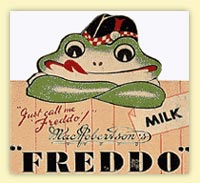
Freddo Frog is a popular Australian chocolate, while frog cake is a Heritage Listed South Australian fondant dessert. Crunchy Frog is a fictitious confectionery from a Monty Python skit of the same name. Chocolate Frogs are a popular sweet in the Harry Potter universe.
Pepe the Frog in 4chan culture
References
References
- Lang, Andrew. ''Myth, Ritual and Religion''. Vol. I. London: Longmans, Green. 1906. pp. 42-46.
- Engelking, Anna. ''The Curse - On Folk Magic of the Word''. Translated by Anna Gutowska. Monographs. Warsaw: Institute of Slavic Studies, Polish Academy of Sciences. 2017 [2000]. p. 320 (footnote nr. 23). {{ISBN. 978-83-64031-63-2.
- (1992). "Gods, Demons and Symbols of Ancient Mesopotamia: An Illustrated Dictionary". The British Museum Press.
- (2005). "Archaeological Perspectives on the Transmission and Transformation of Culture in the Eastern Mediterranean". Council for British Research in the Levant.
- Cooper, JC. (1992). "Symbolic and Mythological Animals". Aquarian Press.
- Budge, E. A. Wallis. (1904). "The Gods of the Egyptians: Or, Studies in Egyptian Mythology". [[Methuen & Co.]].
- Smith, Mark (2002). [https://books.google.com/books?id=l4kQFwWZesMC&pg=PA38 ''On the Primaeval Ocean'']. p. 38.
- Wilkinson, Richard H.. (2003). "The Complete Gods and Goddesses of Ancient Egypt". Thames & Hudson.
- Plutarch. ''De Herodoti Malignitate'', 43, or Moralia, 873f.
- A. Ludwich (1896).
- {{EB1911
- Aristophanes, ''Frogs''. Kenneth Dover (ed.) (Oxford: Clarendon Press, 1993), p. 2.
- (January 2000). "The Continuum Encyclopedia of Symbols". A&C Black.
- "Matsuo Bashō's Frog Haiku (Thirty-one Translations and One Commentary)".
- Eccleshare, Julia. (2015-11-16). "The best frogs in children's books". The Guardian.
- Thompson, Stith. ''The Folktale''. University of California Press. 1977. pp. 101-102, 179.{{ISBN. 0-520-03537-2
- Aarne, Antti; Thompson, Stith. ''The types of the folktale: a classification and bibliography''. Folklore Fellows Communications FFC no. 184. Helsinki: Academia Scientiarum Fennica, 1961. p. 131.
- "‘Cupid, Psyche, and the “Sun-Frog”’, Custom and Myth: (London: Longmans, Green and Co., 1884)." In The Edinburgh Critical Edition of the Selected Writings of Andrew Lang, Volume 1: Anthropology, Fairy Tale, Folklore, The Origins of Religion, Psychical Research, edited by Teverson Andrew, Warwick Alexandra, and Wilson Leigh, 66-78. Edinburgh: Edinburgh University Press, 2015. Accessed June 25, 2020. www.jstor.org/stable/10.3366/j.ctt16r0jdk.9.
- Pattanaik, Devdutt. (2011-09-08). "Frog in the well". [[The Times of India]].
- ''[[Zhuangzi (book)
- Quoted at the end of ''Embroideries'' by [[Marjane Satrapi]].
- Sedgwick, William. (July 1888). "Studies From the Biological Laboratory". N. Murray, Johns Hopkins University..
- "Next Time, What Say We Boil a Consultant".
- . (1922-09-28). ["Pleasantries"](https://books.google.com/books?id=Abc_AQAAMAAJ&q=%22what+a+queer+bird+the+frog+are%22&pg=PA940).
- . (1922). ["The Frog"](https://books.google.com/books?id=80NCAQAAMAAJ&q=%22what+a+queer+bird+the+frog+are%22&pg=PA217).
- "The Frog Round: a Children's Folk Song sung as a Round". Music Files Ltd.
- Hukantaival, Sonja. (2015). "Frogs in Miniature Coffins from Churches in Finland - Folk Magic in Christian Holy Places". Mirator.
- Engelking, Anna. ''The Curse - On Folk Magic of the Word ''. Translated by Anna Gutowska. Monographs. Warsaw: Institute of Slavic Studies, Polish Academy of Sciences. 2017 [2000]. pp. 64-66, 71. {{ISBN. 978-83-64031-63-2
- Berrin, Katherine & Larco Museum. ''The Spirit of Ancient Peru:Treasures from the [[Larco Museum. Museo Arqueológico Rafael Larco Herrera]].'' New York: [[Thames & Hudson]], 1997.
- "Frog". [[National Gallery]].
- (6 March 2013). "Dead frog painting that rots before your eyes". [[Daily Telegraph]].
- Badger, David P. ''Frogs'' (S.l.: Voyageur Press, 2001) includes chapters on "frogs in popular culture, their physical characteristics and behavior, and environmental challenges."[http://aqua.wisc.edu/waterlibrary/books_frogs.asp Are There Fewer Frogs?] {{webarchive. link. (11 September 2007)
- (26 July 2005). "Michigan J. Frog has no leg to stand on". TV.com.
- "Characters / The Muppet Show. Kermit the Frog". TV Tropes.org.
- "The Poliwag Family". Bogleech.
- "The Froakie Family". Bogleech.
- "My Hero Academia (TV Series 2016– ) - IMDb".
- Furie, Matt. (October 13, 2016). "Pepe the Frog's Creator: I'm Reclaiming Him. He Was Never About Hate".
- Segal, Oren. (September 29, 2016). "Pepe the Frog: yes, a harmless cartoon can become an alt-right mascot". [[The Guardian]].
- "Suwako Moriya".
- . (3 April 2003). ["Why do the French call the British 'the roast beefs'?"](https://news.bbc.co.uk/2/hi/uk_news/2913151.stm). *BBC News*.
- (29 January 2007). "Freddo The Frog creator dies". The Sydney Morning Herald.
- (12 September 2001). "Protection for frog cake". [[The Advertiser (Adelaide).
- (1989). "The Complete Monty Python's Flying Circus: All the Words, Volume One". Pantheon Books.
- (30 July 2007). "J.K. Rowling Web Chat Transcript". [[The Leaky Cauldron (website).
This article was imported from Wikipedia and is available under the Creative Commons Attribution-ShareAlike 4.0 License. Content has been adapted to SurfDoc format. Original contributors can be found on the article history page.
Ask Mako anything about Frogs in culture — get instant answers, deeper analysis, and related topics.
Research with MakoFree with your Surf account
Create a free account to save articles, ask Mako questions, and organize your research.
Sign up freeThis content may have been generated or modified by AI. CloudSurf Software LLC is not responsible for the accuracy, completeness, or reliability of AI-generated content. Always verify important information from primary sources.
Report