From Surf Wiki (app.surf) — the open knowledge base
Frog (horse anatomy)
Part of a horse's hoof
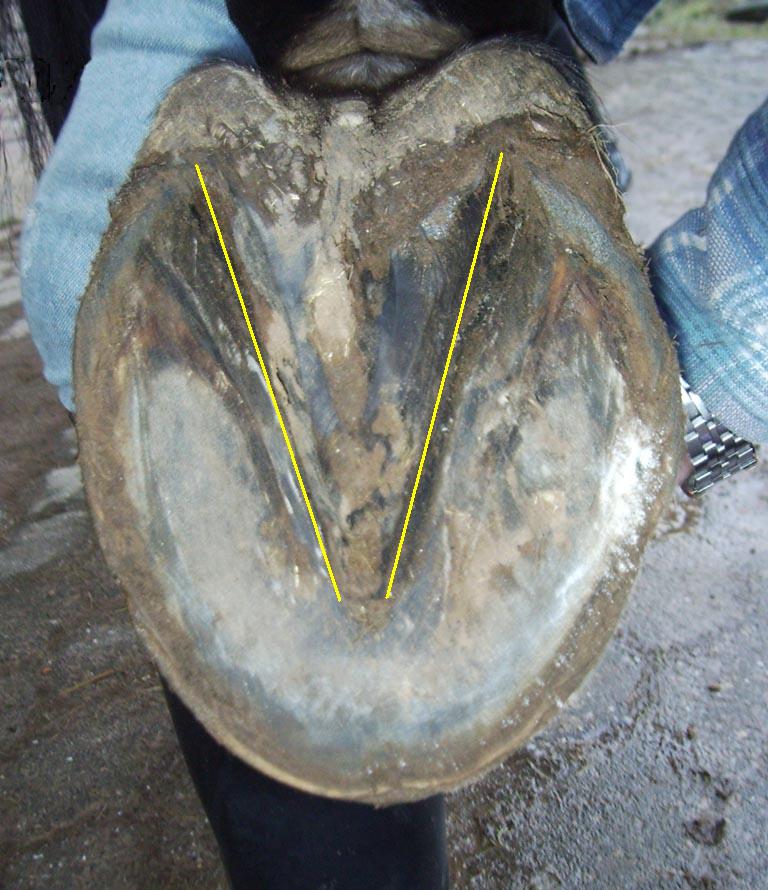
Part of a horse's hoof
The frog is a part of a horse hoof, located on the underside, which should touch the ground if the horse is standing on soft footing. The frog is triangular in shape, and extends midway from the heels toward the toe, covering around 25% of the bottom of the hoof. Someone with time and interest should defork the content versus Horse_hoof#The_frog.--
The frog is a V-shaped structure that extends forward across about two-thirds of the sole. Its thickness grows from the front to the back and, at the back, it merges with the heel periople. In its midline, it has a central groove (sulcus) that extends up between the bulbs.
The color of the frog varies between horses and can have no pigment making it cream colored, or with pigment fully or partially giving darker color. Its rubbery consistency suggests a role as a shock absorber and grip tool on hard, smooth ground. The frog also acts like a pump to move the blood back to the heart, a great distance from the relatively thin leg to the main organ of the circulatory system.
In the stabled horse, the frog does not wear but degrades, due to bacterial and fungal activity, to an irregular, soft, slashed surface. In the free-roaming horse, it hardens into a callus consistency with a near-smooth surface. For good health, the horse requires dry areas to stand. If chronically exposed to bacteria, for example standing in manure, the frog will develop an infection called thrush.{{cite book
The frog is anatomically analogous to the human fingertip.
Digit remnants
A 2018 study on horse foot morphology has suggested that the frog is actually composed of remnants of digits II and IV. This indicates that horses are not truly monodactyl and posits a more complex formation of the horse foot than simple side toe reduction.
References
References
- (1997). "Equine Lameness". Equine Research.
- (2010). "Textbook of veterinary anatomy". Saunders/Elsevier.
- (2018). "The evolution and anatomy of the horse manus with an emphasis on digit reduction". Royal Society Open Science.
This article was imported from Wikipedia and is available under the Creative Commons Attribution-ShareAlike 4.0 License. Content has been adapted to SurfDoc format. Original contributors can be found on the article history page.
Ask Mako anything about Frog (horse anatomy) — get instant answers, deeper analysis, and related topics.
Research with MakoFree with your Surf account
Create a free account to save articles, ask Mako questions, and organize your research.
Sign up freeThis content may have been generated or modified by AI. CloudSurf Software LLC is not responsible for the accuracy, completeness, or reliability of AI-generated content. Always verify important information from primary sources.
Report