From Surf Wiki (app.surf) — the open knowledge base
Frisians
Ethnic group native to Germany and the Netherlands
Ethnic group native to Germany and the Netherlands
| Field | Value |
|---|---|
| group | Frisians |
| Friezen (West), Fresen (North), Fräisen (Sater) | |
| flag_caption | Interfrisian flags by the Groep fan Auwerk and the Interfrisian Council. Since there is no official All-Frisian flag, these are the flag of the Groep fan Auwerk, claimed to be the Interfrisian flag and the flag of the Interfrisian Council. |
| total | 530,000 |
| region1 | Friesland |
| pop1 | 350,000 |
| region2 | Netherlands (excluding Friesland) |
| pop2 | 120,000 |
| region3 | Germany |
| pop3 | 60,000 |
| region4 | Canada |
| pop4 | 4,590 residents of Canada reported having Frisian ancestry in the 2016 Canadian Census. |
| region5 | United States |
| pop5 | 2,145 (ancestry estimate) |
| rels | Protestant majority (Calvinists and Lutherans) |
| Roman Catholic minority | |
| langs | Frisian languages |
| Low Saxon (Friso-Saxon dialects) | |
| Dutch (West Frisian Dutch and Stadsfries) | |
| German (Missingsch) | |
| Danish (Sønderjysk and Southern Schleswig Danish) | |
| related |
Friezen (West), Fresen (North), Fräisen (Sater) Ethnologue: Languages of the World, Sixteenth edition. Dallas, Tex.: SIL International. Online version. Roman Catholic minority Low Saxon (Friso-Saxon dialects) Dutch (West Frisian Dutch and Stadsfries) German (Missingsch) Danish (Sønderjysk and Southern Schleswig Danish)
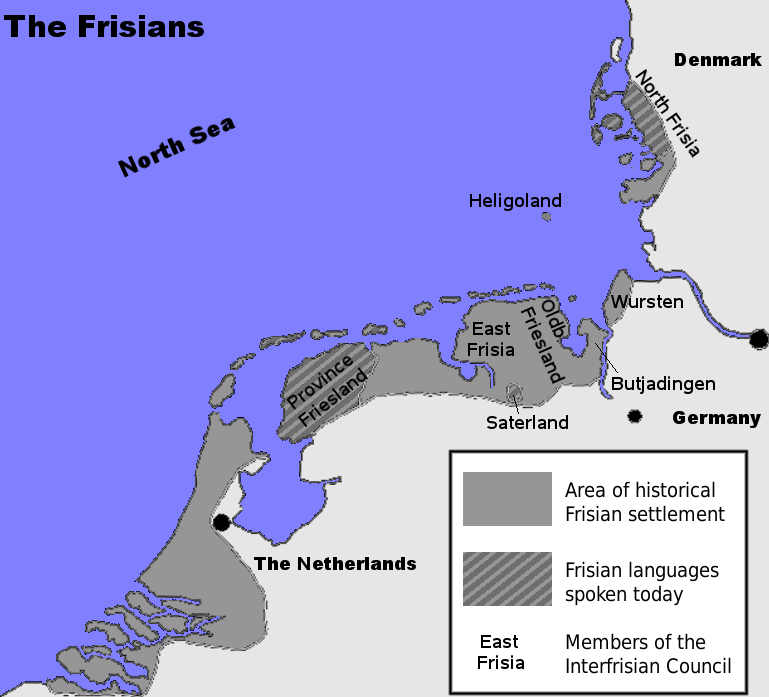
The Frisians ( ) are an ethnic group indigenous to Northwestern Europe on the coastal regions of northern Netherlands, north-western Germany and southwestern Denmark. They inhabit an area known as Frisia and are concentrated in the Dutch province of Friesland and, in Germany, East Frisia and North Frisia (which was a part of Denmark until 1864).
The Frisian languages are spoken by more than 500,000 people; West Frisian is officially recognised in the Netherlands (in the Dutch province Friesland) while North Frisian and Saterland Frisian are recognised as regional languages in Germany.
Name
There are several theories about the origin of the name of the Frisians, which is derived from Frisii or Fresones, names used by the Romans to describe a Germanic tribe that inhabited the same region but disappeared during the 5th century before the appearance of the Frisians. Most probably the name is derived from the verb fresare in Vulgar Latin, meaning 'milling, cutting, grooving, crushing, removing shells'; this name may have been given to the Frisii because they 'cut the land': digging ditches and dykes to drain the wet marshlands where they lived. Compare fresar el paisaje in the Romance language Spanish*.* Another theory is the name derives from frisselje (to braid, thus referring to braided hair).
History
Prior to the appearance of the modern Frisians, their namesake, the ancient Frisii, enter recorded history in the Roman account of Drusus's 12 BC war against the Rhine Germans and the Chauci. They occasionally appear in the accounts of Roman wars against the Germanic tribes of the region, up to and including the Revolt of the Batavi around 70 AD. Frisian mercenaries were hired as cavalry to assist the Roman invasion of Britain. They are not mentioned again until 296, when they were deported into Roman territory as laeti (i.e., Roman-era serfs; see Binchester Roman Fort and Cuneus Frisionum). The discovery of a type of earthenware unique to fourth century Frisia, called terp Tritzum, shows that an unknown number of them were resettled in Flanders and Kent, probably as laeti under Roman coercion.
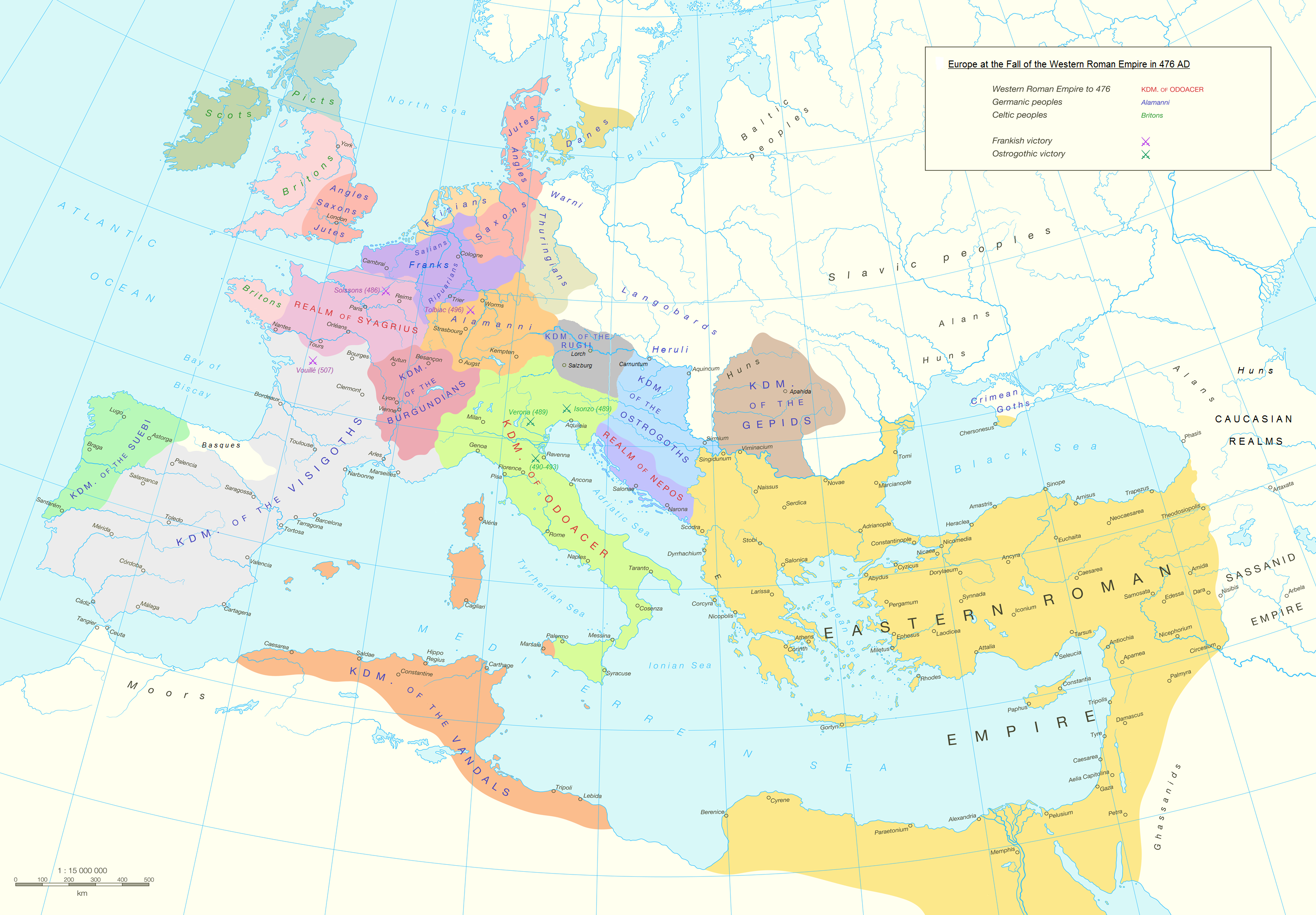
From the third through the fifth centuries, Frisia suffered marine transgressions that made most of the land uninhabitable, aggravated by a change to a cooler and wetter climate. Whatever population may have remained dropped dramatically, and the coastal lands remained largely unpopulated for the next two centuries. When conditions improved, Frisia received an influx of new settlers, mostly Angles and Saxons. These people would eventually be referred to as 'Frisians' (, ), though they were not necessarily descended from the ancient Frisii. It is these 'new Frisians' who are largely the ancestors of the medieval and modern Frisians.
By the end of the sixth century, Frisian territory had expanded westward to the North Sea coast and, in the seventh century, southward down to Dorestad. This farthest extent of Frisian territory is sometimes referred to as Frisia Magna. Early Frisia was ruled by a High King, with the earliest reference to a 'Frisian King' being dated 678.
In the early eighth century, the Frisians mostly worshipped Germanic gods such as Thor and Odin outside the vicinity of Utrecht. Slightly later, the Frisian nobles came into increasing conflict with the Franks to their south, resulting in a series of wars in which the Frankish Empire eventually subjugated Frisia in 734. These wars benefited attempts by Anglo-Irish missionaries (which had begun with Saint Boniface) to convert the Frisian populace to Christianity, in which Saint Willibrord largely succeeded.
Some time after the death of Charlemagne, the Frisian territories were in theory under the control of the Count of Holland, but in practice the Hollandic counts, starting with Count Arnulf in 993, were unable to assert themselves as the sovereign lords of Frisia. The resulting stalemate resulted in a period of time called the 'Frisian freedom', a period in which feudalism and serfdom (as well as central or judicial administration) did not exist, and in which the Frisian lands only owed their allegiance to the Holy Roman Emperor.
During the 13th century, however, the counts of Holland became increasingly powerful and, starting in 1272, sought to reassert themselves as rightful lords of the Frisian lands in a series of wars, which (with a series of lengthy interruptions) ended in 1422 with the Hollandic conquest of Western Frisia and with the establishment of a more powerful noble class in Central and Eastern Frisia.
In 1524, Frisia became part of the Seventeen Provinces and in 1568 joined the Dutch revolt against Philip II, king of Spain, heir of the Burgundian territories; Central Frisia has remained a part of the Netherlands ever since. The eastern periphery of Frisia would become part of various German states (later Germany) and Denmark. An old tradition existed in the region of exploitation of peatlands.
Migration to England and Scotland
Though it is impossible to know exact numbers and migration patterns, research has indicated that many Frisians were part of the wave of ethnic groups to colonise areas of present-day England alongside the Angles, Saxons and Jutes, starting from around the fifth century when Frisians arrived along the coastline of Kent.
Frisians principally settled in modern-day Kent, East Anglia, the East Midlands, North East England, and Yorkshire. Across these areas, evidence of their settlement includes place names of Frisian origin, such as Frizinghall in Bradford and Frieston in Lincolnshire.
Similarities in dialect between Great Yarmouth and Friesland have been noted, originating from trade between these areas during the Middle Ages. Frisians are also known to have founded the Freston area of Ipswich.
In Scotland, historians have noted that colonies of Angles and Frisians settled as far north as the River Forth. This corresponds to those areas of Scotland which historically constituted part of Northumbria.
Frisians in Denmark
The earliest traces of Frisians in modern-day Denmark date back from the 8th century, when Frisian traders and craftsmen settled down in Ribe. In the Later Middle Ages, Frisian farmers settled around Tøndermarsken west of Tønder. The evidence for this are the dwelling mounds or terps (værfter) in the area that are built after the same method as the ones alongside the Wadden Sea further south. Colonists from the south also settled down in Misthusum in the Ballum marshes near Skærbæk during the 12th of 13th century. According to documents around 1400 at least some of them were considered as "Hollanders".
In modern times, Frisian culture in Denmark is described as assimilated and most people of Frisian descent do not consider themselves Frisian. In regards of the Frisian language, very few may speak it as first language but it was traditionally spoken in several polder hamlets near the border with Germany. One estimate puts the Frisian population in Denmark somewhere between 2,000 and 5,000. This number, however, might be grossly exaggerated. Frisian identity in Denmark was promoted by the Eiderstedt farmer and political activist Cornelius Petersen, who built a traditional Frisian farmstead in Møgeltønder in 1914 and founded the rural protest movement Bondens Selvstyre ("Farmers' self-government"). More recently, the retired journalist Benny Siewertsen wrote a partisan pamphlet on Frisian heritage in Denmark.
Language
]] As both the Anglo-Saxons of England and the early Frisians were formed from similar tribal confederacies, their respective languages were very similar, together forming the Anglo-Frisian family. Old Frisian is the most closely related language to Old English and the modern Frisian dialects are in turn the closest related languages to contemporary English that do not themselves derive from Old English (although modern Frisian and English are not mutually intelligible).
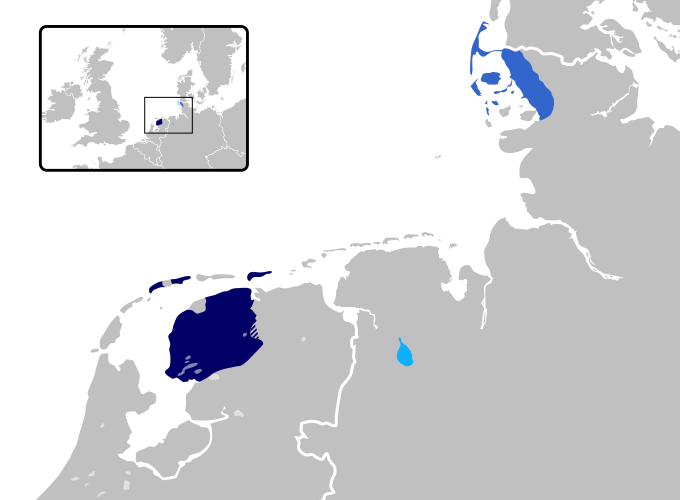
The Frisian language group is divided into three languages:
- West Frisian, spoken in the Dutch province of Friesland
- Saterland Frisian, spoken in the German municipality of Saterland just south of East Frisia
- North Frisian, spoken in the German region of North Frisia (within the Kreis of Nordfriesland) on the west coast of Jutland.
Of these three languages both Saterland Frisian (2,000 speakers) and North Frisian (10,000 speakers) are endangered. West Frisian is spoken by around 350,000 native speakers in Friesland, and as many as 470,000 when including speakers in neighbouring Groningen province. West Frisian is not listed as threatened, although research published by Radboud University in 2016 has challenged that assumption.
Identity
Main article: Frisian nationalism

Today, there exists a tripartite division of North, East and West Frisians; this was caused by Frisia's continual loss of territory in the Middle Ages. The West Frisians, in general, do not see themselves as part of a larger group of Frisians, and, according to a 1970 poll, identify themselves more with the Dutch than with the East or North Frisians.
References
Works cited
References
- (30 December 2023). "Groep fan Auwerk".
- "Interfriesische Flagge".
- "The Position of Frisian in the Germanic Language Area". University of Groningen.
- [http://www.ethnologue.com/show_language.asp?code=fry Lewis, M. Paul (ed.), 2009. Ethnologue: Languages of the World, Sixteenth edition. Dallas, Tex.: SIL International. Online version.]
- "Die friesische Volksgruppe".
- (25 October 2017). "Immigration and Ethnocultural Diversity Highlight Tables". Statistics Canada.
- "Table 1. First, Second, and Total Responses to the Ancestry Question by Detailed Ancestry Code: 2000". U.S. Census Bureau.
- "Herzlich Willkommen".
- Faber, Hans. (August 14, 2022). "A severe case of inattentional blindness: the Frisian tribe's name".
- Lucius Cassius Dio Cocceianus. (229). "Dio's Roman History". William Heinemann.
- (1992). "Roman Britain". University of California.
- Grane, Thomas. (2007). "The Roman Empire and Southern Scandinavia–a Northern Connection! (PhD thesis)". University of Copenhagen.
- Looijenga, Jantina Helena. (1997). "Runes Around the North Sea and on the Continent AD 150–700; Texts and Contexts (PhD dissertation)". Groningen University.
- Berglund, Björn E.. (2002). "Quaternary International". Elsevier.
- (2008). "The Migration Period, Southern Denmark and the North Sea". Maritime Archaeology Programme.
- Issar, Arie S.. (2003). "Climate Changes during the Holocene and their Impact on Hydrological Systems". Cambridge University.
- Louwe Kooijmans, L. P.. (1974). "The Rhine/Meuse Delta. Four studies on its prehistoric occupation and Holocene geology (PhD Dissertation)". Leiden University Press.
- White, David L.. (2018). "Reasons to Think That Anglo-Frisian Developed in Britain". Anglica. An International Journal of English Studies.
- Bazelmans, Jos. (2009). "Ethnic Constructs in Antiquity: The Role of Power and Tradition". Amsterdam University.
- Halbertsma, H.. (2000). "Frieslands oudheid : het rijk van de Friese koningen, opkomst en ondergang". Matrijs.
- Rietbergen, P. J. A. N.. (2000). "A Short History of the Netherlands: From Prehistory to the Present Day". Bekking.
- {{Cite CE1913
- (1981). "Frisians in Anglo-Saxon England: A Historical and Toponymical Investigation". Fryske Akademy.
- (2011-06-16). "The Anglo-Saxon Invasion: Britain is More Germanic than It Thinks". Spiegel Online.
- "The History of the Frisian Folk".
- (1957). "The Frisians in East Anglia". The Economic History Review.
- "The Frisians, their tribes & allies".
- (January 1918). "Frisian Place-Names in England". PMLA.
- Gooskens, Charlotte. (2004). "On the Boundaries of Phonology and Phonetics". Department of Linguistics.
- (8 May 2018). "How I came face-to-face with East Anglia's 'twin'". Eastern Daily Press.
- Brown, Peter Hume. (1911). "History of Scotland to the Present Time". [[Cambridge University Press]].
- McLure, Edmund. (1910). "British place-names in their historical setting". [[Society for Promoting Christian Knowledge]].
- Rasmussen, Alan Hjorth. (1973). "Frisiske kulturelementer : en introduktion og foreløbig oversigt". Folk og Kultur, årbog for Dansk Etnologi og Folkemindevidenskab.
- (9 January 2022). "På jagt efter de sidste frisere i Danmark".
- Knottnerus, Otto S.. (2008). "De vergeten Friezen: Mislukt pamflet van Benny Siewertsen over een boeiend thema". De Vrije Fries: Jaarboek uitgegeven door het Koninklijk Fries Genootschap voor Geschiedenis en Cultuur.
- Benny Siewertsen, ''Friserne – vore glemte forfædre'', Copenhagen 2004/
- Kortlandt, Frederik. (1999). "The origin of the Old English dialects revisited". [[University of Leiden]].
- "Die friesische Volksgruppe in Schleswig-Holstein". Diet of Schleswig-Holstein.
- Matras, Yaron. "Frisian (North)". [[University of Manchester]].
- Menno de Galan & Willem Lust. (9 July 2016). "Friese taal met uitsterven bedreigd? (Frisian language threatened with extinction?)". NOS.
- Tamminga, Douwe A.. (1970). "Friesland, feit en onfeit [Frisia, 'Facts and Fiction']". Junior Kamer Friesland.
This article was imported from Wikipedia and is available under the Creative Commons Attribution-ShareAlike 4.0 License. Content has been adapted to SurfDoc format. Original contributors can be found on the article history page.
Ask Mako anything about Frisians — get instant answers, deeper analysis, and related topics.
Research with MakoFree with your Surf account
Create a free account to save articles, ask Mako questions, and organize your research.
Sign up freeThis content may have been generated or modified by AI. CloudSurf Software LLC is not responsible for the accuracy, completeness, or reliability of AI-generated content. Always verify important information from primary sources.
Report