From Surf Wiki (app.surf) — the open knowledge base
Friedrich Reinhold Kreutzwald
Estonian writer, author of the national epic Kalevipoeg

Estonian writer, author of the national epic Kalevipoeg
| Field | Value |
|---|---|
| name | Friedrich Reinhold Kreutzwald |
| image | Friedrich Reinhold Kreutzwald.jpg |
| birth_place | Jömper Manor, Jömper, Kreis Wierland, Governorate of Estonia, Russian Empire |
| (in present-day Jõepere, Lääne-Viru County, Estonia) | |
| birth_date | |
| death_date | (aged 78) |
| death_place | Dorpat, Kreis Dorpat, Governorate of Livonia, Russian Empire |
| (present-day Tartu, Tartu County, Estonia) | |
| resting_place | Raadi cemetery |
| occupation | Writer |
| movement | Estonian national awakening |
(in present-day Jõepere, Lääne-Viru County, Estonia) (present-day Tartu, Tartu County, Estonia) Friedrich Reinhold Kreutzwald ( – ) was an Estonian writer who is considered to be the father of the national literature for the country. He is the author of Estonian national epic Kalevipoeg.
Life
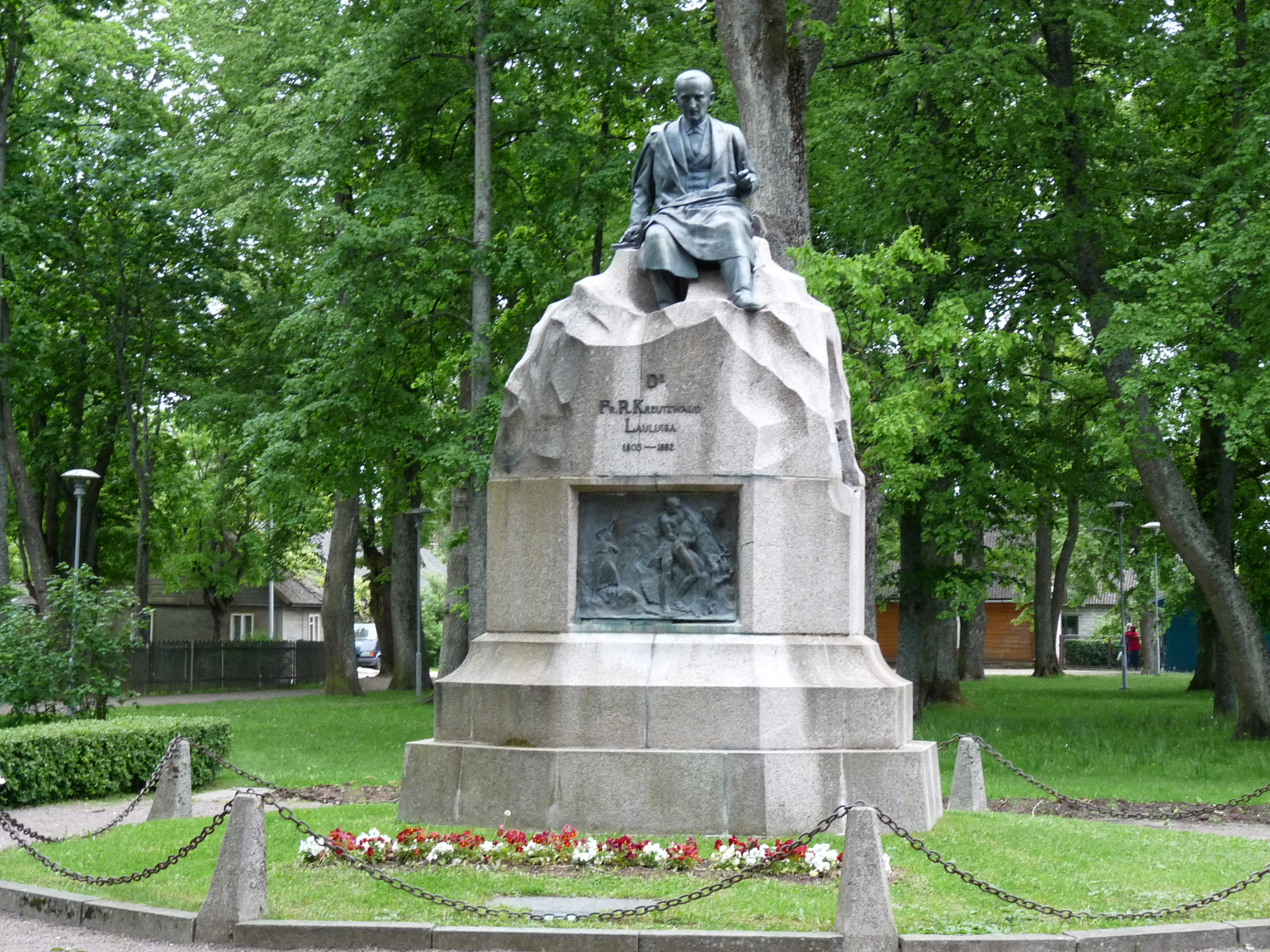
Friedrich Reinhold Kreutzwald's parents were serfs at the Jömper estate, Governorate of Estonia, Russian Empire (in present-day Jõepere, Lääne-Viru County). His father Juhan worked as a shoemaker and granary keeper and his mother Anne was a chambermaid. After liberation from serfdom in 1815, the family was able to send their son to school at the Wesenberg (present-day Rakvere) district school.
In 1820, he graduated from secondary school in Dorpat (present-day Tartu, Tartu County, Estonia) and worked as an elementary school teacher. In 1833, Kreutzwald graduated from the Faculty of Medicine at the Imperial University of Dorpat.
.jpg)
Kreutzwald married Marie Elisabeth Saedler on 18 August the same year. From 1833 to 1877, he worked as the municipal physician in Werro (present-day Võru). He was the member of numerous scientific societies in Europe and received honorary doctorates from a number of universities.
Works

Kreutzwald is the author of several moralistic folk books, most of them translated into German: Plague of Wine 1840, The World and Some Things One Can Find in It 1848–49, Reynard the Fox 1850, and Wise Men of Gotham 1857. In addition to these works, he composed the national epic Kalevipoeg (Kalev's Son), using material initially gathered by his friend Friedrich Robert Faehlmann; and wrote many other works based on Estonian folklore, such as Old Estonian Fairy-Tales (1866), collections of verses, and the poem Lembitu (1885), published after his death.
Kreutzwald is considered to be the author of the first original Estonian book. He was one of the leaders of the national awakening, as well as a paragon and encourager of young Estonian-speaking intellectuals.
References
References
- A. Plakans, ''A Concise History of the Baltic States'' (2011) p. 210
- "F. Reinhold Kreutzwald {{!}} Estonian Writer, Nationalist & Father of Estonian Literature {{!}} Britannica".
- J. D. Rateliff, ''The History of the Hobbit'' (2007) p. 181
- T. Miljan ed., ''Historical Dictionary of Estonia'' (2004) p. 236
This article was imported from Wikipedia and is available under the Creative Commons Attribution-ShareAlike 4.0 License. Content has been adapted to SurfDoc format. Original contributors can be found on the article history page.
Ask Mako anything about Friedrich Reinhold Kreutzwald — get instant answers, deeper analysis, and related topics.
Research with MakoFree with your Surf account
Create a free account to save articles, ask Mako questions, and organize your research.
Sign up freeThis content may have been generated or modified by AI. CloudSurf Software LLC is not responsible for the accuracy, completeness, or reliability of AI-generated content. Always verify important information from primary sources.
Report