From Surf Wiki (app.surf) — the open knowledge base
Freshwater whitefish
Subfamily of fishes
Subfamily of fishes
- Prosopium
- Stenodus
- Beckius
- Parastenodus
The freshwater whitefish are fishes of the subfamily Coregoninae, which contains whitefishes (both freshwater and anadromous) and ciscoes, and is one of three subfamilies in the salmon family Salmonidae. Freshwater whitefish are distributed mainly in relatively cool waters throughout the northern parts of the Northern Hemisphere.
Taxonomy
The Coregoninae subfamily consists of three nominal genera:
- Coregonus Linnaeus, 1758 – whitefishes and ciscoes, which according to some authors number more than 60 species. There are differing opinions on the classification of some species within the genus and the overall number of species. Some species in Arctic regions of Asia and North America forage in marine waters.
- Prosopium Jordan, 1878 – round whitefishes, which includes six species, three of which occur only in a single lake.
- Stenodus Richardson, 1836 – inconnus, which includes two species, sometimes considered a single species with two subspecies. Phylogenetically, Stenodus is not distinct from Coregonus. Two fossil genera (Beckius David, 1946 and Parastenodus David, 1946) are also known, both only from isolated scales from the Late Eocene or early Oligocene Kreyenhagen Shale of the San Joaquin Valley, California.
Niche
In their ecosystems, whitefish tend to be some of the largest fish and occupy niches as benthic predators. The recent invasion of several invasive species, including the sea lamprey and zebra mussels, has begun to pose a threat to the whitefish population by disrupting historic ecological relationships and prey distribution. This has been exacerbated by other changes to their habitat such as changes in land use, climate change, and the introduction of outside nutrients through runoff.
Whitefish as food
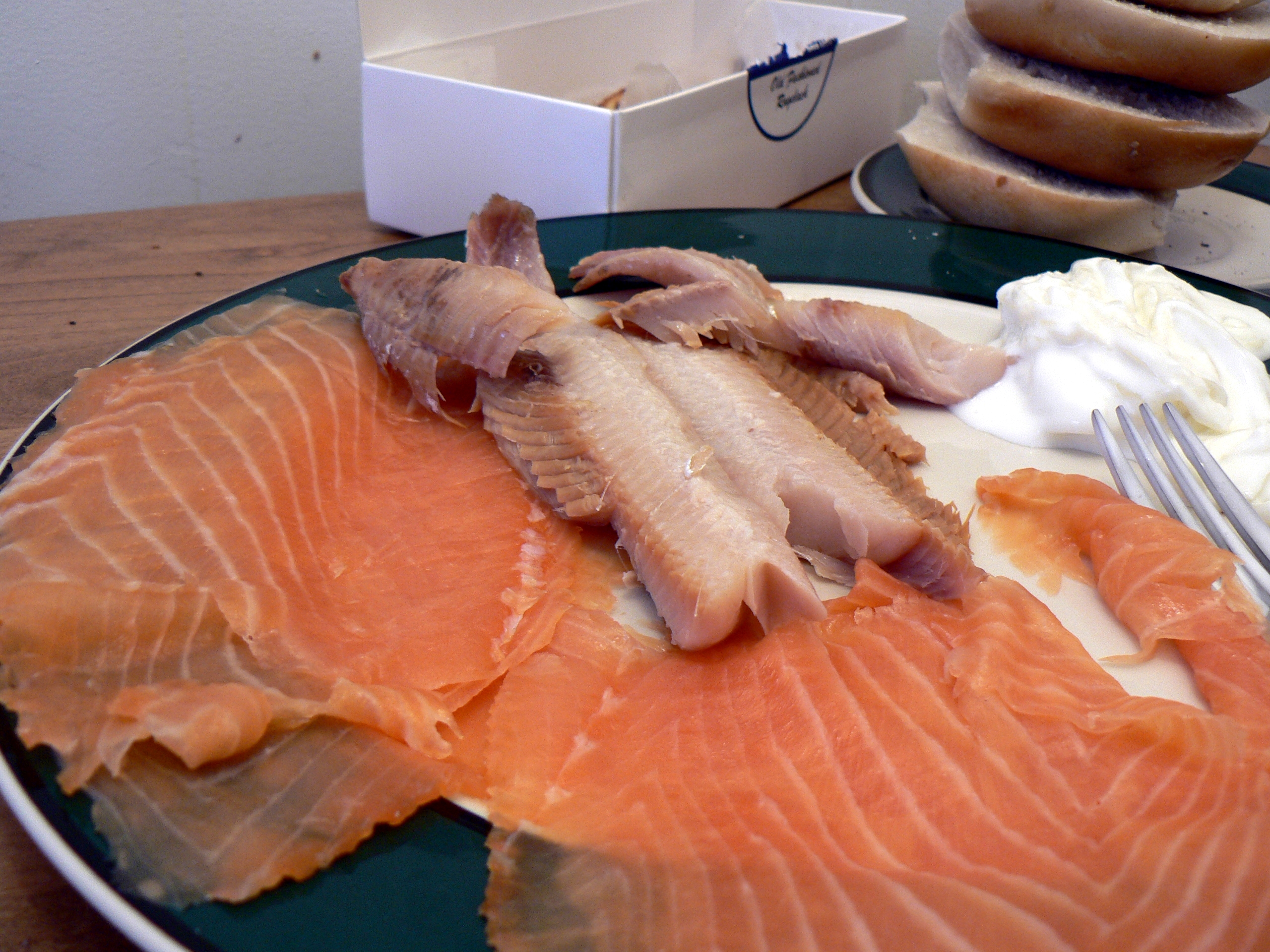
Freshwater whitefish is known for its mild flavor and high omega-3 fatty acid content. It is generally favored by those who dislike stronger fishy taste. Lake whitefish is one of the most commonly consumed varieties of freshwater whitefish. It is especially popular in the Great Lakes region, where it can frequently be found, usually grilled or fried, as a popular offering in many restaurants. Smoked whitefish is locally produced as well. Many freshwater whitefish species have also made up an important component of the traditional diets of many indigenous people who have historically inhabited its range. Smoked whitefish is sold in American delicatessens, especially those specializing in Jewish cuisine, either filleted or made into whitefish salad.
Use by Indigenous peoples
Lake whitefish, adikameg in Ojibwemowin, has historically been a staple food for the Anishinaabek, a diverse nation native to the Great Lakes region. In recent years, following several legal battles which restored the ability of native peoples to exercise their right to hunt and gather, whitefish has become a major resource for those communities. Native Alaskan communities also gather whitefish, specifically the inconnu (or sheefish), as a subsistence food.
Evolution due to human interaction
There are a multitude of species of freshwater whitefish, some are more valued economically than others. Fishing for markets is not uncommon for species such as Coregonus widegreni and Coregonus lavaretus. At the time, there was an increase in younger groups of C. widegreni because when fishing, humans only wanted the larger fish which ended up being the oldest.
References
References
- Nuttall, Mark. (12 November 2012). "Encyclopedia of the Arctic". Routledge.
- Apart from the subfamily Coregoninae, the family Salmonidae includes the salmon, trout, and char species of the subfamily [[Salmoninae]], and grayling species of the subfamily [[Thymallinae]].{{ ITIS | id=161931 | taxon=Salmonidae | access-date=5 January 2014 }}
- {{ ITIS
- {{ ITIS
- Behnke, Robert J. (6 July 2010). "Trout and Salmon of North America". The Free Press, a division of Simon & Schuster Inc..
- {{ ITIS
- "Taxonomic information for Inconnus (Stenodus)".
- (1991). "Phylogenetic relationships among the subfamily Coregoninae as revealed by mitochondrial DNA restriction analysis". [[Journal of Fish Biology]].
- David, Lorre R.. (1946). "Some Typical Upper Eogene Fish Scales from California". Contributions to Paleontology.
- "PBDB Taxon".
- (2014). "Biological Nitrogen Removal". Elsevier.
- (2020-08-20). "Status and Distribution of Cisco (Coregonus artedi) and Lake Whitefish (Coregonus clupeaformis) in Inland Lakes of Wisconsin". Northeastern Naturalist.
- (2017-02-08). "Whitefish (Coregonus lavaretus) Response to Varying Potassium and Sodium Concentrations: A Model of Mining Water Toxic Response". Mine Water and the Environment.
- "Lake Whitefish – Eat Wisconsin Fish".
- (2009). "Pacific Salmon: Ecology and Management of Western Alaska's Populations". American Fisheries Society.
- Kuhnlein, H.V.. (2017). "Traditional Animal Foods of Indigenous Peoples of North America".
- Achitoff-Gray, Niki. (September 2014). "Lox, Whitefish, and Beyond: An Introduction to Appetizing".
- Federman, Niki Russ. (October 2015). "The Russ & Daughters Guide to Smoked & Cured Fish".
- Avey, Tori. (February 2011). "Whitefish Salad".
- Kapadia, Jess. (April 29, 2013). "Whitefish Salad, The Bagel's Secret Lover".
- GLIFWC. (23 May 2017). "Lifting Nets: Gurnoe Decision [video]".
- (March 12, 2019). "Different growth trends of whitefish (Coregonus lavaretus) forms in the northern Baltic Sea". [[Journal of Applied Ichthyology]].
This article was imported from Wikipedia and is available under the Creative Commons Attribution-ShareAlike 4.0 License. Content has been adapted to SurfDoc format. Original contributors can be found on the article history page.
Ask Mako anything about Freshwater whitefish — get instant answers, deeper analysis, and related topics.
Research with MakoFree with your Surf account
Create a free account to save articles, ask Mako questions, and organize your research.
Sign up freeThis content may have been generated or modified by AI. CloudSurf Software LLC is not responsible for the accuracy, completeness, or reliability of AI-generated content. Always verify important information from primary sources.
Report