From Surf Wiki (app.surf) — the open knowledge base
FreeDOS
Open source clone of MS-DOS
Open source clone of MS-DOS
| Field | Value | |
|---|---|---|
| name | FreeDOS | |
| logo | FreeDOS logo4 2010.svg | |
| screenshot | FreeDOS 1.1 screenshot.png | |
| caption | FreeDOS 1.1 default shell, FreeCOM | |
| developer | Jim Hall & The FreeDOS team | |
| programmed in | Assembly language, C | |
| family | DOS | |
| working state | Current | |
| source model | Open source | |
| released | ||
| latest release version | latest release date = | |
| language | English, German, Dutch, French, Turkish, Swedish, Spanish | |
| supported platforms | x86 | |
| kernel type | Monolithic kernel | |
| influenced_by | MS-DOS | |
| ui | Command-line interface (COMMAND.COM) | |
| license | GNU GPL with various different licenses for utilities |
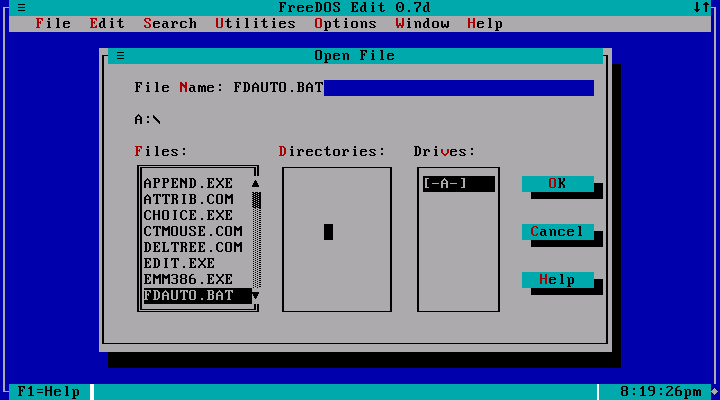
FreeDOS (formerly PD-DOS) is a free software operating system for IBM PC compatible computers. It intends to provide a complete MS-DOS-compatible environment for running legacy software and supporting embedded systems. FreeDOS can be booted from a floppy disk or USB flash drive and is designed to run well under virtualization or x86 emulation.
The FreeDOS project began under Jim Hall in 1994, and the first stable version was released in 2006. Unlike most versions of MS-DOS, FreeDOS is composed of free software, licensed under the terms of the GNU General Public License. However, other packages that form part of the FreeDOS project include non-GPL software considered worthy of preservation, such as 4DOS, which is distributed under a modified MIT License.
0.01
Distribution
FreeDOS 1.1, released on 2 January 2012, is available for download as a CD-ROM image: a limited install disc that only contains the kernel and basic applications, and a full disc that contains many more applications (games, networking, development, etc.), not available but with a newer, fuller 1.2. The legacy version 1.0 (2006) consisted of two CDs, one of which was an 8 MB install CD targeted at regular users and the other which was a larger 49 MB live CD that also held the source code of the project.
Commercial uses
FreeDOS is used by several companies:
- Dell preloaded FreeDOS with its n-series desktops to reduce their cost. The firm has been criticized for making these machines not cheaper and harder to buy, than identical systems with Windows.
- Hewlett-Packard provided FreeDOS as an option in its HP Compaq dc5750 Small Form Factor PC, Mini 5101 netbooks and Probook laptops. FreeDOS is also used as bootable media for updating the BIOS firmware in HP systems.
- FreeDOS is included by Steve Gibson's hard drive maintenance and recovery program, SpinRite.
- Intel's Solid-State Drive Firmware Update Tool loaded the FreeDOS kernel.
- Many motherboard vendors recommend a bootable FreeDOS for running low level BIOS and firmware updates.
Non-commercial uses
FreeDOS is also used in multiple independent projects:
- FED-UP is the Floppy Enhanced DivX Universal Player.
- FUZOMA is a FreeDOS-based distribution that can boot from a floppy disk and converts older computers into educational tools for children.
- XFDOS is a FreeDOS-based distribution with a graphical user interface, porting Nano-X and FLTK.
Development and version history
| Version | Status | Codename | Date | |||
|---|---|---|---|---|---|---|
| 0.01 | ||||||
| 0.02 | ||||||
| 0.03 | ||||||
| 0.04 | ||||||
| 0.05 | ||||||
| 0.06 | ||||||
| 0.1 | ||||||
| 0.2 | ||||||
| 0.3 | ||||||
| 0.4 | ||||||
| 0.5 | ||||||
| 0.6 | ||||||
| 0.7 | ||||||
| 0.8 | ||||||
| 0.9 | ||||||
| 1.0 | ||||||
| 1.1 | ||||||
| 1.2 | ||||||
| 1.3 | ||||||
| 1.4 |
The FreeDOS project began on 29 June 1994, after Microsoft announced it would no longer sell or support MS-DOS. Jim Hall, who at the time was a student, posted a manifesto proposing the development of PD-DOS, a public domain version of DOS. Within a few weeks, other programmers including Pat Villani and Tim Norman joined the project. Between them, a kernel (by Villani), the COMMAND.COM command line interpreter (by Villani and Norman), and core utilities (by Hall) were created by pooling code they had written or found available. For some time, the project was maintained by Morgan "Hannibal" Toal. There have been many official pre-release distributions of FreeDOS before the final FreeDOS 1.0 distribution. GNU/DOS, an unofficial distribution of FreeDOS, was discontinued after version 1.0 was released.[[File:Blinky.svg|thumb|Blinky, the mascot of FreeDOS]]Blinky the Fish is the mascot of FreeDOS. He was designed by Bas Snabilie.
Compatibility
Hardware
FreeDOS requires a PC/XT machine with at least 640 kB of memory. Programs not bundled with FreeDOS often require additional system resources.
MS-DOS and Win32 console
FreeDOS is mostly compatible with MS-DOS. It supports COM executables, standard DOS executables and Borland's 16-bit DPMI executables. It is also possible to run 32-bit DPMI executables using DOS extenders. The operating system has several improvements relative to MS-DOS, mostly involving support for newer standards and technologies that did not exist when Microsoft ended support for MS-DOS, such as internationalization, or the Advanced Power Management TSRs. Furthermore, with the use of HX DOS Extender, many Windows Console applications function properly in FreeDOS, as do some rare GUI programs, like QEMM and Bochs.
DOS-based Windows
FreeDOS is able to run Microsoft Windows 1.0 and 2.0 releases. Windows 3.x releases, which had support for i386 processors, cannot fully be run in 386 Enhanced Mode, except partially in the experimental FreeDOS kernel 2037.
Windows 95, Windows 98 and Windows Me use a stripped-down version of MS-DOS. FreeDOS cannot be used as a replacement because the undocumented interfaces between MS-DOS 7.0–8.0 and Windows "4.xx" are not emulated by FreeDOS; however, it can be installed and used beside these systems using a boot manager program, such as BOOTMGR or METAKERN included with FreeDOS.
Virtualization
FreeDOS is designed to work well with virtualization software such as VirtualBox and VMware. The installation process is identical to real hardware. It is also possible to install FreeDOS on DOSBox and its derivatives. By doing so, it provides additional functionality not present in the emulator.
File systems
FAT32 is fully supported and is the preferred format for the boot drive. Depending on the BIOS used, up to four Logical Block Addressing (LBA) hard disks of up to 128 GB, or 2 TB, in size are supported. There has been little testing with large disks, and some BIOSes support LBA, but produce errors on disks larger than 32 GB; a driver such as OnTrack or EZ-Drive resolves this problem. FreeDOS can also be used with a driver called LFNDOS to enable support for Windows 95-style long file names, but most pre-Windows 95 programs do not support long file names, even with a driver loaded. There is no planned support for NTFS, ext2 or exFAT, but there are several external third-party drivers available for that purpose. To access ext2 file systems, LTOOLS, a counterpart to Mtools, can sometimes be used to copy data to and from ext2 file system drives.
References
References
- (1996-12-25). "The Free-DOS Project – Files [Free-DOS Alpha 4 archive comment and files give date 28 June 1995 – but it could be an update]".
- "Installing FreeDOS tools on DOSBox using FDIMPLES \ VOGONS".
- "Installing FreeDOS in DOSBox-X".
- (2008-12-24). "FreeDOS Spec". Freedos.
- (2021-04-22). "Releases/Alpha 1". Freedos.
- (1996). "FreeDOS Kernel". Miller Freeman.
- "Main Page". The FreeDOS Project.
- (2007-08-21). "Booting DOS from a USB flash drive".
- (2005-07-19). "How to Create a Bootable FreeDOS Floppy Disk".
- (2014-07-14). "Though "barely an operating system," DOS still matters (to some people)". Condé Nast.
- "4DOS". The FreeDOS Project.
- {{FLOSSweekly. 416. Hall, Jim
- (1994-06-29). "PD-DOS project announcement". comp.os.msdos.apps.
- (2002-03-25). "The past, present, and future of the FreeDOS Project".
- (2006-09-23). "About". The FreeDOS Project.
- "Introducing GNU/DOS 2005".
- (2006-12-02). "GNU/DOS Project Discontinued".
- (2012-01-02). "Announcement on official FreeDOS homepage".
- "FreeDOS 1.0". The FreeDOS Project.
- "How Dell repels attempts to buy its 'open source' PC".
- "HP Compaq dc5750 Business PC". Hewlett-Packard.
- "First Look at HP's Low-Cost ProBook Laptop Lineup". [[EWeek]].
- (2009-06-23). "HP's Mini 5101: Netbook Deluxe, With All the Trimmings". Technologizer.
- (2010-10-25). "FreeDOS Bootable Media". [[Hewlett-Packard]].
- (2004-07-19). "SpinRite 6.0 for Linux Users".
- "Intel SATA Solid-State Drive Firmware Update Tool". [[Intel]].
- "Floppy Enhanced DivX Universal Player".
- "FUZOMA Educational Software".
- kraileth. (2012-10-12). "An extraordinary TK example! | eerielinux". Eerielinux.wordpress.com.
- kraileth. (2014-12-30). "An interview with the Nanolinux developer | eerielinux". Eerielinux.wordpress.com.
- "Artificial Intelligence Methods".
- "Georg's Personal Homepage". Georgpotthast.de.
- "FreeDOS History". Freedos.org.
- "FreeDOS software package comparison". Ibiblio.org.
- (2007-10-02). "Removing old distributions from ibiblio". freedos-devel.
- (2003-07-22). "Configure IT Quick: Use FreeDOS as a replacement for MS-DOS". CBS Interactive.
- (2006-09-04). "DOS lives! Open source reinvents past".
- "HX DOS Extender".
- (2014-09-03). "Windows on FreeDOS?". FreeDOS }}{{dead link.
- (2015-05-07). "Creating a Bootable DOS USB Stick".
- (2013-03-22). "Upgrading and Repairing PCs". [[Pearson Education.
- (2014-07-03). "Old school: I work in DOS for an entire day". Condé Nast.
- (2018-09-28). "Re-Open-Sourcing MS-DOS 1.25 and 2.0".
- "FDOS/kernel".
- "FreeDOS official logos".
- "FreeDOS Download Page".
This article was imported from Wikipedia and is available under the Creative Commons Attribution-ShareAlike 4.0 License. Content has been adapted to SurfDoc format. Original contributors can be found on the article history page.
Ask Mako anything about FreeDOS — get instant answers, deeper analysis, and related topics.
Research with MakoFree with your Surf account
Create a free account to save articles, ask Mako questions, and organize your research.
Sign up freeThis content may have been generated or modified by AI. CloudSurf Software LLC is not responsible for the accuracy, completeness, or reliability of AI-generated content. Always verify important information from primary sources.
Report