From Surf Wiki (app.surf) — the open knowledge base
Free solo climbing
Form of climbing without protection

Form of climbing without protection
a type of soloing that uses no protection
Free solo climbing (or free soloing) is a form of rock climbing where the climber (or free soloist) climbs on technical terrain without ropes or any form of protective equipment — they are allowed to use climbing shoes and climbing chalk (or ice tools and crampons if ice climbing). Free soloing is the most dangerous form of climbing, and, unlike bouldering, free soloists climb at heights where any fall can be fatal. Though many climbers have free soloed routes with technical grades that they are very comfortable on, only a small group free solo regularly, and at technical grades closer to the limit of their abilities.
The international profiles of some climbers have been significantly increased by their free soloing activities, such as Alex Honnold, Alex Huber, Alain Robert and John Bachar, but others question the ethics of this, and whether the risks that they are undertaking should be encouraged and commercially rewarded. While "free solo" was originally a term in climbing slang, after the popularity of the 2018 Oscar-winning film Free Solo, Merriam-Webster added the term to their English dictionary in September 2019.
In addition to free soloing on single-pitch and multi-pitch rock climbing routes — including the even longer big wall climbing that features in the Free Solo film — free soloing is also performed in a wide range of other climbing-types including for example in the discipline of ice climbing and of mixed climbing (which is featured in the 2021 climbing documentary film, The Alpinist), as well as in setting speed-climbing records on alpine climbing routes (which is featured in the 2023 climbing documentary film, Race to the Summit).
Description

Free solo climbing (which is sometimes just called soloing in the UK, or third-classing in the US), is where the climber uses no climbing aids (as per all free-climbing), but in addition, uses no form of climbing protection whatsover. The free solo climber may only use their climbing shoes and climbing chalk as they ascend the climbing route.
Free solo climbing is a special form of free climbing but is different from the main forms of free climbing — sport climbing and traditional climbing — that use climbing protection for safety. In theory, bouldering is also free solo climbing (i.e. it also uses no aid or protection) but is usually not referred to as such except in the case of highball bouldering, where falls can be serious. The most committing forms of free soloing are on multi-pitch — and the even longer big wall — routes, where any retreat is very difficult.
In alpine climbing the term solo climbing – as distinct from free solo climbing – is used where the climber carries a rope and some aid climbing equipment to overcome difficult sections.
Many early 20th-century rock climbers who began to free climb (i.e., avoiding any form of aid), were often practicing free solo climbing (or rope soloing), as the effectiveness of their climbing protection (usually a rope around their waist) was minimal. In the history of rock climbing, the first ascent of Napes Needle by W. P. Haskett Smith in June 1886 – an act that is widely considered to be the start of the sport of rock climbing – was effectively a free solo. Early leaders of free climbing such as Paul Preuss, were also strongly interested in free solo climbing as being ethically purer. The 1958 ascent by Don Whillans of Goliath, one of the world's first E4 6a routes, was effectively a free solo (with a rope around his waist). By the 1970s, when climbing protection was sufficiently developed to be effective, the discipline of free solo climbing began to stand apart.
Public view
Many climbers praise free soloing, while others have concerns regarding the danger and the message the ascents send to other climbers. Many companies have taken these views into account when working with free soloists. Clif Bar, the nutrition bar company with long ties to climbing, dropped the sponsorship of five climbers in 2014, citing the risks they take and stirring a debate about how much risk should be rewarded.
However, The North Face and Red Bull have promoted free soloists and helped the free soloing community grow. In addition, Alex Honnold, a free soloist who was previously dropped by Clif Bar, was featured in the 2018 documentary Free Solo, which was met with critical acclaim and won the Academy Award for Best Documentary Feature. The director of Free Solo, Jimmy Chin, talks in the film about the ethics of undertaking the documentary, and the effect that his film team and project could have had on the outcome.
Even in the climbing community, free soloing is controversial. In 2022, when Climbing did a feature on free soloing, they caveated all articles with: "This article is not an endorsement of the practice", and emphasized that in their research amongst climbers, it was only practiced by a very small minority, with many telling Climbing: "I have in the past but not anymore".
In 2022, climbing author and occasional free soloist Jeff Smoot wrote All and Nothing: Inside Free Soloing, which explored through interviews why some rock climbers free solo, including analyzing his own motivations. He described the feeling of self-control over one's fears as a form of addiction that had brought benefits to his life outside of climbing.
Notable climbers

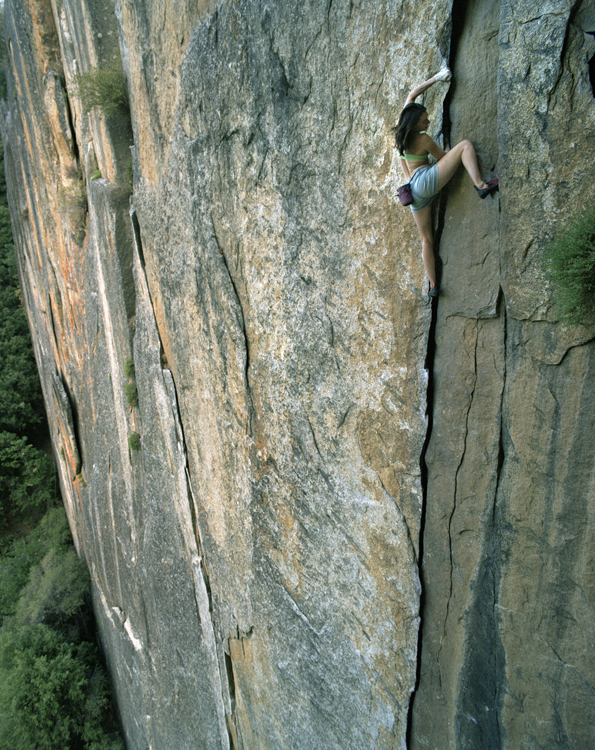
While many rock climbers have free soloed routes (single-pitch or big wall/multi-pitch), at climbing grades well below their ability, a very small minority have practiced free soloing regularly, and at grades closer to their overall limits. The most prominent of this smaller group are those who have broken new grade milestones in free solo climbing and gained a significant profile from their soloing:
- Alex Honnold – the most prolific and well-known free soloist of the 21st century, whose 2017 free solo of the route Freerider on El Capitan became the iconic film, Free Solo.
- Hansjörg Auer – the prolific big wall and high-altitude big wall free soloist, whose 2007 free solo of Fish Route on Marmolada was then the most daring in climbing history.
- Michael Reardon – prolific free soloist whose 2005 free solo of Romantic Warrior won him ''National Geographic'''s "Adventurer of the Year".
- Alexander Huber – one of the strongest rock climbers of the 1990s who set free solo grade milestones in single-pitch free soloing (with Kommunist), and big wall free soloing (with the Brandler-Hasse Direttissima).
- Alain Robert – the early 1990s and 2000s pioneer of buildering, but who also broke important new free solo grade milestones in the 1990s.
- Wolfgang Güllich – one of the strongest rock climbers of the late 1980s who set free solo milestones (Weed Killer), and did the iconic solo of Separate Reality.
- Catherine Destivelle – a leading female climber of the late 1980s, who made iconic free solos in single-pitch (El Matador), and big wall (Bonatti Pillar).
- Patrick Edlinger – a leading European free soloist of the 1980s, with iconic big wall free solos in the Verdon Gorge and Buoux, as featured in the 1982 climbing film, La Vie au bout des doigts.
- – prolific free soloist whose 1985 free solo of Revelations jumped several grade milestones in free solo climbing.
- Peter Croft – a prolific Canadian free soloist of the 1980s, who pioneered big wall free soloing with The Rostrum and Astroman.
- John Bachar – first free solo "superstar" and prolific American soloist of the late 1970s/early 1980s, who pioneered big wall soloing (Nabisco Wall). In addition, several other free solo practitioners are considered historically notable in free solo climbing and include the following: Ron Fawcett, , Brad Gobright, Dan Goodwin, Colin Haley, Derek Hersey, Jimmy Jewell, John Long, Dave MacLeod, Dan Osman, Dean Potter, Paul Preuss, and Tobin Sorenson.
Free soloing is less common amongst female rock climbers, however, as well as Catherine Destivelle, the following female climbers are historically notable free solo practitioners: Steph Davis and Brette Harrington, both of whom have free soloed single-pitch and big wall routes.
Evolution of grade milestones
Single-pitch routes

Main article: List of grade milestones in rock climbing#Free-solo, History of rock climbing
- 2019 : Relatively unknown Italian climber Alfredo Webber, aged 52, free soloed Panem et Circenses in Arco, Italy, first-ever free solo of an .
- 2004 : Alexander Huber free soloed Kommunist in the Tyrol, Austria; the first-ever free solo at grade .
- 1993 : Alain Robert free soloed Compilation in Omblèze, France; the first-ever free solo of an graded route.
- 1987 : Jean-Christophe Lafaille free soloed Rêve de gosse, at La Roche-des-Arnauds, France; considered the first-ever free solo at the grade of .
- 1986 : Wolfgang Güllich free soloed Weed Killer, at Raven Tor, in the Peak District, first-ever free solo at ; that same year, Gullich also did the iconic solo of Separate Reality .
- 1985 : free soloed Revelations, at Raven Tor, Peak District, the first-ever free solo at ; considered a feat that was a decade ahead of its time.
- 1982 : John Bachar free soloed Baby Apes, at Joshua Tree National Park, probably the first-ever free solo at .
- 1961 : John Gill free soloed—onsight—the first ascent of Thimble, the first-ever redpoint, and thus the first-ever free solo, at .
Big wall, multi-pitch routes
Main article: List of grade milestones in rock climbing#Free-soloed, History of rock climbing

- 2017 : Alex Honnold free soloed El Capitan via Freerider, first-ever big wall solo at ; becomes Oscar-winning film, Free Solo).
- 2007 : Hansjörg Auer free soloed Fish Route, on Marmolada, in the Dolomites, Italy, first-ever big wall solo at (35-pitches).
- 2005 : Michael Reardon free soloed, onsight, Romantic Warrior in the Sierra Nevada, USA, first-ever big wall solo at (10-pitches); wins National Geographic "Adventurer of the Year".
- 2002 : Alexander Huber free soloed, the 1,500 ft Hasse-Brandler on the Cima Grande, Dolomites, first-ever big wall solo at .
Climber fatalities
A number of notable free solo practitioners have died while free soloing:
- Paul Preuss (3 October 1913; age 27) died in a 300 m fall from the attempted first ascent of the North Ridge of the Mandlkogel (in the Gosaukamm) as a free solo.
- Jimmy Jewell died (31 October 1987; age 34) free soloing the easy route Poor Man's Peuterey (graded UK-Severe) at Tremadog, North Wales taking a short-cut.
- Tobin Sorenson, died (October 5, 1980; age 25) while free soloing Mount Alberta's North Face in the Canadian Rockies.
- Derek Hersey died (28 May 1993; age 36) while free soloing the Steck-Salathé Route on Sentinel Rock in Yosemite.
- Dwight Bishop died (19 July 2004; age 49) while climbing alone and unroped along the Grand Traverse route on Grand Teton peak in Wyoming.
- John Bachar died (5 July 2009; age 52) in a free solo accident at Dike Wall near Mammoth Lakes, California.
- Michael J. Ybarra died (July 2012; age 45) climbing solo on The Matterhorn Peak in California's Sierra Nevada Mountains.
Climbing magazine reported that a number of prominent free solo practitioners died in related or other extreme sports, including: Dan Osman (died at age 35 while rope jumping at Yosemite), Michael Reardon (died age 42 while rock climbing sea cliffs when he was carried out to sea by a rogue wave), Dean Potter (died age 43 while wingsuit flying when he crashed at Yosemite), Brad Gobright (died age 31 while abseiling at Potrero Chico), and Hansjorg Auer (died age 35 in an avalanche at Howse Peak).
In film
A number of notable films have been made focused on free solo climbing (both on rock and on ice) including:
- Race to the Summit, a 2023 documentary film about the rivalry between Ueli Steck and Dani Arnold in setting solo alpine speed records.
- The Alpinist, a 2021 documentary film about the late Canadian alpinist Marc-André Leclerc, featuring various free solo ice and alpine ascents.
- Free Solo, a 2018 documentary film about Alex Honnold's free solo climb of Freerider on El Capitan.
- King Lines, a 2007 documentary film about Chris Sharma, featuring his free solo climb of the DWS route, Es Pontàs , in Mallorca.
- Hard Grit, a 1998 documentary film about rock climbing on gritstone routes in the British Peak District, which features free soloing.
- Skyscraper Live, a 2026 Netflix special about Alex Honnold's free solo climb of the Taipei 101 building.
Notes
References
References
- (2023). "Free solo".
- Taylor, Will. (25 February 2019). "Why We Won't See a Rise in Free Solo Climbing Deaths After Alex Honnold's Story Won an Oscar".
- Green, Stewart. (20 July 2017). "Free Solo Climbing is Dangerous and Deadly".
- "Gale - User Identification Form".
- Berry, Natalie. "'Free Solo' enters Merriam-Webster Dictionary, Film Scoops 7 Emmys". UK Climbing.
- [[The Mountaineers (club). (2018). "[[Mountaineering: The Freedom of the Hills]]". Quiller Publishing.
- (9 August 2021). "The Origin and Early Evolution of Rock Climbing". Atlantis Press.
- Erikson, Jim. (19 April 2022). "Cleaning Up Climbing History. The Truth Behind 13 Pivotal Ascents and Events".
- Corrigan, Kevin. (22 October 2018). "Opinion: The Free Solo Documentary Addressed Some Uncomfortable Truths, But Ignored Others".
- Branch, John. (2014-11-14). "A Sponsor Steps Away From the Edge". The New York Times.
- "Alex Honnold".
- "The Most Mind-Bending Free Solo Climbs in History".
- (20 November 2014). "Climber Alex Honnold wrote an op-ed after Clif Bar dropped him as a sponsor".
- Potter, Stephen. (4 October 2022). "Why Do Climbers Free Solo?".
- Agafonov, Tyler. (22 September 2022). "Jeff Smoot's 'All and Nothing' dives deep into the world of free soloing". [[The Seattle Times]].
- Silver, Maya. (2026-01-24). "Alex Honnold Completes Biggest Urban Free Solo in History".
- Slavsky, Bennett. (12 March 2021). "Alfredo Webber, Age 52, Free Solos 5.14b".
- (2023). "Hardest route climbed (free solo)".
- Oviglia, Maurizio. (23 December 2012). "The Evolution of Free Climbing".
- (March 2008). "Being Bachar".
- Ament, Pat (2002). ''Wizards of Rock: A History of Free Climbing in America'', Wilderness Press
- Franz, Derek. (9 June 2017). "The world gasps in the aftermath of Alex Honnold's free solo of El Capitan's Freerider (5.13a, 3,000ft)".
- (2 November 2021). "This is Still a Gripping Free-Solo Video – Alex Huber on a 20-Pitch 5.12a".
- Osius, Alison. (4 June 2022). "Free Solo Rock Climbing and the Climbers Who Have Defined the Sport".
- Douglas, Ed. (17 June 2021). "Speed Soloing Is Climbing's Deadliest Game—It Has One Living Player".
- Pilastro, Eleonora. (6 December 2022). "The Real Spider-Man: Alain Robert climbs the world's tallest buildings".
- Bisharat, Andrew. (18 May 2015). "How Dean Potter Reinvented Climbing, Jumping, Flying".
- Clarke}} and Swiss mountaineer Dani Arnold.{{cite web, Owen. (20 December 2024). "A Climber We Lost: Martin Feistl".
- Bisharat, Andrew. (6 September 2022). "The 20 Best Climbing Films of All Time".
This article was imported from Wikipedia and is available under the Creative Commons Attribution-ShareAlike 4.0 License. Content has been adapted to SurfDoc format. Original contributors can be found on the article history page.
Ask Mako anything about Free solo climbing — get instant answers, deeper analysis, and related topics.
Research with MakoFree with your Surf account
Create a free account to save articles, ask Mako questions, and organize your research.
Sign up freeThis content may have been generated or modified by AI. CloudSurf Software LLC is not responsible for the accuracy, completeness, or reliability of AI-generated content. Always verify important information from primary sources.
Report