From Surf Wiki (app.surf) — the open knowledge base
Francis Daniel Pastorius
German-born American educator, lawyer, poet, and public official

German-born American educator, lawyer, poet, and public official
| Field | Value |
|---|---|
| image | Francis Daniel Pastorius relief.jpg |
| caption | Bas-relief impression of Francis Daniel Pastorius, c. 1897 |
| birth_name | Franz Daniel Pastorius |
| birth_date | |
| birth_place | Sommerhausen, Franconian Circle, Holy Roman Empire |
| death_date | |
| death_place | Germantown, Province of Pennsylvania, British America |
| occupation | lawyer, poet, scholar, schoolteacher, abolitionist, founder of Germantown, Pennsylvania |
| spouse |
Francis Daniel Pastorius (September 26, 1651 – February 17, 1719) was a German-born educator, lawyer, poet, and public official. He was the founder of Germantown, Pennsylvania, now part of Philadelphia, the first permanent German-American settlement and the gateway for subsequent emigrants from Germany.{{cite web |access-date=November 8, 2015}}{{cite web |access-date= November 8, 2015 |archive-url= https://web.archive.org/web/20151026013443/http://www.concordiatrust.org/deutsch/earlyhistory.htm |archive-date= October 26, 2015 |url-status= dead
Early life
Franz Daniel Pastorius was born in the Franconian town of Sommerhausen, to a prosperous Lutheran family. He received a Gymnasium education in Windsheim (also in Franconia), where his family moved in 1659. He was trained as a lawyer in some of the best German universities of his day, including the University of Altdorf, the University of Strasbourg and the Friedrich Schiller University of Jena. He started his practice in Windsheim and continued it in Frankfurt-am-Main. He was a close friend of the Lutheran theologian and Pietist leader Philipp Jakob Spener during the early development of Spener's movement in Frankfurt. From 1680 to 1682, he worked as a tutor accompanying a young nobleman during his Wanderjahr through Germany, England, France, Switzerland and the Netherlands.{{cite web |access-date=November 8, 2015}} Pastorius's biography reveals increasing dissatisfaction with the Lutheran church and state of his German youth in the Age of Absolutism. As a young adult his Christian morality even strained the relationship with his father Melchior Adam Pastorius (1624–1702), a wealthy lawyer and burgomaster in Windsheim. These difficulties came to a head in 1677–1679, years of tumult in this imperial city. After Pastorius had completed his doctorate in law, returned to Windsheim and begun his law career, his family and friends (with Habsburg backing) suppressed a popular insurrection against abuses of oligarchic rule. It was in this context that he left his home in 1679, joined the Lutheran Pietists in Frankfurt, and repeatedly urged adherence to Christ's Golden Rule. He emigrated to Pennsylvania four years later, and never went back to Windsheim.
To Philadelphia
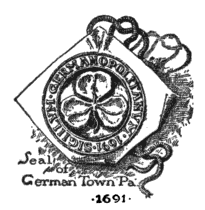
thumb|right|300px|Home of Francis Daniel Pastorius in Germantown, as it appeared circa 1919 In 1683, a group of Mennonites, Pietists, and Quakers in Frankfurt, the so called Original 13, including Abraham op den Graeff, a cousin of William Penn, approached Pastorius about acting as their agent to purchase land in Pennsylvania for a settlement. Pastorius took passage aboard the ship America and arrived in Philadelphia on August 20, 1683. In Philadelphia, he negotiated the purchase of 15,000 acres (61 km²) from William Penn, the proprietor of the colony, and laid out the settlement of Germantown, where he himself would live until his death. As one of Germantown's leading citizens, Pastorius served in many public offices. He was the first mayor and also was a member of the Pennsylvania General Assembly in 1687 and 1691.{{cite web |access-date= November 8, 2015 |archive-date= October 25, 2015 |archive-url= https://web.archive.org/web/20151025005412/http://www.germany.travel/en/ms/german-originality/heritage/famous-people/politics/franz-daniel-pastorius-founder-of-germantown.html |url-status= dead |access-date= November 8, 2015 |archive-date= September 2, 2019 |archive-url= https://web.archive.org/web/20190902210815/http://www.philaplace.org/story/1191/ |url-status= dead
Writings
He wrote extensively on topics ranging from beekeeping to religion. He was "the first poet of consequence in Pennsylvania . . . [and] one of the most important poets of early America" (Meserole, p. 294). His extensive commonplace compilations provide insight into early Enlightenment culture in colonial Pennsylvania. He was also a skilled poet whose work appears in the New Oxford Book of Seventeenth-Century Verse. Pastorius's most important book was his manuscript "Bee Hive", which is now in the University of Pennsylvania's rare book room.Brooke Palmiere, “What the Bees Have Taken Pains For:” Francis Daniel Pastorius, The Beehive, and Commonplacing in Colonial Pennsylvania (2009) https://www.researchgate.net/publication/304089001_What_the_Bees_Have_Taken_Pains_For_Francis_Daniel_Pastorius_The_Beehive_and_Commonplacing_in_Colonial_Pennsylvania Brooke Palmiere, “What the Bees Have Taken Pains For:” Francis Daniel Pastorius, The Beehive, and Commonplacing in Colonial Pennsylvania https://repository.upenn.edu/cgi/viewcontent.cgi?article=1009&context=uhf_2009 It is his commonplace book, which contains poetry, his thoughts on religion and politics, and lists of books he consulted along with excerpts from those books. Also of interest is his Geographical Description of Pennsylvania, first published under the title, Umständige geographische Beschreibung der allerletzt erfundenen Provintz Pennsylvania (1700). agriculture and medicine.
Personal
Pastorius married Ennecke Klostermanns (1658–1723) on November 6, 1688. They had two sons: Johann Samuel Pastorius (1690–1722) and Heinrich Pastorius (1692–1726). Though raised as an upper-class Lutheran, he converted to Lutheran Pietism as a young adult in Germany. He grew increasingly liberal in Pennsylvania, espousing universalism and moving close to Quakerism.{{cite web |access-date=November 8, 2015}}{{cite book |access-date=November 4, 2016}}
Famed band member Jaco Pastorius was his distant descendant.
Legacy
Anti-slavery stand
From among the Krefeld settlers, it was probably the Quakers who provided the impetus for the rejection of slavery. The 13 families from Krefeld had heard about the slave trade in the American colonies for the first time in Rotterdam on their trip to Pennsylvania. They could not imagine that they could own slaves in the land of brotherly love. However, the reality was different: Puritans and Quakers, who otherwise advocated for universal human rights, had no problems with human trafficking and did not believe it was wrong. In 1688, some years after their arrival, he drafted, together with Garret Hendericks, Derick op den Graeff, and Abraham op den Graeff the first protest against slavery in America. Pastorius was a cosigner of the 1688 Germantown Quaker Petition Against Slavery, the first petition against slavery made in the Thirteen Colonies. The protest was signed in the house of Thones Kunders, one of the first burgesses of Germantown. Before the American Civil War, when abolition of slavery was gaining strength, Pastorius was ripe for celebration. The Quaker poet John Greenleaf Whittier celebrated Pastorius's life—and particularly his anti-slavery advocacy—in Whittier also translated the Latin ode addressed to posterity, which Pastorius prefixed to his Germantown book of records.
Operation Pastorius
Despite the Quaker sympathies of Pastorius, his name was appropriated in 1942 by the Abwehr of Nazi Germany for "Operation Pastorius", a failed sabotage attack on the United States during World War II that included a target in Philadelphia.{{cite web |access-date= November 8, 2015 |archive-url= https://web.archive.org/web/20151218132240/http://www.montauklife.com/history/history_night_of_the_nazis.html |archive-date= December 18, 2015 |url-status= dead
Biographies
For generations Pastorius has won the affections of historians. In the early twentieth century, German-American scholars embraced him and the University of Pennsylvania professor Marion Dexter Learned (1857–1917) wrote a lengthy biography; Learned had access to papers that have subsequently been lost. In 1953 DeElla Victoria Toms wrote a Ph.D. dissertation on the intellectual and literary background of Francis Daniel Pastorius.
In 1985 John Weaver documented the cultural background of Pastorius's childhood and youth, and his reasons for emigrating to Pennsylvania in 1683. More recently Princeton University professor Anthony Grafton has written about Pastorius as a representative of European intellectual culture. Grafton's presidential address to the American Historical Association in 2012 was on Pastorius. Weaver extensively revised his earlier research in a book (in PDF) available online and published in 2016.{{cite book |access-date=November 4, 2016}} In 2012 Patrick Erben wrote A Harmony of the Spirits: Translation and the Language of Community in Early Pennsylvania. In 2017 Margo Lambert published "Mediation, Assimilation, and German Foundations in North America: Francis Daniel Pastorius as Cultural Broker."
Legacy

- The Pastorius Home Association, Inc. operates the Pastorius Haus in Bad Windsheim, Germany, and the Pastorius House in Germansville, Pennsylvania.{{cite web |access-date=November 8, 2015}}
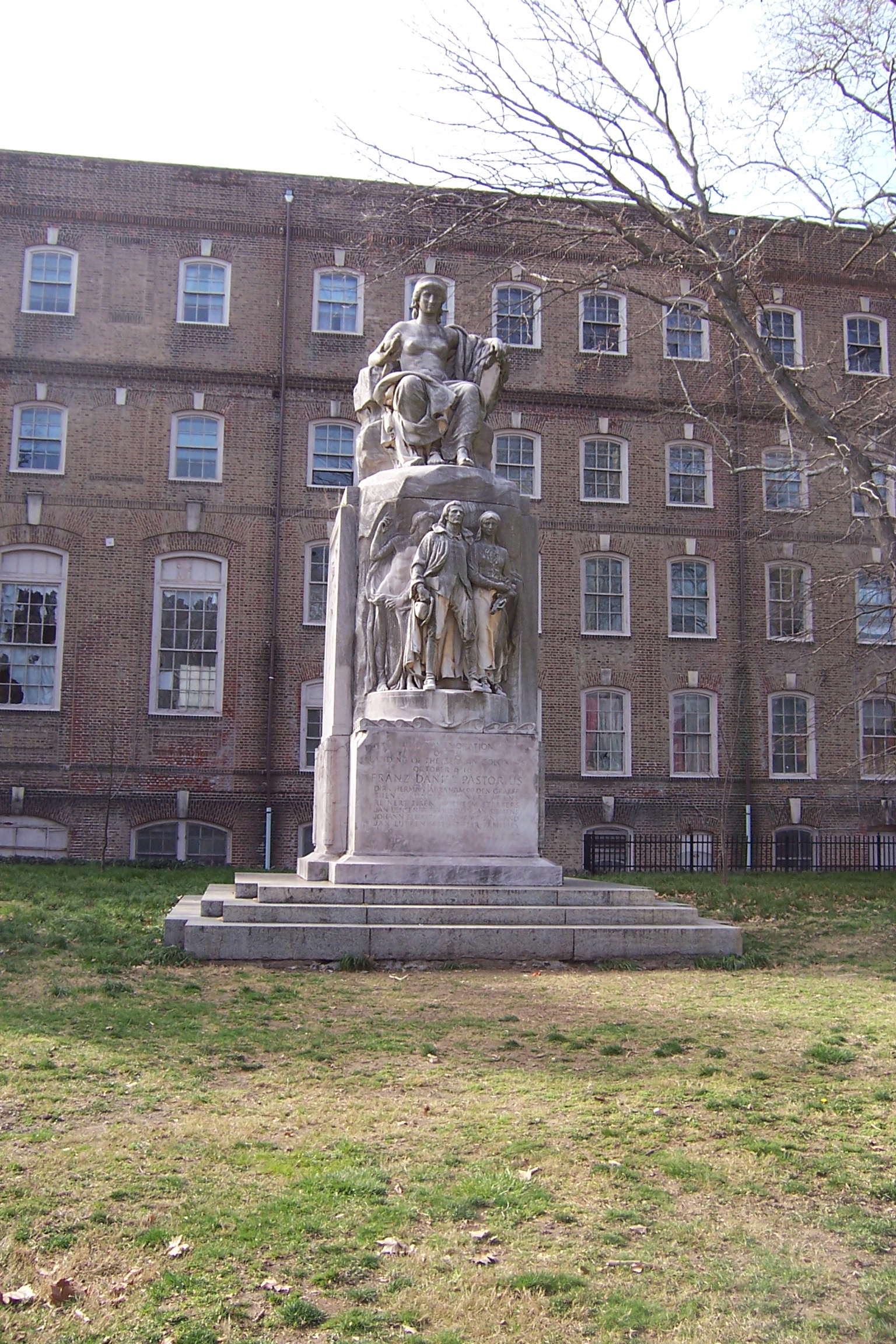
- The Pastorius Monument is located in Vernon Park in Northwest Philadelphia, PA.{{cite web |access-date=November 8, 2015}}
- Pastorius Park is located in the Chestnut Hill section of Philadelphia, PA.{{cite web |access-date=November 8, 2015}}
References
Other sources
- Bowden, Henry Warner (1977) *Dictionary of American Religious Biography * (Westport, CT:Greenwood Press)
- Brophy, Alfred L. "Ingenium est Fateri per quos profeceris: Francis Daniel Pastorius' Young Country Clerk's Collection and Anglo-American Legal Literature, 1682–1716," University of Chicago Law School Roundtable (1996) volume 3: 627–721.
- Dünnhaupt, Gerhard, "F. D. Pastorius" (Biography and Bibliography) in: Personalbibliographien zu den Drucken des Barock, vol. 4, (Stuttgart: Hiersemann, 1991, pp. 3075–3079)
- Genzmer, George Harvey "Pastorius, Francis Daniel," in Dumas Malone (ed.), Dictionary of American Biography, Vol. 7, Part 2, (New York: Charles Scribner's Sons, 1934 (1962 reprint), pp. 290–291)
- Gross, Leonard; Gleysteen, Jan (2007) Colonial Germantown Mennonites (Telford, PA: Cascadia)
- Hombrecher, Hartmut (2023) Transatlantischer Kulturtransfer. Franz Daniel Pastorius' Schriften als Literatur und Praxis (Göttingen: Wallstein)
- Meserole, Harrison T. (ed) "Seventeenth-Century American Poetry," Anchor Seventeenth-Century Series. (Garden City, N.Y.: Doubleday, 1968, pp. 293–304)
Writings by Pastorius
- Deliciæ Hortenses, or Garden-Recreations, and Voluptates Apianæ, ed. Christoph E. Schweitzer (Columbia, South Carolina: Camden House, 1982).
- Francis Daniel Pastorius Reader: Writings by an Early American Polymath, ed. Patrick Erben (University Press: Penn State Press, 2019).
- Marion Dexter Learned, “From Pastorius’ Bee-Hive or Bee-Stock,” Americana Germanica 1, no. 4 (1879): 67–110.
References
- Jenkins, Charles Francis. (1902). "The guide book to historic Germantown". Germantown.
- Franz Daniel Pastorius and Transatlantic Culture: German Beginnings, Pennsylvania Conclusions (Bamberg, Germany, 2016), pp. 88–89, 101–02, 168–69, 172, 187–92. {{ISBN. 978-3-00-054901-4
- Franz Daniel Pastorius and Transatlantic Culture: German Beginnings, Pennsylvania Conclusions (Bamberg, Germany, 2016), pp. 177–85, 187, 242. {{ISBN. 978-3-00-054901-4
- [https://books.google.com/books?id=ab9sDwAAQBAJ&q=Derick+op+den+Graeff William Penn and the Dutch Quaker Migration to Pennsylvania, by Prof. William I. Hull (2018)]
- Paul, Alice. (1912). "The legal position of women in Pennsylvania, 1912. - Colenda Digital Repository".
- (1991). "The New Oxford Book of Seventeenth Century Verse". Oxford University Press.
- This book also contains many of his letters home to Germany. His manuscripts include treatises on horticulture, law,Alfred L. Brophy, [http://blurblawg.typepad.com/files/young_country_clerks_collection.pdf "Francis Daniel Pastorius' Young Country Clerk's Collection and Anglo-American Legal Literature, 1682–1716,"] 3 University of Chicago Law School Roundtable 627–721 (1996).
- A. G. Roeber, Palatines, Liberty, and Property: German Lutherans in Colonial British America (Johns Hopkins University Press, 1993).
- Francis Daniel Pastorius Reader: Writings by an Early American Polymath, Patrick M. Erben ed. (Penn State University Press, 2019).
- [https://archive.org/details/settlementgerma00penngoog Pennypacker, Samuel W, "The Settlement of Germantown and the Beginning of the German Emigration to North America", Philadelphia, William Campbell, 1899]
- (2017). "Who Killed Jaco Pastorius?".
- [https://www.wz.de/krefelder-protestierten-gegen-sklaverei_aid-39318433 Westdeutsche Zeitung: Krefelder protestierten gegen Sklaverei (Article, june 7, 2019)]
- Katharine Gerbner, Writing against Slavery: Germantown, Quakers, and Ethnic Origins of Early American Antislavery Thought, ''Babel of Atlantic'' (Bethany Wiggin ed., Penn State University, 2019).
- {{Cite NIE. (1905)
- Learned, Marion Dexter. (1908). "The Life of Francis Daniel Pastorius, the Founder of Germantown: Illustrated with Ninety Photographic Reproductions". W. J. Campbell.
- DeElla Victoria Toms, The Intellectual and Literary Background of Francis Daniel Pastorius (Ph.D. diss. Northwestern Univ. 1953).
- John Weaver (1985) "Franz Daniel Pastorius (1651 – c. 1729): Early Life in Germany with Glimpses of his Removal to Pennsylvania," Ph.D. University of California, Davis.
- [http://www.nybooks.com/articles/archives/2010/dec/23/jumping-through-computer-screen/?pagination=false Anthony Grafton, Jumping Through the Computer Screen, ''New York Review of Books''].
- [https://archive.today/20130415132358/http://ahr.oxfordjournals.org/content/117/1/1.extract Anthony Grafton The Republic of Letters in the American Colonies: Francis Daniel Pastorius Makes a Notebook, ''American Historical Review,'' February 2012]. Anthony Grafton, Inky Fingers: The Making of Books in Early Modern Europe 152-185 (Harvard University Press, 2020).
- Patrick Erben, A Harmony of the Spirits: Translation and the Language of Community in Early Pennsylvania (UNC Press, 2012).
- Margo Lambert, Pennsylvania History 84 (2017): 141-70; Margo Lambert, Francis Daniel Pastorius: An American in Early Pennsylvania 1683-1719/20 (Ph.D. diss. Georgetown University, 2007).
This article was imported from Wikipedia and is available under the Creative Commons Attribution-ShareAlike 4.0 License. Content has been adapted to SurfDoc format. Original contributors can be found on the article history page.
Ask Mako anything about Francis Daniel Pastorius — get instant answers, deeper analysis, and related topics.
Research with MakoFree with your Surf account
Create a free account to save articles, ask Mako questions, and organize your research.
Sign up freeThis content may have been generated or modified by AI. CloudSurf Software LLC is not responsible for the accuracy, completeness, or reliability of AI-generated content. Always verify important information from primary sources.
Report