From Surf Wiki (app.surf) — the open knowledge base
Fourth Army (United Kingdom)
British field army during the First World War
British field army during the First World War
| Field | Value |
|---|---|
| unit_name | Fourth Army |
| image | 4th Army WW1.jpg |
| image_size | 150px |
| caption | 4th Army formation badge. |
| dates | First World War (1916–1918) |
| Second World War (1943–1944, as deception only) | |
| country | UKGBI |
| branch | |
| type | Army |
| notable_commanders | Sir Henry Rawlinson |
| battles | First World War |
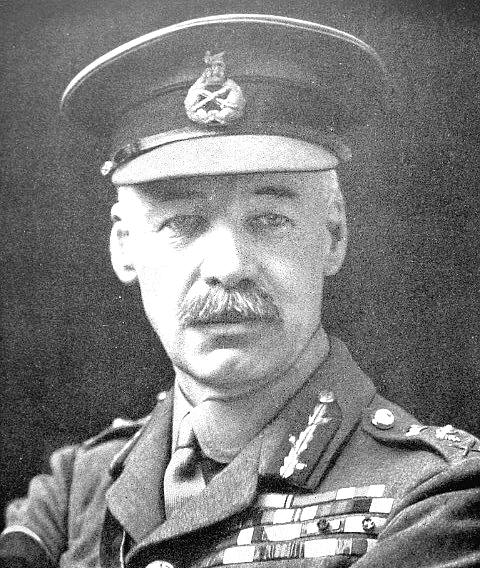
Second World War (1943–1944, as deception only) The Fourth Army was a field army that formed part of the British Expeditionary Force during the First World War. The Fourth Army was formed on 5 February 1916 under the command of General Sir Henry Rawlinson to carry out the main British contribution to the Battle of the Somme.
First World War
History
The Fourth Army was formed in France on 5 February 1916, under the command of Sir Henry Rawlinson. It was created in preparation for the Battle of the Somme after the French Tenth Army was transferred to the Battle of Verdun. On the first day on the Somme, eleven Fourth Army divisions (from XIII Corps, XV Corps, III Corps, X Corps and VIII Corps) attacked astride the Albert–Bapaume road. The attack was completely defeated on the northern sector, so subsequent Fourth Army operations concentrated on the southern sector, handing control of the northern sector to the Reserve Army.
The plan for the Fourth Army during the Third Battle of Ypres (31 July – 10 November 1917), was to mount Operation Hush, an amphibious invasion of the Belgian coast. Once the Germans had been pushed back from the Passchendaele–Westroosebeke ridge and an advance begun on Roeselare and Torhout, the XV Corps would mount the coastal operation. As the Ypres fighting became bogged down, the Fourth Army divisions were drawn off as reinforcements until the army was effectively disbanded.
The Fourth Army was reformed in early 1918—once again under Rawlinson—following the virtual destruction and subsequent disbanding of the Fifth Army during the German offensive known as Operation Michael.
The Fourth Army spearheaded the British Hundred Days offensive that began with the Battle of Amiens and ended with the Armistice in November, 1918.
Order of Battle
On the first day of the Somme the Fourth Army comprised:
- III Corps, commanded by Lieutenant-General Sir William Pulteney.
- VIII Corps, commanded by Lieutenant-General Aylmer Hunter-Weston. (transferred to Reserve Army on 4 July)
- X Corps, commanded by Lieutenant-General Thomas Morland. (transferred to Reserve Army on 4 July)
- XIII Corps, commanded by Lieutenant-General Walter Congreve.
- XV Corps
- 7th Division
- 17th (Northern) Division
- 21st Division
- 33rd Division
- 38th (Welsh) Division
- New Zealand Division
When reformed for the Battle of Amiens:
- Cavalry Corps, commanded by Lieutenant-General Kavanagh
- III Corps, commanded by Lieutenant-General Richard Butler
- 12th (Eastern) Division
- 18th (Eastern) Division
- 47th (2nd London) Division, included the 131st Infantry Regiment, 33rd American Division
- 58th (2/1st London) Division
- Canadian Corps, commanded by Lieutenant-General Arthur Currie
- Australian Corps, commanded by Lieutenant-General John Monash
- 17th (Northern) Division
- 1st Australian Division
- 2nd Australian Division
- 3rd Australian Division
- 4th Australian Division
- 5th Australian Division.
In September 1918 the Army was the only British force reinforced with substantial American (AEF) forces:
- II Corps, American Expeditionary Force under Major General George Read
Commanders
- February 1916–February 1918 General Sir Henry Rawlinson
- February–March 1918 General Sir William Birdwood (temporary)
- April 1918–March 1919 General Sir Henry Rawlinson
Second World War
In the Second World War, no Fourth Army took the field but as part of the deception plans Operation Cockade and the later Operation Fortitude North, the Germans were encouraged to believe that a Fourth Army had been established with its headquarters in Edinburgh Castle and was preparing to invade Norway. The selection of the inactive Fourth Army was likely very deliberate because of its combat history during the First World War. That diverted and kept German units away from the real invasion zone in Normandy. In the subsequent Operation Fortitude South, the Fourth Army, with different units, was presented as part of the fictitious First United States Army Group (FUSAG) in its threat to the Pas-de-Calais. After Operation Market Garden, the Fourth Army was notionally intended to conduct Operation Trolleybar, an amphibious assault upon the coast of the Netherlands and later along the German coast. It was to involve a landing by the phantom 76th Infantry Division until the deception was ended in January 1945.
Fictitious composition during Fortitude
Fortitude North
HQ at Edinburgh
- [[File:II corps.svg|22px]] British II Corps (fictitious - HQ Stirling)
- [[File:55 inf div -vector2.svg|22px]] 55th Infantry Division (Northern Ireland)
- 58th Infantry Division (fictitious, Aberlour)
- 113th Independent Infantry Brigade (garrison for Orkney and Shetland Islands)
- [[File:VII Corps WW1.jpg|22px]] VII Corps (fictitious - HQ Dundee)
- [[File:52 inf div -vector.svg|22px]] 52nd (Lowland) Infantry Division (Dundee)
- [[File:US 55th Infantry Division SVG.svg|22px]] US 55th Infantry Division (fictitious - Iceland)
- [[File:Ranger Tab.svg|23px]] 7th, 9th & 10th US Ranger battalions (fictitious - Iceland)
- [[File:US XV Corps SSI.svg|22px]] US XV Corps (Northern Ireland)
- [[File:2nd Infantry Division (US) SSI.png|16px]] US 2nd Infantry Division
- [[File:US 5th Infantry Division.svg|16px]] US 5th Infantry Division
- [[File:8th Infantry Division patch.svg|16px]] US 8th Infantry Division
Fortitude South
HQ at Hathfield
- 2nd Airborne Division (fictitious - Bulford)
- [[File:II corps.svg|22px]] II Corps (fictitious - HQ Tunbridge Wells)
- 35th Armoured Brigade (Maresfield)
- [[File:55 inf div -vector2.svg|22px]] 55th Infantry Division (Three Bridges
- British 58th Infantry Division (fictitious - Gravesend)
- [[File:VII Corps WW1.jpg|22px]] VII Corps (fictitious - HQ Folkestone)
- [[File:61 inf div -vector.svg|22px]] 61st Infantry Division (Wye)
- [[File:British 80th Infantry (Reserve) Badge.svg|22px]] 80th Infantry Division (fictitious - Canterbury)
- 5th Armoured Division (fictitious - Newmarket)
References
References
- [http://www.1914-1918.net/armies.htm The British Armies of 1914-1918]
- Robson, Stuart. (2007). "The First World War". Pearson Longman.
- "Battles of the Somme, 1916".
- "The Battle of Amiens".
- (2008). "1918 A Very British Victory". Phoenix.
- Major A. F. Becke, ''[[History of the Great War]]: Order of Battle of Divisions'', Part 4 (1944) pp. 99–105
- Roger Hesketh. ''Fortitude: The D-Day Deception Campaign''. St Ermins Press. 1999. {{ISBN. 978-0-316-85172-5
- Thaddeus Holt. ''The Deceivers: Allied Military Deception in the Second World War''. Phoenix. 2005. {{ISBN. 978-0-7538-1917-3
This article was imported from Wikipedia and is available under the Creative Commons Attribution-ShareAlike 4.0 License. Content has been adapted to SurfDoc format. Original contributors can be found on the article history page.
Ask Mako anything about Fourth Army (United Kingdom) — get instant answers, deeper analysis, and related topics.
Research with MakoFree with your Surf account
Create a free account to save articles, ask Mako questions, and organize your research.
Sign up freeThis content may have been generated or modified by AI. CloudSurf Software LLC is not responsible for the accuracy, completeness, or reliability of AI-generated content. Always verify important information from primary sources.
Report