From Surf Wiki (app.surf) — the open knowledge base
Four on the floor (music)
Rhythm used in contemporary music
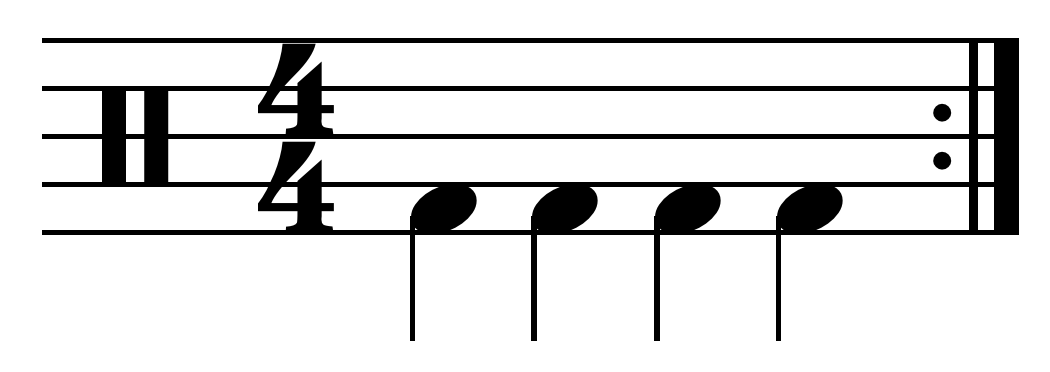
Rhythm used in contemporary music
Four-on-the-floor (or four-to-the-floor) is a rhythm used primarily in dance genres such as disco and electronic dance music. It is a steady, uniformly accented beat in time in which the bass drum is hit on every beat (1, 2, 3, 4). This was popularized in the disco music of the 1970s and the term four-on-the-floor was widely used in that era, since on a drum set, the beat is played with the pedal-operated, drum-kit bass drum.
Four on the floor was common in jazz drumming until bebop styles expanded rhythmic roles beyond the basics in the 1940s. Garage rock bands of the 1960s such as the Troggs and the Seeds used four-on-the-floor on some of their hits.
Many styles of electronic dance music use this beat as an important part of the rhythmic structure.
A form of four-on-the-floor is also used in jazz drumming. Instead of hitting the bass drum in a pronounced and therefore easily audible fashion, it is usually struck very lightly (referred to as "feathering") so that the sound of the drum is felt instead of heard by the listener. Typically, this is combined with a ride cymbal and hi-hat in syncopation. When a string instrument makes the rhythm (rhythm guitar, banjo), all four beats of the measure are played by identical downstrokes.
In reggae drumming, the bass drum usually hits on the third beat but sometimes drummers play four on the floor. Sly Dunbar from Sly and Robbie was one of the reggae drummers who played mostly in this style. Also Carlton Barrett from Bob Marley and the Wailers played four on the floor on several hits by the Wailers like "Is This Love" and "Exodus". In reggae, four on the floor usually goes by the hand with a low end and powerful bassline. Four on the floor can be found in more modern reggae derivative styles such as dancehall, while it is less common to find it in roots reggae. In the roots context, it is generally referred to as a "steppers" rhythm.
Stylistic differences
In South African music
Main article: Gqom
Sgubhu, a variant of gqom and a type of South African electronic dance music, shares some traits with gqom but sets itself apart with its beat structure. Unlike standard gqom, sgubhu is characterized by a much steadier kick drum pattern although having a kick pattern reminiscent of the three-step rhythm, often adhering to a consistent four-on-the-floor rhythm, which aligns more closely with traditional four-on-the-floor electronic dance music. There were several pioneers of the sgubhu genre, including record producer Emo Kid.
References
References
- "The Dance Music Manual: Tools, Toys and Techniques," [[Rick Snoman]] (2004) {{ISBN. 0-240-51915-9
- [[Peter Shapiro (journalist). Shapiro, Peter]]. (2000) ''[[Modulations: A History of Electronic Music. Modulations: a History of Electronic Music: Throbbing Words on Sound]]'', London: [[Distributed Art Publishers]], {{ISBN. 1-891024-06-X, p. 40
- (9 February 2022). "Four On the Floor: Modern Music's Most Popular Rhythmic Pattern".
- (25 February 2022). "Four-on-the-Floor Rhythm Explained".
- Goldsby, John. (2002). "The Jazz Bass Book: Technique and Tradition". Hal Leonard.
- (June 7, 2021). "Four-on-the-Floor Rhythm Explained".
- Sometimes the term is used to refer to a 4/4 uniform drumming pattern for any drum.Miller, Michael. ''The Complete Idiot's Guide to Playing Drums'', 2004. {{ISBN. 1-59257-162-X
- Keith, James. (11 October 2017). "Premiere: Emo Kid Explains South African Club Sound 'Sghubu', Shares New Track "Asbambeki"".
- (21 March 2019). "Afropop Worldwide {{!}} The Gqom Generation of Durban, South Africa".
- Murray, Eoin. (2020-10-15). "Selections: Griffit Vigo".
This article was imported from Wikipedia and is available under the Creative Commons Attribution-ShareAlike 4.0 License. Content has been adapted to SurfDoc format. Original contributors can be found on the article history page.
Ask Mako anything about Four on the floor (music) — get instant answers, deeper analysis, and related topics.
Research with MakoFree with your Surf account
Create a free account to save articles, ask Mako questions, and organize your research.
Sign up freeThis content may have been generated or modified by AI. CloudSurf Software LLC is not responsible for the accuracy, completeness, or reliability of AI-generated content. Always verify important information from primary sources.
Report