From Surf Wiki (app.surf) — the open knowledge base
Four Courts
Major court complex in Dublin, Ireland
.png)
Major court complex in Dublin, Ireland
| Field | Value |
|---|---|
| name | The Four Courts |
| image | Four Courts, DUBLIN - panoramio.jpg |
| caption | The Four Courts |
| map_type | Ireland Central Dublin |
| coordinates | |
| location_town | Inns Quay, Dublin |
| location_country | Ireland |
| architect | Thomas Cooley (1776-84) |
| James Gandon (1785-1802) | |
| Jacob Owen - Benchers' and Solicitors' building (1835-39) | |
| client | Kingdom of Ireland |
| construction_start_date | 1786 |
| building_type | Courthouse |
| material | Portland stone, granite, copper, cast iron, timber, steel, stucco, sandstone |
| altitude | 4 m |
| completion_date | |
| style | Neoclassical |
James Gandon (1785-1802) Jacob Owen - Benchers' and Solicitors' building (1835-39) The Four Courts () is Ireland's most prominent courts building, located on Inns Quay in Dublin. The Four Courts is the principal seat of the Supreme Court, the Court of Appeal, the High Court and the Dublin Circuit Court. Until 2010 the building also housed the Central Criminal Court; this is now located in the Criminal Courts of Justice building.
Court structure
The original courts building on St Michael's Hill close to Christchurch cathedral housed four superior courts, of Chancery, King's Bench, Exchequer and Common Pleas, giving the building its familiar name.
Under the Supreme Court of Judicature Act (Ireland) 1877, these four courts were replaced by two - the Court of Appeal, presided over by the Lord Chancellor, and the High Court of Justice, headed by the Lord Chief Justice - but the building has retained its historic name.
Under the Courts of Justice Act 1924, courts were established for the new Irish Free State with the Supreme Court of Justice, presided over by the Chief Justice, replacing the Court of Appeal and a reconstituted High Court of Justice, presided over by the President of the High Court, continuing the jurisdiction of the old High Court. The Constitution of Ireland in 1937 provided that courts would be established in a manner provided by the Constitution; this did not in fact occur until the implementation of the Courts (Establishment and Constitution) Act 1961. The Supreme Court and High Court (now dropping "of Justice" from their title) established under this act continued the jurisdiction of the courts established under the 1924 Act.
A new Court of Appeal was established in 2014, following a referendum in 2013, largely taking over the appellate jurisdiction of the Supreme Court and the old Court of Criminal Appeal. Its civil division sits in the Four Courts.
History
Prior to the construction of a dedicated courts building at the beginning of the 17th century, the courts sat in various locations around the city but mainly at Dublin Castle. For a brief period in 1606, the courts moved across the river to their current location however they soon moved back into the city due to pressure from Dublin Corporation.
St Michael's Hill structure
In 1608, a dedicated complex was built adjacent to Christ Church Cathedral on what is today St Michael's Hill which was in use as the four courts until opening of the present building around 1796.
Even after renovation and reconstruction works by William Robinson in 1695, there were constant complaints about the building's condition and location. Later works were supervised by Thomas Burgh from 1705-06 while Hugh Darley was also recorded as working as a stonecutter on the structure in 1749.
The Four Courts Marshalsea was originally also located nearby at that time between Winetavern Street and Fishamble Street. It later moved further east to an area around Bridgefoot Street and Thomas Street.
Gandon's building
thumb|right|160px|Part of the original Gandon-designed interior decoration of the dome, lost in the 1922 destruction
Work, based on the design of Thomas Cooley for the Public Records Office of Ireland, began in 1776. After Cooley died in 1784, renowned architect James Gandon was appointed to finish the buildings. It was built between 1786 and 1796, while the finishing touches to the arcades and wings were completed in 1802, The lands were previously used by the King's Inns. and before that a 13th-century Dominican Friary St. Saviour's was located on the site, confiscated following the dissolution of the monasteries by Henry VIII.
Easter Rising
The Four Courts and surrounding areas were held by Commandant Edward Daly's 1st Battalion during the Easter Rising in 1916. Some of the most intense fighting of Easter Week took place in the Church Street, North King Street and North Brunswick Street area. At the end of the week, the Four Courts building itself became the headquarters of the 1st Battalion.
Destruction in Civil War
Main article: Four Courts explosion
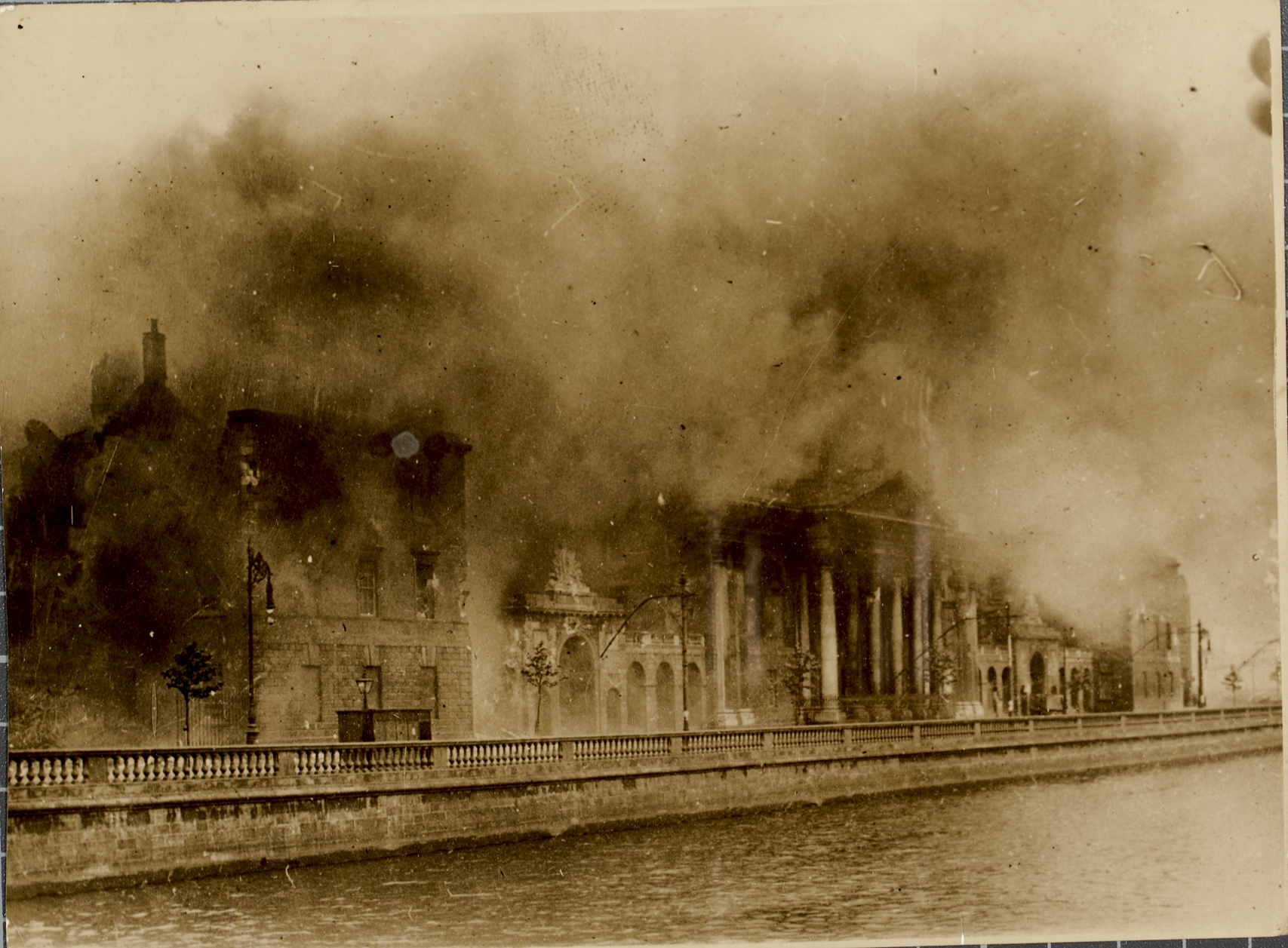
On 14 April 1922, the courts complex was occupied by IRA forces opposed to the Anglo-Irish Treaty, with Rory O'Connor acting as their spokesman. On 28 June the new National Army attacked the building to dislodge the "rebels", on the orders of the Minister for Defence Richard Mulcahy, authorised by President of Dáil Éireann Arthur Griffith. This attack provoked a week of fighting in Dublin. In the process of the bombardment, the historic building was destroyed. The west wing of the building was obliterated in a huge explosion, destroying the Irish Public Record Office at the rear of the building. Nearly a thousand years of archives were destroyed by this explosion, the ensuing fire, and the water poured onto the fire.
The IRA was accused of mining the records office; however, those present, who included future Taoiseach Seán Lemass, said that, while they had used the archive as a store of their ammunition, they had not deliberately mined it. They suggest that the explosion was caused by the accidental detonation of their ammunition store during the fighting.
Reopening in 1932
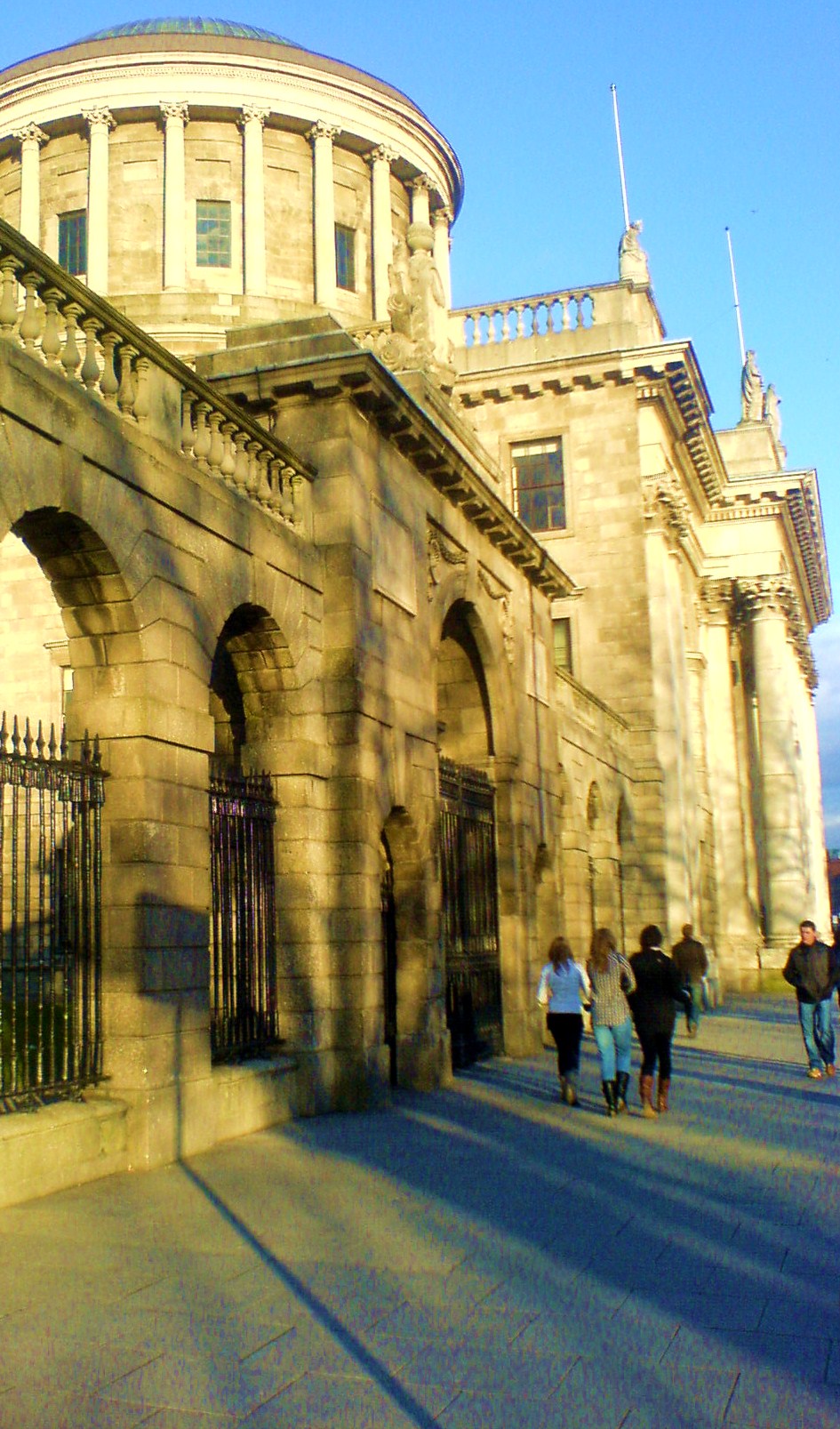
For a decade after the destruction of the Civil War, the courts sat in the old viceregal apartments in Dublin Castle. In 1932, a rebuilt and remodelled Four Courts was opened. However, much of the decorative interior of the original building had been lost and, in the absence of documentary archives (some of which had been in the Public Records Office and others of which were among the vast amount of legal records lost also), and also because the new state did not have the funds, the highly decorative interior was not replaced.
Further development
The Office of Public Works added a modern two-storey extension to the roof of the old Public Records Office in the late 1960s. They also built River House on Chancery Street, overlooking the courts.
Criminal courts
Prior to 2010, both civil and criminal trials were heard in the Four Courts, which was also the location of the Court of Criminal Appeal. When the Criminal Courts of Justice building, near the Phoenix Park, opened in January 2010, all criminal trials were transferred there. The Four Courts remain in use for civil matters.
Plans for Supreme Court building
There are plans to relocate the Supreme Court to a new purpose-built building near the Four Courts.
References
References
- "INNS QUAY, FOUR COURTS".
- Michal Boleslav Mechura. (10 December 2006). "Uimhreacha Na Gaeilge".
- "Four Courts". Incorporated Council of Law Reporting for Ireland.
- "Supreme Court of Judicature Act (Ireland) 1877". Irish Statute Book.
- "The Courts of Justice Act 1924". Irish Statute Book.
- (20 July 2014). "Court of Appeal Act 2014". [[Irish Statute Book]].
- "The Four Courts {{!}} The Courts Service of Ireland".
- (1813). "Remains of the old Four Courts, adjoining Christs [sic] Church, Dublin".
- (1986). "The Four Courts in Dublin Before 1796". Irish Jurist (1966-).
- "Robinson, Sir William {{!}} Dictionary of Irish Biography".
- "Dictionary of Irish Architects".
- (1986). "The Four Courts in Dublin Before 1796". Irish Jurist (1966-).
- [[Maurice Craig (historian). Maurice Craig]]: Dublin 1660–1860, page 243
- Colum Kenny, ''King's Inns and the Kingdom of Ireland: The Irish 'inn of court' 1541–1800'' (Irish Academic Press & Irish Legal History Society, 1992), pp. 261–5
- "St. Saviour's Dublin".
- "Four Courts". RTE.
- 'The Republic – the Fight for Irish Independence 1918–1923' Charles Townshend {{ISBN. 978-0-141-03004-3
- (30 June 2012). "Ruin of Public Record Office marked loss of great archive". Irish Times.
- McDonald, Frank. (1985). "The destruction of Dublin". Gill and Macmillan.
- McDonald, Dearbhail. (24 November 2009). "New order in court as €140m legal 'Pantheon' opens doors". [[Irish Independent]].
- Coulter, Carol. (24 November 2009). "First case set for new criminal courts". [[The Irish Times]].
- Gallagher, Conor. (2017-06-12). "Supreme Court to get its own building for the first time". [[The Irish Times]].
This article was imported from Wikipedia and is available under the Creative Commons Attribution-ShareAlike 4.0 License. Content has been adapted to SurfDoc format. Original contributors can be found on the article history page.
Ask Mako anything about Four Courts — get instant answers, deeper analysis, and related topics.
Research with MakoFree with your Surf account
Create a free account to save articles, ask Mako questions, and organize your research.
Sign up freeThis content may have been generated or modified by AI. CloudSurf Software LLC is not responsible for the accuracy, completeness, or reliability of AI-generated content. Always verify important information from primary sources.
Report