From Surf Wiki (app.surf) — the open knowledge base
Fort William, West Bengal
Fort in Calcutta, India

Fort in Calcutta, India
| Field | Value | |
|---|---|---|
| name | Fort William | |
| native_name | Vijay Durg | |
| location | Kolkata, West Bengal, India | |
| image | Fortwilliam1828.jpg | |
| image_size | 300px | |
| caption | Fort William, a view from the inside, | |
| pushpin_map | India Kolkata | |
| coordinates | ||
| type | Fortress, garrisoned and armoured army headquarters. | |
| built | 1696– | |
| used | 1781–present | |
| controlledby | {{plainlist | |
| garrison | Eastern Command | |
| battles | Battle of Plassey (1757) |
- Bengal Subah (before 1757)
- British East India Company (1757–1858)
- British Raj (1858–1947)
- Indian Army (1947–present)}}
Fort William, officially Vijay Durg, is a fort in Hastings, Calcutta (Kolkata). It was built during the early years of Britain's administration of Bengal. It sits on the eastern banks of the River Hooghly, the major distributary of the River Ganga. One of Kolkata's most enduring British-era military fortifications, other than those in Bombay (Mumbai) and Madras (Chennai), it extends over an area of seventy hectares.
The fort was named after King William III. In front of the Fort is the Maidan, the largest park in the country. An internal guard room became the Black Hole of Calcutta. Today the fort is the headquarters of Eastern Command of the Indian Army.
History
Main article: History of Kolkata
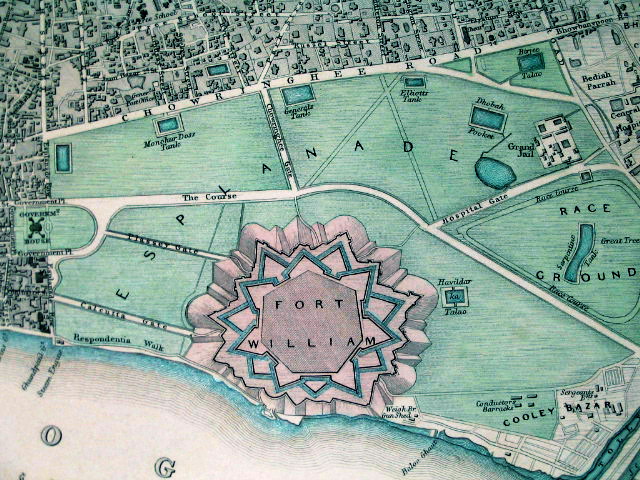
There are two Fort Williams. The original fort was built in the year 1696 by the British East India Company under the orders of Sir John Goldsborough which took a decade to complete. The permission was granted by Mughal Emperor Aurangzeb. Sir Charles Eyre started construction near the bank of the Hooghly River with the South-East Bastion and the adjacent walls. It was named after King William III in 1700. John Beard, Eyre's successor, added the North-East Bastion in 1701, and in 1702 started the construction of the Government House (Factory, see Factory (trading post)) at the centre of the fort. Construction ended in 1706. The original building had two stories and projecting wings. In 1756, the Nawab of Bengal, Siraj Ud Daulah, attacked the Fort, temporarily conquered the city, and changed its name to Alinagar. This led the British to build a new fort in the Maidan. Robert Clive started rebuilding the fort in 1758, after the Battle of Plassey (1757); construction was completed in 1781 at a cost of approximately two million pounds. The area around the Fort was cleared, and the Maidan became "the Lungs of Kolkata". It stretches for around 3 km in the north–south direction and is around 1 km wide.
Today, Fort William is the property of the Indian Army. The headquarters of Eastern Command is based there, with provisions for accommodating 10,000 army personnel. The Army guards it heavily, and civilian entry is restricted.
Much of Fort William is unchanged, but St Peter's Church, which used to serve as a chaplaincy centre for the British citizens of Kolkata, is now a library for the troops of HQ Eastern Command. A major part of the land parcel is home to the family of Army.
A war memorial has been created at the entrance of the fort, and the fort also houses a museum which displays artifacts from the Indo-Pakistani War of 1971, especially those related to the battles in the Eastern sector and the Bangladesh Liberation War.
The fort was officially renamed to Vijay Durg, in honour of the oldest fort along Maharashtra's Sindhudurg coast, in 2025.
First Indian Masonic lodge
In 1730, Ralph Farrwinter and other members of the East India Company opened the first Indian Masonic lodge, a short time after the creation of the Grand Lodge of England in 1717.
Presidency of Fort William
Main article: Bengal Presidency
Structure
The Fort is built of brick and mortar in the shape of an irregular octagon with an area of 5 sqkm. Five of its sides face landward, and three towards the Hooghly River. The design is that of a star fort, suited to defence against cannon firing solid shot, and dates from before the advent of explosive shells. A dry moat 9 m deep and 15 m broad surrounds the fort. The moat can be flooded but is designed as an area in which to use enfilade (or flanking) fire against any attackers reaching the walls. There are six gates: Chowringhee, Plassey, Calcutta, Water Gate, St Georges and the Treasury Gate. There are similar forts at places like Thalassery in Kerala.
Gallery
File:Fort William, Calcutta, 1735.jpg|Fort William, 1735 File:"A Perspective View of Fort William" by Jan Van Ryne, 1754.jpg|Fort William, by Jan Van Ryne, 1754 File:Fort William, Calcutta.jpg|Fort William, Calcutta, 1756 File:First English Chapel, Fort William, Calcutta. Raised in 1714, with contribution of Rs. 1000 by the East India Company (p. 197, March 1824).jpg|First English Chapel, Fort William, Calcutta. Raised in 1714, with contribution of Rs. 1000 by the East India Company (p. 197, March 1824) File:St Peter's Church, Fort William, Calcutta by William Prinsep 1835.jpg|St Peter's Church, Fort William by William Prinsep 1835 File:Old Fort William plate17.jpg|Fort William, River Face 1786 (from a coloured engraving by Thomas Daniell). File:'The interior of the Arsenal, Fort William', Calcutta by William Prinsep 1835.jpg|The interior of the Arsenal, Fort William by William Prinsep 1835 File:Samuel Davis - Fort William, Calcutta - B1977.14.244 - Yale Center for British Art.jpg|Fort William by Samuel Davis File:Main Entrance - Fort William - Kolkata 2013-04-10 7736.JPG|Main entrance, Fort William 2013 File:South Gate - Fort William - Kidderpore Road - Kolkata 2013-04-10 7733.JPG|South gate, Fort William 2013 File:Fort William Church.jpg|St. Peter's Church, Fort William, Kolkata File:Fort William Semaphore.jpg|Semaphore Tower, Fort William, Kolkata File:Gates of Fort William in Kolkata 01.jpg|Main Gates of Fort William
References
References
- Krishna Dutta. (2003). "Calcutta: A Cultural and Literary History". Signal Books.
- Sudip Bhattacharya, Unseen Enemy: The English, Disease, and Medicine in Colonial Bengal, 1617 – 1847, Cambridge Scholars Publishing, 30 Jun 2014, p.54
- "Fort William Kolkata India - History of Fort William".
- Verma, Amrit. (1985). "Forts of India". The Director of Publication Division, Ministry of Information and Broadcasting, Government of India.
- "History | Directorate of Ordnance (Coordination and Services) | Government of India". Ddpdoo.gov.in.
- (16 December 2013). "Memories of 1971 Bangladesh War come alive in Army museum". Economic Times.
- (17 December 2013). "Indian Army to throw parts of Eastern Command HQ open for public". Economic Times.
- (2025-02-05). "Fort William, Army’s Eastern HQ, renamed Vijay Durg". The Hindu.
- [[Simon Deschamps]]. (2017). "Merchant and Masonic Networks in Eighteenth-Century Colonial India". L'Empire.
- Joseph F. G. Golder. "Freemasonry in British India (1728–1888)".
- Nandakumar Koroth, ''History of Forts in North Malabar''
- Grant, James. (1873). "British Battles On Land and Sea". Cassell & Company, Limited.
- (February 1824). "The Gentleman's Magazine, and Historical Chronicle". The Gentleman's Magazine, and Historical Chronicle.
This article was imported from Wikipedia and is available under the Creative Commons Attribution-ShareAlike 4.0 License. Content has been adapted to SurfDoc format. Original contributors can be found on the article history page.
Ask Mako anything about Fort William, West Bengal — get instant answers, deeper analysis, and related topics.
Research with MakoFree with your Surf account
Create a free account to save articles, ask Mako questions, and organize your research.
Sign up freeThis content may have been generated or modified by AI. CloudSurf Software LLC is not responsible for the accuracy, completeness, or reliability of AI-generated content. Always verify important information from primary sources.
Report