From Surf Wiki (app.surf) — the open knowledge base
Foreign relations of Germany
none
Summary
none
The Federal Republic of Germany (up until 1990 abbreviated as FRG, opposed to GDR) is a Central European country and founding member of the European Union, a member of G4, G7, the G20, the Organizations for Economic Co-operation and Development, the North Atlantic Treaty Organization (NATO) and the only remaining of two former German members of the United Nations. It maintains a network of 229 diplomatic missions abroad and holds relations with more than 190 countries. As one of the world's leading industrialized countries it is recognized as a major power in European and global affairs.
Germany's relations to other powers are characterized by its past and by its commitment to promote peace, stability, the rule of law and democracy, while it seeks a progressing integration into the European Union. The heavily West-aligned Germany inherited diplomatic relations and missions from communist East Germany, which was "Germany" to those countries which had only relations to one of the two German states. However, due to its allegiance and market economy, the perception of Germany by some of the former Eastern bloc countries changed with Germany's reunification.
History
Main article: History of German foreign policy
Before 1866, Habsburg Austria and its German Confederation were the nominal leader in German affairs, but the Hohenzollern Kingdom of Prussia exercised increasingly dominant influence in German affairs, owing partly to its ability to participate in German Confederation politics through its Brandenburg holding, and its ability to influence trade through its Zollverein network. The question of excluding or including Austria's influence was settled by the Prussian victory in the Austro-Prussian War (also named the German War or the German-German War) in 1866, excluding the Austrian Empire from Germany. The unification of Germany was the political purpose of the Franco-Prussian War of 1870–71, in which the smaller German states joined behind remaining Prussia in a smashing victory over France. The German Empire was erected in 1871 by Otto von Bismarck, who dominated German and indeed all of European diplomatic history until he was forced to resign in 1890.
Germany's diplomatic weight increased by transitioning its economy and society from an agrarian country to Europe's second industrial powerhouse, which soon sought competition with the leading economic power of that era, Great Britain. As from 1884, Germany engaged – as the last major European power – in overseas colonization, but held only few colonies for economical exploitation, leaving Germany vulnerable to the protectionist mercantilism of other colonial powers who controlled the world's market of raw materials. Germany's development and transition led to internal tensions, which Emperor Wilhelm II., infamous for his Hun speech throughout Europe and an increasing diplomatic liability, sought to hedge with naval armament and increased imperialism much to the suspicion of the other European powers, especially the Entente Cordiale. Encircled by the Triple Entente, and due to the negligence of Germany's emperor and his diplomatic advisors by giving Austria-Hungary a "blank cheque" on treating Entente-allied Serbia for the assassination of Archduke Ferdinand, the Empire of Germany had to fight back its enemies in a war on multiple fronts and was cut off from international trade routes, leading to hunger and impoverishment in Europe's most populous country.
Germany was defeated in the battlefield in 1918, with its riches turning to spoils for the victors. The country had neither say nor seat at the table on which the victors negotiated how Germany and its treasures would be apportioned. The Treaty of Versailles forced Germany to convey away Alsace-Lorraine to France, a part of East Prussia to the Second Polish Republic and to accept the occupation of major industrial areas around Germany's centers for coal and steel production in Silesia and the Rhine province. When Germany was unable to fulfill the Allied demand for reparations in gold, France occupied the Ruhr valley to shave Germany's coal production. The Weimar Republic had to solve these crises to gain back its international stand in diplomacy, which lead Germany to joining the League of Nations in 1926.
However, the ransack and ongoing compromisation of Germany after World War I came with a toll on its internal stability and put the republic's attempt to establish peace and order to failure and its diplomatic influence from marginal to inept. Political extremist factions from left and right put the screws on Germany's politics by rallying against the weakened republic. International indifference to the events in the defeated country only turned into cautious unease after the Reichstag fire and Adolf Hitler's rise to power in 1933. The newly appointed chancellor ran on a platform of revising the Treaty of Versailles by rearmament, shaking off the shackles of occupation and "gaining room to live" (occupation) in the East. Racial and genocidal undertones in his program were internationally ignored as the new government was able to establish the long-sought peace and order in Germany and pursued international recognition as a stabilizing power: although Hitler's government withdrew Germany's membership from the League of Nations in 1933 much to the wary of the remaining nations, Germany managed to appease the world by hosting the Olympic Games of 1936 and presenting the world a stable, progressive and prospering country while secretly starting a program for rearmament at the same time. Shortly after the games, Germany signed the Anti-Comintern Pact with Japan, which sought to establish a common sphere of interest between Germany and Japan and their allied countries as well. Initially the pact was directed against the Soviet Union.
Despite its public presentation, Germany soon would raise suspicion by its rapidly progressing military programs, which weren't overlooked by international press. With massive interference in the internal affairs of Austria, which was unable to overcome economical challenges for 20 years after the fall of the Austro-Hungarian Empire, Germany managed to annex Austria in the Anschluss, reversing the resolution of the German war 70 years earlier and violating the Treaty of Versailles once again, which forbade the union of both countries. Germany tested its newly gained strength on boosting the Sudeten crisis of 1938, as Sudeten Germans, attracted by Germany and its success, rebelled against Czechoslovak authorities. The crisis lead to the Munich Agreement, the first gain in territory for Germany since World War I. However, Hitler was dissatisfied with how the crisis was solved peacefully. The policy of appeasement by Neville Chamberlain allowed for Hitler to violate the agreement shortly after signing it, by dissolving the Czechoslovak government and occupying the rest of the country in 1939, followed by the wary European powers of France and Great Britain to draw a red line for Poland. Germany signed the Pact of Steel with Italy, shaping with the Anti-Comintern Pact with Japan before and with the Tripartite Pact later on, what will come to be the Axis alliance.
After signing the Molotov-Ribbentrop Pact with the USSR on 24 August 1939, which led Japan to distance itself from Germany until the Tripartite Pact was signed in 1940, Germany invaded Poland on 1 September 1939, with the declaration of war followed by Britain and France three days later. The declarations of war did little to change the outcome of the Blitzkrieg against Poland, which soon was occupied by German and Soviet forces. Less than two years later, Germany would invade the USSR under violation of the pact. The same year, the Axis-allied Japanese Empire would attack Pearl Harbor, and as Germany was bound to aid Japan diplomatically by the Tripartite Pact, Hitler declared war against the USA four days after, unintentionally ending any remaining meaningful isolationist opposition in the U.S. against joining the European war and changing the U.S. stance to the rest of the world to this day.
The following years, German diplomacy is occupied with supporting the war effort and keeping together the Axis alliance as well as attending to the minor Axis-allied governments in Europe, such as Hungary, Romania, Slovakia, Bulgaria (all Warsaw Pact states after the Soviet Union won the war in the East) and Croatia to facilitate the "Final Solution". As Germany found itself on the losing side over time, Germany's diplomacy lost its ability to back up the increasingly futile war effort. Only the invocation of favors and long-lasting diplomatic aid and relationships with countries like Chile and Argentina, as well as their own network, enabled the escape of some Nazi high-ranks and collaborators into exile, such as Dr. Josef Mengele. The government of Germany, and therefore its diplomatic corps, ceased to exist according to the Allied Control Council's 1st Proclamation.
Germany as a state was only reestablished in August 1949 in three of the four Allied occupation zones, but international representation for the state was not reestablished until 15 March 1951. As a habit, chancellor Konrad Adenauer employed former Nazis for his administration, and for foreign affairs, he employed former NSDAP diplomats, which left a dark stain on the founding history of the newly formed Federal Foreign Office as a democratic institution.
The first years of the Bonn republic were characterized by the efforts of a second democratic Germany to rehabilitate itself in the eyes of the world. Adenauer's government decided to align West Germany with the Western bloc and made controversial decisions in its early years. Only ten years after World War II has ended, his government decided to rearm Germany once again, founding the Bundeswehr in 1955 and joining the NATO, after he discarded Stalin's attempt to negotiate reunification and neutralization of Germany in 1952. The years of Germany's division and the relations of the two German states, West-German FRG and East-German GDR, to each other mirrored the grander conflict at the Iron Curtain and the two systems. Mutual distrust, exclusion and agitation against one another captured the division of the two German nations. The FRG would characterize any attempt to open diplomatic relations to "the other German state" as an unfriendly act which would provoke the closure of the West-German diplomatic mission in the attempting country. The GDR assumed the sole right of representation for all Germans within the Eastern bloc. However, West Germany attracted some of the communist countries to open diplomatic missions despite the risk of spurning the East-German government, as the Eastern bloc was in dire need of hard currency and its members tried to open channels to markets which would trade in such.
In the 1970s, chancellor Willy Brandt would attempt to ease the relations between the two German states to prevent future confrontations like the Cuba crisis a few years earlier, in which the world narrowly escaped a World War III and nuclear annihilation. West Germany acknowledged the borders which were established after World War II, namely the Oder–Neisse line with Poland. The chancellor's Kniefall von Warschau would mark a major pivot point in the international perception of Germany, from a defeated and criminal warmongering power to a society which collectively would feel ashamed by its past, would swear to abstain military power and dominance and to uphold peace and to seek friendly relations with the People Germany wronged in the past. The gesture found cautiously positive remarks internationally, and Willy Brandt was awarded the Nobel Peace Prize of 1971, to this day the only German chancellor ever being awarded the prize. 1973, both East and West Germany became United Nations members.
Willy Brandt's policies helped grander diplomatic efforts between the two super powers and would bear fruit shortly after his tenure, when the Helsinki Accords were signed in 1975. The Accords enabled organizations of the civil society and NGOs to assess whether the Soviet Union would abide the legally binding declarations it signed, for the rule of law, civil liberties and guarantees of property. They also lead to the arising of human rights activism in the East bloc and to media activity directed from the West towards the East.
Especially for the partaking East German government, which was confident at first the Accords would denote a victory for East bloc diplomacy, the Accords would turn out to be a calamity in internal affairs. West German media, consumed by the East German population despite attempts of inhibition, informed their audience about their rights the East German government just signed off on, very much including the sensitive issue of freedom of movement, especially between the two German states which shared a fortified and dangerous-to-life border, symbolized by the Berlin Wall. Ever since the Accords have been signed, the East German government had to face increasing mail of citizens who petitioned for "permanent departure" to West Germany, invoking the Helsinki Accords.
As East Germany's economical situation became untenable in the 1980s, West German prime minister of Bavaria, Franz Josef Strauß, procured a new credit line for the GDR in 1983, which (by its interest) would impede the economical collapse of East Germany. Combined with the growing frictions within East Germany's society and the continuous escape movement of Germans through Eastern Europe and diplomatic missions of Germany, the GDR would survive its 40th anniversary and peaceful protests by only less than a year, with the collapse of its communist government heavily quickened by negotiations of West Germany to enable the "permanent departure" of Germans by a non-stop train from the Czech Republic through East Germany to West Germany. The departure met intense media coverage, creating a lasting impression on both sides of the German border and forecasting the eventual fall of the Berlin Wall.
In 1990, both German states with both freely elected governments, as well as the four former occupying powers, would sign an agreement about Germany's future. The agreement became effective on 3 October of the same year, which became the German Unity Day.
Primary institutions and actors
Federal Cabinet
The three cabinet-level ministries responsible for guiding Germany's foreign policy are the Ministry of Defense, the Ministry of Economic Cooperation and Development and the Federal Foreign Office. In practice, most German federal departments play some role in shaping foreign policy in the sense that there are few policy areas left that remain outside of international jurisdiction. The bylaws of the Federal Cabinet (as delineated in Germany's Basic Law), however, assign the Federal Foreign Office a coordinating function. Accordingly, other ministries may only invite foreign guests or participate in treaty negotiations with the approval of the Federal Foreign Office.
Bundestag
With respect to foreign policy, the Bundestag acts in a supervisory capacity. Each of its committees – most notably the foreign relations committee – oversees the country's foreign policy. The consent of the Bundestag (and insofar as Länder are impacted, the Bundesrat) is required to ratify foreign treaties. If a treaty legislation passes first reading, it is referred to the Committee on Foreign Affairs, which is capable of delaying ratification and prejudice decision through its report to the Bundestag.
In 1994, a full EU Committee was also created for the purpose of addressing the large flow of EU-related topics and legislation. Also, the committee has the mandate to speak on behalf of the Bundestag and represent it when deciding an EU policy position. A case in point was the committee's involvement regarding the European Union's eastern enlargement wherein the Committee on Foreign Affairs is responsible for relations with ECE states while the EU Committee is tasked with the negotiations.
NGOs
There is a raft of NGOs in Germany that engage foreign policy issues. These NGOs include think-tanks (German Council on Foreign Relations), single-issue lobbying organizations (Amnesty International), as well as other organizations that promote stronger bilateral ties between Germany and other countries (Atlantic Bridge). While the budgets and methods of NGOs are distinct, the overarching goal to persuade decision-makers to the wisdom of their own views is a shared one. In 2004, a new German governance framework, particularly on foreign and security policy areas, emerged where NGOs are integrated into actual policymaking. The idea is that the cooperation between state and civil society groups increases the quality of conflict resolution, development cooperation and humanitarian aid for fragile states. The framework seeks to benefit from the expertise of the NGOs in exchange for these groups to have a chance for influencing foreign policy.
Disputes
Chancellor [[Gerhard Schröder]] with U.S. President [[George W. Bush]] at the White House in 2001
In 2001, the discovery that the terrorist cell which carried out the attacks against the United States on 11 September 2001, was based in Hamburg, sent shock waves through the country.
The government of Chancellor Gerhard Schröder backed the following U.S. military actions, sending Bundeswehr troops to Afghanistan to lead a joint NATO program to provide security in the country after the ousting of the Taliban.
Nearly all of the public was strongly against America's 2003 invasion of Iraq, and any deployment of troops. This position was shared by the SPD/Green government, which led to some friction with the United States.
In August 2006, the German government disclosed a botched plot to bomb two German trains. The attack was to occur in July 2006 and involved a 21-year-old Lebanese man, identified only as Youssef Mohammed E. H. Prosecutors said Youssef and another man left suitcases stuffed with crude propane-gas bombs on the trains.
As of February 2007, Germany had about 3,000 NATO-led International Security Assistance Force force in Afghanistan as part of the war on terrorism, the third largest contingent after the United States (14,000) and the United Kingdom (5,200). German forces are mostly in the more secure north of the country.
However, Germany, along with some other larger European countries (with the exception of the UK and the Netherlands), have been criticised by the UK and Canada for not sharing the burden of the more intensive combat operations in southern Afghanistan.
Global initiatives
Humanitarian aid and development cooperation
Germany is the second largest net contributor to the United Nations. The development policy of the Federal Republic of Germany is an independent area of German foreign policy. It is formulated by the Federal Ministry for Economic Cooperation and Development (BMZ) and carried out by the implementing organisations, which are currently working in more than 60 countries. The German government sees development policy as a joint responsibility of the international community. In 2024 Germany was the second biggest donor of development cooperation after the United States, spending 32.4 billion USD, equivalent to 0.67% of GNI, on Official development assistance.
Ecological involvement
Main article: Kyoto protocol, Intergovernmental Panel on Climate Change
International organizations
Germany is a member of the P5+1, Council of Europe, European Union, European Space Agency, G4, G7, International Monetary Fund, NATO, OECD, Organization for Security and Co-operation in Europe, UN, World Bank Group and the World Trade Organization.
European Union
Main article: Foreign relations of the European Union
The [[flag of Europe
European integration has gone a long way since the European Coal and Steel Community (ECSC) and the Elysée Treaty. Peaceful collaborations with its neighbors remain one of Germany's biggest political objectives, and Germany has been on the forefront of most achievements made in European integration:
Maastricht Treaty
Most of the social issues facing European countries in general: immigration, aging populations, straining social-welfare and pension systems – are all important in Germany.
Germany seeks to maintain peace through the "deepening" of integration among current members of the European Union member states
European Defence Force
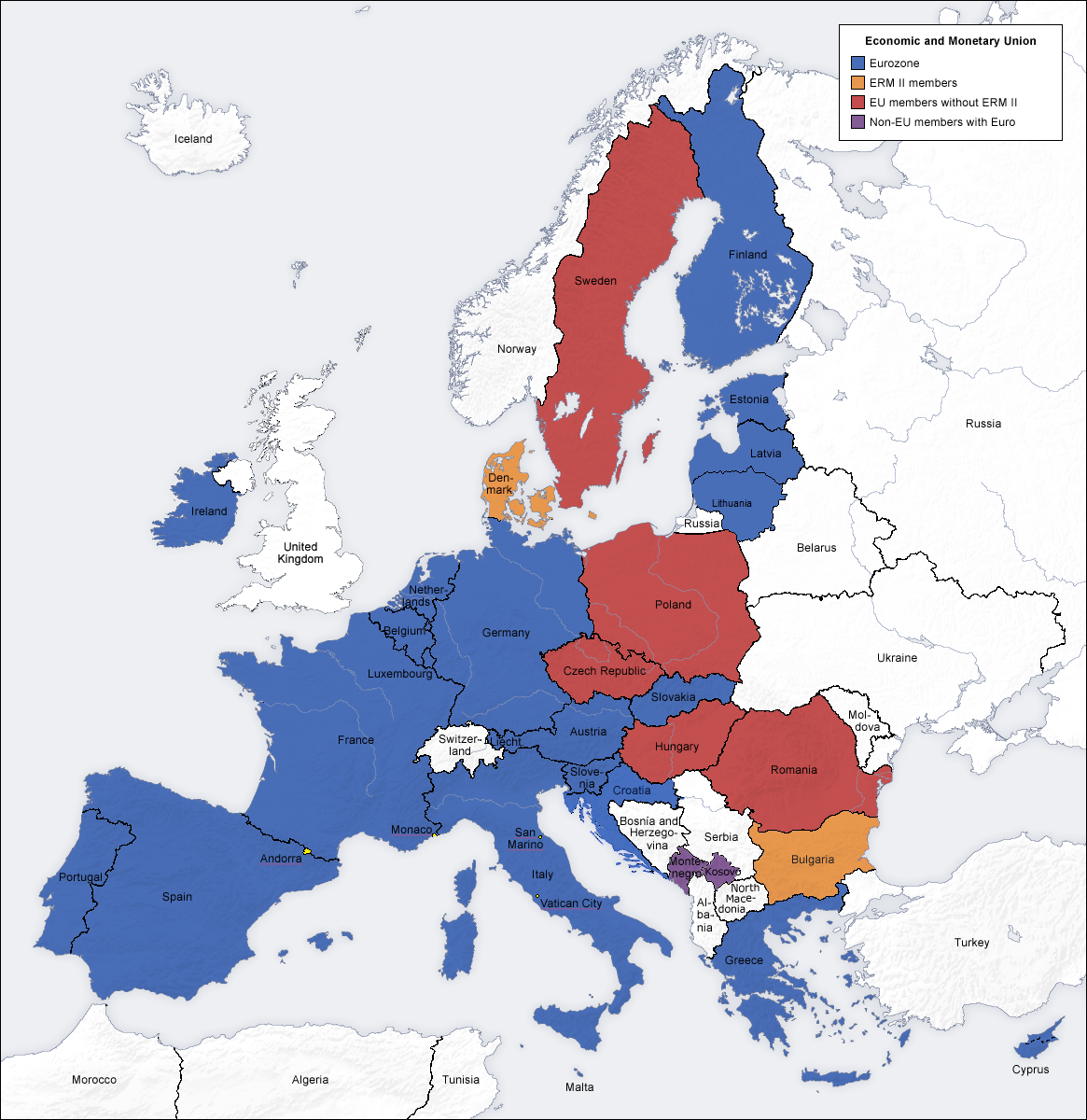
Introduction of the single currency € Euro
Germany has been the largest net contributor to EU budgets for decades (in absolute terms – given Germany's comparatively large population – not per capita) and seeks to limit the growth of these net payments in the enlarged union.
European Constitution
NATO
A meeting of NATO heads of States and governments on 11 July 2018 in [[Brussels
Under the doctrine introduced by the 2003 Defense Policy Guidelines, Germany continues to give priority to the transatlantic partnership with the United States through the North Atlantic Treaty Organization. However, Germany is giving increasing attention to coordinating its policies with the European Union through the Common Foreign and Security Policy.
UN
Main article: Germany and the United Nations
The German Federal Government began an initiative to obtain a permanent seat in the United Nations Security Council, as part of the Reform of the United Nations. This would require approval of a two-thirds majority of the member states and approval of all five Security Council veto powers.
This aspiration could be successful due to Germany's good relations with the People's Republic of China and the Russian Federation. Germany is a stable and democratic republic and a G7 country which are also favourable attributes. The United Kingdom and France support German ascension to the supreme body. The U.S. is sending mixed signals.
NATO member states, including Germany, decided not to sign the UN treaty on the Prohibition of Nuclear Weapons, a binding agreement for negotiations for the total elimination of nuclear weapons, supported by more than 120 nations.
Diplomatic relations
List of countries which the Federal Republic of Germany maintains diplomatic relations with:
[[File:Diplomatic_relations_of_Germany.svg
frameless
425x425px]]
#
Country
Date
1
Netherlands
2
India
3
Sweden
4
Luxembourg
5
Norway
6
United Kingdom
7
Belgium
8
Denmark
9
Peru
10
United States
11
Brazil
12
France
13
Greece
14
Ireland
15
South Africa
16
Italy
17
Pakistan
18
Monaco
19
Canada
20
Serbia
21
Panama
22
Argentina
23
Uruguay
24
Australia
25
Chile
26
Iran
27
Nicaragua
28
Japan
29
Venezuela
30
Switzerland
31
Liechtenstein
32
Thailand
33
Turkey
34
Indonesia
35
Iceland
36
Ecuador
37
El Salvador
38
Mexico
39
Paraguay
40
Costa Rica
41
Syria
42
Egypt
43
Portugal
44
Spain
45
Jordan
46
Bolivia
47
Colombia
48
Lebanon
49
Liberia
50
Dominican Republic
51
Iraq
52
Haiti
53
New Zealand
54
Sri Lanka
55
Ethiopia
—
Holy See
56
Myanmar
57
Philippines
58
Saudi Arabia
59
Afghanistan
60
Libya
61
Cuba
62
Russia
63
Austria
64
Sudan
65
Tunisia
66
Morocco
67
South Korea
68
Ghana
69
Malaysia
70
Laos
71
Nepal
72
Guinea
73
Guatemala
74
Cameroon
75
Honduras
76
Burkina Faso
77
Togo
78
Madagascar
79
Democratic Republic of the Congo
80
Somalia
81
Ivory Coast
82
Chad
83
Republic of the Congo
84
Cyprus
85
Mali
86
Senegal
87
Nigeria
88
Mauritania
89
Central African Republic
90
Sierra Leone
91
Tanzania
92
Gabon
93
Algeria
94
Jamaica
95
Uganda
96
Benin
97
Yemen
98
Niger
99
Burundi
100
Trinidad and Tobago
101
Rwanda
102
Kenya
103
Cambodia
104
Kuwait
105
Zambia
106
Malta
107
Gambia
108
Israel
109
Malawi
110
Singapore
111
Botswana
112
Maldives
113
Barbados
114
Romania
115
Guyana
116
Lesotho
117
Mauritius
118
Eswatini
119
Bangladesh
120
Oman
121
Bahrain
122
United Arab Emirates
123
Poland
124
China
125
Finland
126
Qatar
127
Bahamas
128
Fiji
129
Czech Republic
130
Bulgaria
131
Hungary
132
Mongolia
133
Grenada
134
Guinea-Bissau
135
Mozambique
136
São Tomé and Príncipe
137
Vietnam
138
Suriname
139
Tonga
140
Samoa
141
Papua New Guinea
142
Seychelles
143
Djibouti
144
Comoros
145
Solomon Islands
146
Tuvalu
147
Angola
148
Zimbabwe
149
Cape Verde
150
Saint Vincent and the Grenadines
151
Kiribati
152
Saint Lucia
153
Dominica
154
Vanuatu
155
Belize
156
Antigua and Barbuda
157
Brunei
158
Saint Kitts and Nevis
159
Nauru
160
Albania
161
Namibia
162
Estonia
163
Latvia
164
Lithuania
165
Marshall Islands
166
Croatia
167
Slovenia
168
Ukraine
169
Armenia
170
Kyrgyzstan
171
Kazakhstan
172
Azerbaijan
173
Tajikistan
174
Turkmenistan
175
Uzbekistan
176
Belarus
177
Georgia
178
Federated States of Micronesia
179
Moldova
180
Bosnia and Herzegovina
181
Slovakia
182
Eritrea
183
North Macedonia
184
Andorra
185
San Marino
186
Palau
187
North Korea
—
Cook Islands
188
Timor-Leste
189
Montenegro
—
Kosovo
190
Equatorial Guinea
191
South Sudan
—
Sovereign Military Order of Malta
192
Bhutan
Bilateral relations
Africa
Country
Notes
Algeria
See Algeria–Germany relations
Angola
See Angola–Germany relations
Botswana
See Germany–Botswana relations
Burundi
See Burundi–Germany relations
Cape Verde
Cameroon
See Cameroon–Germany relations
Central African Republic
See Central African Republic–Germany relations
Chad
See Chad–Germany relations
Comoros
Democratic Republic of the Congo
See Democratic Republic of the Congo–Germany relations
Republic of the Congo
Egypt
See Egypt–Germany relations
See Eritrea–Germany relations
See Equatorial Guinea–Germany relations
Ethiopia
See Ethiopia–Germany relations
Gabon
See Gabon–Germany relations
Gambia
See The Gambia–Germany relations
Ghana
See Germany–Ghana relations
See Germany–Guinea relations
Kenya
See Germany–Kenya relations
Liberia
See Germany–Liberia relations
Libya
See Germany–Libya relations
Madagascar
See Germany–Madagascar relations
See Germany–Malawi relations
Mali
See Germany–Mali relations
Mauritania
See Germany–Mauritania relations
Morocco
See Germany–Morocco relations
Mozambique
See Germany–Mozambique relations
Namibia
See Germany–Namibia relations
Niger
See Germany–Niger relations
Nigeria
See Germany–Nigeria relations
Rwanda
See Germany–Rwanda relations
São Tomé and Príncipe
Senegal
See Germany–Senegal relations
Sierra Leone
See Germany–Sierra Leone relations
Somalia
See Germany–Somalia relations
South Africa
See Germany–South Africa relations
South Sudan
See Germany–South Sudan relations
Sudan
See Germany–Sudan relations
Tanzania
See Germany–Tanzania relations
Togo
See Germany–Togo relations
Tunisia
Uganda
See Germany–Uganda relations
Zambia
Zimbabwe
See Germany–Zimbabwe relations
Americas
Country
Notes
Antigua and Barbuda
Argentina
See Argentina–Germany relations
Bahamas
Barbados
See Barbados–Germany relations
Belize
See Belize–Germany relations
Bolivia
See Bolivia–Germany relations
Brazil
See Brazil–Germany relations
Canada
See Canada–Germany relations
Chile
See Chile–Germany relations
Colombia
See Colombia–Germany relations
Costa Rica
See Costa Rica–Germany relations
Cuba
See Cuba–Germany relations
Dominica
Dominican Republic
See Dominican Republic–Germany relations
Ecuador
See Ecuador–Germany relations
El Salvador
See El Salvador–Germany relations
Grenada
Guatemala
See Germany–Guatemala relations
Guyana
See Germany–Guyana relations
Haiti
See Germany–Haiti relations
Honduras
See Germany–Honduras relations
Jamaica
See Germany–Jamaica relations
Mexico
See Germany–Mexico relations
Nicaragua
See Germany–Nicaragua relations
Panama
Paraguay
See Germany–Paraguay relations
Peru
See Germany–Peru relations
St. Kitts and Nevis
St. Lucia
St. Vincent and the Grenadines
Suriname
See Germany–Suriname relations
Trinidad and Tobago
United States
See Germany–United States relations
Uruguay
See Germany–Uruguay relations
Venezuela
See Germany–Venezuela relations
Asia
Country
Notes
Afghanistan
See Afghanistan–Germany relations
Armenia
See Armenia–Germany relations
Azerbaijan
See Azerbaijan–Germany relations
Bahrain
See Bahrain–Germany relations
Bangladesh
Bhutan
The Governments of the Federal Republic of Germany and the Kingdom of Bhutan have maintained diplomatic relations since 25 November 2020. This move further deepened the friendly relations between the two countries. Consular relations have been in place since July 2000. Bhutan has agreed to let Germany set up an honorary consulate in Thimphu. Bhutan has an honorary consulate-general in Germany.
Brunei
See Brunei–Germany relations
Cambodia
See Cambodia–Germany relations
China
See China–Germany relations
Hong Kong
See Germany–Hong Kong relations
India
Indonesia
See Germany–Indonesia relations
Iran
See Germany–Iran relations
Iraq
See Germany–Iraq relations
Israel
See Germany–Israel relations
Japan
See Germany–Japan relations
Jordan
See Germany–Jordan relations
Kazakhstan
See Germany–Kazakhstan relations
Kuwait
See Germany–Kuwait relations
Kyrgyzstan
Laos
See Germany–Laos relations
Lebanon
See Germany–Lebanon relations
Malaysia
See Germany–Malaysia relations
Maldives
See Germany–Maldives relations
Mongolia
See Germany–Mongolia relations
Nepal
See Germany–Nepal relations
North Korea
See Germany–North Korea relations
Oman
See Germany–Oman relations
Pakistan
See Germany–Pakistan relations
Palestine "Palestinian territories"
See Germany–Palestine relations
Philippines
See Germany–Philippines relations
Qatar
See Germany–Qatar relations
Saudi Arabia
See Germany–Saudi Arabia relations
Singapore
See Germany–Singapore relations
South Korea
See Germany–South Korea relations
Sri Lanka
See Germany–Sri Lanka relations
See Germany–Syria relations
Taiwan
See Germany–Taiwan relations
Tajikistan
See Germany–Tajikistan relations
Thailand
See Germany–Thailand relations
Turkey
See Germany–Turkey relations
Turkmenistan
United Arab Emirates
See Germany–United Arab Emirates relations
Uzbekistan
See Germany–Uzbekistan relations
Vietnam
See Germany–Vietnam relations
Yemen
See Germany–Yemen relations
Europe
; Balkans
The European Union and the [[eurozone
The German government was a strong supporter of the enlargement of NATO.
Germany was one of the first nations to recognize Croatia and Slovenia as independent nations, rejecting the concept of Yugoslavia as the only legitimate political order in the Balkans (unlike other European powers, who first proposed a pro-Belgrade policy). This is why Serb authorities sometimes referred to "new German imperialism" as one of the main reasons for Yugoslavia's collapse. German troops participate in the multinational efforts to bring "peace and stability" to the Balkans.
; Central Europe
Weimar triangle (France, Germany and Poland); Germany continues to be active economically in the states of Central Europe, and to actively support the development of democratic institutions. In the 2000s, Germany has been arguably the centerpiece of the European Union (though the importance of France cannot be overlooked in this connection).
Country
Notes
Albania
See Albania-Germany relations
Andorra
Austria
See Austria–Germany relations
Belarus
See Belarus-Germany relations
Belgium
See Belgium–Germany relations
Bosnia and Herzegovina
See Bosnia and Herzegovina–Germany relations
Bulgaria
See Bulgaria–Germany relations
Croatia
See Croatia–Germany relations
Cyprus
See Cyprus–Germany relations
Czech Republic
See Czech Republic–Germany relations
Denmark
See Denmark–Germany relations
Estonia
See Estonia–Germany relations
Finland
See Finland–Germany relations
France
See France–Germany relations
Greece
See Germany–Greece relations
Georgia
See Georgia–Germany relations
Holy See
See Germany–Holy See relations
Hungary
See Germany–Hungary relations
Iceland
See Germany–Iceland relations
Ireland
See Germany–Ireland relations
Italy
See Germany–Italy relations
Kosovo
See Germany–Kosovo relations
Latvia
See Germany–Latvia relations
Liechtenstein
See Germany–Liechtenstein relations
Lithuania
See Germany–Lithuania relations
Luxembourg
See Germany–Luxembourg relations
Malta
See Germany–Malta relations
Moldova
See Germany–Moldova relations
Monaco
Montenegro
See Germany–Montenegro relations
Netherlands
See Germany–Netherlands relations
North Macedonia
See Germany–North Macedonia relations
Norway
See Germany–Norway relations
Poland
See Germany–Poland relations
Portugal
See Germany–Portugal relations
Romania
See Germany–Romania relations
Russia
See Germany–Russia relations
San Marino
Serbia
See Germany–Serbia relations
Slovakia
See Germany–Slovakia relations
Slovenia
Sovereign Military Order of Malta
Spain
See Germany–Spain relations
Sweden
See Germany–Sweden relations
Switzerland
See Germany–Switzerland relations
Ukraine
See Germany–Ukraine relations
United Kingdom
See Germany–United Kingdom relations
Oceania
Country
Notes
Australia
See Australia–Germany relations
Fiji
Kiribati
Marshall Islands
Micronesia
Nauru
See Germany–Nauru relations
New Zealand
See Germany–New Zealand relations
Palau
Papua New Guinea
See Germany–Papua New Guinea relations
Samoa
Solomon Islands
Tonga
See Germany–Tonga relations
Tuvalu
Vanuatu
Notes
References
References
Gaddis, John Lewis (2005). The Cold War. London: Penguin. p. 190. ISBN 978-0-141-02532-2
Feld, Werner. (2012). "Reunification and West German-Soviet Relations: The Role of the Reunification Issue in the Foreign Policy of the Federal Republic of Germany, 1949–1957, with Special Attention to Policy Toward the Soviet Union". Martinus Nijhoff.
Collins, Stephen. (2002). "German Policy-Making and Eastern Enlargement of the European Union During the Ko: Managing the Agenda?". Manchester University Press.
Werner, Andreas. (2016). "NGOs in Foreign Policy: Security Governance in Germany and the Netherlands". Waxmann Verlag.
[http://www.bmz.de/en/index.html Aims of German development policy] {{Webarchive. link. (10 March 2011 Federal Ministry for Economic Cooperation and Development 10 April 2008. Retrieved 7 December 2008.)
Scholler, Heinrich. (2007). "100 Jahre deutsch-äthiopische diplomatische Beziehungen: von der traditionellen Monarchie zum modernen Staat". LIT Verlag Münster.
[http://library.aua.am/library/news/archive/2006_11-17.htm ''Armenian, German leaders discuss bilateral relations''] {{webarchive. link. (31 May 2011 from [[Mediamax news agency]], Yerevan, archived on US Embassy site)
[http://www.bicom.org.uk/publications/israels_foreign_relations/s/1207/the-israel-german-special-relationship/ Israel's foreign relations. The Israel-German special relationship] {{webarchive. link. (28 September 2007 , Britain Israel Communications and Research Centre (BICOM), 23 November 2005. Retrieved 18 August 2006.)
This content may have been generated or modified by AI. CloudSurf Software LLC is not responsible for the accuracy, completeness, or reliability of AI-generated content. Always verify important information from primary sources.