From Surf Wiki (app.surf) — the open knowledge base
Ford Fairlane (Americas)
.jpg)
| Field | Value | ||||
|---|---|---|---|---|---|
| image | 1967 Ford Fairlane GTA vinyl top, front 6.16.19.jpg | ||||
| name | Ford Fairlane | ||||
| caption | 1967 Ford Fairlane | ||||
| manufacturer | Ford | ||||
| layout | FR layout | ||||
| production | 1955–1970 | ||||
| assembly | {{ubl | ||||
| San Jose, California<ref>{{cite web | url | http://media.ford.com/plant_display.cfm?plant_id=33 | title=Facilities | Ford Motor Company Newsroom | publisher=Media.ford.com | access-date=2010-10-19}} (⧉) |
| class | Full-size (1955–1961) | ||||
| Mid-size (1962–1970) | |||||
| body_style | two-door hardtop | ||||
| two-door convertible | |||||
| two-door sedan | |||||
| four-door sedan | |||||
| four-door hardtop | |||||
| four-door station wagon | |||||
| predecessor | Ford Crestline | ||||
| successor | Ford Galaxie (full-size) | ||||
| Ford Torino (mid-size) |
|Somerville, Massachusetts (⧉) |Norfolk, Virginia (⧉) |Memphis, Tennessee (⧉) |Louisville, Kentucky (⧉) |Long Beach, California (⧉) |Dearborn, Michigan (⧉) |Dallas, Texas (⧉) |Chicago, Illinois (⧉) |Mahwah, New Jersey (⧉) |Claycomo, Missouri (⧉) |San Jose, California (⧉) |Metuchen, New Jersey (⧉) |Lorain, Ohio (⧉) |Milpitas, California (⧉) |Atlanta, Georgia (⧉) |Oakville, Ontario, Canada (⧉) |Flemington, New South Wales, Australia (⧉) |Lower Hutt, New Zealand (⧉) |General Pacheco, Argentina (⧉)
Mid-size (1962–1970) two-door convertible two-door sedan four-door sedan four-door hardtop four-door station wagon Ford Torino (mid-size)
The Ford Fairlane is an automobile model that was sold between the 1955 and 1970 model years by Ford in North America. Taking its name from the Dearborn, Michigan estate of Henry Ford, the Fairlane nameplate was used for seven different generations of vehicles. Through its production, the model line would be marketed in a variety of body styles, including two-door and four-door sedans, two-door and four-door hardtops, station wagons, and both traditional and retractable-hardtop convertibles.
Initially introduced as the flagship of the full-size Ford range, the Fairlane marked the introduction of the Crown Victoria and 500 nameplates, both later becoming standalone full size model lines (the latter, as the Ford Five Hundred).
Following the introduction of the Ford Galaxie, the Fairlane 500 (and Fairlane) became Ford's base models, equivalent to the Chevrolet Bel Air and Biscayne respectively, until 1962, when it was repackaged as an intermediate-segment car (today, mid-size) from 1962 to 1970. For 1971, Ford expanded the Ford Torino nameplate across its entire intermediate range, dropping the Fairlane (and Falcon) nameplates in North America. In South America, the sixth generation Fairlane was marketed through 1981; Ford Australia used the nameplate on its own version of the Fairlane (a long-wheelbase Ford Falcon) through the 2007 model year.
First generation (1955–1956)
four-door hardtop (1956) two-door convertible two-door sedan four-door sedan four-door station wagon Ford Mainline Ford Customline Ford Ranch Wagon Ford Country Sedan Ford Country Squire Ford Parklane Ford Courier 272 cuin Y-Block V8 292 cuin Thunderbird V8 (1956) 312 cuin Thunderbird V8 (1956) 3-speed Fordomatic For the 1955 model year the Fairlane name replaced the Crestline as Ford's premier full-sized offering. Six different body styles were offered, including the Crown Victoria Skyliner with a tinted, transparent plastic roof, the regular Crown Victoria coupe with much stainless steel trim, a convertible Sunliner, the Victoria hardtop coupe, and traditional sedans. All featured the trademark stainless-steel "Fairlane stripe" on the side. Power options were a 223 CID straight-6 engine and a 272 CID V8. The 292 CID Y-block was offered as an option and was called the Thunderbird V-8.
The Fairlane 4-door Town Sedan was the most popular sedan Ford sold that year, having manufactured 254,437 with a listed retail price of US$1,960 ($ in dollars ).
Few changes were made for 1956; a four-door Victoria hardtop and two new, more powerful V8 options, of 292 CID and 312 CID, the latter available up to 225 bhp, were introduced. The Lifeguard safety package was introduced. The two-door Victoria hardtop featured a new and slimmer roofline. A one-year only two-door station wagon, the 1956 Ford Parklane, featured Fairlane-level trim. It was marketed to compete against the Chevrolet Nomad. File:1955 Ford Fairlane 4-Door Sedan XMP219.jpg|1955 Ford Fairlane Town Sedan File:1955 Ford Fairlane Sunliner.JPG|1955 Ford Fairlane Sunliner File:Brazil Classics (7357723380).jpg|1955 Ford Fairlane Country Squire station wagon File:Ford Fairlane Club Sedan 1956 1.jpg|1956 Ford Fairlane Club Sedan File:1956 Ford Fairlane Victoria coupe (6713042657).jpg|1956 Ford Fairlane Victoria coupe interior
Second generation (1957–1959)
Two-door sedan Two-door convertible Two-door convertible Two-door retractable hardtop Four-door hardtop Four-door sedan Four-door station wagon Two-door coupe utility | 223 cuin Mileage Maker I6 | 292 cuin Thunderbird V8 | 312 cuin Thunderbird V8 (1957) | 332 cuin Interceptor V8 (1958–1959) | 352 cuin Interceptor V8 (1958–1959) | 3-speed manual | 2-speed Fordomatic (1959) | 3-speed Cruise-O-Matic (1958–1959) | 3-speed Fordomatic (1957–1958)
For 1957, a new style gave a longer, wider, lower, and sleeker look with low tailfins. The new proportions and modern styling were a hit with customers to the extent that the Ford outsold Chevrolet in 1957 for the first time since 1935. A new top trim level, the Fairlane 500, was added to the Fairlane model line and the Country Squire continued to be the luxury station wagon while the Country Sedan was now added to the Fairlane model line, while engine choices were largely the same as the year before. The big news for 1957 was the introduction of the Fairlane 500 Skyliner power retractable hardtop, whose solid top hinged and folded down into the trunk space at the touch of a button, while the Ford Ranchero two-door coupe utility was also introduced.
Another facelift for 1958 had fashionable quad headlights, a grille that matched the 1958 Thunderbird, and other styling changes. New big-block FE V8s of 332 and 352 CID (5.4 L and 5.8 L) replaced the previous largest V8s, and a better three-speed automatic transmission was also available with a steering column transmission gear selector lever.
A new top-level full-sized model was introduced at mid-year 1959, the Ford Galaxie. The 1959 Galaxie displayed both "Fairlane 500" and "Galaxie" badging.
File:Ford Custom 300 (1957) 01.jpg|1957 Ford Fairlane 500 Town Sedan File:El Dorado, KS 67042, USA - panoramio (95).jpg|1957 Ford Fairlane 500 Skyliner interior File:1958 Ford Skyliner - Flickr - dave 7 (cropped).jpg|1958 Ford Fairlane 500 Skyliner showing the top mechanism in action File:1958 Ford Fairlane 500 AOW532 2.jpg|1958 Ford Fairlane 500 Victoria Club Coupe File:11.i. 1958 Ford Fairlane Sunliner.jpg|1958 Ford Fairlane Sunliner rear File:1959 Ford Fairlane 500 Skyliner.jpg|1959 Ford Fairlane 500 Skyliner File:1959 Ford Galaxie Skyliner.JPG|1959 Skyliner, the Ford Galaxie models displayed both "Fairlane 500" and "Galaxie" badges
Third generation (1960–1961)
4-door sedan | 223 cuin Mileage Maker I6 | 292 cuin Thunderbird V8 | 352 cuin Thunderbird V8 | 390 cuin Thunderbird V8 (1961) | 3-speed manual | 2-speed Fordomatic | 3-speed Cruise-O-Matic Ford Country Sedan Mercury Meteor Ford Galaxie Full-sized Fairlane and Fairlane 500 models were restyled for 1960 and again for the 1961 model year. The Galaxie series continued as the top-of-the-line full-sized Ford. Fairlane 500s demoted to mid-level in the lineup and were equivalent to the Chevrolet Bel Air. Fairlanes were primarily sold as base level trim models for fleet use (taxi, police). Two bodystyles were available, a 2-door pillared sedan (Club Sedan and Business Sedan) and a 4-door pillared sedan (Town Sedan).
While the 1960 de luxe Galaxie and Fairlane 500 series sported a tri-color Ford crest on the hood, base Fairlanes had "FORD" in chrome block letters across their hoods. For 1961, all models got the block letters on their hoods.
The big-block 390 CID V8 was available in 1961 as the top-horsepower option, as the "horsepower wars" in Detroit continued. File:1960 Ford Fairlane; Hastings, MN (42233473335) (cropped).jpg|1960 Ford Fairlane Club Sedan rear File:1960 Ford Fairlane Coupe (cropped).jpg|1960 Ford Fairlane Club Sedan File:1960 Ford Fairlane 500.jpg|1960 Ford Fairlane 500 Town Sedan File:1961 Ford (5837961886).jpg|1961 Ford Fairlane 500 Club Sedan
Fourth generation (1962–1965)
| Metuchen, New Jersey | Lorain, Ohio | Milpitas, California | Oakville, Ontario, Canada | Flemington, Australia | Seaview, Lower Hutt, New Zealand Two-door sedan Four-door sedan Four-door station wagon (1963–1965) Ford Fairlane (Australia) | 170 cuin Fairlane I6 (1962–1964) | 200 cuin Fairlane I6 (1963–1965) | 221 cuin Challenger V8 (1962–1963) | 260 cuin Challenger V8 (1962–1964) | 289 cuin Challenger V8 (1963–1965) | 427 cuin FE V8 (1964) | 3/4-speed manual | 2-speed Ford-O-Matic (1962–1964) | 3-speed Cruise-O-Matic (1964–1965)
The Fairlane name was moved to Ford's new intermediate, introduced for the 1962 model year, to bridge the gap between the compact Ford Falcon and the full-sized Galaxie, making it a competitor for GM's A-body "senior compacts", the Plymouth Belvedere, and the AMC Rambler. With an overall length of 197 in (5004 mm) and a wheelbase of 115.5 in (2934 mm), it was 16 in (406 mm) longer than the Falcon and 12.3 in (312 mm) shorter than the Galaxie. Wheel track varied from 53.5 in (1355 mm) to 56 in (1422 mm) depending on model and specification.
Like the Falcon, the Fairlane had a unibody frame, but the body incorporated an unusual feature Ford dubbed torque boxes, four boxed structures in the lower body structure designed to absorb road shock by moving slightly in the vertical plane. Suspension was a conventional short-long arm independent arrangement in front, with Hotchkiss drive in the rear. The Fairlane was initially offered only in two-door or four-door sedan body styles.
The Fairlane's standard engine was the 170 CID (2.8 L) six, but as an option, it introduced Ford's new, lightweight small-block Windsor V8, initially with a displacement of 221 CID (3.6 L) and 145 hp (108 kW); a 260 CID (4.2 L) "Challenger" version with an advertised 164 hp was added at mid-year. The Sports Coupe option débuted mid-year and featured bucket seats and a small floor console. The trim level supplemented the Fairlane and Fairlane 500 trim levels (the 500 model had more decorative trim, such as a wider chrome stripe down the side and three bullets on the rear quarter panels). The Challenger 289 CID engine was introduced in mid-1963, with solid lifters and other performance pieces helping the engine produce an advertised 271 hp; however, it was equipped with single exhaust like the less powerful engines. This engine was coded "K" in the vehicle identification number. Exterior identification was by fender-mounted "V" badges that read "289 High Performance". That same year, station wagons arrived, called the Ranch Wagon and Ranch Custom Wagon. All 1962 Fairlanes had "B" posts despite the popularity of the pillarless hardtop and convertible styles in that era.
Ford saw the problem and introduced two pillarless hardtop coupes for 1963, in Fairlane 500 and Sports Coupe trim. For 1963 and later Sports Coupe models, the center console, which had come from the Falcon parts bin for 1962, was changed to be similar to that of the Galaxie. Sports Coupe models got a floor-mounted shift lever for the center console when Cruise-O-Matic or 4-speed manual transmissions were specified; however when the two-speed Fordomatic was ordered, the shift lever was installed on the steering column (and the console was the same without the shifter). Front-end styling for the 1963 models mimicked the big Galaxie models, but the rear end retained the small tailfins and "pieplate" tail lamp styling cues. The Squire wagon (a fake woodie) was available for 1963 only, including one model with front bucket seats. The "Swing-Away" steering wheel became an option in 1964.
The 1964 and 1965, Fairlane ranges consisted of similar body styles: base Fairlane and Fairlane 500 two-door coupes and four-door sedans, and Fairlane 500 and Sports Coupe two-door hardtops. As in 1963, the Sports Coupe got its own standard "spinner" wheel covers and extra exterior brightwork. Large "Sports Coupe" scripts graced the "C" pillars. The Fairlane Squire wagon was dropped, but the standard station wagon was continued. The 221 V8 was dropped after 1963, leaving the six as the base engine and the 260 as the base V8. The "K-code" 271-horsepower 289 V8 continued into 1964, gaining dual exhausts, while a 195 hp version of the 289 with a two-barrel carburetor and hydraulic lifters was introduced. The two-speed Fordomatic continued as the automatic transmission choice for the 260 in 1964, while 289 V8s got the three-speed Cruise-O-Matic transmission option. All 1965 models featured 14 in wheels as standard, in place of the earlier 13 in wheels, and Fordomatic was finally phased out, leaving the Cruise-O-Matic as the only automatic available for the Fairlane. The 260 was also dropped after 1964, leaving the two-barrel 289 as the base V8. Styling-wise, in 1964, a new grille and headlight bezels were introduced, the tail fins were dropped, some chrome decorating on the side was changed, and the shape of the trunk lid changed. Styling features for 1965 included body-color headlight bezels for the deluxe models and rectangular taillight lenses, a return to the 1962-1963 trunk lid, along with less chrome on the body and a small standup hood ornament.
Australian and New Zealand models had longer cut-outs in the rear bumper to accommodate their license plates.
Australian models had the "reverse light" tail light which was used for an amber rear turn signal. File:1962 Ford Fairlane 1.jpg|1962 Ford Fairlane 500 Town Sedan File:1963 Ford Fairlane 500 Ranch Wagon.jpg|1963 Ford Fairlane 500 Custom Ranch Wagon File:1964 Ford Fairlane 500 Sports coupe (18347927990).jpg|1964 Ford Fairlane 500 Sports Coupe. This example from Australia was modified to a right-hand drive model. File:1964 Ford Fairlane 500 3.6 Front.jpg|1964 Ford Fairlane 500 4-Door Sedan File:1964 Ford Fairlane 500 3.6 Rear.jpg|1964 Ford Fairlane 500 4-Door Sedan File:Ford Fairlane BW 3.JPG|1965 Ford Fairlane 500 2-Door Sedan File:Ford Fairlane BW 2.JPG|1965 Ford Fairlane 500 2-Door Sedan
Thunderbolt
Main article: Ford Fairlane Thunderbolt
As the muscle car market took shape, Ford built a small number of Fairlane two door sedans prepared for drag racing during the 1963 season. These cars were running the 289 and were set up at Dearborn Steel Tubing that built the special cars for Ford special vehicle operations. These soon evolved into the "Thunderbolts" for 1964. The racing Thunderbolt was a two-door post car, heavily modified to incorporate Ford's new 427 CID (7.0 L) V8 race engine with two four-barrel carburetors on a high-riser manifold, ram-air through the openings left by deleting the inboard headlights, equal-length headers, trunk-mounted battery, several fiberglass parts (hood, door skins, fenders, and front bumper), acrylic glass windows, and other lightweight options, including deleted rear-door window winders, carpeting, radio, sealant, sun visors, armrests, jack, lug wrench, heater, soundproofing, and passenger-side windshield wiper. The cars wore Fairlane 500 trim, and were only offered with the two-door sedan body. This special model, of which 111 to 127 total were made (sources disagree), delivered a rated 425 hp at 7,500 rpm.
Racing in NHRA Super Stock (which required only fifty cars be available to the public), on 7 in-wide tires, the Thunderbolt was based on the midlevel Fairlane 500 two-door pillared sedan, and in 1964 set elapsed time and top speed records at 11.6 seconds and 124 mph (200 km/h). took the Super Stock title (with Gas Ronda taking the honors), and won the Manufacturer's Cup. The car as delivered was slightly too light to meet NHRA's 3200-lb (1451-kg) minimum weight unless it was raced with a full tank of gasoline, which would bring it to 3203 lb (1453 kg). NHRA rules at the time required a metal front bumper, so the cars began to be supplied with an aluminum bumper and previous purchasers were supplied with one.
Thunderbolt production was ended due to NHRA rule changes for Super Stock competition, requiring 500 vehicles be built to be entered in that class. Ford had been losing $1500 to $2000 on each Thunderbolt sold at the sticker price of $3900. The first 11 Thunderbolts were painted maroon (known as Vintage Burgundy in Ford literature), the rest white; 99 had manual transmissions. Many are still raced. About 50 similar Mercury Cyclones were also produced by Ford in 1964, destined to be modified to represent Ford in A/FX competition, which they dominated, as well. These vehicles varied greatly in wheel track due to customer options for varying suspension and wheel/tire combinations. Front tracks from 54 to 56 in and rear tracks from 53.5 to 55.5 in were common.
Fifth generation (1966–1967)
Lorain, OH Milpitas, CA Atlanta, GA Two-door convertible Two-door sedan Four-door sedan Four-door station wagon 113 in (wagon) | 200 cuin Fairlane I6 | 289 cuin Challenger V8 | 390 cuin Thunderbird V8 | 427 cuin Cobra V8 | 3/4-speed manual | 3-speed Cruise-O-Matic Mercury Comet Ford Fairlane (Australia)
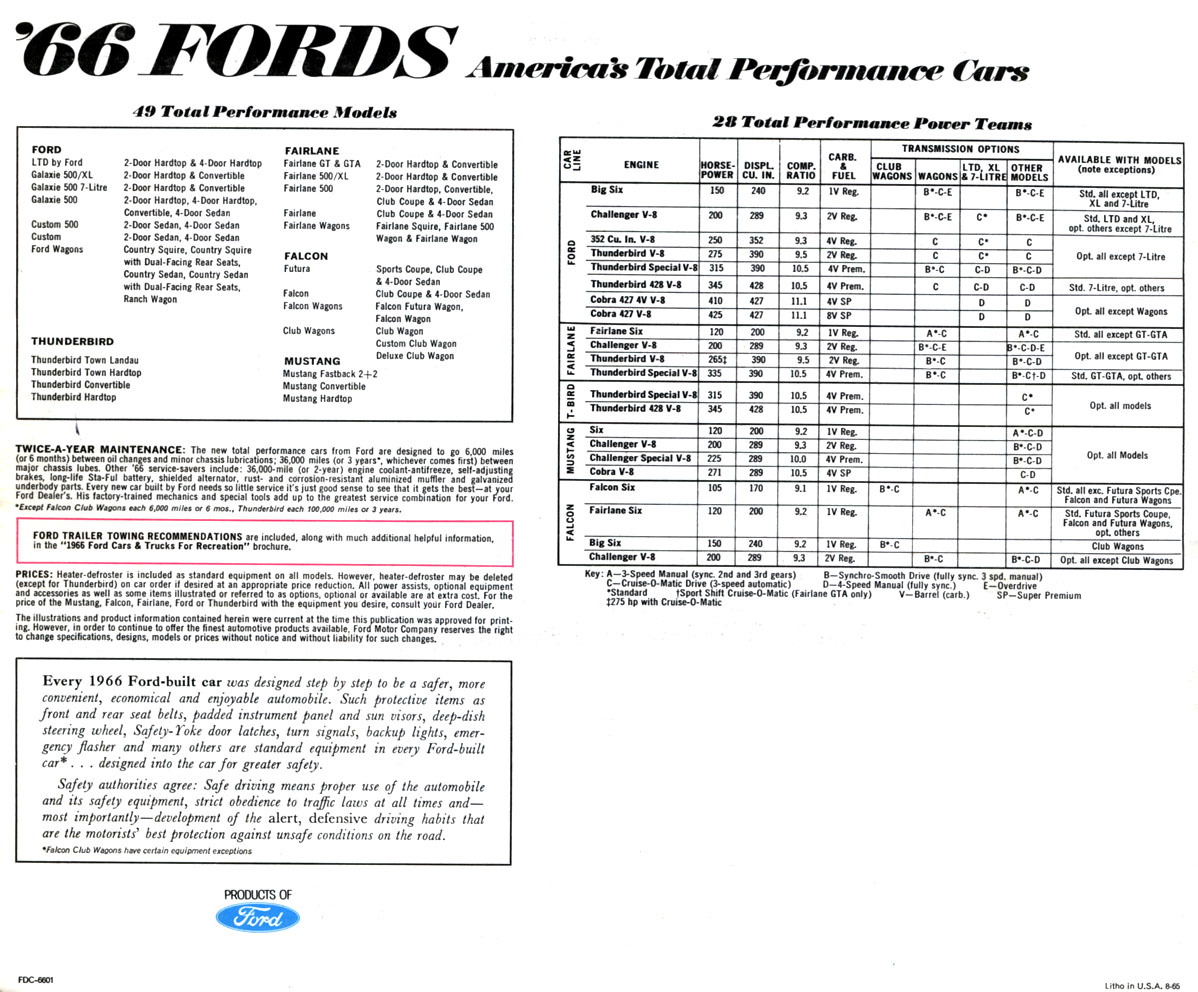
For 1966 the Fairlane became a long wheelbase longer body version of the revised Falcon platform with the mid size wagon bodies common to both model lines. The appearance was changed to match the full-sized Ford Galaxie, which had been restyled in the 1965 model year, and adopted vertically stacked dual headlights. The XL, GT, and GTA packages were introduced, as well as a convertible to join the existing range of sedans, hardtops, and station wagons. The "K-code" 289 CID engine was dropped this year. The GT featured a 390 CID FE V8 as standard, while the GTA also included the newly introduced the SportShift Cruise-o-Matic automatic transmission. The GT/GTA 390 CID engine developed 335 bhp with higher compression, and had a four-barrel carburetor. Mid year, Ford produced 57 special Fairlane 500 two-door hardtops with "R-code" 427 CID V8 engine rated at 425 bhp at 6000 rpm and 480 lbft at 3700 rpm of torque, equipped with Ford's "Top-Loader" four-speed manual transmission. Built to qualify the engine/transmission combination for NHRA and IHRA Super Stock racing, they were white and had fiberglass hoods with a forward-facing hood scoop which ended at the edge of the hood. The Fairlane Squire wagon was reintroduced for 1966.
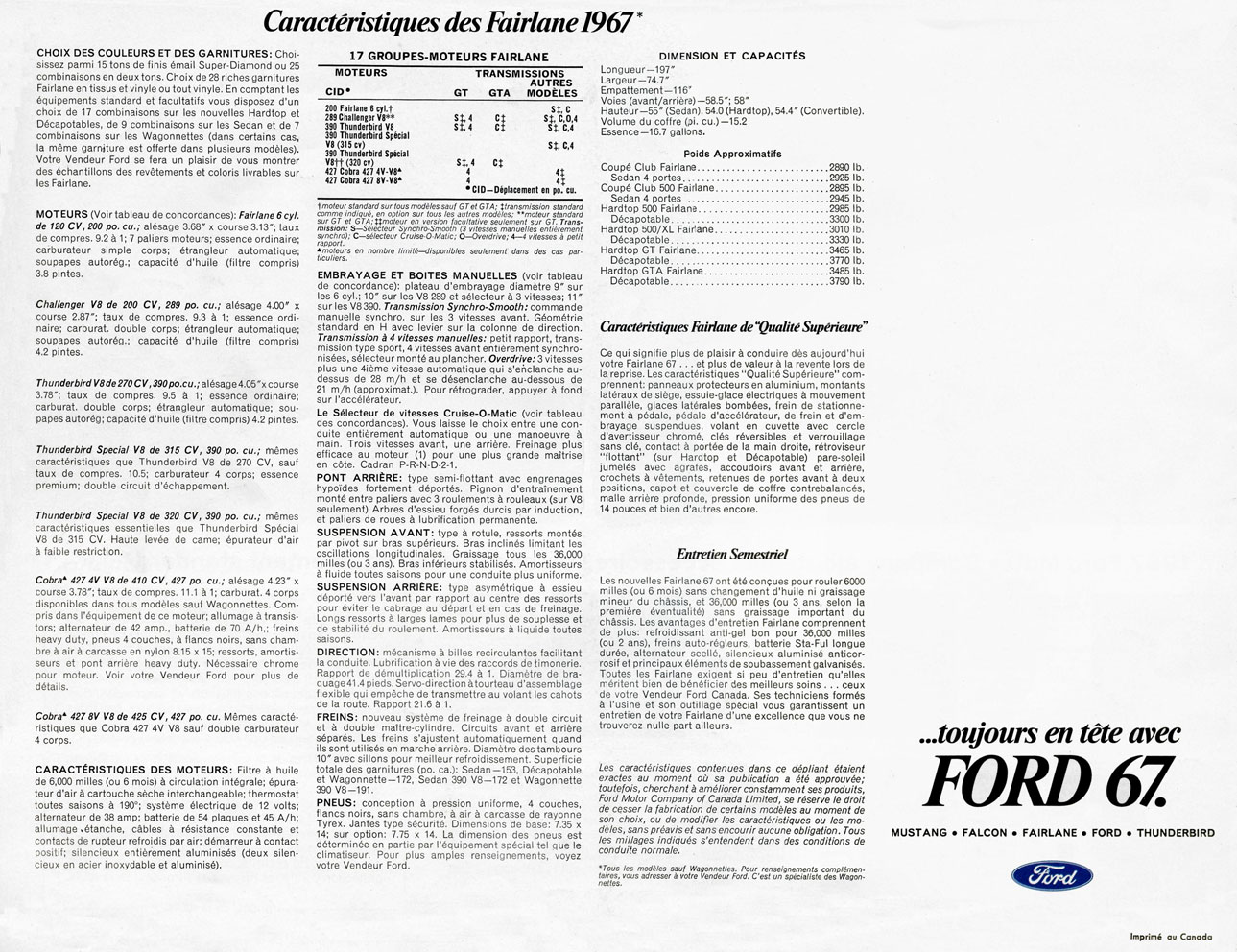
Minor trim changes were introduced for 1967 as the Fairlane was mildly facelifted. For the 1967 model year the Ranchero pickup based on the same platform switched from using the Falcon front end styling to the Fairlane front end design. The 289 CID small-block was the base V8, with a 200 CID six standard, with the 390 CID optional (with either two- or four-barrel carburetor, at 275 and 320 bhp, respectively). The 427s were still available, either with a single four-barrel carburetor or dual quad carbs, developing 410 (W-code) and 425 bhp (R-code), 427s were available on XL models, but very few were built.
Adapted across the entire range of Ford models for 1967, Fairlanes included a number of federal government-mandated safety features, including a new energy-absorbing steering column with a large padded steering wheel hub, soft interior trim, four-way hazard flashers, a dual-chamber braking system, and shoulder belt anchors. The convertible had a tempered safety glass rear window.
Two different two-door coupe models were offered. The lower-end Fairlane Club Coupe had pillars separating the door glass and rear side glass, while the higher trim level Fairlanes were pillarless two-door hardtops, similar to the convertibles.
File:Ford fairlane 500.jpg|1966 Ford Fairlane 500 4-Door Sedan File:1966 Fairlane 500 Station Wagon.jpg|1966 Ford Fairlane 500 Wagon File:1966 Ford Fairlane 500 XL convertible (6048460211).jpg|1966 Ford Fairlane 500 XL Convertible interior File:1967 Ford Fairlane 500 Hardtop 390 (cropped).jpg|1967 Ford Fairlane 500 Hardtop File:1967 Ford Fairlane Ranchero.jpg|1967 Ford Fairlane Ranchero
Sixth generation (1968–1969)
Two-door hardtop Two-door convertible Four-door sedan Four-door station wagon 1969–1981 (Argentina) 113.0 in (wagon) Lorain, Ohio Milpitas, California General Pacheco, Argentina | 200 cuin Fairlane I6 (1968) | 250 cuin Fairlane I6 (1969) | 289 cuin Windsor V8 (1968) | 302 cuin Windsor V8 | 351 cuin Windsor V8 (1969) | 390 cuin Thunderbird V8 | 428 cuin FE V8 (1969) Ford Ranchero Mercury Comet Mercury Cyclone Mercury Montego | 3/4-speed manual | 3-speed Cruise-O-Matic
A redesign was introduced for the 1968 model year, and continued the similarity to the Ford Galaxie series. The wheelbase remained at 116 in, but it grew in other dimensions. They were about four inches (102 mm) longer and 200 lb heavier than the cars they replaced. A fastback Sportsroof model was introduced in the Fairlane 500 series, as well as a more luxurious Torino model at the top of the intermediate range, contributing 172,083 of the Fairlane's 371,787 units sold that year.
In a cost-saving decision, the station wagons carried over the 1966-67 bodies from the cowl back. The Ranch Wagon model name was deleted; Fairlane wagons had either the base or the 500 trim. Base hardtop sales more than doubled, to 44,683 units.
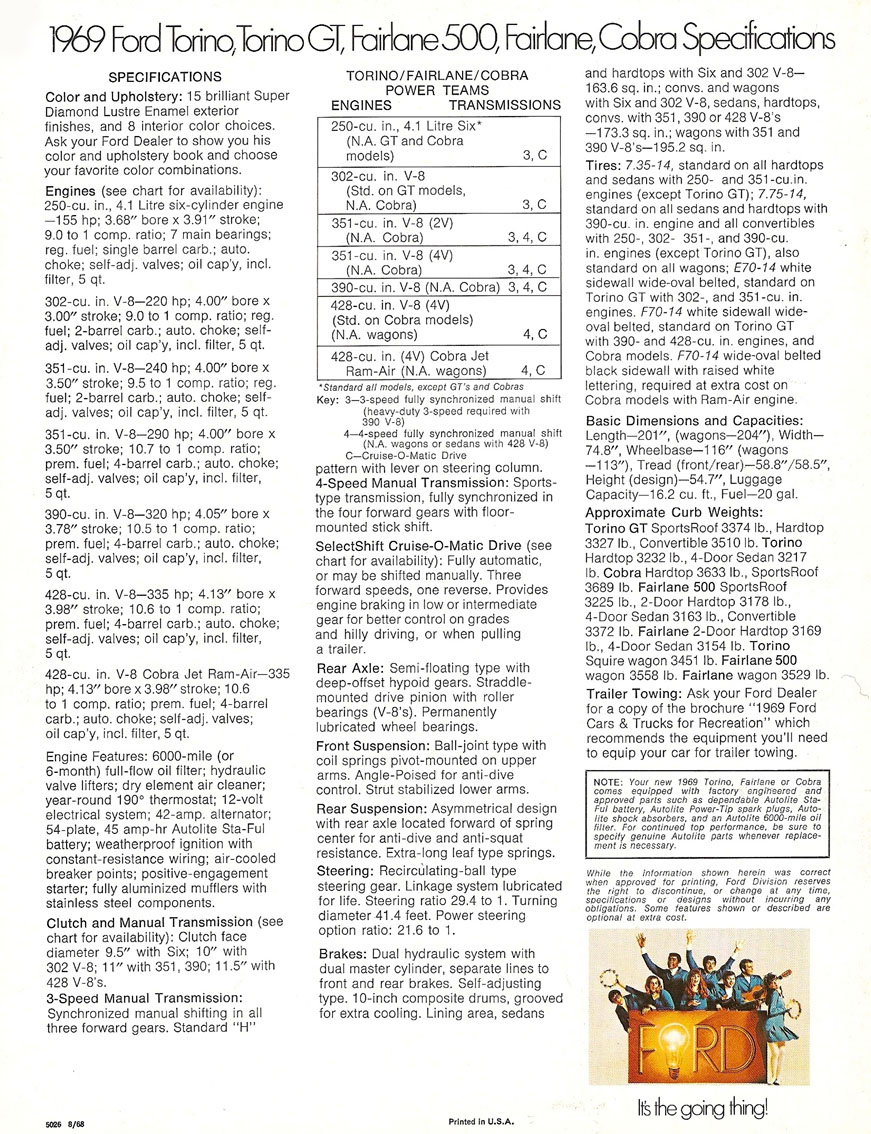
The base engine was the 200 CID six, with several optional V8s. Early production 1968 base V8 Fairlanes were equipped with the two-barrel 289 CID, while later units came with the 302 CID unit. The GTs were part of the Torino range, with the 302 CID V8 standard, with optional engines being the 390 CID V8 in two- and four-barrel versions. The 390 four-barrel was supplanted mid-year as the top performance engine by the 428 CID Cobra Jet, developing 335 bhp. There was also a 428 CID Super Cobra Jet. For 1969, the Fairlane 500, Ranchero, and Torino GT/GTA were also offered with the new 351W CID with a two-barrel producing 250 HP and only in the Torino GT/GTA the 351W four-barrel with 290 HP could be ordered.
The Ranchero coupe utility body style was available in standard, 500, and GT versions.
The Cobra was introduced in 1969 as a competitor for Plymouth's Road Runner. Basic models featured the 302 CID V8 and three-speed manual transmission as standard. Options included the 390 CID and two 428 CID V8s. The Cobras had a standard 428 CID V8 rated at 335 bhp, while options included bucket seats, hood scoop, clock, tachometer, power disc brakes, and 4.30:1 rear axle gearing. "Regular" Fairlanes and Rancheros continued, all with bucket-seat options.
File:Ford-Fairlane-500-1968.jpg|1968 Fairlane 500 convertible File:1969 Ford Fairlane 500 (18784420552) (cropped).jpg|1969 Fairlane 4-door sedan File:1968 Fairlane 500.jpg|1968 Fairlane 500 Sportsroof (fastback)
Seventh generation (1970)
Wagon: 114 in Ford Ranchero Ford Torino Mercury Comet Mercury Montego Lorain, Ohio Milpitas, California Four-door sedan Four-door station wagon | 250 cuin Fairlane I6 | 302 cuin Windsor V8 | 351 cuin Windsor V8 | 351 cuin Cleveland V8 | 429 cuin 385 V8 | 3/4-speed manual | 3-speed Cruise-O-Matic
Ford's intermediates grew again in 1970, now with a 117 in wheelbase. At the start of the model year, only the Fairlane 500 remained as the base trim model in what was now effectively the Torino series.
The straight six-cylinder was the economy power, while largest engine was now a 429 CID with four-barrel carburetor and 360 bhp. Different heads were optional and gave the Cobra 370 bhp and higher compression. Other options included the Cobra Jet Ram Air 429, though Ford quoted the same power output, and the Drag Pack rated at 375 bhp. However, the 1970s were slower than the 1969s, and race teams were forced to run the older models.
The Falcon name was transferred from Ford's now discontinued, in the US, compact to a basic, even lower-trim version of the intermediate platform as a "1970" model on January 1, 1970. This series included a two-door sedan which was not available in the higher trim lines. For 1971, the Falcon and Fairlane 500 names were dropped, as all of the intermediate models took the Torino name. The Falcon and Fairlane names continued to be used in Australia through to the 21st century, while the Fairlane name continued to be used in Venezuela through 1978 on corresponding Ford Torino and LTD II models.
Ford Fairlane in Argentina
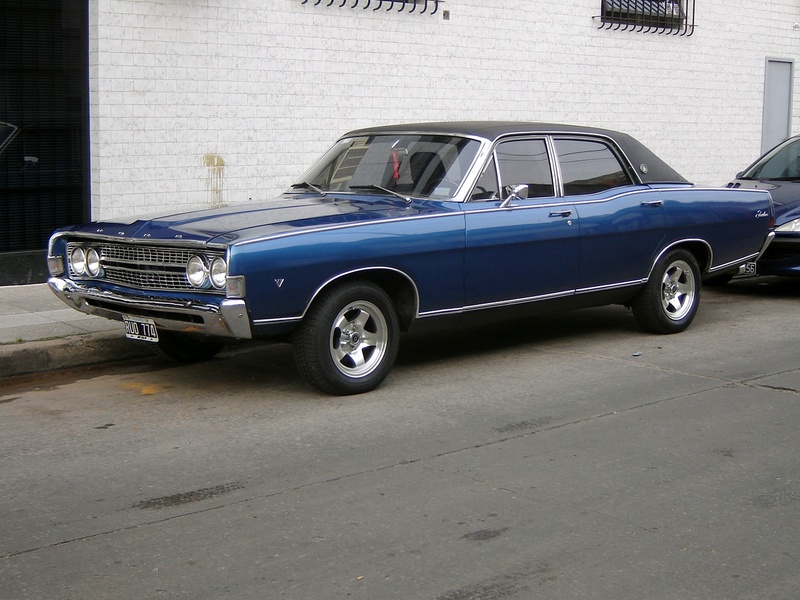
The four-door Fairlane sedan of the 1968 body style was built in Argentina from 1969 to 1973, followed by the 1969 body style which was built from 1973 to 1981. The Argentinian Fairlane came with three equipment packages: Standard, 500, or LTD. The car was similar to the American model except the engines: The two options were a 221 CID 6-cylinder with 132 hp, and the old, phase I 292 CID "Y-block" V8 which had been last used in the 1964 F-Series truck; the V8 was rated at 185 hp.
In 1971 the Ford Motor Company Argentina decided to improve the 292. The spark plugs were inclined towards the front of the engine, allowing them to be changed without removing the engine. The firing order was changede, as was the exhaust valve timing. Larger intake valves, from the Heavy Duty 292 engine used in the United States, were fitted, while the entire head and manifold was redesigned in a style very similar to that of the small block 289. The manifolds now had individual, full length runners. Buxton brand, higher compression pistons with ribbed skirts (from the 302 Windsor) were used, raising the compression ratio to 8 to 1. Claimed power was 185 hp at 4500 rpm. The distributorwas also redesigned. In 1978, the LTD "Elite" option was introduced as the most luxurious version to be made in Argentina. By the end of production in 1981, almost 30,000 Fairlanes had been made.
Ford Fairlane in Venezuela
Ford manufactured the Torino in Venezuela marketed as the Fairlane and Fairlane 500. These cars were identical to the U.S. Torino through 1976 and both base Fairlane and upscale Fairlane 500 used the 1973–1974 Torino base model grille. For 1977–1978 the Fairlane was based on the American LTD II.
2005 concept
At the 2005 Auto Show circuit, Ford revealed a new concept car with the Fairlane nameplate. The "people-mover" Fairlane crossover utility vehicle concept featured three-row seating for six passengers, and previewed the chromed three-bar horizontal grill design, which also appeared on the 2006 Ford Fusion sedan and 2007 Ford Edge crossover utility vehicle."
Production model
:See Ford Flex A production version of the Fairlane concept, now called the Ford Flex, debuted at the 2007 New York Auto Show, and entered production for the 2009 model year in summer 2008. Unlike the concept, the production model comes with seven seats. It is built on the Ford D3 platform, which is also used by the Ford Taurus, and Mercury Sable. It is intended to replace the people-mover capability of the Ford Freestar minivan.
References
References
- "Facilities | Ford Motor Company Newsroom". Media.ford.com.
- Flory, Jr., J. "Kelly". (2008). "American Cars, 1946–1959 Every Model Every Year". McFarland & Company, Inc., Publishers.
- "Six Decades of Best-Sellers - How America's Best-Selling Car has Changed - Motor Trend".
- Ford 1960 Brochure "1960 Fords". Ford Motor Company
- Ford 1961 Brochure "1961 Fords". Ford Motor Company
- McColl, Bruce. (March–April 1997). "The Compact Fairlane Story".
- Webster, Mark. (2002). "Assembly: New Zealand Car Production 1921-98". Reed.
- "1963 Ford Fairlane Brochure". lov2xlr8.no.
- "1965 Ford Brochure". Ford Motor Company.
- "1962 Ford Full Size Brochure". Oldcarbrochures.com.
- "1964 Ford brochure 1". Oldcarbrochures.com.
- Burgess, Phil, ''National Dragster'' editor. "Favorite Race Car Ever voting: Early Door Cars/Roadsters", written 11 July 2008, at [https://www.nhra.com/news/2008/favorite-race-car-ever-voting-early-door-carsroadsters NHRA.com] (retrieved 27 September 2018)
- Adolphus, David Traver. (August 2008). "1964 Ford Fairlane 500 Thunderbolt". Hemmings Muscle Machines.
- "1966 Ford Brochure". lov2xlr8.no.
- "1967 Ford Fairlane Brochure". Ford Motor Company.
- Gunnell, John. (1 April 2002). "Standard Catalog of American Cars, 1946-1975". Krause Publications.
- "1966 Ford Fairlane".
- "1967 Ford Full Line Brochure". Oldcarbrochures.com.
- "1968 Ford Fairlane Brochure". Ford Motor Company.
- "1969 Ford Fairlane Brochure". Ford Motor Company.
- Grey, Jim. (March 23, 2013). "1968 Ford Fairlane GT – The Unexpected Wallflower". Curbside Classic.
- Flory, J. "Kelly" Jr.. (2004). "American Cars 1960-1972". McFarland.
- "Fairlane Registry 1968 VIN Codes". FordFairlane.com.
- ''Ford 25 Aniversario'', published by Ford Venezuela in 1987
- "Fairlane Argentina 2.0". www.fairlaneargentina.com.
- "[http://www.motortrend.com/auto_shows/coverage/112_05_chicago_ford_fairlane_photos/index.html 2005 Chicago Auto Show: Ford Fairlane Photo Gallery]." ''Motor Trend,'' 2005.
- Nevin, Brad. (9 December 2005). "Ford Fairlane Breaks New Ground as a People Mover". Ford Communications Network.
- (2005). "Ford Fairlane Concept". Primedia Magazines.
- (1 October 2006). "Ford OKs Fairlane, Keeps Town Car". Penton Media, Inc..
- (September 14, 2006). "Ford Develops People Movers to Replace Minivans". Car and Driver.
This article was imported from Wikipedia and is available under the Creative Commons Attribution-ShareAlike 4.0 License. Content has been adapted to SurfDoc format. Original contributors can be found on the article history page.
Ask Mako anything about Ford Fairlane (Americas) — get instant answers, deeper analysis, and related topics.
Research with MakoFree with your Surf account
Create a free account to save articles, ask Mako questions, and organize your research.
Sign up freeThis content may have been generated or modified by AI. CloudSurf Software LLC is not responsible for the accuracy, completeness, or reliability of AI-generated content. Always verify important information from primary sources.
Report