From Surf Wiki (app.surf) — the open knowledge base
Forbes Field
Baseball field in Pittsburgh, Pennsylvania, US

Baseball field in Pittsburgh, Pennsylvania, US
| Field | Value | |
|---|---|---|
| name | Forbes Field | |
| nickname | "The House of Thrills" | |
| "The Oakland Orchard" | ||
| image | [[File:Forbes Field exterior.jpg | 275px]] |
| location | 230 South Bouquet St. in Oakland, adjacent to Schenley Park | |
| broke_ground | March 1, 1909 | |
| built | March–June 1909 | |
| opened | June 30, 1909 | |
| closed | June 28, 1970 | |
| demolished | 1971 | |
| surface | Grass | |
| construction_cost | Estimated US$1–2 million | |
| ($ – $ in dollars) | ||
| architect | Charles Leavitt Jr. | |
| general_contractor | Nicola Building Company | |
| tenants | Pittsburgh Pirates (MLB) (1909–1970) | |
| Pittsburgh Steelers (NFL) (1933–1963) | ||
| Philadelphia–Pittsburgh "Steagles" (NFL) (1943) | ||
| "Card-Pitt" (NFL) (1944) | ||
| Pittsburgh Panthers (NCAA) (1909–1924) | ||
| Carnegie Tech Tartans (NCAA) (1922-1928) | ||
| Duquesne Dukes (NCAA) (1933–1942, 1947–1950) | ||
| Homestead Grays (Negro leagues) (1922–1939) | ||
| Pittsburgh Americans (AFL) (1936–1937) | ||
| Pittsburgh Phantoms (NPSL) (1967) | ||
| capacity | 23,000 (1909) | |
| 41,000 (1925) | ||
| 35,000 (1970) | ||
| dimensions | 1954–1970: | |
| Left field—365 ft | ||
| Left center—406 ft | ||
| Center field—457 ft | ||
| Right center—408 ft | ||
| Right field—375 ft[[File:ForbesFieldDimensions.svg | 200px | ]] |
| scoreboard | Hand-operated | |
| embedded |
"The Oakland Orchard" ($ – $ in dollars) Pittsburgh Steelers (NFL) (1933–1963) Philadelphia–Pittsburgh "Steagles" (NFL) (1943) "Card-Pitt" (NFL) (1944) Pittsburgh Panthers (NCAA) (1909–1924) Carnegie Tech Tartans (NCAA) (1922-1928) Duquesne Dukes (NCAA) (1933–1942, 1947–1950) Homestead Grays (Negro leagues) (1922–1939) Pittsburgh Americans (AFL) (1936–1937) Pittsburgh Phantoms (NPSL) (1967) 41,000 (1925) 35,000 (1970) Left field—365 ft Left center—406 ft Center field—457 ft Right center—408 ft Right field—375 ft[[File:ForbesFieldDimensions.svg|200px|]] Forbes Field was a baseball park in the Oakland neighborhood of Pittsburgh, Pennsylvania, from 1909 to June 28, 1970. It was the third home of the Pittsburgh Pirates, the city's Major League Baseball (MLB) team, and the first home of the Pittsburgh Steelers, the city's National Football League (NFL) franchise. From 1909 to 1924, the stadium also served as the home football field for the University of Pittsburgh "Pitt" Panthers. The stadium sat on Forbes Avenue, named for British general John Forbes, who fought in the French and Indian War and named the city in 1758.
The US$1 million ($ million today) project was launched by Pittsburgh Pirates' owner Barney Dreyfuss to replace his franchise's second home, Exposition Park. The stadium was made of concrete and steel, the first such stadium in the National League and third in Major League Baseball, in a bid to be more durable than wooden ballparks. The Pirates opened Forbes Field on June 30, 1909, against the Chicago Cubs, and played the final game against the Cubs on June 28, 1970. The field itself featured a large playing surface, with the batting cage placed in the deepest part of center field during games. Seating was altered multiple times throughout the stadium's life; at times fans were permitted to sit on the grass in the outfield during overflow crowds. The Pirates won three World Series while at Forbes Field; the Pittsburgh Panthers football team had five undefeated seasons before moving in 1924. In 1958, broadcaster Bob Prince dubbed Forbes Field "The House of Thrills" for the then-resurgent Pirates and several games that saw late-inning heroics.
Some remnants of the ballpark still stand, surrounded by the campus of the University of Pittsburgh. Fans gather on the site annually on the anniversary of Bill Mazeroski's World Series winning home run, in what author Jim O'Brien writes is "one of the most unique expressions of a love of the game to be found in a major league city".
History
Planning and design
In 1903, Pittsburgh Pirates' owner Barney Dreyfuss began to look for ground to build a larger capacity replacement for the team's then-current home, Exposition Park. Dreyfuss purchased seven acres of land near the Carnegie Library of Pittsburgh, adjacent to Schenley Park, with assistance from his friend, industrialist Andrew Carnegie. The low-priced land was selected so Dreyfuss could spend more on the stadium itself. The site was initially labeled "Dreyfuss's Folly" due to its long distance—a 10-minute trolley ride—from downtown Pittsburgh, but the land around the park developed and criticisms were dropped. Official Pirates' records show that Forbes Field cost US$1 million for site acquisition and construction. However, some estimates place the cost at twice that amount.
Dreyfuss announced that unlike established wooden ballparks such as the Polo Grounds, he would build a three-tiered stadium out of steel and concrete to increase longevity—the first of its kind in the nation. Charles Wellford Leavitt Jr. was contracted to design the stadium's grandstand. A civil engineer, Leavitt had founded an engineering and landscape architecture firm in 1897.
Initial work on the land began on January 1, 1909,
After Dreyfuss died in 1935, there was renewed media interest in renaming the stadium "Dreyfuss Field". His widow, Florence, resisted. However, a monument to Dreyfuss was placed in center field just in front of the wall.
Opening

The first game was played at Forbes Field on June 30, 1909, one day after the Pittsburgh Pirates had defeated the Chicago Cubs, 8–1, at Exposition Park. Fans began to arrive at the stadium six and one-half hours early for the 3:30 p.m. game. Flags flew at half staff to honor the recently deceased presidents of the Philadelphia Phillies and the Boston Doves. Various National League officials and owners attended the pre-game ceremonies, including league president Harry Pulliam, Civil War veteran and manager of Pittsburgh's first professional baseball team Al Pratt, and American League president Ban Johnson. Pittsburgh Mayor William A. Magee threw out the stadium's ceremonial first pitch, tossing it from the second tier to John M. Morin, Director of Public Safety, on the field below. Morin then went to the mound and threw the first pitch to the Pirate catcher.
The Pittsburgh Press wrote, "the ceremonies were witnessed by the largest throng that ever attended an event of this kind in this or any other city in the country...Forbes Field is so immense—so far beyond anything else in America in the way of a baseball park—that old experts, accustomed to judging crowds at a glance, were at a loss for reasonable figures." Records, however, show that the first game was attended by a standing-room only crowd of 30,338.
The first batter at Forbes Field was future Hall of Famer Johnny Evers, the Cubs second baseman and leadoff batter. He was hit by a pitch and later in the inning scored the first run. The first hit by a Pirate was by catcher George Gibson, who eventually became a Pirate manager. The Chicago Cubs won the first game, 3–2. Dreyfuss declared, "This is indeed the happiest day of my life."
Playing field evolution
The stadium was widely considered the best in the league.
Dreyfuss "hated cheap home runs and vowed he'd have none in his park", which led him to design a large playing field for Forbes Field. The original distances to the outfield fences in left, center, and right field were 360 ft, 462 ft and 376 ft, respectively.
The left field foul pole initially intersected the bleacher section about two-thirds of the way toward where the bleacher corner touched the fence, at a distance of 301 ft,, leaving a narrow slice which could benefit a strict pull hitter, but which soon proved bothersome to left fielders.
In the early spring of 1912, the diamond was shifted so that the left field foul line intersected the end of the left field fence rather than the bleacher section. By 1914, the left field distance was stated as 365 ft, which eventually became the distance marked on the fence.
In 1921, the seating capacity was increased by the addition of several rows of new box seats.
In 1925, seating capacity received a bigger bump when the right field grandstand was extended into the corner and into fair territory, replacing a section of wooden bleachers. Construction of the new stands began in late winter and opened in June 1925.
The change reduced the foul line distance from 376 ft to 300 ft but increasing the near-right center distance to 375 ft. Dreyfuss made no secret of his mixed feelings regarding this move, and in May 1930, in response to American League President E. S. Barnard's proposed plan to stem the recent flood of sub-350-foot home runs, Dreyfuss readily complied by erecting a 28 ft high screen.
Even at this long distance from home plate, the fence stood 12 ft in height in left and center fields, with the new right field wall reduced to 9.5 ft following the 1925 construction (later topped by the screen). The backstop was set at 110 ft behind home plate, larger than the average of 60 ft in most stadiums of the time. Additional seating eventually cut down the plate-to-screen distance to a still larger-than-average 75 ft.
With such a large outfield space, triples and inside-the-park home runs were common. The Pirates hit a record eight triples in a single game, on May 30, 1925. Conversely, the stadium was one of the most difficult to hit over-the-fence home runs. The closeness of the right field line from 1925 onward was the only area that compromised Dreyfuss' original design concept. Even at that, the right field wall angled sharply out to 375 ft, a typical distance for a major league power alley. Babe Ruth hit the final three home runs of his career in Forbes Field on May 25, 1935; the third of these cleared the 89 ft right field roof and was considered the longest home run in the park's history.
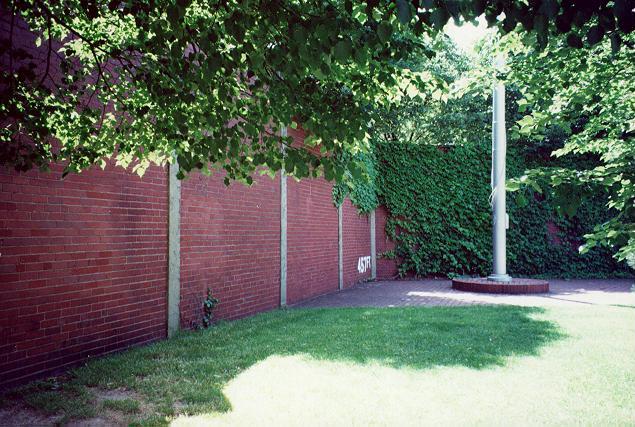
The last major change to the outfield came in 1946, when the fence in left and center was replaced by a brick wall. The fence had been painted green, while the bricks were of a reddish color. Ivy was planted at the base of the new wall, restoring the green background enjoyed by batters.
Although Forbes Field developed a reputation as a "pitcher-friendly" ballpark, there was never a no-hitter thrown in the more than 4,700 games at the stadium.
The field itself consisted of natural grass grown in Crestline, Ohio.
Until 1942, Forbes Field's batting cage, when not in use, was stored on the field, in front of the stands directly behind home plate, a bare-bones but viable solution rendered obsolete by the introduction that season of a new, considerably larger cage. During that season and part of 1943, the new cage resided in foul territory, down the right field line, near the Pirates' bullpen. At some point prior to July 26, 1943, evidently prompted by numerous instances of the relocated cage continuing to impact balls in play, the Pirates finally settled on what would become its permanent and, by far, best-remembered home: in fair territory, just to the left of the 457 ft marker in deepest left-center. The open part of the cage faced the wall, its rear effectively serving as a convex fence,
In 1947, well after Dreyfuss' death, and upon the arrival of veteran slugger Hank Greenberg, the bullpens were moved from foul territory to the base of the scoreboard in left field and were fenced in, cutting 30 ft from the left field area, from 365 ft to 335 ft down the line and 406 ft to 376 ft in left-center field. These were not abnormal major league outfield distances, but the obvious attempt to take advantage of Greenberg's bat led the media to dub the area "Greenberg Gardens". Greenberg retired after the season, but by then Ralph Kiner was an established slugger with the Pirates, and the bullpen was redubbed "Kiner's Korner". Kiner was traded after the 1953 season, and the field was restored to its previous configuration in time for the 1954 season.
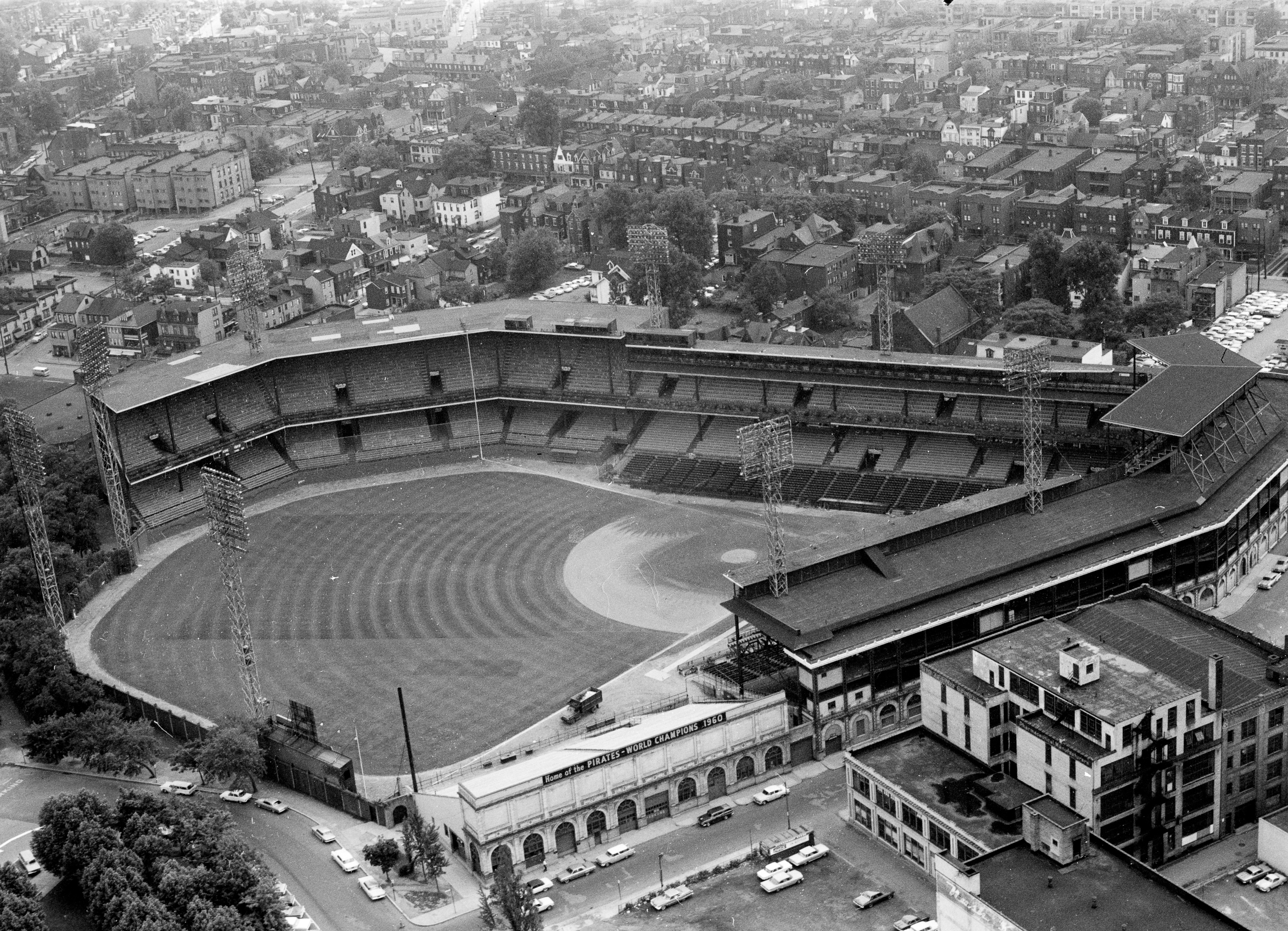
The final posted dimensions of the ballpark were left field line 365 ft, left-center field 406 ft, deepest left-center 457 ft, deep right-center 436 ft, right-center field 375 ft, and right field line 300 ft. The only marker in exact straightaway center field was the Barney Dreyfuss monument, which sat on the playing field just in front of the wall. Some sources stated 442 ft as the distance to straightaway center. Some sources also stated 408 ft as a right-center distance, to the unmarked point where the center field wall intersected the end of the double-deck stands.
Forbes Field's outfield fences / walls featured no advertising, except a 32 ft United States Marine Corps billboard during the 1943 season.
The infield developed a "rock-hard" surface throughout the stadium's history. During the final game of the 1960 World Series, Yankees shortstop Tony Kubek was struck in the throat with a ball that bounced at an unexpected angle off the hard dirt surface, breaking up a potentially rally-killing double play and causing Kubek to exit the game. Pittsburgh went on to win the game and the championship.
On occasions when rainfall soaked the pitcher's mound, groundskeepers would burn gasoline on the mound to dry it off.
Seating and tickets

Forbes Field had an original capacity of 25,000, the largest in the league at the time. temporary bleachers were set up for the occasion and cost $0.50. When winning streaks attracted high attendance to games, fans were permitted to sit on the grass in right field, provided they agreed to allow a player to catch any ball hit in the area. The lowest season of attendance came in 1914, when 139,620 people attended games; the highest at the stadium came in 1960, when 1,705,828 people watched the Pirates play. At 200 people, June 10, 1938, was believed to have marked the smallest crowd to ever attend a Pirates game (against the Philadelphia Phillies), however, Baseball Reference has the attendance for that game listed as 1,034. On September 30, 1962, a crowd of 40,916 people saw the Steelers defeated by the New York Giants, at the Steelers' highest-attended game at the stadium.
Closing and demolition

Though Forbes Field was praised upon its opening, it began to show its age after 60 years of use. The park was the second oldest baseball field in the league at the time – only Shibe Park in Philadelphia was older (it was replaced in 1971 by Veterans Stadium). The location of the park, which initially was criticized for not being developed, grew into a "bustling business district" which led to a lack of parking space. Following a plan to expand their adjacent campus, the University of Pittsburgh purchased Forbes Field in 1958, with an agreement to lease the stadium to the Pirates until a replacement could be built. A proposal for a new sports stadium in Pittsburgh was first made in 1948, but plans did not attract much attention until the late 1950s. Construction began on Three Rivers Stadium on April 25, 1968. The Pittsburgh Pirates and the Chicago Cubs played a double-header on June 28, 1970. Pittsburgh won the first game 3–2. In the later game Al Oliver hit the last home run in the park, and Matty Alou drove in two runs as the Pirates closed the 62-year-old stadium with a 4–1 victory. The 40,918 spectators in attendance stood and cheered as Dave Giusti retired Willie Smith for the final out (recorded by Bill Mazeroski) at the stadium. Pirates Hall of Famer Roberto Clemente played 15 seasons at Forbes Field. He was emotional during the last game saying, "I spent half my life there." After the game, home plate was dug up and taken by helicopter to Three Rivers Stadium to be installed in the artificial turf.
A community group attempted to rescue the structure from demolition, proposing such things as a stage, apartments and a farmers market for the site and comparing it to the Eiffel Tower in significance.
The abandoned structure suffered two separate fires that damaged the park, on December 24, 1970, and July 17, 1971. Eleven days after the second fire, demolition began, and the site was cleared for use by the University of Pittsburgh.
Memorials
In 1955, a statue of Honus Wagner was dedicated in Schenley Plaza adjacent to Forbes Field. Several thousand fans attended the dedication as well as Wagner himself. His failing health caused him to never leave his open convertible in which he arrived (Wagner died near the end of that year). The 1800 lbs statue was moved to Three Rivers Stadium in 1970. Today, the statue stands at the home plate entrance of PNC Park.


The portion of the left field wall over which Bill Mazeroski hit his walk-off home run to end the 1960 World Series, between the scoreboard and the "406 FT" sign, no longer stands at its original location. A portion of that wall, including the distance marker, had been sliced off and moved to the Allegheny Club at Three Rivers Stadium. Before the Three Rivers demolition, the section of the wall was salvaged, and in 2009 it was restored and placed on the Riverwalk outside of PNC Park.
Meanwhile, the original location of that wall is outlined by bricks extending from the left-center field wall across Roberto Clemente Drive and into the sidewalk. A plaque embedded in the sidewalk marks the spot where Mazeroski's home run cleared the wall. In addition, a wooden replica of an entrance to the stadium, including a ticket window and players entrance, was constructed and placed near the remaining wall in 2006. The home plate used in the stadium's final game remains preserved in the University of Pittsburgh's Posvar Hall. However, its location has been altered; author John McCollister wrote, "Had architects placed home plate in its precise spot about half of the Pirates fans could not view it. The reason: it would have to be on display in the fifth stall of the ladies' restroom." However, the original location of the home plate has been more recently determined by others to be approximately 81 ft away from its current display, just inside the GSPIA/Economics Library, and not in a restroom as has been popularly believed.
A ceremony is held each October 13 at the outfield wall in Oakland to listen to a taped broadcast of the final game of the 1960 World Series. The tradition was started by Squirrel Hill resident Saul Finkelstein, who at 1:05 pm on October 13, 1985, sat alone at the base of the flagpole and listened to the NBC radio broadcast of Chuck Thompson and Jack Quinlan. Finkelstein continued the tradition for eight more years, until word spread and other people began attending in 1993. On October 13, 2000—the game's 40th anniversary—over 600 people attended to listen to the broadcast, including Mazeroski himself. For the 50th anniversary, on October 13, 2010, a plaque honoring Mazeroski was dedicated and more than 1,000 attended the broadcast, including Mazeroski and several other former Pirates.
Events
Baseball
| Pittsburgh Pirates}};" | Years | Pittsburgh Pirates}};" | Capacity | Pittsburgh Pirates}};" | 1909–1914 | Pittsburgh Pirates}};" | 1915–1924 | Pittsburgh Pirates}};" | 1925–1937 | Pittsburgh Pirates}};" | 1938 | Pittsburgh Pirates}};" | 1939–1941 | Pittsburgh Pirates}};" | 1942–1946 | Pittsburgh Pirates}};" | 1947–1952 | Pittsburgh Pirates}};" | 1953–1959 | Pittsburgh Pirates}};" | 1960–1970 |
|---|
In 1909, Forbes Field's opening season, the Pirates beat the Detroit Tigers in the World Series. It was the only meeting of eventual Hall of Famers Honus Wagner and Ty Cobb.
On October 2, 1920, Forbes Field hosted the last triple-header in MLB history.
On August 5, 1921, Forbes Field was the site of the first live radio broadcast of a Major League Baseball game in the United States. Regular broadcasts of Pirates games began over KDKA in 1936, announced by A. K. "Rosey" Rowswell, a local humorist and friend of team owner Bill Benswanger. Rowswell is quoted as describing his broadcasting with, "It's not just play-by-play that matters. It's what you say in between the pitches that counts." His style influenced junior partner Bob Prince, who began broadcasting in 1948. Rowswell broadcast games at Forbes Field until his death in 1955.
In 1925, the Pirates became the first team to come back from a three-game to one deficit to defeat the Washington Senators and win the World Series. Pittsburgh's third and final World Series championship while they played at Forbes Field came in 1960. Bill Mazeroski hit the first home run to end a World Series, the only walk-off home run in World Series Game 7 history. These two World Series victories mark the only times that the Pirates clinched a championship at home, with Forbes Field hosting both.
Two unassisted triple plays were turned at Forbes Field. The first took place on May 7, 1925, when Pittsburgh's Glenn Wright achieved the feat. Two seasons later, in 1927, Jimmy Cooney—who had been a victim of the first triple play—also acquired three outs by himself.

On May 25, 1935, at Forbes Field, Babe Ruth hit the last three home runs of his career as his Boston Braves lost to the Pirates, 11–7. His last home run cleared the right field stands roofline, making him the first player to ever do so.
On October 8, 1946, six months before his major league debut, Jackie Robinson played with his African American all-stars against Honus Wagner's all-stars.
Most of the game-action scenes from the 1951 film Angels in the Outfield were filmed at the stadium.
On May 28, 1956, Dale Long of the Pirates took what one author has stated was the first-ever curtain call in baseball history, after hitting home runs in eight consecutive games caused fans to cheer for five minutes.
The Homestead Grays of the Negro leagues played all home games at Forbes Field from 1922 to 1939. Grays owner Cumberland Posey became friends with Dreyfuss, who rarely missed a Grays game. In 1930, Josh Gibson made his premiere for the Grays at Forbes Field. Also in 1930, the Grays and the Kansas City Monarchs played the first baseball game at night in Pittsburgh on July 18, 1930. A crowd of over 15,000 was expected. Floodlights were installed the day before the game after they were transported from Cleveland, where the Grays and Monarchs had played on July 16. Six members of the Grays' 1936 team have been inducted into the Baseball Hall of Fame. Beginning in 1937, the Grays won nine consecutive Negro National League championships.
The University of Pittsburgh's baseball team also often used Forbes Field for home games.
Football
The University of Pittsburgh's football team moved from Exposition Park into Forbes Field upon its opening in 1909 and played there until 1924 when it moved into the larger Pitt Stadium only a few blocks away. In their first game at Forbes Field on October 16, 1909, the Panthers defeated Bucknell University 18–6. In 1910, Pitt's second year at Forbes Field, the Panthers went undefeated without allowing a single point. The Panthers had several successful seasons while playing at Forbes Field, including five in which they went undefeated and were awarded national championship titles in 1910, 1915, 1916, 1917, and 1918. During their years at Forbes Field, Pitt's teams were led by Hall of Fame coaches Joe Thompson, Glenn "Pop" Warner and Jock Sutherland. Forbes Field was the site of yet another broadcasting first when on October 8, 1921, Harold W. Arlin announced live play-by-play action of the Pitt-West Virginia football game on radio station KDKA, the first live radio broadcast of a college football game in the United States. Duquesne University also played many of their home games there in the 1930s and 1940s.
The 1926 Carnegie Tech Tartans football team pulled off one of the greatest upsets in sports history by defeating the 8–0 Notre Dame Fighting Irish, shutting them out, 19–0. Legendary ND head coach, Knute Rockne, thought the Pittsburgh team would be easily defeated and did not show up for the game.
Pittsburgh native, Art Rooney founded his NFL team under the name the Pittsburgh Pirates, on July 8, 1933, for $2,500 ($ in present-day terms). The franchise's first game, against the New York Giants, was held on September 20, 1933, at Forbes Field. The Giants won the game 23–2 in front of 25,000 people. Rooney wrote of the game, "The Giants won. Our team looks terrible. The fans didn't get their money's worth." The Pirates rebounded to gain their first ever franchise victory a week later at Forbes Field, against the Chicago Cardinals. On November 30, 1952, the Steelers met the New York Giants at Forbes Field for a snowy afternoon game. Pittsburgh entered the game with a 3–6 record, but went on to set multiple team records, including scoring nine touchdowns, to win the game 63–7. Excited by their team's play, the 15,140 spectators ran onto the field and began to tear the field goal posts out of the ground. The University of Pittsburgh's acquisition of Forbes Field in 1958 gave the Steelers some options, and they began transferring some of their home games to the much larger Pitt Stadium that year. The Steelers played their final game at Forbes Field on December 1, 1963. The franchise moved to Pitt Stadium exclusively the following season.
Boxing and other events
Boxing bouts were held at Forbes Field from the 1910s to the 1950s, attracting crowds of over 15,000 people. On June 23, 1919, Harry "The Pittsburgh Windmill" Greb—the only boxer to beat Gene Tunney—defeated Mike Gibbons in a ten-round bout at Forbes Field. Another bout on September 25, 1939, was attended by 17,000 people including Art Rooney and Pie Traynor. Pittsburgh native Billy Conn defended his light heavyweight title against Melio Bettina, whom he had beaten months earlier. Conn won the bout by decision in 15 rounds. Two years later, on June 18, 1941, Conn fought Joe Louis at New York City's Polo Grounds, in an attempt to become the world heavyweight champion. The Pirates and the New York Giants, who were playing at Forbes Field, were called into their dugouts while the 24,738 fans in attendance listened to the radio broadcast of the hour-long bout. Conn led the bout into the final round, but fought for the knockout and was knocked out himself.
On Sunday, October 17, 1909, at 3:00 p.m. a communion service was held at Forbes Field as the culmination of the International Centennial Celebration and Conventions of the Disciples of Christ marking the 100th anniversary of the signing of the "Declaration and Address" by Thomas Campbell in September 1809. Campbell was a founding father of the American Restoration Movement (Disciples of Christ, Christian Church, Churches of Christ). Delegates and members of churches from all over the world were present.
The Mine Safety and Health Administration hosted a mine rescue and safety demonstration at Forbes on October 30, 1911. The event included first-aid and rescue demonstrations. Around 15,000 attended the event, including President William H. Taft.
References
Bibliography
References
- Gershman, Michael. (1993). "Diamonds: The Evolution of the Ballpark". oughton Mifflin.
- Biederman, Lester. (June 5, 1938). "Forbes Field Rated Tops . . . . . . . . Gets Perfect Ball Park Tag". The Pittsburgh Press.
- "PHMC Historical Markers Search". Commonwealth of Pennsylvania.
- (2010). "Historic Landmark Plaques 1968–2009". Pittsburgh History & Landmarks Foundation.
- Keck, Harry (August 13, 1958). [https://www.newspapers.com/image/?clipping_id=89477002 "Enthusiasm of the Fans Rubbing Off on the Pirates"]. ''Pittsburgh Sun-Telegraph''. p. 37. Retrieved November 24, 2021.
- Leonard, Vincent (August 12, 1959). [https://www.newspapers.com/clip/54179167/aug-12-1959-forbes-field-acquires-a/ "Sports Vignettes: The Big Return; As If For the Championship"]. ''The Daily Republican''. Retrieved June 26, 2020.
- Leonard, Vince (August 31, 1959). [https://www.newspapers.com/clip/54162046/aug-31-1959-forbes-field-acquires-a/ "Sports Vignettes: Buc Thrillers"]. ''The Daily Republican''. Retrieved June 25, 2020.
- [https://news.google.com/newspapers?id=lddaAAAAIBAJ&sjid=MmwDAAAAIBAJ&pg=3238%2C7150581&dq=house-thrills "Back the Bucs in '60"]. ''Pittsburgh Post-Gazette''. April 12, 1960. Retrieved June 26, 2020.
- Keck, Harry (April 18, 1960). [https://www.newspapers.com/image/?clipping_id=89465691 "Same Exciting Script Being Used in House of Thrills"]. ''Pittsburgh Sun-Telegraph''. p. 16. Retrieved November 24, 2021.
- Cernkovic, Rudy (June 7, 1960). [https://www.newspapers.com/clip/54167579/jun-7-1960-derivation-of-forbes/ "Blood Pressure of Buc Fans Return to Normal (During Road Trip)"]. ''The Weirton Daily Times''. Retrieved June 25, 2020.
- {{harvnb. Cicotello. 2007
- {{harvnb. Gershman. 1993
- Cicotello. 2007
- McCollister. 2008
- Tom. (2015-06-19). "Sitting in the Bleachers at Pittsburgh's Forbes Field in 1910".
- {{harvnb. McCollister. 1998
- "Pirates' Timeline". [[Major League Baseball Advanced Media]].
- He had gained experience in steel and concrete constructs while designing the [[Belmont Park. Belmont]] and [[Saratoga Race Course. Cicotello. 2007
- {{harvnb. Cicotello. 2007
- Weather conditions were reported as clear skies with a temperature around 80 degrees.Bonk, Dan. "Forbes Field: Build it Yourself." Point Four Ltd., 1995.
- "Oakland: Organizations: Forbes Field".
- (June 30, 1909). "35,000 Fans Help to Dedicate Ball Park". [[Carnegie Library of Pittsburgh]].
- Pittsburgh ''Daily Post'', June 27, 1909, p. 30
- Pittsburgh ''Press'', March 3, 1912, p. 20
- Pittsburgh ''Press'', August 25, 1914, p. 20
- Pittsburgh ''Press'', February 13, 1921, pp. 15][Pittsburgh ''Daily Post'', February 13, 1921, p. 18
- {{harvnb. Leventhal. 2000
- United News (March 20, 1930). [https://news.google.com/newspapers?id=4bVhAAAAIBAJ&sjid=v2gDAAAAIBAJ&pg=4148%2C4489078 "Barnard Plans to Check 'Cheap' Homers; Proposes Screen for All Sectors Less Than 350 Feet"]. ''The Pittsburgh Post-Gazette''. "Three major league clubs already have taken to the screen idea, the Phillies and Cardinals erecting screens at their parks last season and the Pirates building one at Forbes Field this season." Retrieved April 20, 2018.
- Davis, Ralph (March 22, 1950). [https://news.google.com/newspapers?id=-UsbAAAAIBAJ&sjid=L0sEAAAAIBAJ&pg=1703%2C6798287 "Plan to Cut Trick Homers is Sensible: Fandom Tires of Freak Four-Baggers, Which Have Robbed One of Game's Features of Its Most Pronounced Thrill"]. ''The Pittsburgh Press''. "President Barney Dreyfuss has always been opposed to freak homers. He hesitated for a long time about increasing his seating capacity by encroaching on his playing area. He finally did it, because everyone else was doing it. But he is said to have regretted the move after it was made, and now has offset it by ordering a screen in front of the right field stands." Retrieved April 20, 2018.
- Wertenbach, Fred (May 24, 1930). [https://news.google.com/newspapers?id=pRkhAAAAIBAJ&sjid=OUsEAAAAIBAJ&pg=6490%2C2008537&dq=robbed-new-screen "Bucs Beat Cubs; Ens Shifts Line-Up; Comorosky Going Back to Old Post"]. ''The Pittsburgh Press''. "Wilson was robbed of his thirteenth homer when his drive crashed into the new screen in right and went for a double in the sixth." Retrieved April 20, 2018.
- Pittsburgh ''Press'', December 2, 1945, p. 36
- Pittsburgh ''Sun-Telegraph'', April 21, 1946, p. 21
- Dvorchak, Robert. (April 5, 2009). "Talented 1909 Pirates Started New Era of Baseball". [[Pittsburgh Post-Gazette]].
- Thorn, John; Palmer, Pete (1993). [https://www.google.com/search?tbo=p&tbm=bks&q=%22batting+cage%22+%22behind+home+plate%22+%22forbes+field%22+intitle:Total+intitle:Baseball&num=10 ''Total Baseball: The Official Encyclopedia of Major League Baseball'']. New York, NY : HarperPerennial. p. 138.
- Biederman, Les. [https://news.google.com/newspapers?id=M1IbAAAAIBAJ&sjid=fkwEAAAAIBAJ&pg=3574%2C3561874&dq=new-batting-cage-cost-contraption-huge-parked-front-bull-pen-ball-struck-stopped "The Scoreboard"]. ''The Pittsburgh Press''. April 20, 1942. Retrieved May 28, 2019.
- Biederman, Les. [https://news.google.com/newspapers?id=bgkeAAAAIBAJ&sjid=q0wEAAAAIBAJ&pg=6521%2C5513717&dq=fletcher-doubled-cage-right "Bucco Heintzelman Baffles Braves, 3-0; Ken Allows Boston Only Three Hits"]. ''The Pittsburgh Press''. July 19, 1942. Retrieved May 28, 2019.
- Boyle, Havey. [https://news.google.com/newspapers?id=qcMwAAAAIBAJ&sjid=_GkDAAAAIBAJ&pg=3802%2C2819616&dq=barrett-whipped-double-right-field-presence-batting-cage-near-bull-pen-second "Pirates Given Approval of Fans"]. ''Pittsburgh Post-Gazette''. April 28, 1943. Retrieved May 28, 2019.
- Balinger, Edward. [https://news.google.com/newspapers?id=wegnAAAAIBAJ&sjid=_WkDAAAAIBAJ&pg=5410%2C6015176&dq=olmo-socked-fly-cage "Vaughan's Homer Beats Bucs, 10-6; Arky's Blow Comes With Bases Full; Olmo, DiMag Hit Homers"]. ''Pittsburgh Post-Gazette''. July 27, 1943. Retrieved May 28, 2019.
- somewhat akin to that surrounding the base of the light tower standing just to the left (as well as those surrounding the left field and right-center field towers). Unlike the batting cage and the flagpole just to its right, the light towers themselves—as opposed to the aforementioned fences—were not in play; a batted ball striking any one of them, or landing inside the surrounding fence, was a home run.Hernon, Jack. [https://news.google.com/newspapers?id=vQsNAAAAIBAJ&sjid=N2oDAAAAIBAJ&pg=4963%2C1515411&dq=kiner-down-inside-guard-around-light-tower "Kiner's 13th Brings Bucs Good Luck; Win in 12th by 5-4 After 7-6 Defeat"]. ''Pittsburgh Post-Gazette''. June 12, 1950. Retrieved May 28, 2019.
- Finch, Frank. [http://www.mediafire.com/view/4p57y5a2vmjt0az/.png "Are Dodgers Waking Up?"]. ''Los Angeles Times''. June 1, 1964. Retrieved May 28, 2019.
- Biederman, Les. [https://news.google.com/newspapers?id=10sqAAAAIBAJ&sjid=xE8EAAAAIBAJ&pg=3546%2C3354468&dq=stargell-homer-left-field-light-tower "Bucs' Bats Boom for McBean; Early Punch Stampedes Giants, 10-0"]. ''The Pittsburgh Press''. April 22, 1968. Retrieved May 28, 2019.
- Musick, Phil. [https://news.google.com/newspapers?id=OM8yAAAAIBAJ&sjid=DZYEAAAAIBAJ&pg=5836%2C3394213&dq=stargell-put-one-against-light-tower-right-center "Bucs' Taylor More Than Just Talk; Carl's Hit Beats Padres, 4-3; Torrid Finish"]. ''The Pittsburgh Press''. July 25, 1969. Retrieved May 28, 2019.
- {{harvnb. Gershman. 1993
- {{harvnb. McCollister. 1998
- {{harvnb. McCollister. 2008
- Cicotello. 2007
- {{harvnb. Cicotello. 2007
- (June 10, 1938). "Philadelphia Phillies vs Pittsburgh Pirates Box Score". sports-reference.com.
- One [[Sports journalism. Gershman. 1993
- {{harvnb. Mehno. 1995
- {{harvnb. Mehno. 1995
- {{harvnb. Mehno. 1995
- {{harvnb. McCollister. 1998
- {{harvnb. Cicotello. 2007
- {{harvnb. Walker
- (May 1, 1971). "People's Plan Set at Saving Forbes Field". [[Spartanburg Herald-Journal]].
- (July 15, 1971). "Pitt Will Demolish Forbes Field as Citizens Group Appeal Fails". [[Observer–Reporter]].
- {{harvnb. Lowry. 1986
- Langosch, Jenifer. (April 6, 2009). "Pirates Show Off Revamped PNC Park". [[Major League Baseball Advanced Media]].
- (April 10, 2009). "Maz's Wall Displayed Again by Pirates". [[Yahoo! Sports]].
- LaRussa, Tony. (May 6, 2006). "Forbes Field Remnants Restored". [[Pittsburgh Tribune-Review]].
- Hoover, Bob. (June 16, 2006). "Forbes Field to Rise Again". [[Pittsburgh Post-Gazette]].
- Kirkland, Kevin. (July 8, 2006). "Carpenters Re-Create Entrance to Forbes Field". [[Pittsburgh Post-Gazette]].
- "Crosley Field and Forbes Field". [[CNN]].
- {{harvnb. McCollister. 2008
- (2010). "Searching for Home Plate". Post-Gazette Publishing Co.
- {{harvnb. O'Brien. 1998
- {{harvnb. McCollister. 2008
- Kirkland, Kevin. (October 10, 2008). "Fans Relive Joy of Pirates' 1960 World Series Win". [[Pittsburgh Post-Gazette]].
- {{harvnb. McCollister. 2008
- {{harvnb. McCollister. 2008
- Dvorchak, Robert. (October 14, 2010). "Game 7 'Still Feels Like It Happened Yesterday'". [[Pittsburgh Post-Gazette]].
- "Forbes Field History | Baseball Almanac".
- {{harvnb. Cicotello. 2007
- [[Harold Arlin]] announced the play-by-play action between the Pittsburgh Pirates and the Philadelphia Phillies over [[KDKA (AM). McCollister. 2008
- {{harvnb. Cicotello. 2007
- "Bill Mazeroski". Baseball Hall of Fame.
- Loeffler, William. (August 13, 2010). "'History Detectives' Episode About Forbes Field Game Airs Aug. 23". [[Pittsburgh Tribune-Review]].
- {{harvnb. Cicotello. 2007
- {{harvnb. Cicotello. 2007
- {{harvnb. Cicotello. 2007
- (July 18, 1930). "First Night Baseball Game at Forbes Field". [[Pittsburgh Post-Gazette]].
- (July 17, 1930). "Install Lights at Forbes Field". [[Pittsburgh Post-Gazette]].
- "Chapter Three: The Negro Leagues". WITF, Inc..
- "Chapter One: Baseball in Pittsburgh". WITF, Inc..
- (1960). "The Owl". University of Pittsburgh.
- (1961). "The Owl". University of Pittsburgh.
- (1962). "The Owl". University of Pittsburgh.
- {{harvnb. Cicotello. 2007
- {{harvnb. Cicotello. 2007
- {{harvnb. Cicotello. 2007
- "College Football Data Warehouse: Pittsburgh Total National Championships". College Football Data Warehouse.
- {{harvnb. Cicotello. 2007
- "Pittsburgh Steelers: Firsts, Records, Odds & Ends". National Football League.
- {{harvnb. O'Brien. 2001
- (August 22, 2007). "74 Years with the Steelers". Pittsburgh Steelers.
- {{harvnb. Cicotello. 2007
- Wiebusch
- {{harvnb. O'Brien. 2001
- (August 22, 2007). "Steelers' History". Pittsburgh Steelers.
- {{harvnb. Cicotello. 2007
- {{harvnb. Cicotello. 2007
- {{harvnb. Cicotello. 2007
- {{harvnb. Cicotello. 2007
- "Program: International Centennial Celebration and Conventions of the Disciples of Christ".
- "In the Beginning ... The Early Days of Mine Rescue". [[Mine Safety and Health Administration]].
- "As American as Baseball and Apple Pie..". WQED Pittsburgh.
This article was imported from Wikipedia and is available under the Creative Commons Attribution-ShareAlike 4.0 License. Content has been adapted to SurfDoc format. Original contributors can be found on the article history page.
Ask Mako anything about Forbes Field — get instant answers, deeper analysis, and related topics.
Research with MakoFree with your Surf account
Create a free account to save articles, ask Mako questions, and organize your research.
Sign up freeThis content may have been generated or modified by AI. CloudSurf Software LLC is not responsible for the accuracy, completeness, or reliability of AI-generated content. Always verify important information from primary sources.
Report