From Surf Wiki (app.surf) — the open knowledge base
Football in Croatia
none
none
| Field | Value |
|---|---|
| boxwidth | 250 |
| title | Football in Croatia |
| image | Poljud panorama 2.jpg |
| imagesize | 270px |
| image_alt | |
| caption | Home stadium of club Hajduk Split, a club on the coast of Split |
| union | Croatian Football Federation (HNS) |
| country | Croatia |
| sport | association football |
| noncountry | |
| teamlabel1 | |
| nationalteam | men's national team |
| women's national team | |
| teamlabel2 | |
| repteam | |
| national_list | HNL |
| 1. NL | |
| 2. NL | |
| 3. NL | |
| First County | |
| Croatian Cup | |
| Croatian Super Cup | |
| club_list | UEFA Champions League |
| UEFA Europa League | |
| UEFA Europa Conference League | |
| UEFA Super Cup | |
| FIFA Club World Cup | |
| intl_list | FIFA World Cup |
| UEFA European Championship | |
| UEFA Nations League |
women's national team
- NL
- NL
- NL First County Croatian Cup Croatian Super Cup UEFA Europa League UEFA Europa Conference League UEFA Super Cup FIFA Club World Cup UEFA European Championship UEFA Nations League
Football is Croatia's most popular sport. The Croatian Football Federation (HNS) is the governing body and is responsible for overseeing all aspects of football in the nation, both professional and amateur. The national and club teams are governed by UEFA in Europe and FIFA in global competitions. The history of the sport is delineated by a variety of unofficial sides as Croatia was not an independent entity until the late 20th century.
The club teams that compete domestically do so in the top flight, the Croatian Football League (Hrvatska nogometna liga), the second-tier, First Football League (Prva NL), the third-tier, Second Football League (Druga NL), and fourth-tier Third Football League (Treća NL). The counties of Croatia likewise compete in a regional league system. Club teams contest their respective league championships, the Croatian Cup, and the Croatian Super Cup. The two largest club teams are Dinamo Zagreb and Hajduk Split, who share a rivalry.
The national team of Croatia is a major sporting franchise in European and international football. They have qualified for every major tournament with the exception of Euro 2000 and the 2010 World Cup. Croatia has reached the quarter-finals of the UEFA European Championship twice (1996, 2008) and finished second in the UEFA Nations League in 2023. At the FIFA World Cup, Croatia were the runners-up once (2018) and third on two occasions (1998, 2022), securing three World Cup medals.
History
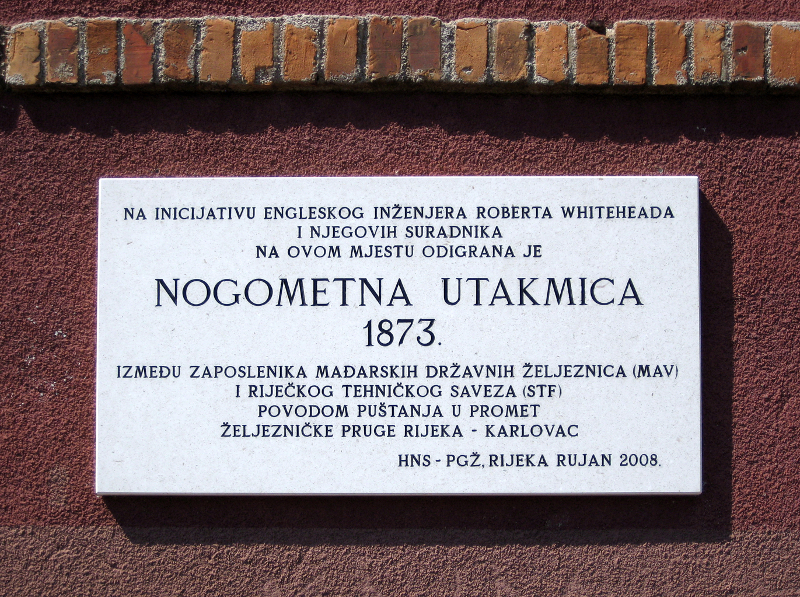
The earliest record of football in Croatia dates from 1873, when English engineers and technicians for Stabilimento tecnico Fiumano played in Rijeka against the engineers building the local railway line, with local Fiumans also taking part in the game. The first recorded football match in the Kingdom of Croatia was played in 1880 in Županja, between English workers of The Oak Extract Company and local youths. In 1890 the first school-based football clubs are founded by high school students in Rijeka. The sport was further popularized in Croatia by Franjo Bučar in the 1890s. The Croatian translation of the sport's name, nogomet, was coined by the linguist Slavko Rutzner Radmilović in 1893 or 1894. The name was adopted into Slovenian as well. In 1896, the first edition of the Rules of the Football Game in Croatian was printed in Zagreb.
The earliest officially registered association football clubs were founded in Pula before the turn of the century, when in August 1899 the locals founded Club Iris and later in the same year Veloce Club, both multi-sport association with very popular football sections. The first clubs to be founded in the then Kingdom of Croatia-Slavonia per se were HAŠK and PNIŠK, in 1903. In Rijeka, the Hungarian-leaning Fiumei Atletikai Club was founded in 1905 and the multicultural CS Olimpia in 1904, but Olimpia's football section may have held its first seating only in 1906 (the date is still debated among historians). In the same year, the Giovine Fiume club was founded by the Italian irredentist youth of the city and HŠK Concordia was established in Zagreb.
The first public football match in Croatia was played on Marulić Square in Zagreb on October 28, 1906 between HAŠK and PNIŠK and ended with a score of 1:1. This match was played according to the then only valid English rules. The HAŠK team then consisted of the following players: Hinko Würth, Josip Besednik, Hugo Kuderna, Josip Novak, Ivo Lipovšćak, Anđelo Grgić, Marko Kostrenčić, Dragutin Albrecht, Marko Kren, Vladimir Erbežnik, Zvonimir Bogdanović; while the following played for PNIŠK: Dragutin Baki, Jan Todl, Veljko Ugrinić, Schreiber, Kiseljak, Pilepić and Uhrl.
Among the other early clubs are Victoria and Olimpija Karlovac, created in 1908. 1908 also saw the first recorded win by a Croatian city-based club against an English side, when CS Olimpia beat the official football team of the Cunard Line ship RMS Brescia 1-0. In 1909 GŠK Marsonia started playing in Slavonski Brod and Rijeka's then strongest side Fiumei AC was invited to play officially in the Hungarian Championship, but turned down the offer. In the same year, HNK Segesta officially appeared for the first time in Sisak.
In 1910 the club Forza e Coraggio was founded in Dubrovnik and the Società Ginnastica e Scherma in Zadar officially opened its football section. The two would battle in the first Dalmatian Championship in 1911, won by Forza e Coraggio, which was then forced by the authorities to change its name to U.S. Ragusa. Hajduk, Građanski and SK Opatija were all founded in the same year, 1911. The first football club to be founded purely by Croats was Bačka in Subotica in 1901, in what was then the Kingdom of Hungary and is today Serbia. In Bosnia and Herzegovina, Zrinjski Mostar was founded by Croats in 1905 and was the first club to be founded in that country. The Croatian Football Federation (HNS) itself was created in 1912, which was also the year of the first Croatia and Slavonia championship.
The football section of HŠS 1912-13. organized the first Croatian football championship, in which clubs exclusively from Zagreb, Građanski, HAŠK, Concordia, AŠK Croatia and Tipografski športski klub Zagreb participated. This first championship was not completed due to unsportsmanlike behavior, and the new one was interrupted in 1914 due to the war. In 1912 the Dalmatian championship was won by Società Bersaglieri and in its third season by Calcio Spalato, who then played and lost against the strongest club from the Trieste region, Edera.
After World War I, Croats played a major part in the founding of the first football federation of the Kingdom of Serbs, Croats and Slovenes, later named the Football Association of Yugoslavia. Its headquarters were initially in Zagreb before moving to Belgrade in 1929. This was an era when great talents like Ico Hitrec dominated the national fields. In 1927, Hajduk Split took part in the inaugural Mitropa Cup, a tournament dedicated to the best Central European clubs.
Croatia itself played its first international football match as a representative team of the Banovina in a match held on April 2, 1940 against Switzerland. During World War II, the Croatian Football Federation joined FIFA as a representative of the Independent State of Croatia, but this was contentious and short-lived, as was the fascist puppet-state of which it was part. After the war, football was resumed within the institutional framework of the second Yugoslavia. The communist regime in the new state quickly moved to apply a damnatio memoriae to all club names and brands involved in the Croatian or Italian championships or which bore obviously Croatian or Italian national names. The government in Belgrade justified the rearrangement of all local football clubs with its plan to copy the Stalinist model of athletic organisation, merging all local clubs into omni-comprehensive sport unions—often forcing local institutions and party representatives to enact a total rebranding of the local clubs' identities—and thus bring them into line with communist goals and ideals.
Following these policies, Građanski was rebranded into NK Dinamo Zagreb, U.S. Fiumana (CS Olimpia's name under the Italian fascist regime) became S.C.F. Quarnero in Yugoslavia, ŽŠK Victoria became NK Lokomotiva in Zagreb, and dozens of other less famous clubs followed suit. Most clubs had henceforth to explicitly display loyalty to the new regime, and it was common for them to feature the communist red star as part of a new emblem, often paired with proletarian sounding and appealing identities. Among the victims of these changes, some clubs were completely disbanded, including top sides Concordia, PNIŠK and HAŠK, as well as major ethnic Croat clubs in today's Bosnia and Herzegovina, SAŠK and HŠK Zrinjski Mostar. One of the very few large Croatian clubs to avoid restructuring was Hajduk Split, who had refused to participate in the fascist Croatian competition and had strong links with the partisan army of Tito.
As Tito broke with Stalin, in the 1950s most sport unions reverted to purely football clubs. Over the following decades, Croatian clubs performed well in the Yugoslav First League and the Yugoslav Cup. Hajduk and Dinamo formed one half of the Big Four of Yugoslav football (the other two being FK Partizan and Red Star Belgrade). Rijeka won 2 Yugoslav cups. In 1967, Zlatko Čajkovski of German club Bayern Munich became the only Croatian manager to win the European Cup Winners' Cup. After Croatia gained independence in the 1990s, the football federation was reconstituted and joined the international associations. The Croatian internationals from the 1987 FIFA World Youth Championship-winning team went on to achieve more success, spawning the "golden generation" who finished in third place at the 1998 FIFA World Cup. Since then, Croatia has continued to produce top players. At the more recent Euro 2008, they famously beat 2006 FIFA World Cup bronze medalists Germany 2–1 in a shock win but exited the tournament courtesy of a penalty shoot-out defeat to Turkey in the quarterfinals. The national team's best performance came at the 2018 World Cup, where they finished as runners-up, losing 2–4 to France in the final. 38% of Croats watched the 2018 FIFA World Cup final. Croatia followed the achievement by again finishing third in the 2022 World Cup, after a 2–1 win over Morocco.
Earliest clubs in Croatia
| Club | Year | City, Region | Description | Dissolution |
|---|---|---|---|---|
| Club Iris | 1899 | Pula, Austrian Littoral | Football section opened in August 1899. Dissolution date unknown. | ? |
| Veloce Club Polese | 1899 | Pula, Austrian Littoral | Football section of cycling club. Dissolution date unknown. | ? |
| PNIŠK | 1903 | Zagreb, Kingdom of Croatia-Slavonia | 1909 | |
| HAŠK | 1903 | Zagreb, Kingdom of Croatia-Slavonia | 1945 | |
| Club Sportivo Olimpia | 1904 | Rijeka, Corpus Separatum | Later renamed to NK Rijeka. | *Still Active* |
| Fiumei Atletikai Club | 1905 | Rijeka, Corpus Separatum | Dissolution date unknown. | ? |
| Segesta Sisak | 1906 | Sisak, Kingdom of Croatia-Slavonia | *Still Active* | |
| Giovine Fiume | 1906 | Rijeka, Corpus Separatum | 1912 | |
| HŠK Concordia | 1906 | Zagreb, Kingdom of Croatia-Slavonia | 1945 | |
| Törekves SE | 1907 | Rijeka, Corpus Separatum | Dissolution date unknown. | ? |
| AŠK Croatia | 1907 | Zagreb, Kingdom of Croatia-Slavonia | 1945 | |
| HŠK Victoria Sušak | 1908 | Sušak, Kingdom of Croatia-Slavonia | 1948 | |
| GŠK Marsonia | 1909 | Slavonski Brod, Kingdom of Croatia-Slavonia | *Still Active* | |
| Associazione Sportiva Edera | 1910 | Pula, Austrian Littoral | 1926 | |
| Forza e Coraggio | 1910 | Dubrovnik, Kingdom of Dalmatia | In 1912 renamed Unione Sportiva di Ragusa. Dissolution date unknown. | ? |
| Società Ginnastica e Scherma Zara | 1910 | Zadar, Kingdom of Dalmatia | Dissolution date unknown. | ? |
| NK Zmaj | 1910 | Zadar, Kingdom of Dalmatia | Later renamed in NK Arbanasi. | *Still Active* |
| Calcio Spalato | 1910 | Split, Kingdom of Dalmatia | Dissolved in the '20s | '20s |
| Nogometni Odjel Sokola Opatija - Volosko | 1911 | Opatija, Austrian Littoral | Later renamed NK Opatija. | *Still Active* |
| 1. HŠK Građanski | 1911 | Zagreb, Kingdom of Croatia-Slavonia | Later renamed to NK Dinamo. | *Still Active* |
| Unione Sportiva | 1911 | Dubrovnik, Kingdom of Dalmatia | Dissolution date unknown. | ? |
| NK DAVOR | 1911 | Dubrovnik, Kingdom of Dalmatia | Dissolution date unknown. | ? |
| HŠK Hajduk | 1911 | Split, Kingdom of Dalmatia | *Still Active* | |
| DFV Vorwärts Abbazia | 1912 | Opatija, Austrian Littoral | German minority club. Official dissolution date unknown. | ? |
| Tornai SE | 1912 | Rijeka, Corpus Separatum | Hungarian minority club. Official dissolution date unknown. | ? |
| HRŠD Anarh | 1912 | Split, Kingdom of Dalmatia | Later renamed to RNK Split. | *Still Active* |
| HŠK Slaven | 1912 | Koprivnica, Kingdom of Croatia-Slavonia | *Still Active* | |
| Olimpija Suhopolje | 1912 | Suhopolje, Kingdom of Croatia-Slavonia | 1916 | |
| SK Lav | 1913 | Knin, Kingdom of Croatia-Slavonia | Later renamed to HNK Dinara. | *Still Active* |
| HŠK Šparta | 1913 | Zagreb, Kingdom of Croatia-Slavonia | Later renamed to NK Šparta-Elektra. | *Still Active* |
Clubs in European competitions
Main article: Croatian football clubs in European competitions
- Hajduk Split is the only Croatian club to date—either during the Yugoslav period or since independence—to have played in the knockout stages of the European Cup or UEFA Champions League, having reached the quarter-finals on three occasions (in 1975–76, 1979–80 and 1994–95).
- Dinamo Zagreb have qualified for the Champions League group stage on eight occasions (in 1998–99, 1999–2000, 2011–12, 2012–13, 2015–16, 2016–17 , 2019–20 and 2022–23) but have yet to progress further.
- Both Dinamo and Hajduk have advanced past the round of sixteen of the UEFA Cup or UEFA Europa League, Hajduk played in the semi-finals in 1983–84 and the quarterfinals in 1985–86. They also reached the UEFA Cup's last sixteen in 1981–82 and 1986–87, while Dinamo Zagreb reached the quarterfinals in 2020–21 and the last sixteen in 1997–98 and 2018–19.
- Dinamo Zagreb had success winning the Inter-Cities Fairs Cup in 1967 which is the only European trophy won by Croatian clubs. Dinamo also reached the final four years earlier in 1963 but suffered a loss to Valencia. In 1970–71 season, they reached third round. Croatian clubs also had success in the defunct UEFA Cup Winners' Cup. Both Dinamo Zagreb (1960–61) and Hajduk Split (1972–73) reached the semi-finals of the competitions. Dinamo have also reached the quarterfinals in 1964–65 and 1969–70, while Hajduk were eliminated at that stage in 1977–78. UEFA Cup Winners' Cup is also the only European competition that has seen Croatian clubs other than Dinamo and Hajduk reach the advanced stages. Rijeka reached the quarterfinals in the 1979–80 edition, while Varteks advanced to the quarterfinals in 1998–99, the last edition of the competition.
Best results
The table below lists Croatian clubs' best results in elimination rounds of European club competitions:
| Competition | Season | Round | Team 1 | Agg. | Team 2 | 1st leg | 2nd leg | 1960–61 | 1972–73 | 1975–76 | 1979–80 | 1983–84 | 1994–95 | 2020–21 | 1998–99 |
|---|---|---|---|---|---|---|---|---|---|---|---|---|---|---|---|
| UCWC | SF | Fiorentina ITA | 4–2 | YUG Dinamo Zagreb | 3–0 | 1–2 | |||||||||
| UCWC | SF | Leeds United ENG | 1–0 | YUG Hajduk Split | 1–0 | 0–0 | |||||||||
| EC | QF | Hajduk Split YUG | 2–3 | NED PSV Eindhoven | 2–0 | 0–3 (aet) | |||||||||
| EC | QF | Hamburger SV GER | 3–3 (a) | YUG Hajduk Split | 1–0 | 2–3 | |||||||||
| UC | SF | Hajduk Split YUG | 2–2 (a) | ENG Tottenham Hotspur | 2–1 | 0–1 | |||||||||
| UCL | QF | Hajduk Split CRO | 0–3 | NED Ajax | 0–0 | 0–3 | |||||||||
| EL | QF | Dinamo Zagreb CRO | 1–3 | ESP Villarreal | 0–1 | 1–2 | |||||||||
| UCWC | QF | Varteks CRO | 1–3 | ESP Mallorca | 0–0 | 1–3 |
Footballers in international club competitions
The following table lists all Croatian players who are credited to win an international final (either appeared in the final, being unused substitutes or were in the squad in earlier rounds of the tournament). It does not include Croatians who were considered Yugoslav players prior to Croatia's independence in 1991.
As of 2024 a total of eleven Croatian players are credited as winning the Champions League: Alen Bokšić, Zvonimir Boban, Davor Šuker, Dario Šimić, Igor Bišćan, Mario Mandžukić, Luka Modrić, Ivan Rakitić, Mateo Kovačić, Dejan Lovren and Ivan Perišić, although Šimić, Bišćan and Lovren did not appear in the finals. In terms of appearances, fourteen players have played in the final (Bokšić, Boban, Šuker, Boris Živković, Marko Babić, Igor Tudor, Dado Pršo, Ivica Olić, Mandžukić, Modrić, Rakitić, Lovren, Perišić and Kovačić), but only five players appeared more than once – Bokšić (1993, 1997), Boban (1994, 1995), Olić (2010, 2012), Mandžukić (2013, 2017) and Modrić (2014, 2016, 2017, 2018, 2022, 2024). Two Croatian players have scored a goal in the final match, Mandžukić in the 2013 and 2017 final, and Rakitić in the 2015 final.
As of 2024 a total of nine Croatian players are credited as winning the Europa League: Mario Stanić, Ivica Olić, Ivica Križanac, Darijo Srna, Ivan Rakitić, Šime Vrsaljko, Mateo Kovačić, Kristijan Jakić and Mario Pašalić – although Stanić did not appear for his club in the final. The only Croatian player to have scored a goal in the final match was Nikola Kalinić in the 2015 final.
| Ranking | Name | Team(s) | Years | CL | EL | SC | FCWC | CWC | IC | Total |
|---|---|---|---|---|---|---|---|---|---|---|
| 1 | Real Madrid | 2014–2024 | 6 | 0 | 5 | 4 | 0 | 1 | 16 | |
| 2 | Real Madrid, Chelsea | 2016–2021 | 4 | 1 | 3 | 3 | 0 | 0 | 11 | |
| 3 | Sevilla, Barcelona | 2014–2023 | 1 | 2 | 1 | 1 | 0 | 0 | 5 | |
| 4 | Milan | 2003–2007 | 2 | 0 | 1 | 1 | 0 | 0 | 4 | |
| 5 | Marseille, Juventus, Lazio | 1993–1999 | 1 | 0 | 0 | 0 | 1 | 1 | 3 | |
| Bayern Munich | 2013 | 1 | 0 | 1 | 1 | 0 | 0 | |||
| 7 | Milan | 1994 | 1 | 0 | 1 | 0 | 0 | 0 | 2 | |
| Real Madrid | 1998 | 1 | 0 | 0 | 0 | 0 | 1 | |||
| Liverpool | 2001–2005 | 1 | 0 | 1 | 0 | 0 | 0 | |||
| Zenit Saint Petersburg | 2008 | 0 | 1 | 1 | 0 | 0 | 0 | |||
| 11 | Real Madrid | 1998 | 0 | 0 | 0 | 0 | 0 | 1 | 1 | |
| Parma | 1999 | 0 | 1 | 0 | 0 | 0 | 0 | |||
| Bayern Munich | 2001 | 0 | 0 | 0 | 0 | 0 | 1 | |||
| Bayern Munich | 2001 | 0 | 0 | 0 | 0 | 0 | 1 | |||
| CSKA Moscow | 2005 | 0 | 1 | 0 | 0 | 0 | 0 | |||
| Shakhtar Donetsk | 2009 | 0 | 1 | 0 | 0 | 0 | 0 | |||
| Atlético Madrid | 2018 | 0 | 1 | 0 | 0 | 0 | 0 | |||
| Atlético Madrid | 2018 | 0 | 0 | 1 | 0 | 0 | 0 | |||
| Liverpool | 2019 | 1 | 0 | 0 | 0 | 0 | 0 | |||
| Bayern Munich | 2020 | 1 | 0 | 0 | 0 | 0 | 0 | |||
| Eintracht Frankfurt | 2022 | 0 | 1 | 0 | 0 | 0 | 0 | |||
| Atalanta | 2024 | 0 | 1 | 0 | 0 | 0 | 0 |
Format
The governing body of football in Croatia is the Croatian Football Federation. It oversees the organization of:
- Leagues:
- HNL
- Prva NL
- Druga NL
- Treća NL
- Regional leagues
- Cup tournaments:
- Croatian Cup
- Croatian Supercup
- National teams:
- Croatia national football team
- Croatia national under-21 football team
- Croatia national under-19 football team
- Croatia national under-17 football team
- Croatia women's national football team
Seasons
The following articles detail major results and events in each footballing season since the early 1990s, when the Croatian First Football League was established. Each article provides final league standings for that season, as well as details on cup results, Croatia national football team results, and a summary of any other important events during the season.
Teams
Main article: List of football clubs in Croatia
According to many surveys conducted by multiple newspapers, the most popular club in Croatia is Dinamo Zagreb which is also the most successful club. Their main rivals are Hajduk Split, followed by HNK Rijeka and NK Osijek.
Futsal
Futsal, called mali nogomet (lit. "small football") in Croatia, is also widely played and is sometimes considered as a mini football league. It is often taught in schools and also played by football professionals as a pastime.
The Croatian First League of Futsal is the top-tier futsal competition where majority of Croatia national futsal team is selected.
There are also national competitions in other minifootball versions.
Fans
The Croatian football fans organize in various fan groups such as the Torcida (Hajduk), Bad Blue Boys (Dinamo), Armada (Rijeka), Kohorta (Osijek), etc.
On the international games, the Croatian fans usually wear the checkerboard colors red and white, as they are on the Croatian coat of arms.
Attendances
The average attendance per top-flight football league season and the club with the highest average attendance:
| Season | League average | Best club | Best club average |
|---|---|---|---|
| 2024–25 | 5,678 | Hajduk Split | 22,028 |
| 2023–24 | 5,316 | Hajduk Split | 18,873 |
| 2022–23 | 4,085 | Hajduk Split | 15,345 |
| 2021–22 | — | — | — |
| 2020–21 | — | — | — |
| 2019–20 | 3,526 | Hajduk Split | 12,883 |
| 2018–19 | 2,659 | Hajduk Split | 8,651 |
| 2017–18 | 2,948 | Hajduk Split | 11,999 |
| 2016–17 | 2,750 | Hajduk Split | 8,340 |
| 2015–16 | 2,453 | Hajduk Split | 9,266 |
| 2014–15 | 2,874 | Hajduk Split | 8,056 |
| 2013–14 | 3,167 | Hajduk Split | 9,806 |
| 2012–13 | 2,446 | Hajduk Split | 9,029 |
| 2011–12 | 2,072 | Hajduk Split | 9,567 |
| 2010–11 | 1,991 | Hajduk Split | 6,933 |
| 2009–10 | 2,025 | Hajduk Split | 4,667 |
| 2008–09 | 3,074 | Hajduk Split | 9,471 |
| 2007–08 | 2,848 | Dinamo Zagreb | 7,165 |
| 2006–07 | 3,021 | Hajduk Split | 7,559 |
| 2005–06 | 3,084 | Dinamo Zagreb | 11,156 |
| 2004–05 | 2,682 | Hajduk Split | 7,750 |
| 2003–04 | 2,595 | Hajduk Split | 6,179 |
| 2002–03 | 3,313 | Dinamo Zagreb | 8,281 |
| 2001–02 | 2,453 | Hajduk Split | 4,720 |
| 2000–01 | 2,942 | Hajduk Split | 7,156 |
| 1999–2000 | 2,839 | Hajduk Split | 6,647 |
| 1998–99 | 4,050 | Hajduk Split | 11,875 |
| 1997–98 | 3,565 | Dinamo Zagreb | 7,419 |
| 1996–97 | 2,866 | Dinamo Zagreb | 6,100 |
| 1995–96 | 3,837 | Hajduk Split | 9,375 |
| 1994–95 | 3,664 | Osijek | 9,267 |
| 1993–94 | 2,783 | Hajduk Split | 6,647 |
| 1992–93 | 4,122 | Dinamo Zagreb | 15,400 |
| 1992 | 2,865 | Hajduk Split | 7,091 |
Source:
References
Sources
References
- Smith, Rory. (2022-12-12). "The Team That Refuses to Lose". The New York Times.
- De Launey, Guy. (2013-05-01). "What is Croatia's secret to sporting success?". BBC News.
- (1998-07-09). "Croatia Is Basking In Its Surprising Soccer Success The Team, Toughened By War, Has Advanced To The Semifinals In Its First Trip To The Tournament. - Philly.com". Articles.philly.com.
- Rogić, Marijan. (2008). "Hrvatsko nogometno predstavništvo 1940. - 2008.". Gipa.
- Sengupta, Arjun. (2022-12-10). "The improbable rise of the Croatian football team".
- Smith, Rory. (2022-12-12). "The Team That Refuses to Lose". The New York Times.
- Morse, Ben. (2022-12-17). "Croatia beats Morocco in World Cup third-place playoff match".
- (2006). "Rijeka Nogometa". VSDR.
- "Prije 115 godina odigrana je prva službena nogometna utakmica u Hrvatskoj".
- Percan, Anton. (2011). "Nogomet u Puli". Pula : Histria Croatica C.A.S.H..
- "VIRTUAL MUSEUM".
- "Zara, le prime disfide contro ragusei e spalatini (1 e continua)".
- "Croatia - Dalmatia 1910-1919".
- "POVIJEST".
- "Povijest - Hrvatski nogometni savez".
- Mills, Richard. (2018). "The Politics of Football in Yugoslavia: Sport, Nationalism and the State". I.B. Tauris.
- Mills, Richard Mervyn Stanley. (2019). "Nogomet i politika u Jugoslaviji : sport, nacionalizam i država". Profil.
- Jamie Jackson. (25 November 2007). "Football: Why are they all better than us? | Football | The Observer". Theguardian.com.
- Launey, Guy De. (2013-05-02). "BBC News – What is Croatia's secret to sporting success?". Bbc.co.uk.
- (16 July 2018). "World Cup Final attracted 163m viewers in 20 territories".
- "Olić osmi hrvatski igrač u finalu Lige prvaka". [[HINA]].
- Bariša, Mladen. (20 May 2009). "Finale Kupa UEFA: Torcida će u Istanbulu nagovarati Srnu da se vrati u Hajduk". [[Slobodna Dalmacija]].
- (2012-07-09). "When Saturday Comes – Power shifts at the top of Croatian football". Wsc.co.uk.
- "Croatian attendances".
This article was imported from Wikipedia and is available under the Creative Commons Attribution-ShareAlike 4.0 License. Content has been adapted to SurfDoc format. Original contributors can be found on the article history page.
Ask Mako anything about Football in Croatia — get instant answers, deeper analysis, and related topics.
Research with MakoFree with your Surf account
Create a free account to save articles, ask Mako questions, and organize your research.
Sign up freeThis content may have been generated or modified by AI. CloudSurf Software LLC is not responsible for the accuracy, completeness, or reliability of AI-generated content. Always verify important information from primary sources.
Report