From Surf Wiki (app.surf) — the open knowledge base
Football at the 1924 Summer Olympics

| Field | Value |
|---|---|
| tourney_name | Football at the 1924 Summer Olympics |
| image | Football pictogram.svg |
| size | |
| caption | Pictogram for Football |
| country | France |
| dates | 25 May – 9 June 1924 |
| num_teams | 22 |
| confederations | 4 |
| sub-confederations | |
| associations | |
| venues | 4 |
| cities | 1 |
| champion | |
| champion-flagvar | use if the flag is other as current |
| champion_other | |
| count | 1 |
| second | |
| second-flagvar | use if the flag is other as current |
| second_other | |
| third | |
| third-flagvar | use if the flag is other as current |
| third_other | |
| fourth | |
| fourth-flagvar | use if the flag is other as current |
| fourth_other | |
| matches | 24 |
| goals | 96 |
| attendance | 210424 |
| top_scorer | URU Pedro Petrone (6 goals) |
| prevseason | 1920 |
| nextseason | 1928 |
| sub-confederations = | champion-flagvar = use if the flag is other as current | second-flagvar = use if the flag is other as current | third-flagvar = use if the flag is other as current | fourth-flagvar = use if the flag is other as current Football at the 1924 Summer Olympics was the sixth edition of the football tournament at the Summer Olympic Games held in Paris. This was the first official open FIFA World Championship in history, allowing professional player participation for the first time.
The tournament expanded to 22 countries from four confederations for the first time, with African side Egypt (as was the case in the previous edition), Turkey which is partly in Asia, Uruguay representing South America and the United States representing North America.
Uruguay made a memorable debut, going undefeated and winning the gold medal. This earned them the first of the four stars above their crest.
Venues
| Colombes | Paris | Paris | Seine-Saint-Denis | ||
|---|---|---|---|---|---|
| Olympic Stadium | Bergeyre Stadium | ||||
| Capacity: 60,000 | Capacity: 10,455 | ||||
| [[File:Stade de Colombes 1924.jpg | 150px]] | [[File:Match Olympique contre Irun le 25 décembre 1920.JPEG | 150px]] | ||
| Pershing Stadium | Paris Stadium | ||||
| Capacity: 8,110 | Capacity: 5,145 | ||||
| [[File:Match Red Star contre Olympique le 8 avril 1923.JPEG | 150px]] | [[File:Match Olympique contre Red Star Club le 19 septembre 1920.JPEG | 150px]] |
Amateur status
In 1921, the Belgium Football Association first allowed for payments to players for time lost from work; in the months that followed four other Associations (Switzerland and Italy amongst them) permitted similar subsidies. The Football Association, perhaps with foresight, considered their statement of 1884 to be one which FIFA should hereafter follow. They had stated: "Any player registered with this Association ... receiving remuneration ... of any sort above ... necessary expenses actually paid, shall be considered to be a professional."
In 1923 the four British Associations sought an assurance that FIFA accept this definition; the four FIFA representatives on the International Football Association Board refused and, consequently, both the United Kingdom and Denmark withdrew their footballers from representing their nations at the 1924 Olympic Games.
Entries
Main article: Football at the 1924 Summer Olympics – Men's team squads
In Association Football (1960), Bernard Joy wrote about the 1912 Games that the authorities in Sweden "had debated for a long time whether to include football ... because its popularity was not yet world wide". Twelve years later, in Paris, football had become so important to the Games that a 1/3 of the income generated came from football. In terms of international development these Games signalled the first participation in a major Championship of a team from South America, a continent which would provide the main competition to Europe from that moment on.
In Paris, Uruguay, who had paid their third class passage to Paris and gone on a successful tour of Spain beforehand, would join as many as 18 European teams; the United States, Turkey and Egypt.
The Uruguayans had won the 1923 Sudamericano by maximum points in the December of the previous year to qualify for the tournament as their continent's sole participants; defeating rivals Argentina 2–0 in the final game in which Pedro Petrone scored halfway through the first half. Joy wrote: "A doctor and a physical expert were as important elements of the staff as the coach himself. They saw to it that their charges reached perfect physical condition. They were kept that way by staying away from the attractions of Paris at a villa in the quiet village of Argenteuil". In Paris Jose Leandro Andrade would be dubbed La Merveille Noire. Despite this little was known about them; they had never played outside South America and their international experience had mainly been spent travelling across the harbour from Buenos Aires to Montevideo.{{Citation | access-date = 25 May 2008
Italy, having remained unbeaten since 1922, found themselves beaten 4–0 by an early incantation of Hugo Meisl's Wunderteam (who would absent themselves from the Games).{{Citation | access-date = 25 May 2008 With just six weeks to go before the Games Italy had been walloped 7–1 by Hungary.{{Citation | access-date = 25 May 2008 | access-date = 25 May 2008
The Hungarians had just come off a good run of results in the previous year, but had been beaten by the Swiss in the days leading up to the Games; Max Abegglen, who had only been playing international football for two years, scoring his 7th international goal that day for the Swiss.{{Citation | access-date = 25 May 2008 |access-date = 25 May 2008 |url-status = dead |archive-url = https://web.archive.org/web/20100615203810/http://www.fifa.com/tournaments/archive/tournament%3D512/edition%3D197020/overview.html |archive-date = 15 June 2010
Entering for the second time Egypt caused a surprise defeat in their opening game.{{Citation | archive-url = https://web.archive.org/web/19991003162529/http://www.angelfire.com/ak/EgyptianSports/results.html | url-status = dead | archive-date = 3 October 1999 | access-date = 25 May 2008
Final tournament

The Games competition was assisted by a Preliminary Round which featured the silver-medallists from the 1920 Games, Spain in a game with Italy. Since that time Spain had only lost once and that by a single goal away to Belgium and had drawn 0–0 with the Italians in March 1924.{{Citation | access-date = 18 June 2008
Hungary put five past Poland, the Swiss sent Lithuania on their way, 9–0. The Uruguayans played first-rate football, combining speed, skill and perfect ball-control. By marrying short passing to intelligent positional play, they made the ball do all the work, and so kept their opponents on the run wrote Joy. The Uruguayans sailed past Kingdom of SCS by seven clear goals, then overcame the United States by three goals to nil.
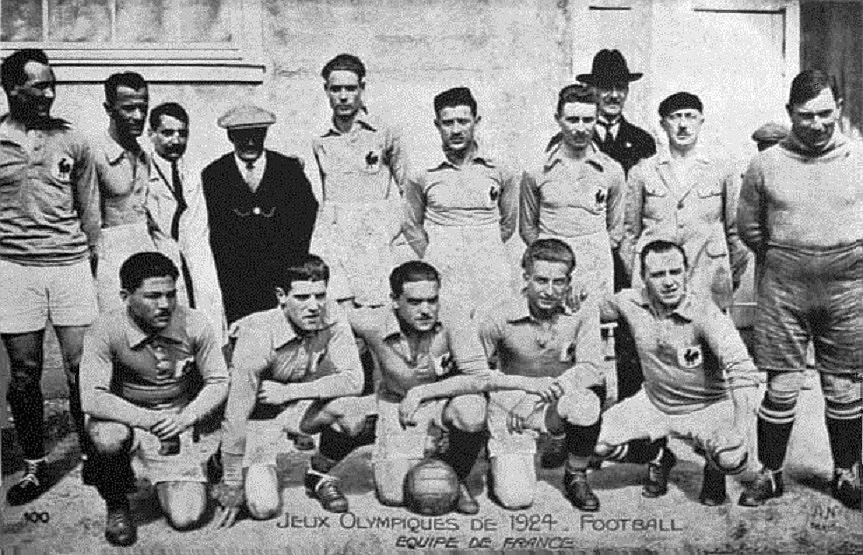
In the first round Czechoslovakia (following their decision to walk off the field in 1920) faced Switzerland and the game went into extra-time. One Czech was sent off, and the Norwegian referee had to call for order during a break. For the replay, Abegllen took the captain's duties and all was different; Switzerland winning by the single goal. Otherwise there were two surprises, the first went Egypt's way; 3–0 to the good against Hungary. The second saw Sweden defeat the reigning gold-medallists, Belgium 8–1. Oscar Verbeeck's own goal set the Swedes on their way; Sven Rydell's hat-trick the feature of the match. The Swedish outside-left Rudolf Kock (who would become chairman of the selectors in 1948 working alongside George Raynor), would have another fine game against Egypt where Sweden won 5–0. France and Holland had been similarly dominant in the first round, but Uruguay beat France 5–1 to claim a semi-final place.

In another quarter-final Italy went out to Switzerland disputing a winner by Max Abegglen, who converted a break-away goal. The Italians protested that he had been off-side. The referee Johannes Mutters, refused to alter the decision of his linesman; a jury upheld the judgement. There was further dispute in the semi-final where Holland (coached by the former Blackburn Rovers' player William Townley) took a first half lead against Uruguay through Feyenoord's Kees Pijl. With twenty minutes to go Pedro Cea scored an equaliser and with less than ten Georges Vallat, the French referee, awarded Uruguay a penalty. FIFA reported that "the Netherlands protested the ruling of a penalty kick that turned out to be the winning goal but then Uruguay protested against the Olympic Committee's selection of a Dutch referee for the final. To appease the South Americans, the committee pulled the name of a final referee out of a hat and picked out a Frenchman, Marcel Slawick".{{Citation |access-date = 18 June 2008 |url-status = dead |archive-url = https://web.archive.org/web/20100615203810/http://www.fifa.com/tournaments/archive/tournament%3D512/edition%3D197020/overview.html |archive-date = 15 June 2010
In the final the Swiss were defeated by the Uruguayans whose two goals in the second half put paid to their opponent's ambitions, Uruguay eventually prevailing 3–0. Interest in the final had been considerable, such was the draw of the Uruguayan side; 60,000 watched and 10,000 were locked out.
Bracket
|26 May – Colombes| **** |7| |0 |25 May – Vincennes| **** |1| |0 || **** || bye | || **** || bye | || **** || bye | || **** || bye | || '*IRL Irish Free State || *bye'' | || **** || bye | |25 May – Vincennes| **** |9| |0 |25 May – Paris| **** |5| |2 |25 May – Colombes| **** |1| |0 || **** || bye | || **** || bye | || **** || bye | || **** || bye | |26 May – Paris| **** |5| |0 |29 May – Paris| **** |3| |0 |27 May – Saint-Ouen| **** |7| |0 |27 May – Colombes| **** |6| |0 |28 May – Colombes| IRL Irish Free State |1'''| |0 |28 and 30 May – Paris| ** (replay)|1 (1)| |1 (0) |29 May – Vincennes| **** |2| |0 |29 May – Colombes| **** |8| |1 |29 May – Saint-Ouen| **** |3| |0 |1 June – Colombes| **** |5| |1 |2 June – Saint-Ouen| **** |2| IRL Irish Free State |1 |2 June – Paris| **** |2| |1 |1 June – Vincennes| **** |5| |0 |6 June – Colombes| **** |2| |1 |5 June – Colombes| **** |2| |1 |9 June – Colombes| **** |3| |0 |8 and 9 June – Colombes| ** (replay)|1 (3)| |1 (1)|
Match details
First round
Sedláček
Novák
Čapek
Dietrich
Abegglen
Ramseyer
Scarone
Cea
Petrone
Romano
Hirzer
Opata
Second round
Nicolas
Boyer
Pijl
de Natris
Della Valle
Rydell
Brommesson
Keller
Hegazi
Scarone
Quarter-finals
Petrone
Romano
Brommesson
Rydell
Abegglen
Semi-finals
Scarone
Bronze medal match
Lundqvist
Gold medal match
Cea
Romano
| URU Ernesto Figoli |
|---|

|}
Final ranking
As per statistical convention in football, matches decided in extra time are counted as wins and losses, while matches decided by penalty shoot-outs are counted as draws.
Medalists

| Gold | Silver | Bronze |
|---|
Goalscorers

;7 goals
- URU Pedro Petrone (Uruguay)
;6 goals
- SUI Max Abegglen (Switzerland)
;5 goals
- NED Kees Pijl (Netherlands)
- SWE Sven Rydell (Sweden)
- SUI Paul Sturzenegger (Switzerland)
- URU Héctor Scarone (Uruguay)
;4 goals
- URU Pedro Cea (Uruguay)
- SWE Putte Kock (Sweden)
;3 goals
- FRA Édouard Crut (France)
- FRA Paul Nicolas (France)
- NED Ok Formenoy (Netherlands)
- SWE Charles Brommesson (Sweden)
- SWE Per Kaufeldt (Sweden)
- URU Ángel Romano (Uruguay)
;2 goals
- CZE Josef Sedláček (Czechoslovakia)
- CZE Rudolf Sloup (Czechoslovakia)
- EGY Ibrahim Yakan (Egypt)
- FRA Jean Boyer (France)
- ITA Giuseppe Della Valle (Italy)
- SUI Walter Dietrich (Switzerland)
- TUR Bekir Refet (Turkey)
- HUN Ferenc Hirzer (Hungary)
- HUN Zoltán Opata (Hungary)
;1 goal
- BEL Henri Larnoe (Belgium)
- CZE Josef Čapek (Czechoslovakia)
- CZE Jan Novák (Czechoslovakia)
- EGY Hussein Hegazi (Egypt)
- HUN József Eisenhoffer (Hungary)
- IRE Paddy Duncan (Ireland)
- IRE Frank Ghent (Ireland)
- ITA Adolfo Baloncieri (Italy)
- NED André le Fèvre (Netherlands)
- NED Albert Hurgronje (Netherlands)
- NED Jan de Natris (Netherlands)
- SWE Tore Keller (Sweden)
- SWE Evert Lundqvist (Sweden)
- SUI Robert Pache (Switzerland)
- SUI Rudolf Ramseyer (Switzerland)
- USA Andy Straden (United States)
- URU José Vidal (Uruguay)
;Own goals
- ESP Pedro Vallana (Spain; playing against Italy)
Trivia
- Sweden won the bronze medal. Their 8-1 defeat of the reigning champions, Belgium, in the opening round is still considered one of the biggest upsets in World football by criteria laid down by ELO.{{Citation | access-date = 18 June 2008 | archive-url = https://web.archive.org/web/20080624184149/http://www.eloratings.net/Upsets.htm | archive-date = 24 June 2008 | url-status = dead
- Some of the games took place at the Vélodrome de Vincennes.
- The lap of honour (or previously called "Olympic turn"), the celebration ritual that a champion team does after winning a tournament, was invented by the Uruguayan team after winning this Olympic title, as they wanted to salute those in attendance by running all around the athletics field.
- Uruguay's Pedro Petrone was two days shy of his 19th birthday when he accepted his gold medal; he is still the youngest football gold-medalist in the history of the Games.
- Future Chinese leader Deng Xiaoping was a worker in France at the time, in order to watch the final he pawned his coat. He mentioned his experience on this during an interview after his retirement.
References
References
- "Official FIFA World Cup Origin document".
- [https://www.fifa.com/tournaments/mens/mensolympic/paris1924/match-center Olympic football tournament - Paris] on FIFA.com
- (10 June 1924). "60,000 SEE URUGUAY WIN IN SOCCER FINAL - Record Olympic Crowd Present as South Americans Beat Switzerland, 3 to 0. THOUSANDS TURNED AWAY Colombes Stadium Filled to Capacity and Women Famt in Crush Outside of Gates. CONTEST IS HARD FOUGHT Swiss Play Courageously, but Defense Breaks In Second Half Before Brilliant Attack". The New York Times.
- "Football at the 1924 Paris Summer Games". Sports Reference.
- (1915). "Butterworth's Workmen's Compensation Cases: New series". Butterworth.
- Michael Lewis. "Henry Farrell, the man who helped the US soccer team make Olympic history | Football". [[The Guardian]].
- "Uruguay 1930 | Four Four Two | BIG READ".
- (October 2017). "Olympics | Rio 2016 Schedule, Medals, Results & News".
This article was imported from Wikipedia and is available under the Creative Commons Attribution-ShareAlike 4.0 License. Content has been adapted to SurfDoc format. Original contributors can be found on the article history page.
Ask Mako anything about Football at the 1924 Summer Olympics — get instant answers, deeper analysis, and related topics.
Research with MakoFree with your Surf account
Create a free account to save articles, ask Mako questions, and organize your research.
Sign up freeThis content may have been generated or modified by AI. CloudSurf Software LLC is not responsible for the accuracy, completeness, or reliability of AI-generated content. Always verify important information from primary sources.
Report